The owner sees the same faces every week. The Monday morning flat white regular. The salon client who always books before payday. The shop customer who pops in “just for one thing” and leaves with three.
Most small businesses already have loyal customers. The problem is that loyalty often lives only in memory. Staff remember some names, forget others, and reward repeat custom inconsistently. That leaves money on the table and gives regulars no clear reason to come back one more time.
A good loyalty programme fixes that. It turns casual goodwill into a repeatable system. For a café, salon, restaurant, gym, or local shop, that system doesn't need a complicated CRM or a full IT project. It needs to be simple enough for staff to use, clear enough for customers to understand, and useful enough to build a real relationship rather than another forgettable discount.
Beyond Discounts What Is a Customer Loyalty Programme Really?
A customer loyalty programme is a structured way to reward repeat business. But that dry definition misses the point.
For a small business, it's the digital version of a friendly barista remembering a regular's order. It says, “You come back often. That matters here.” The reward might be a free coffee, a birthday perk, cashback, points, or a visit-based offer. The core value is recognition.
It's a value exchange, not a giveaway
When owners ask what is a customer loyalty program, the practical answer is this: it's an agreement.
The business offers a reason to return. The customer offers repeat visits, repeat spend, and permission to build a better experience around their habits. That's why the strongest programmes aren't only about discounts. They help a business spot its best customers, reward them properly, and stay top of mind.
According to Statista's overview of loyalty schemes in Great Britain, in 2025, 80% of adults in Great Britain were members of at least one loyalty program, the highest participation rate since 2018. That tells small businesses something important. Customers already understand the model. The question isn't whether people will join loyalty schemes. The question is whether a local business gives them one worth using.
What a modern programme should actually do
A useful loyalty programme should help a small business do five things well:
- Recognise regulars so they're not treated the same as first-time buyers.
- Reward behaviour that matters, such as repeat visits or higher-value bookings.
- Capture simple customer insight like frequency, favourite products, or redemption patterns.
- Create a reason to return before a competitor wins the next visit.
- Make loyalty visible so customers feel progress, not guesswork.
A loyalty programme works when customers feel remembered, not managed.
Owners looking for more practical strategies for customer loyalty usually find that the strongest ideas are surprisingly simple. A clear offer, a short sign-up, and a reward customers want will outperform a clever scheme that nobody understands.
Why Loyalty Is Your Small Business Superpower
Small businesses don't usually lose customers because a national chain has better branding. They lose them because the competing offer feels easier, clearer, or more rewarding that day.
That's why loyalty matters so much at local level. A neighbourhood business often can't outspend bigger competitors on ads, but it can build habits. Habits drive repeat footfall. Repeat footfall stabilises revenue. Stable revenue makes staffing, stock, and cash flow easier to manage.
Loyalty makes local trade more predictable
A café doesn't need every passer-by. It needs a dependable base of regulars. The same goes for a salon with appointment gaps, a boutique with uneven weekday traffic, or a fitness studio trying to keep members engaged.
That's where loyalty stops being a “nice extra” and becomes a business tool.
Mintel notes in its analysis of UK retail loyalty programmes that 80% of consumers in the UK market are actively engaged in at least one loyalty programme. The same source states that members generate 12–18% more incremental revenue growth annually compared to non-members, while top-tier programmes boost revenue by 15–25% per year.
Those numbers matter because they show the effect isn't theoretical. Done properly, loyalty changes buying behaviour.
What this looks like in day-to-day trading
For a small business, the gains usually show up in ordinary ways first:
- More repeat visits because customers have a reason to come back sooner.
- Higher average spend when rewards encourage one more item, add-on, or upgrade.
- Better customer retention because regulars feel recognised, not anonymous.
- Stronger word of mouth because satisfied regulars talk.
Practical rule: If a loyalty programme doesn't help the business become part of a customer's routine, it won't last.
Why small businesses often win here
Local businesses have one advantage that large chains struggle to copy. They're personal by nature.
A salon can tie rewards to treatment cycles. A coffee shop can reward morning regulars. A local retailer can reward seasonal shoppers and frequent browsers differently. That human context matters. A good programme turns “they know me here” into something visible and repeatable.
The mistake is treating loyalty like a generic discount engine. Its true superpower is relationship-building with structure behind it.
Choosing Your Flavour The Main Types of Loyalty Programmes
Most loyalty schemes use a handful of basic mechanics. The hard part isn't understanding them. It's picking one that matches how customers already buy.
A coffee shop has high-frequency, low-ticket visits. A salon has lower frequency but higher value per visit. A gym often relies on referrals and habit. A local shop may need something flexible enough to fit both regular spenders and occasional drop-ins.
The four models most small businesses use
Points programmes work like a running score. Customers collect value over time and swap it for a reward later. This suits businesses that want flexibility.
Tiered programmes feel more like status. Customers earn better perks as they spend or visit more often. This works when exclusivity matters.
Cashback programmes return part of the spend as future credit. These are easy for customers to grasp because the value feels direct.
Digital stamp cards are the simplest race to a finish line. Buy enough times, and the next reward is earned. For many cafés and quick-service businesses, this is still the easiest starting point.
Which Loyalty Programme Type is Right for Your Business?
| Programme Type | How It Works | Best For | Simplicity |
|---|---|---|---|
| Points | Customers earn points on purchases and redeem them later | Retail, restaurants, salons | Medium |
| Tiers | Customers unlock higher benefits as they reach milestones | Salons, gyms, premium services | Lower |
| Cashback | Part of each purchase returns as credit for a future visit | Shops, beauty, repeat-service businesses | Medium |
| Digital stamp card | Each visit or purchase earns a stamp until a reward is reached | Cafés, bakeries, takeaway, car wash | High |
How to choose without overthinking it
A simple filter helps:
- Choose stamp cards if customers buy often and rewards should be obvious.
- Choose points if the business sells a mix of products or services at different prices.
- Choose cashback if owners want to encourage another visit without promising a free item.
- Choose tiers if the brand has a premium feel and wants to reward its strongest regulars differently.
Some businesses also combine loyalty with referrals. Gyms are a good example because member behaviour often overlaps with social recommendation. Owners in that space may find this guide on how independent gyms can boost referrals useful, especially when loyalty and referral incentives need to work together rather than compete.
For owners who want a broader guide for brick-and-mortar loyalty, the main lesson is simple. Don't start with the fanciest model. Start with the one customers can understand in seconds.
Benefits You Can Actually See and Measure
Many owners like the idea of loyalty but still ask the same fair question. How will the business know whether it's working?
The answer isn't “more engagement” or “better brand affinity”. Those phrases sound nice and help nobody at the till. A useful programme should show visible changes in customer behaviour.
According to the UK government's review of loyalty pricing in the groceries sector, 27% of shoppers reported joining a supermarket loyalty scheme within the last 12 months, and revenue from loyalty-priced grocery products exceeded £5 billion between November 2023 and January 2024. The scale is different for a local business, but the lesson is the same. Loyalty changes how people buy when the offer is clear.
The numbers worth watching
A small business doesn't need a huge dashboard. It needs a few indicators that are easy to understand.
- Visit frequency. Are members coming back more often than before?
- Average transaction value. Do loyalty members add one more item or choose a higher-value service?
- Reward redemption. Are customers using rewards, or ignoring them?
- Top customer activity. Who comes most often, and what do they respond to?
- Lapsed regulars. Which former regulars have gone quiet?
Why digital beats guesswork
Paper cards tell a business one thing. A card got stamped.
Digital systems can do more. They can show who signed up, who redeemed, which offers moved, and which customers are drifting away. That matters because loyalty should lead to better decisions, not a box full of half-stamped cards in a drawer.
The goal isn't to collect more customer data. The goal is to use a small amount of useful data to treat regulars better.
When owners can see patterns clearly, they stop guessing. They can test whether a free item works better than a fixed discount, whether a birthday offer gets used, or whether weekday traffic improves after a targeted nudge. That's the point where loyalty becomes a business tool rather than a feel-good add-on.
How to Launch Your First Loyalty Programme This Weekend
Most failed loyalty launches start with too much ambition. Too many reward rules. Too many edge cases. Too much time spent debating names, colours, and app screens before a single customer joins.
A first programme should be plain, fast, and easy for staff to explain. If it takes longer than a few seconds to describe at the counter, it's already too complicated.
Step one: define one simple offer
Pick one reward that regular customers will care about.
For a café, that might be a free drink after a set number of visits. For a salon, it could be money off a future treatment or a bonus add-on. For a local shop, it might be a spend-based reward.
Use this filter before launching:
- Can staff explain it quickly? If not, simplify it.
- Does the customer see the value immediately? If not, the reward is too abstract.
- Can the business afford it repeatedly? If not, trim it before launch.
A reward should feel achievable. Customers need to believe they'll get there.
Step two: choose a tool that removes friction
Many owners become stuck. They assume a digital loyalty programme needs till integration, new hardware, developer help, or a full customer database.
It doesn't.
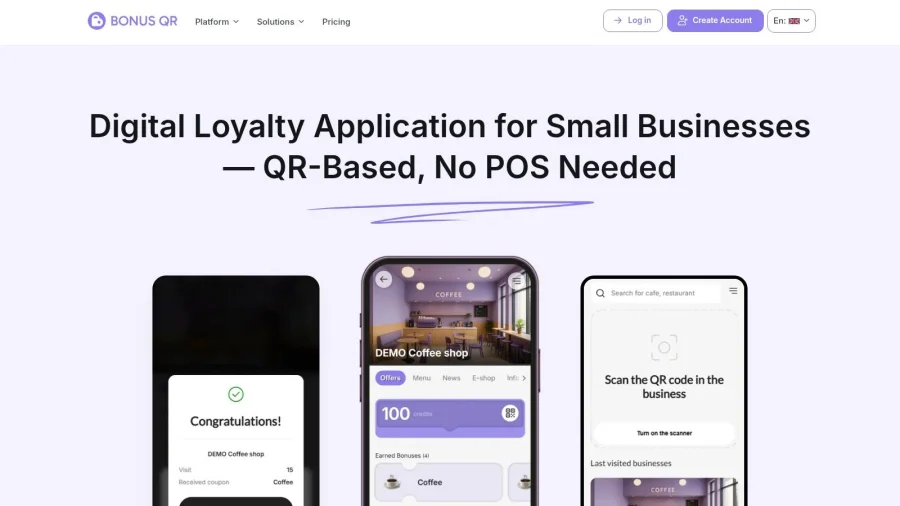
The most practical setup for a local business is usually one that works with a QR code, a phone, and a simple staff workflow. BonusQR helps businesses increase repeat visits with QR-based loyalty, digital stamps, points, cashback, coupons, built-in analytics, and no POS integration requirement. Customers keep a personal QR code on mobile or web, and staff scan and redeem inside the app.
That kind of setup suits busy teams because it removes the technical barrier. No complicated rollout. No waiting for a custom system before getting started.
Step three: promote it where customers already buy
The best programme in the world won't work if customers never hear about it.
Promotion should happen at the natural moment of purchase or booking. Keep it visible and repetitive.
- At the counter with a short staff prompt.
- On printed signs near payment and collection areas.
- On receipts or booking confirmations if the business uses them.
- In follow-up messages where appropriate.
- On social posts that explain the reward clearly.
Merchandising still matters here. Owners who want physical prompts such as tent cards, stickers, or takeaway inserts may find this guide for businesses buying promotional items helpful when choosing printed materials that support the launch without overspending.
What actually makes programmes stick
Antavo reports in its UK loyalty programme trends article that only 57% of UK loyalty programme owners report satisfaction, and it ties stronger results to mobile-first experiences. The same source says mobile apps and AI-driven personalisation have been proven to increase customer spend by 57% among loyalists.
For a small business, the practical takeaway is simpler than the terminology suggests:
- Keep it mobile-friendly because that's where customers will carry it.
- Make sign-up fast because long forms kill momentum.
- Use the data sparingly but usefully so offers feel relevant.
- Train staff to mention it every day because habits don't build themselves.
If customers need instructions to understand the programme, the programme needs work.
A business doesn't need a grand launch. It needs a clear offer, a low-friction tool, and consistent promotion for the first few weeks.
Common Loyalty Programme Pitfalls and How to Avoid Them
Not every loyalty programme helps. Some create confusion, train customers to wait for discounts, or sit unused on phones after the first sign-up.
That matters because loyalty space is crowded. Mintel's UK customer loyalty reporting notes that 55% of UK consumers belong to at least four loyalty schemes, while only 58% have actively used three or fewer in the past six months in its market report on retail customer loyalty. In plain terms, customers join plenty of schemes and ignore many of them.
The mistakes that sink programmes early
- The reward takes too long to earn. Customers lose interest before they feel progress.
- The perk is dull. A reward the owner likes isn't the same as one customers want.
- Sign-up is clunky. If staff fumble with it, customers won't bother.
- Nobody talks about it. Quiet programmes stay invisible.
- The rules are messy. Confusion kills repeat use.
The practical fixes
Ask a few regulars what would feel worthwhile before finalising the reward. That quick conversation is often more useful than hours spent guessing.
Make the first win feel close. Customers need momentum.
Keep the staff script short. Something like, “Would you like to collect rewards on your visits?” works better than a speech about membership benefits.
A loyalty programme should feel easier than using cash from a coat pocket.
Finally, review real usage, not assumptions. If customers sign up but don't redeem, the issue usually isn't demand. It's friction, weak value, or poor communication.
Your Loyalty Programme Questions Answered
Do small businesses really need a loyalty programme?
Not every business needs one immediately. But any business that relies on repeat visits should seriously consider it. Cafés, salons, quick-service restaurants, fitness studios, and neighbourhood retailers all benefit when regular custom becomes more consistent and visible.
Does it need to connect to the POS system?
No. Many small businesses do better with a standalone digital setup because it's faster to launch and easier for staff to learn. The key is a simple scan-and-reward process, not technical complexity.
How much should a reward cost the business?
The reward should feel valuable to the customer but remain comfortable for the business to give repeatedly. A practical rule is to choose a reward with clear perceived value and controlled margin impact. If owners feel nervous every time someone redeems it, the reward is too expensive.
What's the easiest type to start with?
For most high-frequency local businesses, a digital stamp card is the easiest entry point. It's familiar, quick to explain, and simple for customers to track. For businesses with mixed pricing or larger baskets, points or cashback may fit better.
What matters more, the reward or the sign-up experience?
Both matter, but the sign-up experience usually decides whether customers join at all. If it's slow, awkward, or confusing, even a strong reward won't save it.
What's the single biggest reason programmes fail?
They ask too much from the customer. Too many steps, too much waiting, too little payoff.
How should staff introduce it?
Keep the prompt natural and brief. Ask every eligible customer, not just the ones who seem interested. Consistency matters more than charm here.
Can a loyalty programme build relationships, not just repeat spend?
Yes. In fact, that's when it works best. The strongest programmes don't just track transactions. They help a business recognise regulars, reward them fairly, and stay relevant between visits.
A loyalty programme should feel like good local service with a reliable system behind it.
If the current setup still depends on paper cards, staff memory, or ad hoc discounts, start smaller than expected. Launch one clear reward, make joining easy, and give customers a reason to come back before a competitor does. That's what turns loyalty from a vague idea into repeatable revenue.


