
 Deutsch
 Español
 Français
 Italiano
 Magyar
 Polski
 Slovenčina
 Čeština
Customer touchpoints are defined as every individual interaction a customer has with a brand throughout the entire customer journey, spanning digital, physical, and human channels. These interactions occur across pre-purchase, purchase, and post-purchase phases, and each one shapes how a customer perceives your brand. According to Zendesk, touchpoints include everything from a first Google search to a post-sale support call. Understanding what are customer touchpoints gives you the foundation to manage every moment that builds or breaks customer trust. Businesses that map and manage these interactions deliberately gain a clear advantage in retention, satisfaction, and long-term loyalty.
What are the different types of customer touchpoints?
Customer touchpoints fall into three broad categories: digital, physical, and human. Smaply confirms that combining channel type with journey stage is the most effective way to categorise touchpoints for strategic management. This dual lens prevents gaps and ensures you account for every relevant interaction.
Digital touchpoints include your website, mobile app, email campaigns, social media profiles, paid adverts, and live chat. These are the most measurable and often the most frequent. A customer might encounter your brand through a Google ad, visit your website, sign up for an email list, and receive a welcome sequence, all before making a single purchase.

Physical touchpoints cover in-store experiences, product packaging, printed materials, and live events. A well-designed shop floor or a thoughtfully packaged delivery creates a tangible impression that digital channels cannot replicate. Physical touchpoints carry particular weight in hospitality, retail, and food service sectors.
Human touchpoints involve direct contact with your team. Sales calls, customer support conversations, and in-person service interactions all fall here. These moments carry the highest emotional weight. A single poor support experience can undo weeks of positive digital engagement.
The table below shows how touchpoints map across journey stages and channel types.
| Journey stage | Digital touchpoints | Physical touchpoints | Human touchpoints |
|---|---|---|---|
| Awareness | Social media ads, blog posts | Billboards, events | Word of mouth, referrals |
| Consideration | Website, email, comparison pages | Brochures, pop-up shops | Sales calls, demos |
| Purchase | Checkout page, payment app | Point of sale, packaging | In-store staff, live chat |
| Post-purchase | Order confirmation, push notifications | Delivery, unboxing | Support agents, account managers |
| Advocacy | Loyalty app, review requests | Loyalty cards, receipts | Community events, referral schemes |
Omnichannel consistency across all three channel types is not optional. Customers do not separate their experience by channel. They expect the same quality of service whether they contact you by email, walk into your shop, or speak to a support agent.
How to identify and map customer touchpoints
Mapping customer journey touchpoints is a five-step process that turns guesswork into a clear picture of how customers actually experience your brand.
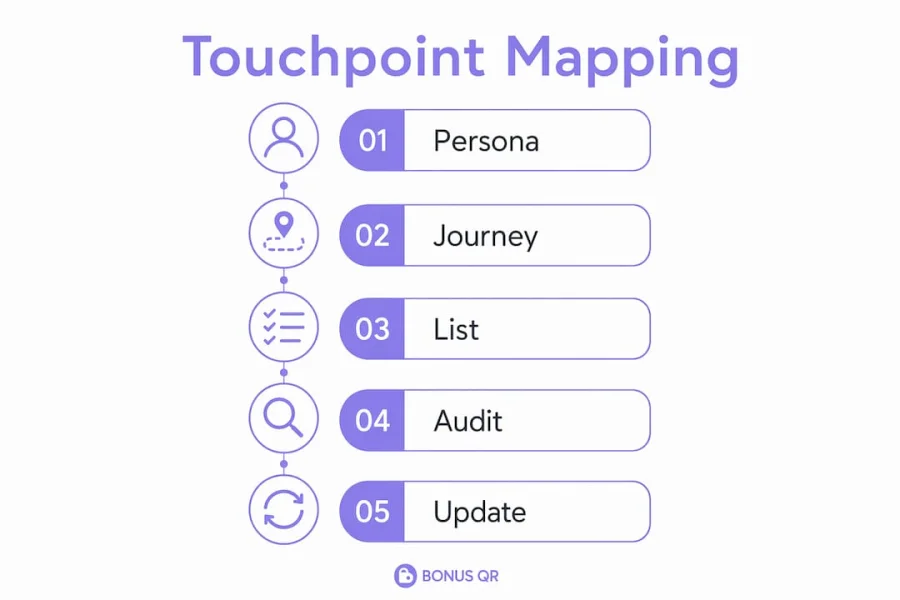
Step 1: Build detailed customer personas. A persona is a profile of your typical customer, including their goals, frustrations, preferred channels, and buying habits. Without personas, your map reflects what you think customers do, not what they actually do. Create at least two or three personas to cover your main customer segments.
Step 2: Map the full customer journey. Plot the path each persona takes from first awareness through to repeat purchase and advocacy. Use a simple timeline format. Mark the key stages: awareness, consideration, purchase, post-purchase, and loyalty. This gives you the structure onto which you will attach specific touchpoints.
Step 3: List every touchpoint at each stage. Go channel by channel and list every interaction a customer could have with your brand. Include touchpoints you control, such as your website and email campaigns, and those you do not control, such as third-party reviews and word-of-mouth recommendations. Smaply notes that each touchpoint should be defined by channel, device, and the specific customer task being performed. That level of precision turns a general map into a decision-making tool.
Step 4: Collect customer feedback at key touchpoints. Surveys, net promoter score (NPS) ratings, post-purchase reviews, and support ticket analysis all reveal how customers actually feel at each stage. Qualitative feedback uncovers friction points that analytics alone will miss. Pair your customer feedback data with behavioural metrics like page exit rates and cart abandonment figures.
Step 5: Analyse performance and prioritise improvements. Score each touchpoint by its impact on customer satisfaction and its current performance. Prioritise the touchpoints with high impact and poor performance first. This is where you will find the biggest gains. Mapping touchpoints is an ongoing process, not a one-time project. Static maps become obsolete quickly as technology and customer behaviour evolve.
- Build customer personas
- Map the full journey by stage
- List every touchpoint, owned and organic
- Collect feedback and behavioural data
- Analyse, prioritise, and act
Pro Tip: Conduct a full touchpoint audit every quarter. Customer behaviour shifts, new channels emerge, and your product offering changes. A quarterly review keeps your map accurate and your strategy current.
Why do customer touchpoints matter for business success?
Customer touchpoints are relationship-building moments, not just transactional steps. Zendesk states that each interaction either strengthens or weakens the customer-brand relationship. That framing changes how you should think about every email, every support call, and every checkout page.
The timing and sequence of touchpoints influence customer decisions as much as the content of the interactions themselves. TechTarget confirms that AI-driven personalisation now uses real-time behavioural signals to determine which touchpoints a customer encounters next. This goes far beyond broad demographic targeting. A customer who browses a product page three times in one week signals a different intent than one who visits once and leaves.
Context preservation between touchpoints is one of the most common failure points for growing businesses. When a customer contacts your support team after receiving a marketing email, the support agent should know about that email. Failing to maintain that context causes frustration and drives churn. Omnichannel platforms that centralise customer history solve this problem directly.
The benefits of managing touchpoints well are concrete:
- Higher customer retention through consistent, relevant experiences
- Reduced churn caused by friction at key decision points
- Stronger brand trust built through reliable, personalised interactions
- Better conversion rates at purchase and post-purchase stages
- More effective customer engagement in retail and service environments
The pitfalls of poor touchpoint management are equally concrete. Inconsistent messaging across channels confuses customers. Slow response times at human touchpoints signal indifference. Irrelevant communications at the wrong stage of the journey push customers toward competitors.
Pro Tip: Map the emotional state of your customer at each touchpoint, not just the action they take. A customer who just received a delayed order is in a very different emotional state than one browsing your catalogue for the first time. Tailor your response accordingly.
How to optimise customer touchpoints using technology and feedback
Optimising your touchpoints starts with listening to the ones you do not fully control. Many touchpoints are organic, including word-of-mouth conversations, third-party review sites, and social media mentions. Smaply identifies active participation in these organic channels as a core part of any effective touchpoint strategy. You cannot own every conversation, but you can influence it by responding publicly, encouraging reviews, and creating shareable experiences.
Breaking down internal silos is the single highest-impact structural change most businesses can make. Sharing customer context between marketing, sales, and support teams ensures that every person who interacts with a customer has the full picture. A support agent who can see a customer’s purchase history, loyalty status, and recent email interactions delivers a fundamentally better experience than one working from a blank screen.
Technology plays a central role in making this possible. Omnichannel platforms centralise customer history and workflows. Loyalty platforms like Bonusqr add a data layer that tracks customer behaviour across visits, purchases, and reward redemptions. Push notifications, real-time analytics, and automated campaign triggers give you the ability to act on behavioural signals at exactly the right moment. For a practical overview of omnichannel consistency across retail channels, the principles apply directly to touchpoint management.
The table below summarises key optimisation methods and their expected impact.
| Optimisation method | What it addresses | Expected impact |
|---|---|---|
| Omnichannel platform integration | Context loss between channels | Reduced churn, higher satisfaction |
| Customer feedback loops (NPS, surveys) | Hidden friction at key touchpoints | Faster identification of drop-off points |
| AI-driven personalisation | Irrelevant or mistimed communications | Higher engagement and conversion rates |
| Loyalty programme integration | Weak post-purchase touchpoints | Improved retention and repeat purchase rate |
| Organic channel monitoring | Unmanaged word-of-mouth and reviews | Stronger brand reputation and referral volume |
Customer feedback is the most direct signal you have for identifying which touchpoints need attention. Combine quantitative metrics, such as NPS scores, cart abandonment rates, and support resolution times, with qualitative responses from open-ended surveys. The combination reveals not just where customers drop off, but why.
Pro Tip: Assign ownership of each touchpoint category to a specific team member or department. When nobody owns a touchpoint, nobody improves it. Clear accountability drives consistent action.
Key takeaways
Every customer touchpoint is a moment that either builds or erodes the relationship between your brand and your customer, and managing them deliberately is the most direct path to stronger retention and loyalty.
| Point | Details |
|---|---|
| Define touchpoints precisely | Classify each interaction by channel, device, and customer task for an accurate map. |
| Map across all three channel types | Cover digital, physical, and human touchpoints to avoid gaps in the customer experience. |
| Audit touchpoints quarterly | Static maps become outdated quickly; regular reviews keep your strategy aligned with real behaviour. |
| Break down internal silos | Sharing customer context across teams has the highest single impact on satisfaction. |
| Treat every interaction as relational | Each touchpoint either strengthens or weakens trust; optimise accordingly, not just for conversion. |
Touchpoint strategy: what I have learned from working across industries
The most common mistake I see businesses make is treating their touchpoint map as a finished document. They spend weeks building it, present it to the team, and then file it away. Six months later, they have launched a new app, changed their email platform, and hired three new support staff. The map is already wrong.
The businesses that get the most value from touchpoint mapping treat it as a living process. They assign owners, schedule quarterly reviews, and update the map whenever a new channel or product is introduced. That discipline is unglamorous, but it is what separates businesses with genuinely consistent customer experiences from those that only appear consistent on paper.
AI personalisation is changing the stakes significantly. The ability to sequence touchpoints based on real-time behaviour, rather than a fixed campaign calendar, means that customers now expect relevance at every stage. A generic welcome email sent three days after sign-up feels like a missed opportunity when a competitor is sending a personalised recommendation within hours of a browsing session. The gap between businesses that use behavioural data well and those that do not is widening every year.
The insight I return to most often is this: the touchpoints that matter most are rarely the ones businesses spend the most time on. The post-purchase phase, particularly the period between first and second purchase, is where most customer relationships are won or lost. A well-timed loyalty reward, a relevant follow-up message, or a proactive support check-in at that stage does more for retention than any acquisition campaign. Businesses that understand AI-driven personalisation in retail are already acting on this. The rest are still focused almost entirely on the top of the funnel.
— Michal
How Bonusqr helps you manage and strengthen customer touchpoints
Bonusqr is built for businesses that want to turn post-purchase touchpoints into a consistent source of retention and revenue. The platform covers points collection, stamp cards, cashback, push notifications, and real-time analytics, all without requiring POS integration. Every feature is designed to create a trackable, personalised interaction at the moments that matter most. You can explore the full range of loyalty system features to see how each one maps to a specific touchpoint in your customer journey. For service-based businesses, Bonusqr’s loyalty application for services provides a ready-made framework for managing customer interactions across multiple visit types and spend levels.
FAQ
What are customer touchpoints in simple terms?
A customer touchpoint is any moment a customer interacts with your brand, from seeing an advert to contacting support after a purchase. These interactions span digital, physical, and human channels across the full customer journey.
What are the main types of customer touchpoints?
The three main types are digital touchpoints (website, email, app), physical touchpoints (store, packaging, events), and human touchpoints (support agents, sales staff). Effective strategies cover all three categories across every stage of the customer journey.
How do you identify customer touchpoints for your business?
Start by building customer personas, then map the full journey from awareness to advocacy. List every interaction at each stage, collect feedback from customers, and analyse performance data to identify friction points and opportunities.
Why is touchpoint mapping important for customer loyalty?
Touchpoint mapping reveals where customers experience friction or disengagement, allowing you to fix problems before they cause churn. Each interaction is a relationship-building moment, and consistent positive experiences across all touchpoints directly increase retention.
How often should you update your customer touchpoint map?
Touchpoint maps should be reviewed and updated at least quarterly. Customer behaviour shifts, new channels emerge, and business offerings change, so a static map quickly becomes inaccurate and loses its value as a planning tool.