Reward points are units of value that a retailer, credit-card issuer, or platform credits to your account for spending, engaging, or referring. The single rule to remember: treat 1p per point as your baseline value, and only chase higher returns when a transfer partner genuinely beats it.
- Best use: save transferable points for airline or hotel transfers when the return clearly exceeds 1p.
- Typical baseline: cash, statement credit, and portal bookings usually land around 1p per point.
- Quick tip: avoid merchandise and most gift-card redemptions. They routinely pay out below 1p, according to Bankrate. Programmes like Microsoft Rewards and card issuers behind Chase Ultimate Rewards or American Express Membership Rewards all follow this same basic value logic.
Key Takeaways
Reward points are worth roughly 1p each at baseline, and the biggest gains come from transfers, not from chasing merchandise or gift cards.
| Point | Details |
|---|---|
| Use the 1p floor | Value cash and statement credit redemptions at roughly 1p per point as your baseline comparison. |
| Check transfers first | Airline and hotel partner transfers can return 2p to 5p per point, especially for premium cabins. |
| Run the valuation test | Divide the cash price by points required before redeeming for merchandise or gift cards. |
| Stack earning tactics | Combine welcome bonuses, category cards, and shopping portals for faster accumulation. |
| Track and secure balances | Check dashboards regularly, note expiry dates, and enable two-factor authentication. |
How reward points get issued, tracked, and shown in your account

Every points programme runs on the same skeleton, whether it is a coffee shop stamp app or a major credit card. You earn, the issuer posts the activity, your balance updates, and you choose a redemption when you are ready.
Earning typically comes from:
- Purchases at the issuing retailer or with the card
- Search, browsing, or app activity (common with platforms like Microsoft Rewards)
- Referrals and friend invites
- Limited-time promotions and bonus categories
- Sign-up or welcome bonuses
The flow looks like this: you earn → the transaction posts → the balance updates on your dashboard → you redeem through the programme’s portal or partner transfer. Small businesses running their own schemes, such as those built on BonusQR’s loyalty platform, follow this same structure, just on a smaller, more customisable scale.
Pro Tip: Activity-based programmes can lag. Microsoft Rewards points from searches or Xbox activity sometimes take a day or two to post, so don’t panic if your balance looks stale immediately after an action.
What types of programmes award reward points?
Not all points behave the same way, and knowing which type you’re dealing with changes how you should plan redemptions.
- Retail loyalty programmes: points per pound spent at one merchant, often redeemable in-store for discounts.
- Paid membership programmes: points or perks tied to an annual fee, layered on top of standard earning.
- Credit-card flexible points: earned on spending, often transferable to travel partners, as with Chase Ultimate Rewards or American Express Membership Rewards.
- Airline and hotel miles: earned through flights, stays, or co-branded cards, redeemable mainly within that one ecosystem.
- Activity-based schemes: Microsoft Rewards and Xbox Rewards award points for searches, quizzes, and gaming activity rather than purchases.
Flexible card points and some retail schemes allow transfers or broad redemption choices. Airline miles and activity points generally stay locked within their own ecosystem, as Shopify notes in its overview of how loyalty mechanics differ by design.
How can you earn more reward points?
Stacking is where most of the real value hides, and it doesn’t require obsessive effort.
- Welcome bonuses: the single fastest way to build a balance, often worth thousands of points in one go, according to MileIntel’s research on maximising credit card points.
- Category cards: cards paying 3 to 5 times the standard rate on groceries, dining, or travel.
- Everyday spend optimisation: routing routine purchases through your highest-earning card.
- Shopping portals: bonus points layered on top of normal card earnings when you click through first.
- Promotions and referrals: seasonal bonus offers and friend-referral credits that cost nothing extra to claim.
Three layers, one purchase.
Pro Tip: Welcome bonuses usually require hitting a minimum spend within 60 to 90 days. Don’t overspend just to hit the threshold. The points aren’t worth the interest charges if you can’t pay the balance off.
How do you redeem reward points for the best value?
Redemption options vary sharply in payout, and the gap between the best and worst choice is often 3 to 5 times.
- Cash or statement credit: the simplest option, typically around 1p per point.
- Travel portal bookings: pay for flights or hotels directly through the issuer’s portal.
- Transfers to airline or hotel partners: usually the highest-value route, but requires research.
- Gift cards or merchandise: convenient, but frequently below 1p per point.
- Sweepstakes or auctions: entertaining, rarely a strong use of value.
Mini-guide 1: Redeeming for statement credit
- Log into your rewards dashboard.
- Select “redeem for cash” or “statement credit.”
- Confirm the points-to-cash ratio before submitting.
Mini-guide 2: Transferring to a travel partner
- Check the partner’s award chart for the flight or stay you want.
- Confirm the transfer ratio isn’t diluted (some are 1:1, others less).
- Transfer only once you’ve verified award availability, since points can’t easily be un-transferred.
Before redeeming for merchandise or a gift card, Cardocrat recommends dividing the cash price by the points required. If the result sits well under 1p, take the cash option instead.
What are reward points actually worth?
Value depends entirely on how you redeem, and the spread is wide enough to matter.
| Redemption type | Typical value per point |
|---|---|
| Cash or portal booking | ≈ 1p |
| Airline or hotel transfer | ≈ 2p to 5p |
| Merchandise or gift card | Often under 1p |
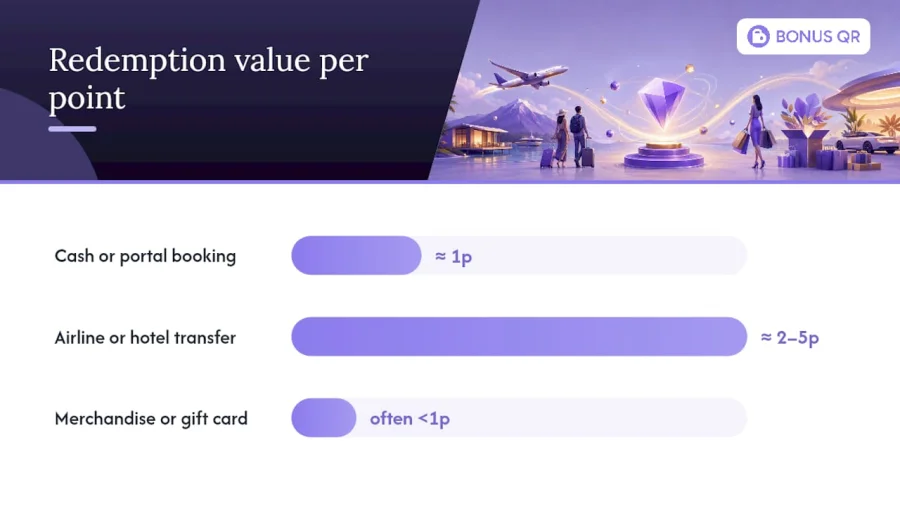
Bankrate’s valuation research confirms this pattern across major card programmes. The gap compounds fast at scale: 50,000 points redeemed for cash at 1p nets you £500. The same 50,000 points transferred to a partner airline at 2p can be worth £1,000, and premium-cabin award bookings sometimes push that closer to 5p because business and first-class seats carry a far higher cash price relative to the points required.
The spread between the worst and best redemption on the same points balance can double or quintuple your payout, which is why checking before you redeem matters more than which programme you’re in.
Variance between programmes comes down to how generously each one prices its own award seats or rooms. A programme with tight, cheap award availability will consistently beat one that inflates its “point cost” for the same trip.
How do you get the most out of your reward points?
Start simple and add complexity only where the return justifies the effort.
- Redeem for cash at 1p. Zero research required, and it’s a perfectly sound outcome for most people.
- Use shopping portals and category bonuses. Free points layered onto spending you were already doing.
- Consolidate into transferable currencies. Keeping points in a flexible programme like Chase Ultimate Rewards or American Express Membership Rewards preserves your options.
- Target transfer partners for premium travel. This is where the 2p to 5p range becomes achievable, particularly for business or first-class seats.
- Watch for transfer bonuses. Issuers occasionally offer 20% to 30% bonuses on transfers to specific partners for a limited window.
A reader with transferable points who waits for a sizeable transfer bonus can significantly increase their partner miles before booking, which can be the difference between an economy seat and a business-class upgrade on the same balance.
Pro Tip: Transfer only when you’ve confirmed award seat availability and you’re within a live bonus window. Points sitting in a flexible account keep their options open; miles sitting in an airline account can expire or get devalued at that airline’s discretion.

How do you track and protect your reward points balance?
Losing track of points is the quiet way most value disappears.
- Check your programme dashboard, credit-card portal, or retailer app regularly rather than relying on statement summaries.
- Use a simple spreadsheet or note if you hold points across several programmes, since Microsoft’s own regional rules show how earning and expiry policies shift by market.
- Secure the account: strong, unique passwords, two-factor authentication, and a protected linked email address.
Pro Tip: Export or screenshot your balances every few months and jot down partner transfer ratios and expiry dates. Programmes change terms with little warning, and a written record saves you from relying on memory later.
What mistakes waste the value of your reward points?
Most lost value comes from a handful of repeatable errors, not bad luck.
- Redeeming below 1p without checking: always run the cash price divided by points-required test first.
- Skipping the transfer-partner comparison: a direct redemption might look fine until you check what a transfer would return.
- Letting points expire: set a reminder tied to your programme’s specific expiry rule.
- Chasing small merchandise “deals”: a discounted gadget for points rarely beats cash value.
- Overspending to hit a bonus threshold: interest charges wipe out any bonus you earned.
- Neglecting account security: a hijacked account can mean a wiped balance with no easy recovery.
Run the valuation check, cash price divided by points required, before any merchandise or gift-card redemption. It takes thirty seconds and prevents the most common way people quietly lose value.
When should you take the cash and when should you chase transfers?
If simplicity matters most to you, treat 1p cash as a genuinely good outcome and stop there. If you travel often, learning transfer partners is worth the effort for that 2p to 5p upside. Bonusqr’s own work building points systems for small businesses centres on exactly this trade-off: giving owners the flexibility to choose what balance of simplicity and reward actually suits their customers.
Frequently asked questions
How do I redeem reward points? Log into your programme’s dashboard and choose cash, statement credit, a travel portal booking, or a partner transfer. Cash and statement credit are usually the simplest, no-research options.
How much are reward points worth? Most cash and portal redemptions return about 1p per point. Transfers to airline or hotel partners can reach 2p to 5p per point, while merchandise and many gift cards fall below 1p.
How do I get reward points faster? Welcome bonuses offer the quickest boost, followed by category cards paying elevated rates on your top spending areas, plus shopping portals and referral bonuses layered on top.
Do reward points expire? Rules vary by programme. Some points never expire while your account stays active; others expire after a set period of inactivity. Check your specific programme’s terms and note the date.
What’s the difference between credit-card points and airline miles? Credit-card points, like those from Chase Ultimate Rewards, are usually flexible and transferable to several partners. Airline miles are locked to one airline’s own award chart and pricing.


