
 Deutsch
 Español
 Français
 Italiano
 Magyar
 Polski
 Slovenčina
 Čeština
You can run an effective loyalty programme without an app: use printed or stamp cards, phone-number lookup, Apple or Google Wallet passes, QR codes, or SMS and email accounts depending on your customers. Fast-till retail suits stamp cards or QR, hospitality often does best with wallet passes or QR, and this guide walks through setup, costs and a platform that handles all five methods.
TL;DR:
- Fast tills suit stamp cards or static QR; slower visits allow phone lookup or wallet passes, and mixed age groups need a physical option.
- Pilot one collection method and one simple reward rule for two to four weeks, then track redemptions, repeat visits, and average spend before expanding.
- Cards and QR stickers can launch the same day with printing costs upfront; branded wallet passes and automated SMS typically take one to four weeks.
- Dynamic QR codes are harder to reuse from screenshots; verify phone lookups with a customer code and check a name before rewarding redemptions.
- EU businesses must explain how they use contact details, establish a lawful basis, ask permission before marketing, and allow deletion requests under GDPR.
How each app-free method works at the till
Every app-free method needs a clear flow at checkout, or staff will skip it when the queue builds up.
Physical and stamp cards are the simplest: the cashier hands over a card, stamps or hole-punches it, or scans a barcode printed on it. The only real cost is reprinting and the risk of a customer losing the card.
Phone-number lookup asks the customer for their number at the till. Staff type it into the POS or a quick-key pad, which pulls up the account instantly, though typos create duplicate accounts and staff need a simple way to handle that.
Wallet passes (Apple Wallet or Google Wallet) work by sending the customer a link, usually by SMS or email, that adds a pass to their phone. At checkout they present the barcode or tap NFC, and the balance updates automatically, no app download needed.
QR codes can be static (one fixed code printed on a sticker or receipt) or dynamic (a new code generated per visit). The customer scans it with their phone camera, which opens a web page linked to their account.
SMS and email accounts rely on magic links or one-time codes sent to the customer, who taps to confirm a redemption without creating a password.
- Stamp cards need the least staff training but the most physical restocking.
- Phone lookup is fast but depends on accurate data entry.
- Wallet passes update automatically and need no app installed.
- QR codes work from a sticker, a receipt or a table tent.
- SMS and email flows suit customers who rarely scan codes but always check messages.
Pro Tip: Pick one primary method for your busiest hour and offer a second as a fallback, rather than asking every customer to choose from five options at the till.
Which option fits your business
The right method depends on how fast your transactions move, not on which one sounds most modern.
Fast tills, think coffee shops, bakeries, petrol stations, do best with stamp cards or static QR codes because there’s no typing and no waiting for a customer to find their phone. Slower transactions, such as a sit-down restaurant bill or a salon appointment, give staff time to ask for a phone number or send a wallet pass link while the customer is still at the counter.
Customer tech comfort matters as much as transaction speed. A younger, smartphone-heavy customer base will adopt QR and wallet passes quickly. An older or more mixed customer base often still prefers a physical card they can keep in a wallet.
Staff capacity is the part owners underestimate. A phone-lookup system only works if every till operator is willing to ask for and correctly key in a number during a rush. If your team already struggles with upsell scripts, a stamp card that needs no data entry at all will get used more consistently than a system requiring manual lookup.
- Fast, high-volume tills: stamp cards or static QR.
- Slower, higher-ticket transactions: phone lookup or wallet pass.
- Mixed or older customer base: keep a physical card option running alongside any digital method.
- Low smartphone penetration among your regulars: lead with cards, not QR.
Accessibility matters too: not every customer owns a smartphone, so a programme that only works through a scan or a wallet pass excludes part of your base. Start with the simplest method that covers your busiest hour, then layer in a second channel once staff are comfortable with the first.
Step-by-step checklist to launch an app-free loyalty programme
A working pilot needs five decisions made before you print anything.
- Define a simple reward rule, such as a stamp card giving a free item after ten visits, or one point per $5 spent.
- Pick one collection method and map exactly what staff say and do at checkout.
- Create the physical or digital assets: printed cards, a QR sticker for the counter, the wallet pass design, or an SMS template.
- Train staff with a short script, for example: “Would you like to join our loyalty programme? Just give me your number” or “Scan this code and your first stamp is on us.”
- Run the pilot for two to four weeks, track redemptions and visits, and adjust the reward threshold if uptake is slow.
Pro Tip: Write the staff script down and stick it near the till for the first two weeks. Consistency matters more than the method you pick.
Keep the first version deliberately basic. A single reward tier with one collection method tells you more in a month than a complex, multi-tier programme launched all at once.
Costs, fees and realistic timelines for an app-free rollout
Printed cards and QR stickers are the cheapest entry point, typically a one-off print and design cost with no recurring fee beyond reordering stock. Counter signage and table tents add a small, one-time cost.
Recurring costs depend on the method: SMS flows carry a per-message fee, wallet-pass issuance is usually bundled into a SaaS subscription tier, and some platforms charge nothing extra for QR-based collection. Transaction fees from your payment processor are separate from loyalty costs unless you choose a platform that ties rewards directly to card payments.
- Printed cards and QR stickers: one-off cost, minimal upkeep.
- SMS campaigns: per-message fee on top of any subscription.
- Wallet passes: usually included in a subscription tier rather than charged per pass.
- A same-day pilot is realistic with cards or QR; branded wallet passes or automated SMS campaigns typically take one to four weeks to design and test.
Registration friction is one of the biggest barriers to loyalty adoption, and making rewards visible at the point of purchase increases the likelihood customers adopt a new method rather than defaulting to a card they already carry.
Why a modular platform shortens the path from idea to pilot
Running several app-free methods side by side, cards for regulars, QR for new visitors, wallet passes for the smartphone-heavy crowd, usually means stitching together separate tools unless the platform was built to handle all of them from one dashboard.
A platform like BonusQR specialises in customisable loyalty solutions covering points collection, stamp cards, cashback, coupons, discounts and visit-based rewards, all manageable from a single account rather than five disconnected systems.
- Multiple modules let a business combine onboarding promotions, special-occasion offers and standard point collection without separate software.
- Mobile and web integration, real-time analytics and marketing automation come built in rather than bolted on.
- Setup does not require POS integration, with free and premium subscription tiers plus branded white-label apps for larger operations.
Because none of these modules demand a dedicated customer app, they map directly onto the methods covered above, stamp cards, QR, wallet passes and SMS, without asking a business to rebuild its till process from scratch.
Keeping an app-free programme secure
Security for card-based or QR loyalty programmes centres on preventing duplicate claims and fake redemptions rather than protecting login credentials, since there’s often no password to steal.
Dynamic QR codes that refresh per visit are harder to screenshot and reuse than a static code printed once and shared. Wallet passes carry a unique barcode per customer, which limits the damage if one code is copied, since the account tied to it is specific to that person rather than shared across a till.
Phone-number lookup needs a verification step, such as confirming the last purchase date or sending a one-time code, to stop someone guessing a number and claiming a stranger’s rewards. Token-based designs that keep most loyalty state on the customer’s device rather than in a central database reduce the amount of sensitive data a business needs to protect in the first place.
Staff training matters as much as the technology: a quick verification habit, checking a name or recent purchase before honouring a redemption, catches most attempted fraud before it costs you a free item.
Handling customer data and privacy properly
Phone numbers and email addresses are personal data, and collecting them at the till means thinking about where that information goes and who can see it.
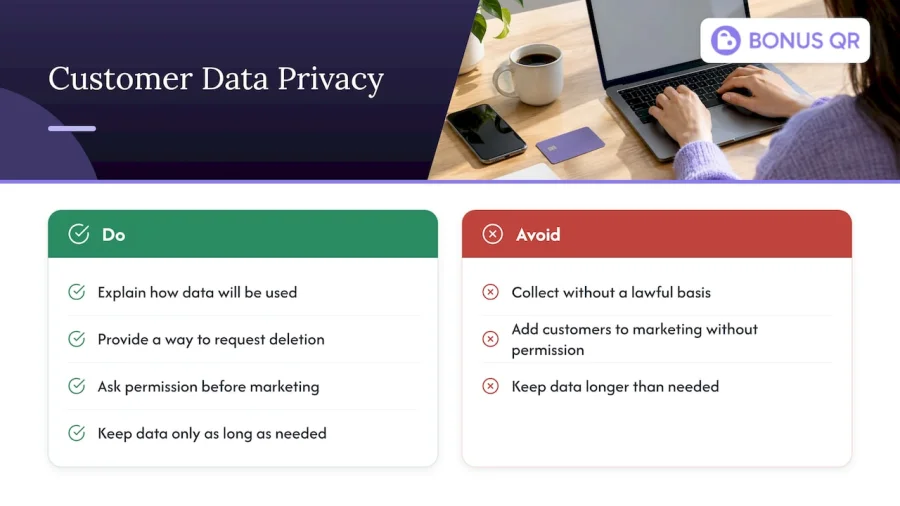
For businesses serving customers in the European Union, GDPR requires a lawful basis for collecting contact details, a clear explanation of how the data will be used, and a way for customers to ask for their data to be deleted. Even where GDPR doesn’t directly apply, building the same habits, asking permission before adding someone to marketing lists, keeping data only as long as needed, protects customer trust regardless of jurisdiction.
Privacy-preserving loyalty designs that store most of a customer’s loyalty history on their own device rather than in a central company database cut down on the data a business holds, and therefore the risk if that data is ever exposed.
Wallet passes are a useful middle ground here: the pass itself carries an identifier, but much of the interaction happens on the customer’s device rather than in a shared database. A simple written privacy note at sign-up, even a single sentence explaining how the phone number or email will be used, goes a long way towards keeping a programme compliant and trustworthy.
Connecting app-free loyalty to your POS or CRM
Not every app-free method needs a technical integration, which is part of why they’re quicker to launch than a bespoke app.
Stamp cards and static QR codes can run entirely independently of your POS, tracked through a simple dashboard rather than wired into the till software. Phone-number lookup sits a step further along: some POS systems support a loyalty field natively, while others need the loyalty platform to run alongside the till rather than inside it.
Wallet passes and SMS campaigns generally connect to a CRM or customer database in the background, syncing visit and spend data so marketing messages can be personalised without staff doing anything extra at checkout. The practical question to ask before choosing a method is whether your current POS already supports loyalty fields or whether you need a standalone system that tracks visits and redemptions on its own.
A platform that doesn’t require POS integration to get started lets you launch with cards or QR immediately, then connect deeper CRM syncing later once the pilot proves the reward rules work.
Marketing campaigns that work without an app
The campaigns that perform best with app-free loyalty lean on the channel customers already check, a text message, an email, or a card they’re already carrying, rather than asking them to open a new app.
A “bring the card, get double stamps” promotion on a slow weekday drives repeat visits without any new technology. A birthday-month SMS with a one-time code redeemable in store works well for salons, cafés and independent retailers because it needs nothing from the customer beyond showing the text at the till.
Seasonal QR promotions, a sticker on the counter offering a bonus stamp for scanning during a specific week, work particularly well for cafes and quick-service restaurants where the scan takes seconds. Referral campaigns that hand an existing customer a card to give a friend, with both receiving a reward once the friend’s card is stamped, spread by word of mouth rather than a download prompt.
Keep the offer visible at the point of purchase: a countersign or till-side prompt converts better than a message buried in an email a customer might not open until days later.
Why we’d start small before scaling an app-free programme
Most businesses overthink the rollout and underthink the pilot. A single reward rule, run for two to four weeks with one collection method, tells you more about real customer behaviour than a five-tier programme launched all at once.
Track redemptions, repeat visits and any uplift in average spend. If the numbers hold up, add wallet passes and automated SMS reminders next, but keep the reward rule visible and simple throughout.
— Michal
Getting started with BonusQR
Whichever method suits your till, cards, QR stickers, wallet passes or SMS, we built our modules to cover all of them from one account rather than asking you to juggle separate tools.
Stamp cards and point collection run on our Free and Basic tiers, while campaign automation, analytics and wallet-pass issuance sit in Premium, listed at €69 a month on our pricing page. Businesses wanting a fully branded wallet pass or white-label app can check the setup fee and monthly subscription details on our white-label page.
If you’d rather start seeing a reward rule live before committing to a tier, register for a BonusQR account and launch your first pilot this week.
FAQ
What apps can I use for loyalty cards?
You don’t need a dedicated app at all: printed cards, QR codes, and Apple or Google Wallet passes cover most loyalty use cases without a download. Wallet passes work through the phone’s built-in wallet app, so customers add a pass rather than installing something new.
How do loyalty programmes help businesses?
Loyalty programmes encourage repeat visits by giving customers a reason to come back, whether that’s a stamp card nearing completion or points building towards a reward. They also give businesses a simple way to track visit frequency and spending patterns without complex analytics tools.
What is customer loyalty with an example?
Customer loyalty is a customer’s tendency to keep choosing the same business over competitors, often because of a rewards programme, consistent service or habit. A coffee shop stamp card offering a free drink after ten purchases is a straightforward example that needs no app or account to work.
How do I create a loyalty account?
Most app-free loyalty accounts start with a phone number or email captured at checkout, which links to a card, QR code or wallet pass. Some platforms also let you send a magic link by SMS so a customer can confirm their account without typing a password.