
 Deutsch
 Español
 Français
 Italiano
 Magyar
 Polski
 Slovenčina
 Čeština
Loyalty marketing for wellness centres is the practice of designing reward and recognition programmes that build emotional commitment and repeated engagement, not just transactional discounts. The wellness industry faces a real retention challenge: 48% of providers lost long-term clients in 2025, yet 73% of wellness clients are willing to pay more for personalised service. That gap between what clients want and what most centres deliver is exactly where a well-built loyalty programme creates competitive advantage. This guide covers every component you need, from reward design to staff training, to build a programme that keeps clients coming back.
What key elements should a loyalty marketing programme for wellness centres include?
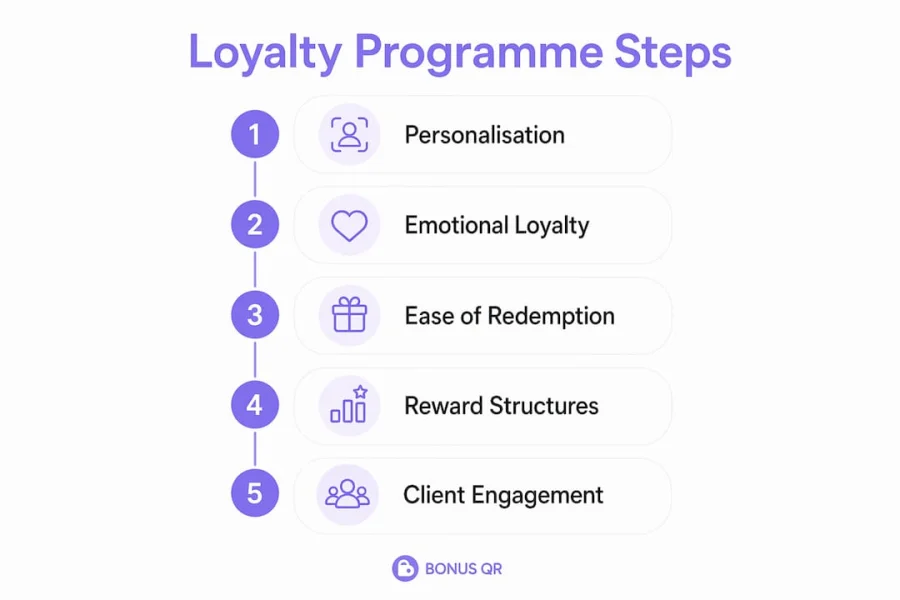
The most effective wellness loyalty programmes combine personalisation, emotional recognition, and frictionless redemption. Points alone do not retain clients. 70% of wellness clients say recognition or rewards are key to their loyalty, which means the structure of your programme matters as much as the rewards themselves.
Personalisation as the foundation
Personalisation is the single most important element in any wellness loyalty programme. A client who receives a birthday message referencing their preferred treatment feels seen. A client who receives a generic discount email does not. Your CRM must capture treatment history, product preferences, health considerations, and visit frequency so that every communication feels relevant. Emotional loyalty depends on CRM use and personalisation, not just points accumulation.
Reward structures that work in wellness
Points programmes remain the most common structure in wellness centres. A typical model awards 1 point per £1 spent, with redemption at around 20 points for £1 off a future treatment. That said, points work best when they reward multiple behaviours, not just spend. Consider awarding bonus points for:
- Rebooking at the desk before leaving
- Leaving a verified review
- Referring a friend who completes a visit
- Sharing a post on social media
- Attending a new treatment for the first time
Stamp cards work well for single-service centres, such as massage or facial clinics, where clients repeat the same treatment. Cashback models suit higher-spend clients who respond to tangible financial returns. The right structure depends on your client mix and average spend per visit.
Emotional loyalty tactics
Milestone recognition builds loyalty that discounts cannot replicate. Acknowledging a client’s 10th visit, their one-year anniversary with your centre, or a personal occasion creates an emotional connection. Milestone acknowledgements build loyalty more effectively than points alone because they signal that your business values the relationship, not just the transaction.
Exclusive access is another powerful tactic. Priority booking for peak slots, early access to new treatments, and members-only events all create a sense of belonging that clients cannot get from a discount code.
Ease of redemption
Ease of experience in booking and redemption is as important as the reward value itself. Complex redemption processes drive abandonment regardless of how attractive the reward appears. Your programme must allow clients to check their balance, redeem rewards, and rebook with minimal steps, ideally within the same app or booking platform they already use.
Pro Tip: Test your redemption process yourself before launch. If it takes more than three steps to redeem a reward, simplify it. Clients will not persist through friction the way staff will.
How to design and implement a loyalty marketing strategy for wellness centres
Building a loyalty programme without a clear plan produces inconsistent results. The steps below give you a practical framework to follow from planning through to ongoing management.
-
Audit your current CRM capabilities. Before designing rewards, confirm that your system can capture client preferences, visit history, and contact details. A programme built on incomplete data will not personalise effectively.
-
Define your goals. Decide whether your primary aim is to increase visit frequency, raise average spend, reduce churn, or grow referrals. Each goal requires a different reward trigger. Reducing churn calls for automated rebooking reminders. Growing referrals calls for a structured referral incentive.
-
Design your reward tiers. Start with a single tier for new programmes. Add tiers only once you have enough data to understand client behaviour. A three-tier structure (for example, Silver, Gold, and Platinum) works well for centres with a broad client base and varied spend levels.
-
Set up automation triggers. Automated rebooking triggers based on typical treatment cycles reduce client churn significantly. A facial client who books every six weeks should receive a reminder at day 42. A massage client on a monthly cycle should hear from you at day 28. Set these triggers once and let the system run.
-
Build your communication plan. Multi-channel communication across email, SMS, and in-clinic signage improves programme awareness and retention. Email suits longer messages such as milestone celebrations and monthly reward summaries. SMS works for short, time-sensitive prompts like rebooking reminders. In-clinic signage reinforces the programme at the point of service.
-
Train your front-desk team. Staff are the human layer of your loyalty programme. They must know how to pull up CRM notes before a client arrives, reference preferences during check-in, and prompt clients to rebook before they leave.
-
Launch with a clear onboarding offer. Give new members an immediate reason to engage, such as double points on their first visit or a complimentary add-on after their second booking.
-
Track and review monthly. Measure visit frequency, redemption rates, referral numbers, and churn rate. If redemption is low, the reward is either too hard to earn or too difficult to use.
| Metric | What it tells you | Review frequency |
|---|---|---|
| Visit frequency | Whether the programme drives repeat bookings | Monthly |
| Redemption rate | Whether clients find the rewards worth using | Monthly |
| Referral rate | Whether clients are motivated to recommend you | Quarterly |
| Churn rate | Whether the programme retains at-risk clients | Monthly |
| Average spend per visit | Whether loyalty members spend more over time | Quarterly |
Pro Tip: Avoid launching with too many reward options. A simple, clear programme with one or two earn-and-redeem mechanics outperforms a complex system that confuses both clients and staff.
Common pitfalls include launching without staff buy-in, setting redemption thresholds so high that clients never reach them, and relying on discounts as the primary reward. Discounts train clients to wait for offers rather than book at full price. Build your programme around value, access, and recognition first, and use discounts sparingly.
Which rewards best motivate wellness clients, and how do you personalise them?
The most motivating rewards in wellness are not always the most expensive. Clients respond to feeling valued, and that feeling comes from recognition as much as from financial benefit.
Transactional versus emotional rewards
Transactional rewards, such as percentage discounts and free products, are easy to understand and easy to copy. Any competitor can match a 10% discount. Emotional rewards, such as a handwritten note on a client’s anniversary visit or priority access to a newly launched treatment, are harder to replicate because they depend on knowing the client personally.
Exclusive perks like priority booking and early access to services motivate clients more than discounts and prevent the devaluation of premium services. When you discount regularly, clients begin to perceive your full price as inflated. When you offer exclusive access, you reinforce the premium nature of your offering.
Personalising rewards by client behaviour
Tailor rewards to what each client actually does, not to what you assume they want. A client who books facials every six weeks and has never tried a body treatment responds differently to a “try something new” offer than a client who rotates between services regularly. Use your CRM data to segment clients and match reward offers to their actual behaviour.
Effective personalisation categories include:
- Frequency-based rewards: Clients who visit weekly or fortnightly respond well to cumulative milestone rewards, such as a complimentary treatment after ten visits.
- Spend-based rewards: Higher-spend clients respond to cashback or exclusive product bundles rather than small discounts.
- Behaviour-based rewards: Clients who refer friends or leave reviews deserve specific recognition, separate from their standard points balance.
- Occasion-based rewards: Birthday and anniversary offers feel personal when they reference the client’s preferred treatment, not just a generic voucher.
For practical wellness rewards examples that you can adapt to your centre’s service mix, the key principle is specificity. A reward that matches a client’s known preferences lands far better than a generic offer.
Avoiding reward devaluation
Discount overuse is the most common mistake in wellness loyalty programmes. When every communication contains a discount, clients stop perceiving your services as premium. Reserve discounts for specific triggers, such as a lapsed client reactivation or a new treatment launch, and use recognition, access, and experience rewards as your primary currency.
Incentivising social behaviours through social proof strategies such as rewarding reviews and social sharing adds a referral dimension to your programme without relying on discounts. A client who shares a post about their experience brings in new clients at no additional acquisition cost.
How do you create a frictionless client experience in wellness loyalty?
The best loyalty programme in the world fails if clients find it difficult to use. Frictionless experience is not a nice-to-have. It is the difference between a programme clients engage with and one they forget about after their first visit.
The concept of invisible loyalty
“Invisible loyalty” describes a programme so well integrated into the client experience that clients feel rewarded without having to think about it. Their points update automatically after each visit. Their rebooking reminder arrives at exactly the right moment. Their milestone reward appears in their inbox before they even realise they have reached it. Clients prefer loyalty programmes that integrate into their booking and service experience without adding steps or complexity.
Practical steps to reduce friction
- Use a single app or platform for booking, loyalty balance, and reward redemption. Clients should not need to log into a separate system to check their points.
- Automate reward notifications so clients receive confirmation of earned points immediately after a visit, not days later.
- Allow redemption at the point of booking, not only at the point of payment. Clients who can apply a reward when they book feel the benefit before they even arrive.
- Display loyalty balance prominently in your booking confirmation emails and appointment reminders.
- Train front-desk staff to mention a client’s current balance during check-out and prompt them to rebook before they leave.
For broader ideas on client engagement without large budgets, the principle of reducing friction applies equally to wellness and retail settings.
The front-desk role in personalisation
Front-desk use of CRM is the most underused tool in wellness loyalty. When a receptionist greets a client by name, mentions their preferred therapist, and notes that they are two visits away from a milestone reward, the client feels known. That feeling drives loyalty more reliably than any points balance. Tag client data clearly in your CRM so that any staff member can retrieve the relevant details in under thirty seconds.
Pro Tip: Create a simple pre-arrival checklist for front-desk staff: check the client’s name, their last treatment, their current loyalty balance, and any personal notes from previous visits. This takes ninety seconds and transforms the greeting.
Key takeaways
Effective wellness loyalty marketing requires personalisation, emotional recognition, and frictionless redemption working together, not any single tactic in isolation.
| Point | Details |
|---|---|
| Personalisation drives retention | Use CRM data to tailor rewards and communications to each client’s actual behaviour and preferences. |
| Emotional rewards outperform discounts | Priority access, milestone recognition, and exclusive perks build loyalty that discounts cannot replicate. |
| Automation reduces churn | Set rebooking triggers at treatment-specific intervals to reach clients before they lapse. |
| Multi-channel communication works | Combine email, SMS, and in-clinic signage to keep clients aware of and engaged with your programme. |
| Frictionless redemption is non-negotiable | Simplify every step from earning to redeeming so clients engage without effort. |
What I have learned about loyalty marketing in wellness centres
The wellness industry talks a great deal about loyalty programmes but invests surprisingly little in the human side of them. After working with wellness businesses across different markets, the pattern I see most often is this: a centre launches a points programme, sends a few emails, and then wonders why redemption rates are low and churn has not improved.
The problem is almost never the reward structure. It is the absence of emotional connection. Clients do not stay with a wellness centre because they have accumulated enough points. They stay because the centre makes them feel understood. That requires CRM discipline, staff training, and a genuine commitment to remembering who each client is.
The other mistake I see regularly is treating loyalty marketing as a campaign rather than an ongoing system. A loyalty programme is not a promotion you run in January and review in December. It is a set of automated triggers, personalised communications, and staff behaviours that run continuously in the background. The centres that get this right treat their loyalty programme the way they treat their booking system: as infrastructure, not as marketing.
My strongest recommendation is to start with your CRM before you design a single reward. If your data is incomplete or your staff do not use it consistently, no reward structure will compensate for that gap. Fix the data layer first, then build the programme on top of it.
The future of wellness loyalty sits in relationship marketing strategies that combine automated personalisation with genuine human moments. Technology handles the triggers and the tracking. Your team handles the connection. Neither works without the other.
— Michal
How Bonusqr supports wellness centre loyalty programmes
Bonusqr gives wellness centre managers a practical platform to build and run the kind of loyalty programme this guide describes. The platform supports points collection, stamp cards, cashback, and milestone rewards, all configurable without technical expertise. Push notifications, automated triggers, and real-time analytics mean you can run a personalised, multi-channel programme without a dedicated marketing team. The loyalty features for service businesses include mobile and web app integration, so clients manage their rewards in the same place they book their appointments. For centres that want a fully branded experience, Bonusqr’s white-label loyalty app puts your centre’s name and identity at the front of every client interaction. You can also review the full Bonusqr feature set to match specific tools to your programme goals.
FAQ
What is loyalty marketing for wellness centres?
Loyalty marketing for wellness centres is the practice of using reward programmes, personalised communications, and recognition tactics to build repeated engagement and emotional commitment from clients. It goes beyond transactional discounts to create lasting client relationships.
How do you retain wellness clients effectively?
Retaining wellness clients requires personalised communication, automated rebooking reminders timed to each client’s treatment cycle, and milestone recognition that makes clients feel valued. CRM data is the foundation of all three.
What rewards work best for wellness loyalty programmes?
Exclusive access, priority booking, and milestone recognition motivate wellness clients more than discounts. Points programmes work well when they reward multiple behaviours, including referrals, reviews, and rebooking, not just spend.
How often should you communicate with loyalty programme members?
Multi-channel communication across email, SMS, and in-clinic signage produces the best results. Frequency depends on the trigger: automated reminders should fire at treatment-specific intervals, while milestone messages should arrive as soon as a client qualifies.
How do you measure whether a wellness loyalty programme is working?
Track visit frequency, redemption rate, referral rate, and churn rate monthly. Low redemption signals that rewards are either too hard to earn or too difficult to use. Rising visit frequency and falling churn confirm that the programme is working.