A customer reaches the till, orders their usual coffee and starts searching their wallet for a creased loyalty card. Sometimes they find it; sometimes it's at home, in another coat or lost altogether. The shop can still hand out a paper card, but it can't tell whether that customer has been back since, how often they visit or what might bring them in again.
That's the small-business dilemma with loyalty cards stamps: the reward mechanic is familiar and easy to explain, but a paper record leaves the owner guessing. A QR-based stamp record keeps the simple earn-and-redeem idea while making customer activity visible, without requiring a new till system or specialist hardware.
The Paper Punch Card Hiding in Every Wallet
The paper card looks simple from behind the counter. A customer pays, a team member punches a space, and the card goes back into a wallet. The trouble begins when the customer can't find it, the punch is hard to read, or a new member of staff isn't sure whether a stamp counts.
Those moments are familiar in cafés, salons and independent shops. They're small enough to seem harmless, but every lost card makes the reward harder to track and less useful to the customer. If the card is forgotten at home, the owner has to decide whether to issue a stamp anyway, ask the customer to return with it or risk an awkward conversation.
What the card doesn't tell the owner
A completed paper card shows that someone collected enough punches. It doesn't show who they are, how long completion took, whether they returned after redeeming or which offer might suit them next. The business sees a handful of cards at the counter, not a reliable picture of customer behaviour.
That gap matters when an owner wants to make a practical decision. Should the reward be easier to reach? Are customers returning regularly, or only when a discount is available? Does a quieter day need a targeted offer, or is the current reward already doing its job? Paper cards can't answer those questions.
A paper card can reward a visit. It can't explain the visit pattern behind it.
Paper still has a place. It's cheap to print, needs no sign-up and is easy to hand to someone while serving them. But for an owner who wants to learn from repeat visits rather than hope the cards are working, the format gives very little back.
What a Stamp-Based Loyalty Card Actually Does
A stamp card is a visible progress mechanic. A customer completes a qualifying action, earns one stamp and collects stamps until reaching a set reward. After redemption, the cycle can restart. The customer can see how far they've come, and staff can explain the rule without translating points or percentages.
The basic loop is straightforward:
- Qualifying action: The customer makes a purchase or visit that meets the stated rule.
- Stamp added: The business records one stamp on the customer's card.
- Reward earned: Once the card reaches its threshold, the customer claims the stated benefit and begins another cycle if the programme allows it.
Stamps, points and tiers aren't interchangeable
A stamp card tracks units towards a specific reward. A points system usually keeps a continuing balance, sometimes tied to spend, while a tier programme recognises status or customer activity rather than counting a fixed sequence of purchases. Those formats can work, but they add a different kind of logic.
Stamp cards also need a clear choice between visit-based and spend-based earning. One stamp per qualifying visit is easy to understand for a café or salon. A spend threshold may suit a shop where basket sizes vary, provided the customer can tell exactly what amount qualifies.
The model has deep roots. Trading stamps originated in the United States in 1891 through the Sperry and Hutchinson company. In the UK, the format arrived in 1958, when Richard Tompkins founded Green Shield Stamps. Customers received one stamp for every 6 pence spent, attached stamps to collection books and exchanged completed books for household goods through Green Shield's redemption shops (history of trading stamps and loyalty programmes).
The underlying idea remains useful: a transaction creates a mark, progress is visible and the reward is tangible. Customers comparing ways to earn rewards beyond food and drink can also explore savings on home care refills as an example of a programme built around repeat purchases.
Designing Stamp Rules That Customers Actually Complete
A stamp programme works best when the customer can understand the rule quickly and see a realistic path to the reward. The design starts with four decisions: what earns a stamp, how many stamps are needed for the reward, what the reward is and how long the card remains valid.
Ecrebo's UK loyalty report found that loyalty cards were used an average of three times per week, with 28% of shoppers using them at least four times weekly. Yet 49% said the rewards they received weren't good enough, and 74% said personalised rewards would make them more likely to participate (Ecrebo's UK loyalty report). The practical lesson is to design for repeat behaviour, not for mentioning a discount.
Set the earning rule first
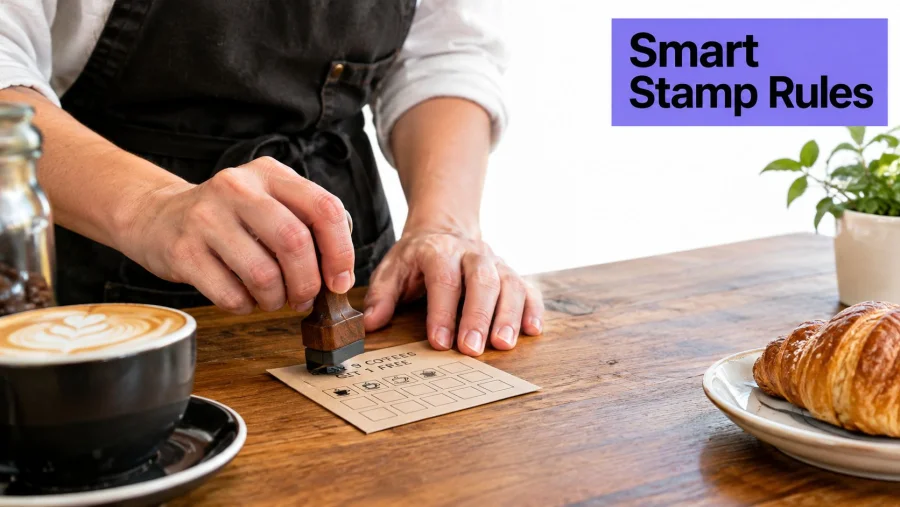
Write down exactly what earns one stamp. A café might use one stamp per qualifying drink; a salon might use one per paid appointment. If the rule is based on spend, state the qualifying amount and whether add-ons or discounted purchases count. Avoid exceptions that staff must memorise during a rush.
Then set a threshold that matches how often customers naturally return. For frequent-visit businesses, a short cycle of six to ten qualifying visits gives customers a visible, achievable goal rather than pushing the reward into the distant future. A customer who visits less often may need a different validity period or a reward that better reflects the time between purchases.
Match the reward to the business
A café can offer a familiar item or a clearly defined upgrade. The reward should feel worth earning without making redemption costly or confusing. A salon or gym may see customers less frequently, so a longer cycle can make sense if the reward is proportionate and the customer understands the conditions.
Personalisation needn't mean discounting everything. Use observable behaviour, such as visit frequency, average basket, preferred product category or a customer's dormant status, to shape relevant offers. For a business weighing stamp cards against a continuing balance, BonusQR points program details provide an example of a different reward mechanic to compare with fixed stamp cycles.
Paper Punch Cards Versus QR Stamp Records
Paper and QR cards share the same core mechanic, but they give the business very different records. Paper is cheap to produce and takes almost no explanation. A QR stamp record asks the customer to scan or show a digital pass, then records the activity against a profile.
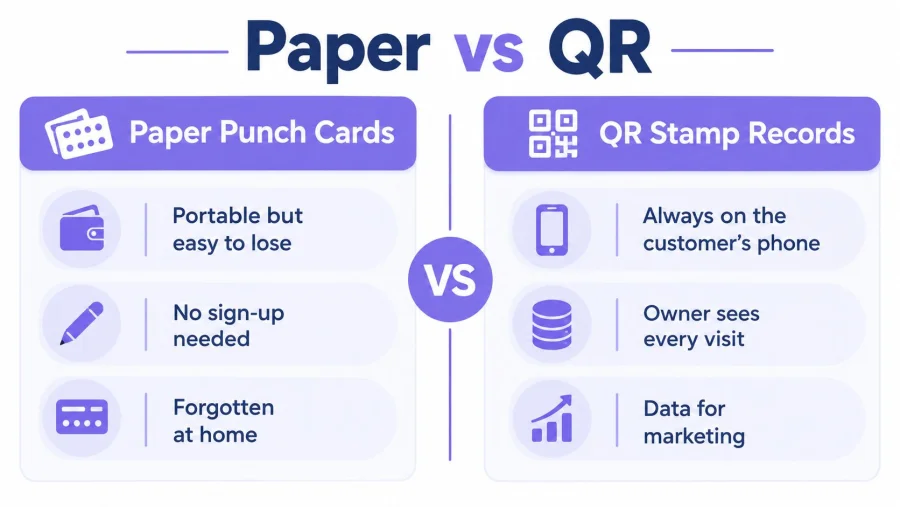
| What matters | Paper punch card | QR stamp record |
|---|---|---|
| Getting started | Hand it over without sign-up | Customer joins through a digital flow |
| Keeping the card | Easy to carry, easy to forget or lose | Can be kept on a phone or in a supported wallet |
| What the owner sees | A card and its visible punches | A record of stamps and customer activity |
| Follow-up | No direct way to contact the cardholder | Can support relevant messages when contact details and permissions allow |
What paper does well, and where it stops
Paper is a reasonable choice for testing whether customers like a reward. It's tangible, familiar and doesn't require staff to use a phone or scanner. But it offers no visit history, customer identity or record of spending. Owners have to infer whether the programme is working from the cards customers happen to bring back.
A QR record preserves the simple stamp-and-reward experience while making progress portable and trackable. Customers don't need to keep a physical card in good condition, and owners can review activity rather than count punches by hand. That doesn't automatically make the programme successful: a slow scan process, unclear offer or unnecessary sign-up steps can still put people off.
Paper is easy to hand out. QR is easier to learn from.
For customers who also compare prepaid offers in other everyday services, this guide to prepaid car wash ticket savings provides a useful example of how repeat-use value can be presented. For quick-service operators considering a digital customer experience, mobile web loyalty for quick-service restaurants describes a format built around mobile access.
Building Trust With Clear Terms and Fair Expiry
A customer walks in holding a half-filled punch card and asks whether it still counts. On paper, there is no clean answer unless you happen to remember your own policy. The expiry date was never printed, the terms were never written down, and the conversation now runs on goodwill rather than rules.
Moments like that are where trust gets won or lost. Customers already suspect loyalty schemes are tilted against them. Ipsos found that 54% of Britons believed supermarket loyalty cards benefited the supermarket more than the customer, while 64% believed supermarkets raised prices to make loyalty discounts look more attractive (Ipsos research on perceptions of supermarket loyalty cards). An independent café or salon cannot afford to feed that suspicion. Stating the deal plainly, on the card itself or on the sign-up screen, costs nothing.
Put the important rules where customers can see them
Before launch, get five things in writing:
- The qualifying action: which visit or purchase earns a stamp.
- The reward: what the customer receives and any limits on its use.
- Exclusions: product categories, services or appointment types that don't qualify.
- Expiry or inactivity terms: whether stamps or rewards lapse and what triggers it.
- Changes to the programme: how customers will hear about changes to earning or redemption.
UK legal guidance says schemes offering discounts or rewards should comply with the Consumer Rights Act 2015 and consumer-protection law. Their terms should be clear and non-misleading, and explain mechanics such as expiry dates, exclusions and changes to earning or redemption rates (UK guidance on compliant consumer loyalty programmes).
Make expiry understandable
Expiry terms differ from one scheme to the next, so customers shouldn't have to guess what happens to an unfinished card. State the rule at sign-up and repeat it where customers earn or redeem stamps. If inactivity wipes a balance, say what counts as inactivity.
Paper makes this harder than it should be. A wallet-sized card has no room for terms anyone will read, so the expiry ends up as a verbal promise or a faded date stamp. A QR stamp record can show the expiry date and the rule beside the customer's progress, on a screen they are already looking at.
The practical test: can a customer repeat your rule back after reading it once? "Earn one stamp per qualifying appointment, redeem the completed card before the date shown." If staff have to explain it twice, rewrite it.
What Digital Scanning Actually Gives the Owner Back
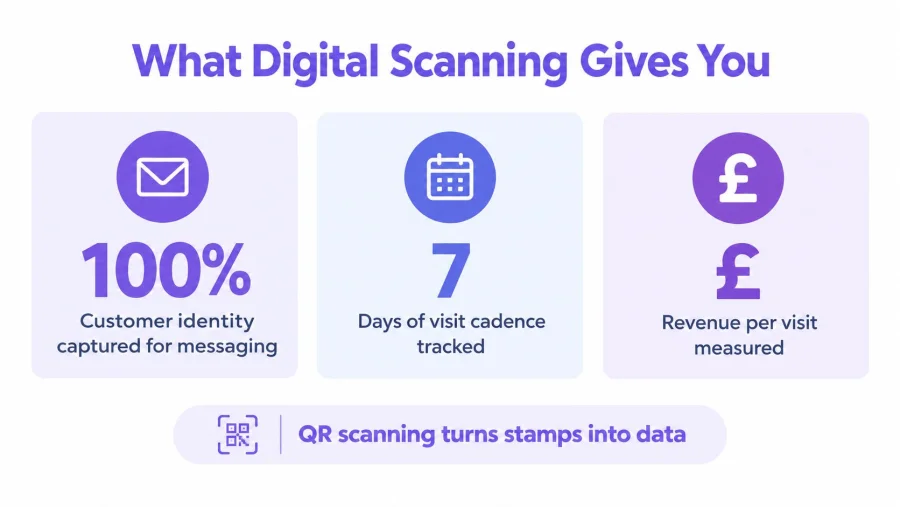
A paper card tells an owner almost nothing once it leaves the counter. A QR scan turns each stamp into a record tied to a customer profile, so the business can see progress, gaps and returns instead of counting torn cardboard at closing time.
Track the measures that change a decision
The useful questions are operational, not vanity metrics:
- How many stamps are issued? A low count may mean staff need a quicker way to offer the programme.
- How many customers complete a card? If few customers reach the reward, the threshold or earning rule may be too demanding.
- How long does redemption take? A long delay can signal that the reward is too far away or the programme doesn't match visit patterns.
- Do customers return after redemption? A return suggests the reward may be supporting a continuing relationship, not just bringing forward one purchase.
- What happens to spend on redemption visits? Comparing visits can help distinguish a useful reward from a discount that replaces a full-price sale.
That evidence gives the owner room to adjust one variable at a time: shorten a cycle, change the reward or make the scan easier for staff. Measurement still leaves judgement with the operator, but it beats guessing from a stack of partly filled cards.
Expiry needs the same attention after launch. Rules vary widely across loyalty schemes: some balances lapse after a fixed period, while others treat inactivity as the trigger. Watch unfinished cards and expired rewards in your own programme, then keep the policy visible where customers earn and redeem.
For shops that want a card available from a phone's wallet, Apple Wallet integration for retail stores is one way to make the digital pass easier to keep at hand.
Launching a Stamp Card With BonusQR in One Afternoon
A small operator doesn't need to redesign the till to start a digital stamp programme. The practical sequence is to choose the earning mechanic, write the reward and rules, set up the customer-facing card, then give staff a simple scanning routine.
With BonusQR, a business can set a stamp threshold and reward, then let customers sign up by mobile or web and receive a personal QR code. The customer's profile can track stamps, rewards and visit history. Staff scan and redeem within the app, so a separate POS integration or extra hardware isn't required.
A workable setup sequence
Start with one rule staff can explain in a sentence. Choose whether a qualifying action is a visit or purchase, decide the stamp threshold, name the reward and set any expiry or exclusions. Then check the process from the customer's side: can someone join without a long form, find their pass again and understand what happens when the card is complete?
Customers can keep their pass in Apple Wallet or Google Wallet. The same profile can also host useful business information, such as menus or price lists, news, reviews and reservations. That gives the customer a place to return to, rather than a stamp counter that exists only at checkout.
BonusQR offers a free start, an affordable white-label app under the business's own icon in about 14 days, or a fully custom app for operators who need advanced integrations. Built-in analytics can show customer and visit trends, while push and email campaigns can support timely offers and feedback requests. Those tools are most useful when they follow a clear programme rule, not when they add more messages and exceptions than the team can manage.
Before launch, train staff on the scan, stamp and redemption steps. A short prompt at the counter helps make the programme part of service without turning checkout into a sales pitch.
A Simple Launch Checklist and the First Metric to Watch
Keep the first version focused. A short checklist makes the programme easier to explain, operate and improve once customers start using it.
- Define the qualifying action. Decide exactly which visit or purchase earns a stamp.
- Choose the threshold. For frequent-visit businesses, start with a six-to-ten-stamp cycle and review whether customers complete it.
- Name the reward plainly. Say what the customer gets and list any relevant limits.
- State the expiry rule. Make validity and inactivity terms visible before sign-up.
- Prompt the scan. Give staff a short line to use at checkout and a clear scanning routine.
- Choose one measure first. Track completion rate before adding more dashboard measures.
Completion rate answers the central design question: are customers reaching the reward? If customers earn stamps but don't redeem, the reward or threshold may need attention. If scans are rarely recorded, the team may need a simpler checkout prompt or workflow.
Start with a clear rule, then use customer activity to improve it. Launch a free stamp programme on BonusQR and give customers an easy reason to return, while giving the business a record it can learn from.


