
 Deutsch
 Español
 Français
 Italiano
 Magyar
 Polski
 Slovenčina
 Čeština
For most Central European SMEs, a configurable SaaS digital loyalty-card platform — one that supports stamp cards, points, cashback, and mobile Wallet integration — is the right choice. Bonusqr is built precisely for this: quick to launch, no POS required, and flexible enough to grow with your business.
- Technical check first: Confirm whether you need a no-POS (QR-based) setup or a POS/API integration. Most SMEs can go live with QR alone.
- Run a 30–90 day pilot: Enrol 10–20% of your regular customers, set a single reward trigger, and measure enrolment rate and redemption before scaling.
Key takeaways
Digital loyalty cards are the most cost-effective retention tool available to Central European SMEs — provided you launch with a measurement plan and a staged pilot.
| Point | Details |
|---|---|
| Start with a pilot | Enrol 10–20% of customers first; validate enrolment rate and redemption before scaling. |
| Capture identity at every visit | Collect email or phone at sign-up — this first-party data is the programme’s core asset. |
| Match mechanic to goal | Stamp cards for frequency, points for basket size, tiers for high-value customer retention. |
| Measure four KPIs | Track enrolment rate, monthly active rate, redemption rate, and basket uplift at 30/60/90 days. |
| Bonusqr for quick launch | Bonusqr supports no-POS QR launch, Wallet integration, and analytics from a single platform. |
Why do digital loyalty cards matter for Central European SMEs?
Without identified customers, every visit must be reacquired. You pay for ads, run blanket discounts, and hope the same people return. That is the structural cost of anonymous footfall, and it compounds quietly until acquisition costs become unmanageable.
Industry analysis from The Diplomat Bucharest found that retailers across Central and Eastern Europe may be wasting a large proportion of promotional budgets on offers that reach customers who would have purchased anyway. A data-driven loyalty programme recovers much of that spend by targeting incentives only where they change behaviour.
Retention economics matter here. Bain & Company’s well-cited framing holds that even modest improvements in customer retention can produce significant profit uplifts, because a retained customer costs far less to serve than a new one acquired through paid media.
The case study evidence is consistent: well-constructed loyalty programmes increase visit frequency, raise basket value, and compound customer lifetime value (CLV) over time. Programmes like IKEA Family have demonstrated significant increases in purchase likelihood among top members, while campaigns using segmentation have produced noticeable turnover uplifts.
For Central European SMEs specifically, two pressures make this urgent. Customer acquisition costs are rising across the region, and the loss of third-party cookies has eroded the cheap retargeting that many small businesses relied on. A loyalty programme converts paid-media spend into owned reach — you stop renting your audience and start building one.
- First-party data (email, phone, purchase history) is the asset loyalty creates.
- Identified customers can be segmented, messaged, and retained at a fraction of acquisition cost.
- Blanket discounts erode margin; targeted rewards protect it.
Pro Tip: Before you launch, classify your current promotions. If most offers go to customers who would have bought regardless, you are a “blind discounter” — the first thing a loyalty programme fixes.
Which loyalty mechanics work for which business goals?
Picking the wrong mechanic is one of the most common early mistakes. Each model moves a different behaviour, and mixing them without a clear goal creates confusion for customers and staff alike.
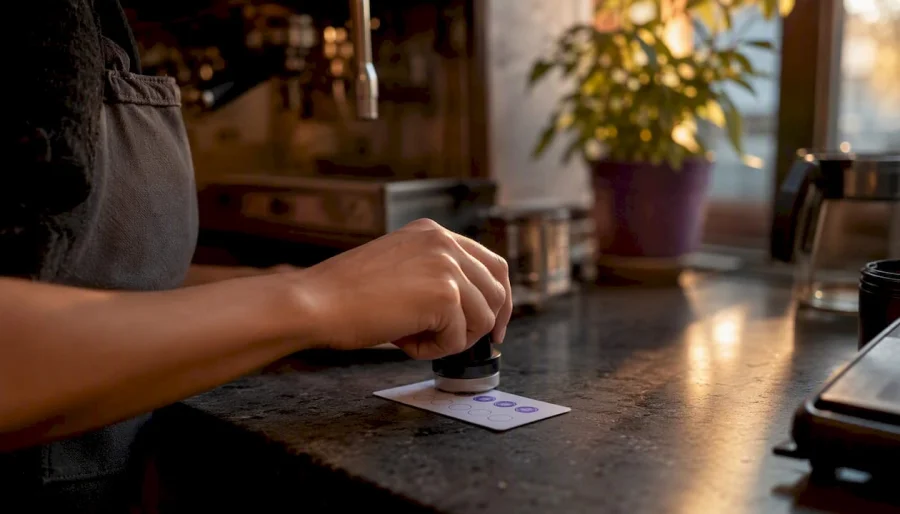
Stamp cards drive repeat visits for low-value, high-frequency purchases. A café or bakery is the natural fit: buy nine coffees, get the tenth free. Simple, visible, and easy to explain at the till.
Points programmes suit businesses with variable basket sizes — a retailer or pharmacy where spend differs each visit. Points accumulate proportionally, which rewards higher spenders without alienating occasional ones.
Cashback works well where price sensitivity is high and the customer needs a tangible, immediate-feeling reward. It is transparent and easy to communicate, though it can feel closer to a discount than a loyalty benefit if not framed carefully.
Tiers create aspiration and reduce churn among high-value members.
Coupons and vouchers are tactical. Use them to reactivate lapsed customers, fill quiet periods, or reward a specific action (a first online order, a referral). They work best as a complement to a core mechanic, not as the programme itself.
Referrals are underused by SMEs. A simple “give a friend a reward, get one yourself” trigger can acquire new identified customers at near-zero cost. Pair it with an onboarding stamp or points bonus to lock in the new member’s first repeat visit.
| Business goal | Recommended mechanic | Typical SME use case |
|---|---|---|
| Increase visit frequency | Stamp card | Café, bakery, hair salon |
| Raise average basket size | Points on spend | Retailer, pharmacy, deli |
| Protect margin, reward loyalty | Tiered cashback | Gym, hotel, service business |
| Reactivate lapsed customers | Coupon / voucher | Any sector, quiet periods |
| Acquire new identified customers | Referral + onboarding bonus | Any sector, early growth stage |
Explore reward types for retailers and loyalty card templates for ready-made structures you can adapt.
Pro Tip: Combine an onboarding bonus (double stamps or a welcome voucher) with a low ongoing micro-reward. The bonus prevents the early drop-off that kills most new programmes before they generate useful data.
Are you ready to invest, and what will it cost?
Readiness signals that say yes:
- You serve more than 200 transactions per month and cannot identify most of those customers.
- Your cost to acquire a new customer is rising, or you are spending on ads to reach people who have already bought from you.
- You have no email or phone list built from actual purchases.
- You have at least one staff member who can handle enrolment conversations and a basic comms plan.
Typical cost components for a SaaS digital loyalty platform:
- Monthly subscription: free tiers exist for early pilots; paid tiers typically unlock automation, analytics, and higher member limits.
- One-off setup: white-label app branding or custom app development carries a one-time fee; QR-based no-POS setups are usually included in the subscription.
- Optional integration costs: POS or e-commerce API connections may require developer time or a one-off configuration fee.
- Voucher fulfilment: some platforms charge per redemption or per notification sent at scale.
A simple ROI threshold: if your programme retains even a small percentage of customers who would otherwise have lapsed, and each retained customer makes two or three additional visits per year, the incremental margin typically covers a mid-tier subscription within the first quarter. Run the numbers against your own average basket and gross margin before committing.
Red flags when evaluating vendors:
- No data export or API access — you cannot own your customer list.
- Opaque SLAs with no uptime or support commitments.
- No GDPR-compliant consent flow built in.
- Vendor lock-in: rewards or member data that cannot be migrated if you switch.
Pro Tip: Ask every vendor: “Can I export my full member list and transaction history as a CSV at any time?” A vendor who hesitates is telling you something important.
What are your technical options for implementation?
Start with the least disruptive path that still captures a first-party customer ID. For most SMEs, that means a no-POS QR setup on day one.
- No-POS (QR + mobile web/Wallet): Customer scans a QR code at the counter, joins via a web form or Wallet pass, and stamps or points are added manually or via a simple staff interface. Live in days, no IT project required.
- Partial POS via SDK/API: Loyalty events (a purchase, a redemption) are triggered automatically from the POS. More accurate, but requires a brief integration project.
- Full POS integration: Every transaction is captured and attributed. Best data fidelity, highest setup effort. Worth it at scale.
- White-label app: Your brand, your app, on the App Store and Google Play. Higher upfront cost, strongest brand experience, and the richest push-notification channel.
A centralised loyalty platform can consolidate in-store and e-commerce transactions, issue digital cards into Apple and Google Wallet, and support segmentation and voucher issuance — the CBA CZ Cooperative case study (13,000+ members) demonstrates this pattern at regional scale.
Pro Tip: For GDPR, collect only what you need at enrolment (name, email or phone, consent tick). Store it on a platform with a documented data-retention policy. A simple opt-in at the point of stamp is legally sufficient and keeps the sign-up friction low.
Which KPIs should you track, and what do good results look like?
Measure four things: identification, engagement, conversion, and value. They map to short, medium, and long-term business outcomes respectively.
Geo-based tests work well for multi-location businesses.
At 30 days, check enrolment rate and whether staff are comfortable with the workflow. At 60 days, look at redemption rate and early repeat-visit signals. At 90 days, compare basket uplift and incremental transactions against your cost. If the numbers justify it, scale.
Pro Tip: Track café repeat-visit patterns as a benchmark even if you are not a café — the visit-frequency dynamics translate well to any high-frequency SME.
How do you run a practical 90-day launch?
A staged pilot reduces risk.
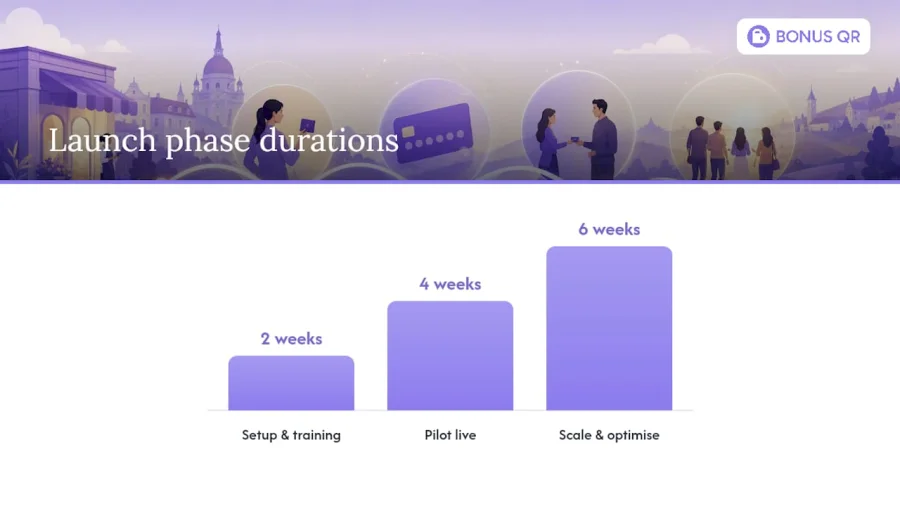
- Weeks 1–2 (Setup and training): Configure your programme mechanic (stamp card or points), set the reward trigger, brief staff on the enrolment script, and prepare in-store signage and a short welcome message.
- Weeks 3–6 (Pilot live): Enrol your pilot cohort, capture enrolment rate daily, and check for redemption friction. Watch for drop-off after the first stamp — that signals the reward is too distant.
- Weeks 7–12 (Scale and optimise): If pilot KPIs are on target, open enrolment to all customers. Run your first A/B test: try two onboarding messages (a simple welcome vs. a welcome with a bonus offer) and compare 30-day retention.
Tests worth running in the first 90 days:
- Reward size: does a larger reward increase enrolment but reduce margin? Find the minimum effective reward.
- Redemption window: shorter windows (30 days to use a voucher) drive urgency; longer windows reduce lapse.
- Segmentation: do members who receive a personalised message after their third visit return faster than those who receive nothing?
Operational reminders:
- Write a two-sentence staff script for enrolment conversations.
- Place QR codes at eye level at the counter and on receipts.
- Send a welcome message within 24 hours of enrolment.
- Set a customer support contact (email or WhatsApp) for members who have questions about their rewards.
Pro Tip: The pilot → scale → optimise sequence is the pattern that practitioners consistently recommend. Do not skip the pilot phase to save time — the data it generates is what makes the scale phase work.
What most loyalty card advice gets wrong for SMEs
The standard advice is to “pick the right mechanic and launch.” That framing misses the real problem.
Most SMEs do not fail at loyalty because they chose points over stamps. They fail because they launch without a measurement plan, give up when enrolment is slow in week two, and never find out whether the programme was actually working. The mechanic is almost secondary.
The more useful question is: what is the minimum viable programme that captures a customer identity and creates one reason to return? For most Central European SMEs, that is a digital stamp card with a welcome bonus and a 30-day pilot. Not a tiered points engine with a white-label app. Start there, measure it, and let the data tell you what to build next.
There is also a persistent myth that loyalty programmes are for large retailers. The CBA CZ Cooperative case study shows a regional cooperative running a centralised loyalty system at scale. The mechanics are the same at 200 transactions a month as they are at 200,000 — the difference is only the tooling, and SaaS platforms have closed that gap entirely.
How Bonusqr delivers what Central European SMEs actually need
Bonusqr gives you a configurable digital loyalty platform — stamp cards, points, cashback, coupons, Wallet integration, push notifications, and analytics — without requiring a POS integration to get started. That combination is what makes it the practical choice for SMEs in Central Europe that need to move quickly and prove ROI before committing to a larger build.
Feature highlights mapped to the buying criteria above:
- No-POS launch: QR-based enrolment, live in days, no IT project.
- Wallet support: Apple and Google Wallet card issuance included.
- Automation: Push and email notifications, segmented campaigns, and onboarding flows.
- Analytics: Real-time member, redemption, and basket data.
- Scalability: White-label and custom app options for businesses ready to invest in a branded experience.
A café using Bonusqr’s stamp card programme can expect enrolment to begin on day one and early redemption signals within the first 30 days. A retailer using the electronic reward platform can layer points on spend, add a referral module, and run segmented voucher campaigns — all from one dashboard.
To get started, visit Bonusqr, request a demo, and ask specifically about pilot scope, data export options, and SLA commitments. Those three questions will tell you everything you need to know about whether a vendor is the right long-term partner.