Discounts are a proven retention tool, but their effectiveness depends entirely on how, when, and to whom you deploy them. The role of discounts in retention is to reduce the perceived cost of staying loyal, giving price-sensitive customers a concrete reason to choose you over a competitor. Research from CouponFollow shows that 73% of shoppers say consistent discounts drive brand loyalty more than brand affinity itself. That figure rises to 79% among Gen Z shoppers. For business owners and marketers, this is not a signal to discount everything. It is a signal to discount strategically, and to understand exactly what you are buying with every percentage point you give away.
How do discounts impact customer loyalty and retention?
The discounts impact on loyalty is measurable, significant, and cuts in multiple directions. Discounts do not just reward existing customers. They actively reshape buying behaviour, brand perception, and long-term retention rates.
Consider these findings from recent market research:
- 61% of shoppers have permanently switched brands after discovering a competitor through a discount offer.
- 44% abandoned a brand entirely after its discounts disappeared, suggesting loyalty built on price alone is fragile.
- Among Gen Z, the response to discounts is even stronger, with 79% citing them as a primary loyalty driver over brand identity or product quality.
- According to Bizrate Insights, 60% of shoppers name price as their primary retention factor, ahead of free shipping at 34% and loyalty rewards at 32%.
These numbers reveal a clear pattern: discounts attract and retain price-sensitive customers at scale. However, the same data carries a warning. Only 5% of shoppers remain loyal at full price if a competitor offers a 20% discount, and 37% switch immediately. This means discounts can retain customers, but they can also make your customer base more vulnerable to competitive pricing moves.
The generational dimension matters for your marketing mix. Gen Z responds to discounts more strongly than older cohorts, making promotional offers a particularly effective acquisition and retention tool for brands targeting younger demographics. If your audience skews towards millennials or Gen X, the importance of discounts in retention remains high, but non-monetary perks and loyalty programmes carry more relative weight.

The practical implication is this: discounts work as a retention mechanism, but they work best when they are part of a broader strategy rather than a standalone tactic. A customer retained purely by price is a customer you will lose the moment a cheaper option appears.
What are the risks of relying too heavily on discounts?
Discounts carry real financial and strategic risks when used without discipline. The most documented danger is what practitioners call the “discount death spiral.” This occurs when frequent promotions train customers to wait for sales rather than buying at full price. Once that behaviour is established, it is very difficult to reverse.
“Frequent discounting fails to address underlying value gaps and leads to adverse customer base selection, where the most price-sensitive shoppers dominate your retention metrics while premium buyers quietly leave.” — Plan Left, Customer retention marketing that works
The financial mechanics are equally concerning. Cannibalisation rates for broad coupon campaigns run between 20% and 60%, meaning a significant portion of discounted sales would have happened anyway at full price. You are not generating incremental revenue. You are subsidising purchases that were already going to occur.
The risks compound in several specific ways:
- Margin erosion. A 20% discount on a product with a 40% gross margin cuts your profit per unit by half. Repeated across a customer base, this is a structural threat to profitability.
- Brand perception damage. Customers who see frequent discounts begin to question the true value of your product. Premium positioning is difficult to maintain alongside constant promotional pricing.
- Adverse selection. Heavy discounting attracts and retains the most price-sensitive segment of the market. These customers have the lowest lifetime value and the highest churn risk when discounts stop.
- Dependency cycles. Once customers expect discounts, removing them triggers immediate churn. You have not built loyalty. You have built a conditional relationship based on price.
The brands most damaged by discount dependency are those that started using promotions reactively, without a clear exit strategy or measurement framework. Fast-growing e-commerce businesses are particularly vulnerable because early-stage acquisition discounts can become embedded in customer expectations before the business has the margin to sustain them.
The solution is not to avoid discounts entirely. It is to treat every discount as a deliberate investment with a measurable return, rather than a default response to competitive pressure or slow sales.
How can you use discounts strategically to protect margins?
Strategic discounting for retention requires three things: the right customer, the right offer, and the right moment. Get all three right, and discounts become one of your most cost-effective retention tools. Miss any one of them, and you are giving money away.
Here is a practical framework for deploying discounts without damaging profitability:
-
Segment before you discount. Use RFM routing, which segments customers by recency, frequency, and monetary value, to identify who actually needs a discount to stay. Best customers should rarely receive discounts; targeting them with promotions simply reduces the revenue they would have generated anyway. Focus retention offers on at-risk segments: customers who have not purchased recently, or those showing signs of disengagement.
-
Apply the right discount depth. The discount depth sweet spot for retention is 20% to 30% for a period of one to three months. Below 20%, the offer is rarely compelling enough to change behaviour. Above 30%, you risk signalling desperation, which undermines brand confidence and attracts the wrong type of customer.
-
Time discounts to high-risk moments. Cancellation flows are the single most effective placement for retention discounts. When a customer signals intent to leave, a targeted, time-limited offer addresses the immediate objection without broadcasting the discount to your entire base. Win-back email campaigns using time-limited offers re-activate 8% to 12% of churned customers, making them a high-return tactic when executed correctly.
-
Measure incrementality, not just redemption. Redemption rates tell you how many people used a discount. They do not tell you how many of those people would have stayed anyway. A holdout test, which compares a treated group receiving the discount against an untreated control group, isolates the true incremental impact of your offer. Without this, you cannot know whether your discount campaign is generating retention or simply subsidising it.
-
Create urgency and limit redemptions. Open-ended discounts with no expiry date remove the behavioural trigger that makes promotions effective. Set clear deadlines and cap the number of redemptions. This preserves the sense of scarcity that drives action.
Pro Tip: When running a cancellation flow, only present a discount if the customer’s stated reason for leaving is price-related. Offering a discount to someone leaving due to poor service or product fit is both wasteful and tone-deaf. Personalise the intervention to the actual objection.
The table below summarises the key parameters for strategic discount deployment:
| Parameter | Recommended range | Rationale |
|---|---|---|
| Discount depth | 20% to 30% | Effective without signalling desperation |
| Offer duration | 1 to 3 months | Creates urgency while allowing behaviour change |
| Target segment | At-risk and price-sensitive customers | Avoids margin leakage on loyal buyers |
| Measurement method | Holdout test | Isolates true incremental retention value |
| Placement | Cancellation flows and win-back campaigns | Targets highest-risk moments |
What alternatives and complements can strengthen retention beyond discounts?
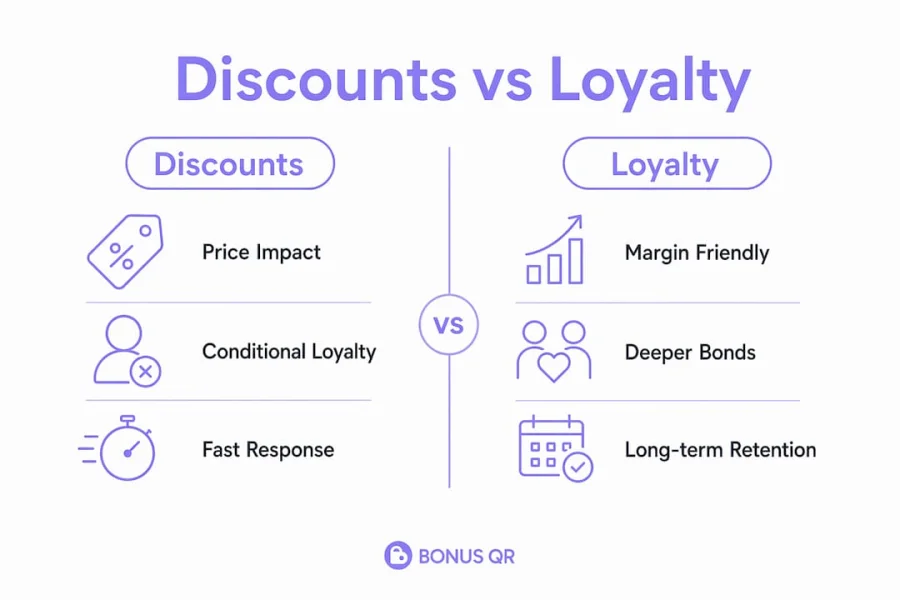
Discounts are one tool in a broader retention toolkit, and they are not always the most effective one. Loyalty programmes have moved from optional perks to essential strategic components of customer retention, particularly as consumers become more sophisticated about promotional pricing.
Non-price incentives offer a distinct advantage: they build retention without eroding margin. Loyalty points, free shipping thresholds, exclusive access, and personalised rewards all create switching costs that price alone cannot replicate. A customer who has accumulated 500 points in your loyalty programme has a concrete financial reason to stay that has nothing to do with your competitors’ pricing.
The comparison between discounts and loyalty-based retention tools is instructive:
| Retention tool | Margin impact | Loyalty depth | Best use case |
|---|---|---|---|
| Percentage discount | High erosion | Low to medium | Price-sensitive or at-risk customers |
| Loyalty points | Low erosion | High | Frequent buyers and long-term retention |
| Free shipping | Medium erosion | Medium | Basket size growth and repeat purchase |
| VIP access or experiences | Very low erosion | Very high | Premium customers and brand advocates |
| Personalised rewards | Variable | High | Segmented retention campaigns |
The most effective retention strategies combine discounts with loyalty mechanics rather than treating them as alternatives. For example, you might offer a 20% discount to re-engage a lapsed customer, then enrol them in a points programme that rewards ongoing purchases without requiring further price reductions. The discount gets them back. The loyalty programme keeps them.
Exploring the difference between discounts and rewards is worth your time if you are deciding how to allocate your retention budget. Rewards tend to build deeper emotional connection with a brand, while discounts address immediate price objections. Used together, they cover both the rational and emotional dimensions of customer loyalty.
Experiential perks deserve particular attention for businesses targeting higher-value customers. Early access to new products, members-only events, and personalised service upgrades create loyalty that competitors cannot simply undercut with a lower price. These perks also reinforce brand premium rather than eroding it, which is the opposite effect of heavy discounting.
The benefits of loyalty programmes for small businesses extend well beyond retention. They generate first-party data on customer behaviour, enable personalised marketing, and create measurable engagement metrics that discounts alone cannot provide.
Key takeaways
Strategic discounting retains customers when targeted at price-sensitive or at-risk segments, applied at the right depth, and measured against true incremental outcomes rather than redemption volume alone.
| Point | Details |
|---|---|
| Discounts drive loyalty at scale | 73% of shoppers cite consistent discounts as a stronger loyalty driver than brand affinity. |
| Discount depth matters | Offers between 20% and 30% for one to three months retain customers without signalling desperation. |
| Segment before discounting | Use RFM routing to protect margins by excluding loyal, high-value customers from promotional offers. |
| Measure incrementality | Holdout tests reveal whether discounts are generating retention or subsidising purchases that would have happened anyway. |
| Combine discounts with loyalty | Pairing a re-engagement discount with a points programme addresses both immediate price objections and long-term retention. |
Why measured discounting beats blanket promotions every time
I have worked with enough businesses to know that the instinct to discount is almost always reactive. Sales slow down, a competitor drops their prices, or a customer complains, and the immediate response is to reach for a promotional offer. It feels decisive. It produces visible short-term results. And it quietly costs far more than most business owners realise.
The businesses I have seen retain customers most effectively are not the ones with the deepest discounts. They are the ones that treat every promotional offer as a deliberate decision with a clear objective, a defined audience, and a measurement plan. They know exactly which customers need a price incentive to stay, and they reserve discounts for those customers specifically. Everyone else gets value delivered through service, experience, or loyalty rewards.
The data supports this approach. Discounting is a reflex that quietly erodes net margin by subsidising sales that would have occurred anyway. Incrementality testing is the discipline that separates businesses that use discounts profitably from those that simply give money away.
My honest view is that most businesses are over-discounting their best customers and under-investing in the loyalty mechanics that would make those customers genuinely resistant to competitive offers. If you are running blanket promotions to your entire database, you are almost certainly subsidising purchases from people who would have bought at full price. That is not retention. That is margin leakage dressed up as a marketing campaign.
The customer retention benefits that compound over time come from building genuine switching costs, not from training customers to expect a lower price. Start with segmentation, measure everything, and treat discounts as a precision tool rather than a default setting.
— Michal
How Bonusqr helps you turn discounts into lasting loyalty
Bonusqr gives you the tools to deploy discounts as part of a structured loyalty strategy rather than a standalone tactic. The platform lets you issue targeted discount coupons alongside points, cashback, and stamp card rewards, so you can re-engage at-risk customers with a price incentive and then retain them through ongoing loyalty mechanics. Real-time analytics show you exactly which offers are driving repeat visits and which are simply being redeemed without changing behaviour. You can set redemption limits, automate time-sensitive campaigns, and track results without needing POS integration. Explore the full range of loyalty and discount features on Bonusqr to see how a structured programme can protect your margins while building the kind of loyalty that holds up under competitive pressure.
FAQ
What is the role of discounts in customer retention?
Discounts reduce the perceived cost of staying with a brand, giving price-sensitive customers a direct financial reason to continue purchasing. Their effectiveness depends on targeting, timing, and discount depth rather than volume or frequency.
How deep should a retention discount be?
The optimal range is 20% to 30% for a period of one to three months. Below 20%, offers rarely change customer behaviour. Above 30%, you risk undermining brand confidence and attracting customers with very low lifetime value.
Do discounts build genuine loyalty?
Discounts build conditional loyalty that is tied to price rather than brand preference. Research shows 44% of customers abandon a brand when its discounts disappear, which means discounts alone do not create durable retention without complementary loyalty mechanics.
What is RFM routing and why does it matter for discounting?
RFM routing segments customers by recency, frequency, and monetary value to identify who genuinely needs a discount to stay. It prevents margin leakage by ensuring your best customers, who would buy anyway, are excluded from promotional offers.
How do loyalty programmes compare to discounts for retention?
Loyalty programmes build deeper switching costs and carry lower margin impact than direct discounts. Deloitte research confirms that loyalty programmes are now essential strategic levers for retention, particularly when combined with targeted promotional offers for at-risk segments.


