
 Deutsch
 Español
 Français
 Italiano
 Magyar
 Polski
 Slovenčina
 Čeština
You can design and launch a loyalty card programme in six practical steps that drive repeat visits and measurable ROI. The sequence is: plan → design → produce or set up → launch → measure → iterate. Start today by picking one KPI and identifying a pilot location or customer segment.
Here is your quick-reference checklist:
- Plan: Set a SMART goal (e.g. increase repeat visits by a measurable amount within a few months), choose your reward mechanic, and define your budget.
- Design: Create the card layout or digital flow, decide what data to collect, and choose your ID mechanism (QR code, NFC, or barcode).
- Produce or set up: Print physical cards or configure your digital platform, test the sign-up flow, and approve proofs.
- Launch: Train staff, put up in-store signage, send a pre-launch email, and offer a first-week incentive.
- Measure: Track sign-ups, activation rate, redemption rate, and average order value (AOV) uplift over a 30-day pilot.
- Iterate: Adjust reward thresholds, change mechanics that under-perform, and scale what works.
Research suggests loyal customers spend up to 67% more than new ones. That single figure makes the case for starting now rather than waiting for the perfect programme. Run a 30-day pilot with one simple mechanic, measure the results, and build from there.
Key takeaways
Starting a loyalty card programme works when you keep the first mechanic simple, set measurable KPIs before launch, and build GDPR compliance into the sign-up flow from day one.
| Point | Details |
|---|---|
| Start with one simple mechanic | A stamp card or basic points system is easier to launch, explain, and measure than a multi-tier programme. |
| First reward within one month | Calibrate your reward threshold so new members can redeem within roughly 30 days to drive activation. |
| GDPR compliance before launch | Article 13 disclosures, separate marketing opt-ins, and consent records must be in place before the first sign-up. |
| Track three pilot KPIs | Sign-up rate, activation rate, and AOV uplift give you a clear signal within 30 days without creating measurement noise. |
| Bonusqr for fast digital launch | Bonusqr supports stamp cards, points, push notifications, and analytics with no POS integration required. |
What is a loyalty card programme, and why does it work for small businesses?
A loyalty card programme is a structured system that rewards customers for repeat purchases or other defined actions, using a physical card, a digital card, or a combination of both to track and redeem those rewards. For small and medium-sized businesses (SMEs), the practical value is straightforward: it gives you a reason to collect customer data, a mechanism to increase visit frequency, and a tool to raise average order value without discounting indiscriminately.
Loyal customers are not just more frequent buyers — they spend more per visit, refer others, and cost far less to retain than new customers cost to acquire. Programmes that increase purchase frequency by even a modest margin can have a compounding effect on annual revenue, because each additional visit also tends to carry a higher basket value.
The measurable benefits for SMEs break down like this:
- Repeat purchase frequency: Customers with an active reward balance return more often to reach the next threshold.
- Higher AOV: Members tend to add items to qualify for a reward, lifting basket size.
- Richer customer data: Sign-up captures names, emails, and purchase history you can use for targeted campaigns.
- Lower acquisition cost: Retaining an existing customer costs significantly less than acquiring a new one, and loyalty programmes reduce that acquisition cost by keeping customers in your ecosystem.
- Referrals: A well-designed programme with a referral mechanic turns satisfied members into a low-cost acquisition channel.
The KPIs that map directly to these benefits are: purchase frequency (visits per month), redemption rate (percentage of earned rewards actually claimed), AOV uplift (average spend of members vs. non-members), and customer lifetime value (CLV). Choose two or three of these for your pilot; tracking all five from day one creates unnecessary complexity.
Which loyalty card format suits your business?
The format you choose shapes everything from your setup cost to your customers’ daily experience. There are four main options, and the right one depends on your budget, your customers’ habits, and how much technical complexity you are prepared to manage.
Physical plastic cards remain durable and familiar. Many customers still prefer a card in their wallet, and plastic cards work without any app download. The trade-off is manual tracking unless you pair the card with a barcode or QR code that links to a digital back-end. Many SMEs combine plastic cards with QR or NFC features to enable hybrid tracking and contactless redemption, which gives you the tactile appeal of a physical card with the data capture of a digital system.

QR-code or NFC mobile cards live on a customer’s phone, either in a branded app, a mobile wallet (Apple Wallet or Google Wallet), or as a saved link. Setup is faster and cheaper than printing, and you get real-time data from day one. The friction point is that customers need to present their phone at the point of sale, which requires a brief habit change.
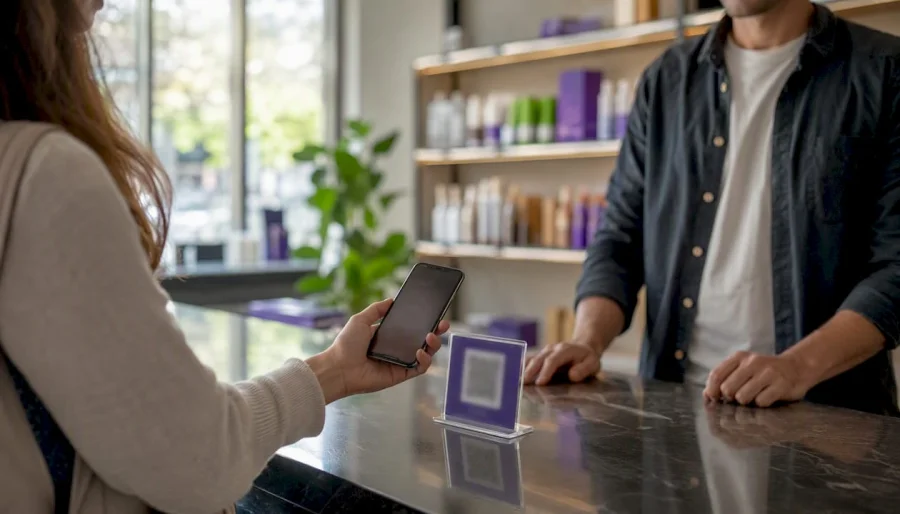
App-only programmes offer the richest feature set: push notifications, personalised offers, and detailed analytics. They suit businesses with a loyal, tech-comfortable customer base and a budget for ongoing app maintenance or a SaaS subscription.
Hybrid combinations pair a physical card for in-store use with a digital profile for online tracking and communication. This is increasingly the default for retailers and hospitality businesses that serve both walk-in and online customers.
On the mechanics side, the main options are:
- Stamp cards: Collect a set number of stamps (visits or purchases) to earn a reward. Simple, transparent, and ideal for cafés, bakeries, and any business with a high visit frequency.
- Points per spend: Customers earn points proportional to their spend, redeemable against future purchases. Works well for boutiques, salons, and service businesses with variable basket sizes.
- Tier systems: Customers move through Bronze, Silver, and Gold tiers as they accumulate points or spend. Effective for businesses where status and exclusivity matter to the customer.
- Cashback or fixed discounts: A percentage of spend is returned as credit. Transparent and easy to explain, though it can erode margin if not calibrated carefully.
- Non-purchase actions: Reward referrals, reviews, account creation, or social follows. These extend the programme beyond transactions and are worth adding once your core mechanic is running.
Pro Tip: Start with a single mechanic for your pilot. A stamp card or a simple points-per-spend system is easier to explain at the counter, easier to measure, and easier to adjust than a multi-tier programme built before you know what your customers actually respond to.
Step 1: How do you plan a loyalty programme that actually works?
Planning is where most small businesses either set themselves up for success or create a programme that quietly fades out within six months. The difference usually comes down to specificity: vague goals produce vague results.
Set SMART goals linked to concrete KPIs
Write your goal as a specific, measurable target before you design anything. Examples you can adapt:
- Increase the average number of monthly visits per active member from 1.8 to 2.4 within 90 days of launch.
- Raise the average order value of loyalty members by 15% compared to non-members within the first quarter.
- Achieve a reasonable redemption rate on issued rewards within the first couple of months.
- Reduce customer churn (customers who have not visited in 60 days) by 10% within six months.
- Generate new customer sign-ups through referral mechanics within a few months of adding the referral module.
Pick two or three of these for your pilot. Tracking all five from the start creates noise; you want a clear signal.
Budget line items to include
A realistic budget covers more than card printing. Plan for:
- Card production or platform fees: Physical cards range from a few cents to over €1 per card depending on material and print run. SaaS platforms typically charge a monthly subscription.
- Reward costs: Calculate the cost of your reward at your expected redemption rate. A free coffee after ten purchases costs you one coffee per ten transactions, but that figure needs to sit inside your margin.
- Promotional costs: In-store signage, email campaigns, social posts, and any launch incentive (e.g. double points in week one).
- Staff training: Even a half-hour briefing has a time cost. Budget for it.
- Integration or setup fees: Some platforms charge one-time onboarding or customisation fees on top of the monthly subscription.
- Contingency (10–15%): Unexpected costs appear in almost every launch, from reprinting cards with a corrected barcode to a push notification that needs resending.
Which KPIs to choose for a pilot
For a 30-day pilot, focus on: sign-up rate (new members enrolled per week), activation rate (percentage of enrolled members who redeem at least once), and AOV uplift (members vs. non-members). These three tell you whether the programme is attracting customers, engaging them, and affecting spend. Add redemption rate and retention cohort data in month two once you have a baseline.
Step 2: How should you design the card and the programme system?
Design decisions made at this stage affect both customer adoption and your legal compliance obligations. Get them right before you print anything or go live.
Card design checklist
| Design element | What to decide | Practical note |
|---|---|---|
| Branding | Logo, brand colours, font | Consistent with your other materials |
| Call to action | “Collect 10 stamps, get 1 free” | One clear reward statement on the front |
| ID mechanism | Barcode, QR code, or NFC chip | QR is cheapest; NFC suits contactless-first businesses |
| Expiry information | Date or “valid while programme runs” | Required for consumer clarity |
| Data fields | Member ID, issue date | Minimal printed data; rest lives in the system |
| Material | PVC plastic, eco card, or digital | See trade-offs below |
Material trade-offs
Plastic PVC cards are durable, cost-effective for print runs above 500 units, and familiar to customers. Eco-card alternatives (recycled PVC or paper-based cards) cost slightly more per unit but align with sustainability messaging, which matters to a growing segment of Central European consumers. Metal cards carry a premium feel and suit high-tier membership tiers in luxury retail or hospitality. Purely digital cards eliminate production cost entirely and are the fastest to update, but they require customers to have a smartphone and a willingness to use it at the point of sale.
For most SMEs starting out, a QR-enabled plastic card or a digital-only card via a mobile wallet is the most practical starting point. You can always add a premium physical tier later.
Data minimisation at sign-up
Collect only what you need at enrolment: name, email address, and a phone number if you plan to use SMS. Date of birth is useful for birthday rewards but should be optional. Purchase history is captured automatically once the card is active. Collecting excessive data at sign-up increases your GDPR obligations and reduces sign-up completion rates — both outcomes you want to avoid.
Pro Tip: Make the first reward achievable within roughly one month of joining. A customer who earns their first reward quickly is far more likely to make a second purchase and become a habitual member. If your first reward requires six months of purchases, most new members will disengage before they ever redeem.
Step 3: Production and technical setup for your programme
Physical card production checklist
- Choose a reputable card printer and request a digital proof before approving the full run.
- Order a small prototype batch (50–100 cards) to check colour accuracy, barcode readability, and card feel before committing to a full production run.
- Confirm barcode or QR code specifications with your tracking system before printing.
- Allow 5–10 business days for standard production and delivery; rush orders typically cost 20–30% more.
- Store cards securely and track inventory to avoid running out during a promotional period.
Digital platform setup checklist
- Select a platform that matches your technical capacity: no-code SaaS options require no developer involvement and can be live within a day or two.
- Confirm whether the platform requires POS integration or works independently via QR scan or app check-in.
- Test the full sign-up flow on both iOS and Android before launch.
- Set up your reward rules, earning actions, and notification triggers in the platform dashboard.
- Configure your GDPR consent fields and privacy policy link within the sign-up form before going live.
Typical cost ranges
Physical card programmes carry upfront production costs plus any manual tracking overhead. Digital SaaS programmes shift cost to a monthly subscription but eliminate print runs and reduce admin. A realistic cost picture for a small business:
- Entry-level digital setup: Free or low-cost SaaS tier, minimal design cost, no print spend. Suitable for a pilot with under 200 members.
- Mid-range hybrid programme: A paid SaaS subscription covering analytics and push notifications, plus a short print run of branded cards. Suitable for an established SME with an existing customer base.
- Full custom or white-label app: A one-time development fee plus ongoing subscription. Suited to businesses that need deep brand integration or multi-location management.
Watch for hidden fees: per-message charges on push notifications or SMS, third-party integration costs if you need to connect to a specific POS system, and onboarding or customisation charges that are not included in the headline subscription price.
Step 4: How do you launch and promote your loyalty programme effectively?
A well-designed programme that nobody knows about will not move your KPIs. The launch phase is where many small businesses underinvest, and the gap between a successful programme and a forgotten one often comes down to the first two weeks.
Pre-launch actions
- Brief every member of staff who interacts with customers. They need to explain the programme in one sentence, handle common objections (“Do I have to download an app?”), and enrol customers confidently at the point of sale.
- Put up in-store signage at the counter, near the entrance, and on any table or shelf where customers pause.
- Send a pre-launch email to your existing customer list with a clear subject line (“Your loyalty card is almost here — join first for a bonus”).
- Update your website homepage and social profiles with a brief announcement.
Launch incentives that drive early sign-ups
- Double points or bonus stamps in week one: Creates urgency without permanently changing your reward economics.
- Referral bonus for early adopters: Reward the first 100 members who refer a friend. This seeds your member base quickly and generates social proof.
- Welcome reward on sign-up: A small immediate benefit (a discount on the next purchase, or a free item with a minimum spend) reduces the activation gap between joining and first redemption.
Staff script at the point of sale
A simple, confident script works better than a long explanation. Something like: “We’ve just launched our loyalty programme — every purchase earns you points towards a free [reward]. It takes 30 seconds to sign up. Would you like to join?” If the customer asks about an app, the answer is: “You can use it on your phone or we can give you a card — whichever is easier for you.”
Measure initial activation by tracking how many enrolled members make a second purchase within the first 30 days. That figure is your activation rate, and it is the clearest early signal of whether the programme is working.
Step 5: How do you measure success and improve your programme?
Core metrics to track
- Sign-up rate: New members per week, tracked against your target.
- Activation rate: Percentage of enrolled members who redeem at least once within 30 days.
- Redemption rate: Percentage of earned rewards that are actually claimed. A very low rate may mean the reward threshold is too high; a very high rate may mean it is too low and eroding margin.
- Incremental spend: AOV of members versus non-members, measured over the same period.
- Retention cohort: What percentage of members from month one are still active in month three?
Running a 30-day pilot analysis
At the end of your pilot, compare members and non-members on AOV and visit frequency. If members are visiting more often and spending more, the programme is working at a basic level. If redemption is very high but incremental spend is flat, the reward may be too easy to earn and is simply replacing margin rather than driving new behaviour.
Scale, optimise, or pause?
| Signal | What it means | Recommended action |
|---|---|---|
| High sign-ups, high activation, AOV uplift | Programme is working | Scale: expand to more locations or add a referral mechanic |
| High sign-ups, low activation | Reward threshold too high or sign-up friction | Lower first reward threshold; simplify enrolment |
| Low sign-ups, high activation among those enrolled | Awareness problem | Increase promotion: more signage, email, social |
| High cost per reward, flat incremental spend | Reward economics off | Recalibrate points value or switch reward type |
| Low redemption, high unredeemed balance | Customers disengaging | Send a re-engagement push notification or email |
For ideas on scaling mechanics after a successful pilot, innovative loyalty schemes can help you add advanced features without rebuilding from scratch.
Programme archetypes and Central Europe-friendly examples
You do not need to invent your programme from scratch. These three archetypes cover the majority of SME use cases and can be adapted quickly. For ready-made templates, loyalty card templates offer copy and design examples you can adapt immediately.
Café stamp card
Setup: 10 stamps = 1 free drink. Physical or digital card, stamped at each visit regardless of order size. First reward achievable in roughly 2–3 weeks for a regular customer.
- Multi-language card text (Czech/Slovak/German/English) for Central European tourist footfall.
- Reward threshold calibrated to a typical visit frequency of 3–4 times per week.
- Optional birthday reward added in month two once the base programme is established.
- First CTA at the counter: “Collect 10 stamps and your next coffee is on us.”
Boutique tiered points system
Setup: 1 point per €1 spent. 100 points = €5 reward.
- Digital card via mobile wallet or branded app; no physical card needed.
- Tier names localised to the brand (e.g. “Stříbrný člen” / “Zlatý člen” for Czech-speaking customers).
- Referral bonus: 50 points for each friend who makes a first purchase.
- Reward economics: at 1 point per €1 and a €5 reward at 100 points, the effective discount rate is 5%, which sits comfortably inside most retail margins.
Service business referral model
Setup: Hairdresser, gym, or wellness centre. Earn points per visit plus a referral bonus (e.g. 200 points when a referred friend books their first appointment).
- Referral mechanic drives new customer acquisition at a fraction of paid advertising cost.
- Push notification sent 48 hours before a member’s points expire to drive re-engagement.
- Gift card integration alongside the loyalty programme (for example, pairing with a hospitality gift card option) can extend the programme’s reach during seasonal gifting periods.
- First reward: a complimentary add-on service (e.g. a free conditioning treatment) after five visits.
For more loyalty card ideas for small businesses, including sector-specific campaign examples, Bonusqr’s resource library covers retail, hospitality, and service archetypes in detail.
GDPR and data privacy: what every Central European SME must check
Loyalty programmes collect personal data by design, which means GDPR applies from the moment you ask a customer for their name and email. GDPR requires that loyalty schemes be designed with data-protection by design and by default, and high-risk processing may trigger a Data Protection Impact Assessment (DPIA). This is not optional compliance — it is a pre-launch requirement.
Pre-launch legal checklist
- Lawful basis: Identify your lawful basis for each processing activity. For core programme operation, legitimate interest or contract performance may apply. For marketing communications, you need explicit consent.
- Article 13 disclosures: At sign-up, you must disclose your identity as data controller, the lawful basis for each processing activity, and your retention periods. This information must be present at the point of collection, not buried in a link.
- Separate opt-ins: Marketing consent (email, SMS, push notifications) must be collected via a separate, unticked checkbox. Bundling marketing consent into programme membership terms is not compliant.
- Processor agreements: If you use a SaaS platform, a third-party email provider, or any analytics tool, you need a Data Processing Agreement (DPA) in place with each processor.
- Retention policy: Define how long you will hold active member data and what triggers deletion for inactive members. A common approach is to retain active member data for the duration of membership plus 12 months, and to delete or anonymise inactive member data after 24 months of no activity.
When a DPIA is required
A DPIA is likely required if your programme involves large-scale profiling of customer behaviour, if you plan to match loyalty identifiers to social media platforms for targeted advertising, or if you process special category data. Regulators have penalised businesses for transferring loyalty programme identifiers to social media platforms without a separate legal basis or explicit consent, and the sanctions have been substantial. If you plan to use loyalty data for social media retargeting, document your legal basis carefully and consider whether explicit consent is the safest route.
Subject access and erasure requests
Build a simple process for handling these before launch. A customer has the right to request a copy of their data or ask for it to be deleted. Your platform or CRM should be able to export a member’s full record and delete it on request. Document the process and assign responsibility to a named person in your business.
Pro Tip: Record the exact consent timestamp and the precise version of the sign-up form shown to each customer. If a regulator asks whether a customer consented to email marketing on a specific date, you need to be able to answer with a log entry, not a general assurance.
How do you maximise customer sign-ups at enrolment?
The best programme in the world fails if customers do not join. Enrolment strategy is often treated as an afterthought, but it deserves the same attention as reward design.
The single most effective enrolment tactic is a trained, confident staff member asking at the point of sale. A customer who has just had a positive experience is at peak receptiveness. The ask should be brief, benefit-led, and low-friction: one sentence explaining the reward, one sentence explaining the sign-up process.
Beyond the counter, a QR code on receipts, packaging, and table cards gives customers a second chance to join after they leave. An email to your existing customer list with a clear subject line and a single sign-up link typically converts well because these recipients already trust you. Social media posts announcing the programme work best when they show the reward clearly rather than describing the mechanics.
For businesses with a website or booking system, adding a loyalty sign-up prompt to the checkout confirmation page or booking confirmation email captures customers at a moment of high engagement. Keep the sign-up form to three or four fields maximum: name, email, and an optional phone number. Every additional field reduces completion rates.
Referral mechanics accelerate enrolment beyond your existing customer base. Offer a bonus to both the referrer and the new member on their first qualifying action. This creates a genuine incentive to share, and it means your most loyal customers become your most effective recruiters.
How should you handle customer data securely and ethically?
Collecting customer data is a responsibility, not just an asset. The practical steps to handle it well are not complicated, but they need to be deliberate.
Store member data in a system with access controls: only staff who need to see customer records should be able to. If you use a SaaS platform, check that it offers role-based permissions and that data is encrypted at rest and in transit. Avoid storing customer data in spreadsheets shared via email or in cloud folders without access restrictions.
Use data only for the purposes you disclosed at sign-up. If a customer consented to email marketing but not to SMS, do not send them text messages. If you want to use loyalty data for social media retargeting, you need a separate, documented legal basis and, in most cases, explicit consent for that specific use. Treating consent as a blanket permission for all future uses is one of the most common compliance errors SMEs make.
Conduct a brief annual review of your data practices: check that your retention policy is being followed, that inactive member records are being deleted on schedule, and that your processor agreements are still current. This does not need to be a formal audit; a one-hour review with whoever manages your CRM or loyalty platform is sufficient for most small businesses.
Common mistakes that derail a loyalty programme launch
Most loyalty programme failures are predictable and avoidable. These are the pitfalls that come up most often.
Setting the first reward too far away. If a customer needs to visit 20 times before earning anything, most will disengage before they get there. Calibrate the first reward to be reachable within roughly one month, and you will see a measurable difference in activation rates.
Launching without staff buy-in. If your team does not understand the programme or does not ask customers to join, enrolment will be low regardless of how well the programme is designed. Invest in a proper briefing and give staff a simple script.
Building too much complexity at launch. A programme with five earning actions, three tiers, and a referral mechanic sounds impressive but is hard to explain, hard to manage, and hard to measure. Start with 2–3 earning actions and add complexity only after the pilot proves the core mechanic works.
Ignoring the data. Launching a programme and not checking the metrics for three months means you are spending on rewards without knowing whether they are changing behaviour. Set a calendar reminder to review your pilot KPIs at day 30.
Skipping GDPR compliance at sign-up. Adding a compliant consent flow after launch is harder than building it in from the start. The Article 13 disclosures, separate marketing opt-ins, and consent records need to be in place before the first customer signs up.
Choosing a platform that requires POS integration you cannot support. If your till system does not support the integration, the programme will either not launch or will require expensive custom development. Choose a platform that works independently of your POS, at least for the pilot phase.
What actually separates programmes that last from those that quietly disappear
The most common failure mode is not a bad reward or a poor design. It is a programme that was launched with enthusiasm, never properly measured, and quietly abandoned when the initial excitement faded. The businesses that run successful loyalty programmes treat them as a live marketing channel, not a one-time project.
The inside tip that rarely appears in generic guides: the single highest-ROI action in the first 30 days is configuring an automated welcome bonus. A customer who receives a push notification or email within 24 hours of signing up, confirming their points balance and showing them exactly how close they are to their first reward, is significantly more likely to return within the week. Most SaaS platforms support this automation natively, and it takes about ten minutes to configure. Yet the majority of small businesses that launch a loyalty programme never set it up.
The other thing worth saying plainly: a physical card with no digital back-end is not a loyalty programme. It is a stamp card. That is fine for a café pilot, but it gives you no data, no ability to re-engage lapsed members, and no way to measure incremental spend. If you want to build something that compounds over time, you need at least a basic digital layer, even if the customer-facing experience is a physical card.
Bonusqr makes it faster to go from plan to live programme
If you want to skip the technical setup and focus on running your business, Bonusqr gives you a digital loyalty platform that is live in hours, not weeks. There is no POS integration required, which means you can launch a digital stamp card or a full electronic reward programme without touching your existing till system.
The platform covers the full feature set this guide describes: stamp cards, points systems, tiered cashback, push notifications, automated welcome bonuses, referral mechanics, and real-time analytics. For businesses that want a branded experience, Bonusqr also offers white-label and custom app development for deeper integration. Pricing starts with a free tier, so you can run a pilot without a financial commitment before upgrading.
Compare the time cost of manual tracking against a monthly SaaS subscription, and the economics of a platform become clear quickly. Visit Bonusqr’s loyalty card programmes page to see the full feature set, or register and configure your first programme today.