
 Deutsch
 Español
 Français
 Italiano
 Magyar
 Polski
 Slovenčina
 Čeština
Rewarding loyal customers isn't just about giving away free stuff. It's about building a system that makes them feel seen and valued, turning casual buyers into your biggest fans.
How? With personalized perks, dead-simple digital programs, and consistent recognition. This approach is far more profitable than endlessly chasing new leads.
This guide gives you a step-by-step playbook to create a loyalty program that actually works-without a huge budget or technical headaches.
Why Rewarding Customers Is Your #1 Growth Strategy
Forget the expensive hunt for new customers. What if your biggest growth opportunity is already walking through your door, quietly hoping you’ll notice?
For small businesses-from coffee shops to salons-the secret to sustainable growth isn't just acquisition. It's appreciation.
Your regulars are the bedrock of your business. They spend more, visit more often, and become your most authentic marketing channel. The numbers don't lie: increasing customer retention by just 5% can boost profits by a staggering 25% to 95%.
It always costs more to attract a new face than to keep a familiar one happy.
The Real Cost of Ignoring Your Regulars
In today's market, customers don’t just appreciate rewards-they expect them. If you don't acknowledge their loyalty, you risk them feeling taken for granted. This creates a perfect opening for a competitor to win them over with a simple "welcome back" offer.
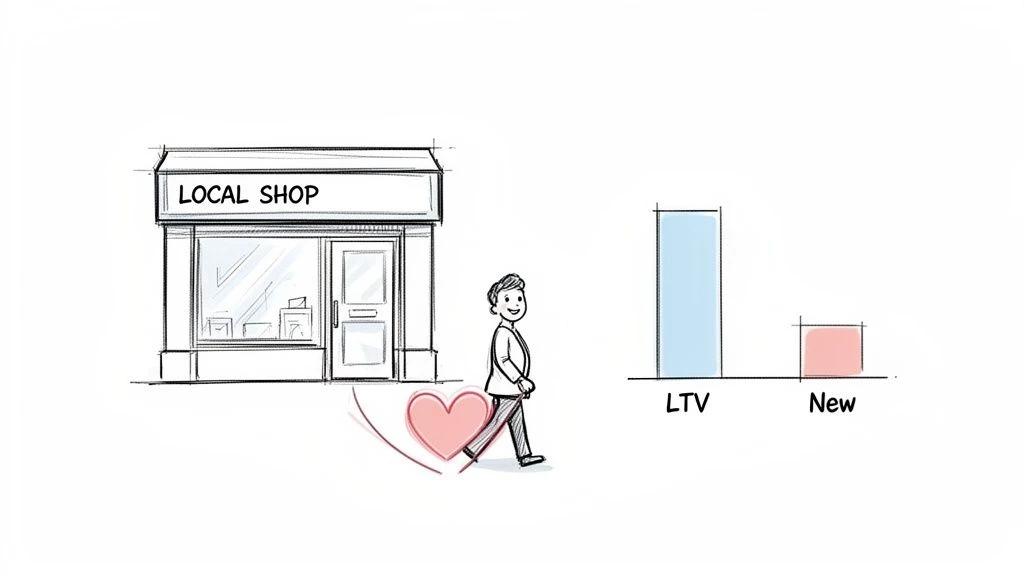
The difference in lifetime value (LTV) between a one-time visitor and a loyal regular is dramatic. That regular who grabs a $5 coffee twice a week? They're worth over $500 a year. The one-time buyer is worth... well, $5.
To tap into the power of your regulars, you need to implement smart customer retention best practices that turn casual visits into lasting relationships.
Making Loyalty Simple and Accessible
The good news? You no longer need a massive budget or an IT department to compete with the big chains. The days of flimsy, easily-lost paper punch cards are over.
Modern tools give even the smallest businesses the power to launch slick, effective loyalty programs that solve the biggest pain points for owners.
Here’s how a simple digital system changes the game:
- It’s Effortless for Customers: They already have their phones. A quick scan is all it takes to join and track rewards, killing the "I forgot my card" excuse for good.
- It’s Simple for Your Staff: No clunky software or lengthy training. Employees can sign up a new member in seconds, right at the counter.
- It Gives You Real Insight: You can finally see who your best customers are, how often they visit, and which rewards actually get them excited.
Platforms like BonusQR were built for exactly this reality. They offer a super cost-effective way to launch a digital loyalty program that feels professional but is incredibly easy to manage.
This lets you focus on what you do best-running your business-while your loyalty program becomes your most powerful engine for growth.
Step 1: Build a Loyalty Program That Actually Works
Before you print punch cards or sink money into a flashy app, let's talk strategy. A loyalty program that actually moves the needle isn’t guesswork. It’s a system built to hit real business goals.
It all boils down to one question: "What specific business problem am I trying to solve?"
"Increase loyalty" isn't a good enough answer. We need clear, measurable targets that will guide every decision you make.
Set Clear and Measurable Goals
Think of your goals as the destination you plug into your GPS. Your loyalty program's goals have to be specific enough to track and tied directly to the health of your business.
Let’s get concrete. Here’s what this looks like for different businesses:
- For a Coffee Shop: "Increase visit frequency of regulars from 3x to 4x per week in Q3."
- For a Retail Boutique: "Boost the average transaction value of members by 15% over the next six months."
- For a Salon: "Encourage 25% of existing hair clients to try a new service (like a manicure) by offering a bonus reward."
See the difference? These goals give your program a real job to do. It stops being a cost center and becomes a powerful tool for growth.
Define a Realistic Budget
"How can I afford to give away free stuff without killing my margins?"
This is the #1 fear for most small business owners. The trick is to build a budget that's both sustainable and directly tied to your sales.
Here's a simple, effective formula: dedicate 1-2% of your total revenue to your loyalty program. If your coffee shop brings in $20,000 a month, that’s a rewards budget of $200 to $400. This way, the cost scales perfectly with your success-the more you sell, the more you can afford to give back.
Remember, this isn't just an expense; it's a proven investment. The global loyalty management market is on track to hit $17.52 billion by 2026 for a reason-it works. In fact, a staggering 87% of professionals report that their loyalty programs deliver a positive ROI. You can see more on this in the in-depth customer loyalty index for 2025.
Understand What Your Customers Actually Want
Now for the most important part-figuring out what your customers truly value. Throwing generic rewards at them gets generic results. What motivates a coffee lover rushing to work is entirely different from what a salon client values during a relaxing appointment.
Put yourself in their shoes.
- The coffee shop customer probably values speed and convenience. A reward like "skip the line" could be far more appealing than a free pastry they never wanted.
- The salon client, on the other hand, is there for pampering and exclusivity. They'd likely be more motivated by a complimentary upgrade-like a deep conditioning treatment-or early access to book holiday appointments.
This isn’t about what’s cheapest for you; it’s about what feels most valuable to them. Getting this right is the secret to creating rewards people will actively work to earn. If you want to dig deeper, our article on how to create a rewards program that drives loyalty offers more specific strategies.
Prioritize Simplicity Above All Else
Here it is. The single biggest mistake small businesses make: complexity. If your program is confusing for customers or a pain for your staff, it's dead on arrival. Simplicity isn't just a nice-to-have; it's everything.
Customers will ditch a program that makes them download an app, remember a password, or carry a physical card. Your team won't promote a program that slows down checkout.
This is exactly where simple, modern digital tools make all the difference. Platforms like BonusQR were built to solve this exact problem.
- For Customers: They just scan a QR code with their phone's camera. That's it. No app to download, no password to create.
- For Staff: It slots right into the existing workflow. A quick scan is all it takes to credit a customer's purchase, keeping the line moving.
By choosing a system that's ridiculously simple, you remove the barriers that kill most loyalty programs.
Step 2: Design Rewards Your Customers Genuinely Want
Let’s be real: the old ‘buy 10, get one free’ punch card is tired. To build a real connection, you have to think beyond generic freebies. The secret is crafting rewards that make your customers feel seen, understood, and a little bit special.
A reward's true power isn't measured in dollars. It's measured in how it makes your customer feel. A thoughtful gesture is far more memorable than a standard discount. It shows you’re paying attention.
To get started, it helps to see the whole picture. This flowchart breaks down the essential steps for building any solid loyalty program.
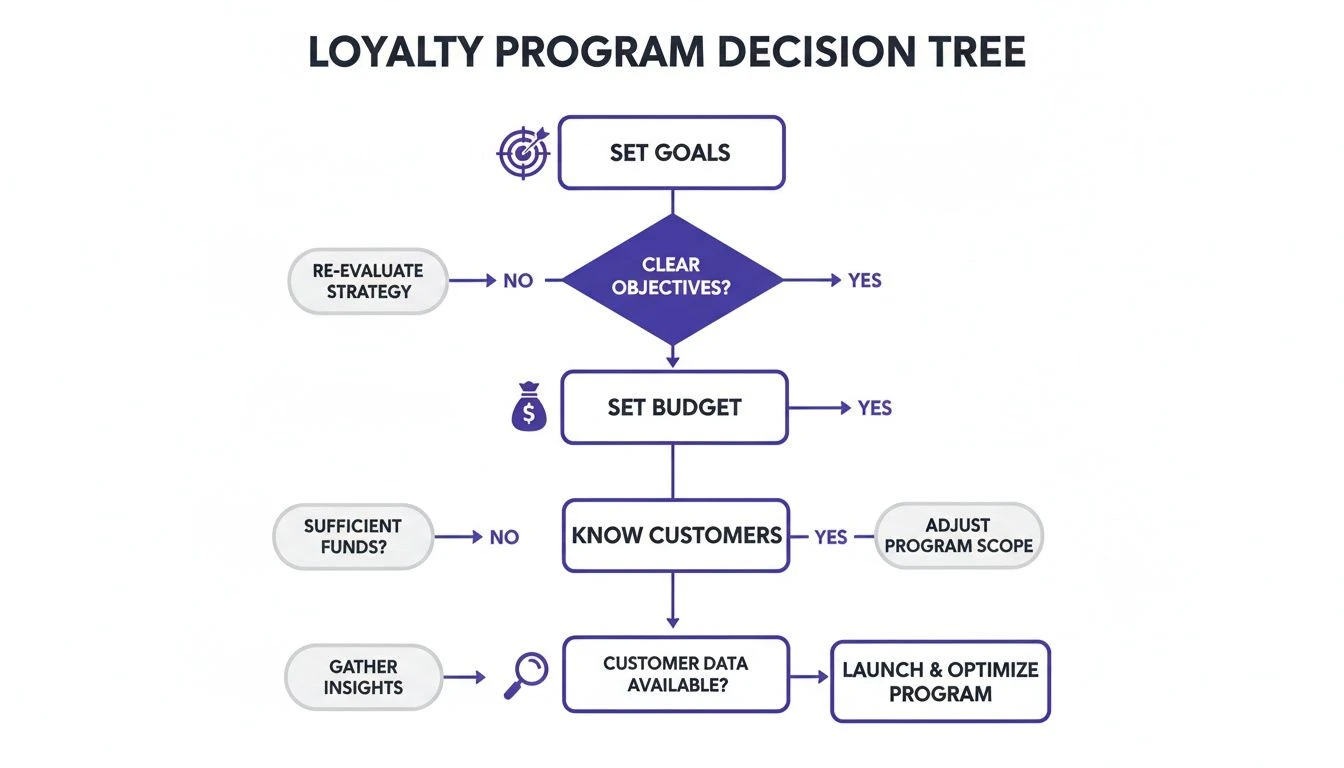
As you can see, everything flows from having clear goals, a budget, and-most importantly-a deep understanding of your customers.
Choosing the Right Reward Structure for Your Business
Not all loyalty programs are built the same. The right one depends on your business model and your customers. A coffee shop with daily traffic has different needs than a salon with less frequent, high-value visits.
Let's break down the most popular models to find your perfect fit.
| Reward Model | How It Works | Best For | Pros | Cons |
|---|---|---|---|---|
| Points-Based | Customers earn points for every dollar spent or for each visit. They can redeem these points for specific rewards. | Businesses with frequent, lower-cost purchases (e.g., coffee shops, bakeries, quick-service restaurants). | Simple to understand. Encourages repeat visits and is highly flexible in what you can offer. | Can feel transactional. If points accumulate too slowly, customers might lose interest. |
| Tiered Program | Customers "level up" to new tiers with better perks and status as their spending or visit frequency increases. | Businesses with a wide range of customer spending (e.g., retail stores, salons, service-based businesses). | Creates a sense of achievement and exclusivity. Strongly incentivizes customers to spend more to reach the next level. | Can seem complex if not explained well. The top tier might feel unattainable for new customers. |
| Surprise & Delight | Rewards are given out unexpectedly, triggered by milestones, behavior, or just because. | Any business looking to build a strong emotional connection and social media buzz. | Generates powerful positive feelings and feels incredibly personal. Great for creating shareable moments. | Lacks a clear path to earning, which can frustrate some customers. Harder to budget for and scale. |
The best approach often combines these elements. You could run a simple points system but sprinkle in surprise rewards for your most engaged members.
High-Value Rewards That Cost You (Almost) Nothing
The most effective perks often have a high perceived value for the customer but a low actual cost to your business. It all comes down to offering exclusivity, convenience, and recognition-things money can't always buy.
Here are 20+ low-cost, high-impact ideas you can adapt for your business:
- A complimentary product upgrade (e.g., a larger coffee, a premium nail polish color).
- A "skip the line" pass for your busiest hours.
- Early access to new products or seasonal menu items.
- A "bring a friend" bonus where both get a discount.
- First dibs on booking holiday appointments.
- VIP entry to a customer appreciation night.
- A free add-on service (like a deep conditioning treatment with a haircut).
- Your customer's favorite drink, on the house, "just because."
- A surprise birthday reward sent straight to their phone.
- Feature a loyal customer's photo on your social media (with their permission).
- A free sample of a new product you’re thinking about launching.
- Exclusive access to a members-only flash sale.
- 10% off their entire purchase on their "loyalty anniversary."
- A free tote bag or other branded merch after a certain number of visits.
- A handwritten thank-you note with a small bonus coupon inside.
- Guaranteed seating or a reserved table during peak times.
- A free tutorial on a technique (e.g., "how to style your new haircut at home").
- Double points day on a historically slow day of the week.
- A "we miss you" offer if they haven't stopped by in a while.
- Let a top customer choose the next "special of the week."
- A complimentary consultation with one of your experts.
If you really want to stand out, think beyond standard discounts. Offering truly unique perks, like unforgettable UK experiences, can create a much stronger bond.
The power of these rewards is that they feel personal. They aren't just transactions; they're genuine gestures of appreciation. And with a simple digital tool like BonusQR, tracking and delivering them is a breeze.
Step 3: Launch and Promote Your Loyalty Program
You’ve designed a fantastic rewards program. But a great program is useless if no one knows it exists.
A successful launch is all about creating momentum from day one. The goal is to make joining feel like a no-brainer-an obvious and irresistible choice for every person who walks through your door.
Turn Your Staff into Program Champions
Your frontline team is your single biggest promotional tool. If they aren’t bought in, your customers won't be either. Before you launch, get your staff genuinely excited.
Start with a quick, hands-on training session. Have them sign up themselves so they see just how simple it is.
Most importantly, give them simple, benefit-driven scripts. Ditch the vague "Want to join our rewards program?" and arm them with something that has real punch:
- For a Cafe: "Want to get your next coffee on us? It only takes 10 seconds to join our new rewards club."
- For a Salon: "Before you head out, let's get you signed up for our VIP program. You'll get 15% off your next service just for joining today."
When your team understands the value and can explain it with confidence, their enthusiasm is contagious.
Create an Unmissable In-Store Presence
Your physical space is prime real estate. You need to make your loyalty program impossible to miss. This comes down to clear signage and a strong call to action.
Zero in on the most valuable spot in your entire business: the checkout counter.
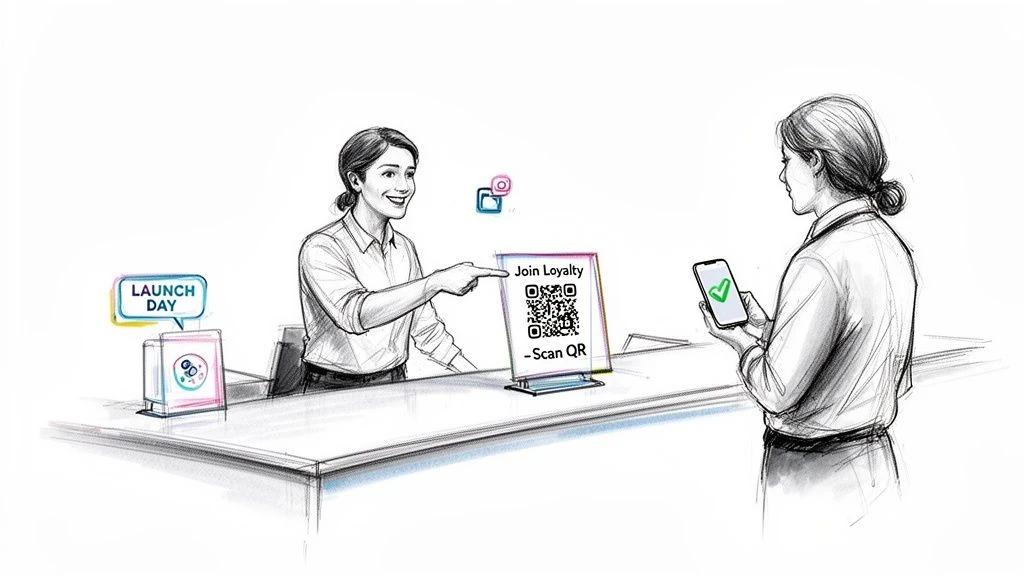
A simple, well-placed sign at the point of sale is your secret weapon. It should have a clear headline like "Your Loyalty Has Its Rewards" and feature a large, easy-to-scan QR code. This visual cue prompts the customer and backs up your staff's verbal invitation.
This is where a tool like BonusQR really shines. The entire sign-up process happens with a quick scan. No apps, no clunky forms. You remove all friction, making it incredibly easy for customers to say "yes."
Build Buzz with a Multi-Channel Promotion Plan
While your in-store game is crucial, spread the word across all your channels to reach everyone.
Your plan should include:
- Email Announcement: Send a dedicated email to your customer list with a hooky subject line like, "A New Way We're Saying Thank You." Clearly spell out the benefits and include a direct link or QR code.
- Social Media Blitz: Plan a series of posts for launch week. Use eye-catching graphics, a short video of a team member explaining the perks, and Instagram Stories with a clickable link to join.
- Website Banners: Add a can't-miss banner to your homepage announcing the new program.
Data shows customers sign up from all over. While in-store is key, 35% of consumers join via company websites and 30% through mobile phones. Hitting multiple touchpoints maximizes your chances of capturing every interested customer. You can dig into more loyalty program statistics and trends to see how vital this approach is.
Spark Immediate Action with a Launch-Day Offer
People love being part of something new, especially when there's an extra incentive. To build a strong member base from the get-go, create a limited-time bonus for your first wave of sign-ups.
This doesn't have to break the bank. It just needs to create urgency.
Consider an offer like:
- "Be one of the first 50 to join and get double points on your first purchase!"
- "Join today and get a free pastry with your coffee, on us."
A launch-day bonus gives your staff a powerful talking point and rewards customers for acting fast.
Step 4: Measure Success and Improve Your ROI
Launching your program is a huge first step. But the real payoff begins when you start measuring what works and fine-tuning your approach. A program you don't track is just a shot in the dark.
This isn't about getting lost in spreadsheets. It's about focusing on a few key numbers that tell the true story of your program's health and its return on investment (ROI).
The Key Performance Indicators That Matter
For a small business, tracking success needs to be simple. Zero in on the three metrics that have the biggest impact on your bottom line.
- Customer Retention Rate (CRR): The ultimate measure of loyalty. It tells you what percentage of customers are coming back. A rising CRR is direct proof your program is working.
- Reward Redemption Rate: Are people actually using their rewards? A low redemption rate is a huge red flag. A high rate shows you've hit on perks customers genuinely want.
- Average Purchase Frequency: How often are your loyalty members buying from you compared to non-members? If they're visiting more, your program is successfully building habits.
Not long ago, tracking these was a massive headache. Thankfully, QR-based loyalty systems have solved this.
With a platform like BonusQR, tracking these vital KPIs is effortless. The data is collected automatically and served up on a simple dashboard. You can see your retention, redemption, and visit frequency at a glance-taking all the guesswork out of measuring success.
Turning Data into Actionable Improvements
The data you're collecting is a roadmap for making your program better. When you see how customers are interacting with your rewards, you can make smart, targeted changes.
Think of it as a constant feedback loop: measure, analyze, and act.
Here’s how to put that data to work:
- Spot Your VIPs: Your dashboard will clearly show you who your most frequent and highest-spending customers are. Use this knowledge to surprise them with exclusive, unannounced perks to cement their loyalty.
- Tweak Underperforming Rewards: Got a reward that’s just collecting dust? If your "free cookie" has a 5% redemption rate but your "50% off a specialty latte" has a 40% rate, you know exactly where to focus your efforts.
- Test New Offers: Use your data to run small experiments. Try offering double points on a historically slow day, like a Tuesday afternoon, and see if it boosts traffic.
By regularly checking your metrics and making small adjustments, you create a program that evolves with your customers. You learn what truly motivates them, which is the secret to perfecting your strategy on how to reward loyal customers and maximizing your ROI.
For a deeper dive, check out our simple guide on how to calculate customer retention rate.
Your Loyalty Program FAQs Answered
You have questions about customer rewards. You're not alone. Let's tackle the most common concerns so you can move forward with confidence.
Is a loyalty program too expensive for my small business?
Not at all. In fact, a good rewards program is an investment that quickly pays for itself.
Acquiring a new customer can cost 5 to 25 times more than keeping one you already have. A well-designed program hits your bottom line by encouraging more frequent visits and higher spending from the people who already love what you do.
With a simple, cost-effective solution like BonusQR, you skip the hefty price tag of a custom app. You can easily start with a budget as small as 1% of your monthly revenue and watch it generate a positive return.
What is the easiest way to get customers to sign up?
The secret is to make it dead simple at your point of sale. That's the moment your customers are most engaged.
Combine a simple visual cue with a quick verbal prompt from your staff. Put a QR code right on your counter and train your team to ask:
"Want to join our free rewards program for a discount on your next visit? It takes less than 10 seconds to sign up."
This one-two punch works wonders. A QR code-based system from BonusQR removes all the friction-no clunky app downloads, no passwords. Your customer just scans and they're in. That’s why it delivers the best sign-up rates.
How do I know if my rewards program is actually working?
Look past the vanity metric of total sign-ups. To understand if your program is driving real business results, focus on three key numbers:
- Reward Redemption Rate: Are people actually cashing in their rewards? A high number is a great sign you’ve created perks your customers genuinely value.
- Purchase Frequency: Are your members visiting more often than non-members? This shows your program is successfully building loyal habits.
- Average Spend: Are members spending more per visit? This is a crystal-clear indicator that your program is increasing customer lifetime value.
A great loyalty platform gives you a simple dashboard to see these metrics at a glance, proving your program's ROI and giving you the insights to improve it over time.
Should I use physical punch cards or a digital system?
While punch cards seem easy, they come with serious downsides. Customers lose them, you can't collect any data, and they feel outdated.
A digital solution is far better for any modern business. It’s more convenient for customers (it lives on their phone) and gives you the power to track everything automatically.
Most importantly, it lets you personalize rewards. A tool like BonusQR gives you all these digital advantages without the high cost or complexity of a custom app, making it the perfect choice for small businesses ready to grow.