Your loyalty program already knows who comes back, how often and what they buy. Used well, it is also the easiest place to ask those same customers what you should do better. The method is simple: ask one short question right after a real visit, reward the answer lightly, read the results every week, and tell customers what you changed.
This guide shows how to do that in a small business: when to ask, which questions to use, how to keep rewards from skewing the answers, and how to close the loop so people keep responding.
Key takeaways
- Ask right after a purchase or visit, with one question that refers to that specific experience. Short and recent beats long and general.
- Loyalty members are a better feedback panel than anonymous reviewers because you can tie each answer to real visit and spend history.
- Rewards raise response rates, but they can tilt answers positive. Reward the act of answering, never the score.
- Feedback only pays off when it is a closed loop: read it weekly, follow up with unhappy customers, and announce what changed.
- You do not need a survey suite to start. One NPS-style question, one open comment and a notification or email are enough.
Why a loyalty program is the best place to ask
Most small businesses hear from two kinds of customers: the delighted and the furious. Research on online reviews notes that customers at either extreme are the most motivated to post unsolicited reviews, while the average customer stays silent. If your only feedback source is public review sites, you are reading a distorted sample.
A loyalty program fixes part of that problem. Members have already shown up more than once, they have a reason to engage with you, and sharing an opinion takes one tap instead of creating an account on a review platform. That makes it realistic to hear from the quiet middle of your customer base.
There is a second advantage that review sites cannot match: identity. When a member rates a visit, you can see how often they come, what they usually order and whether they have gone quiet since. A 6 out of 10 from a weekly regular means something very different from a 6 from someone on a first visit. If you want to go deeper on reading that behavior, our guide to customer loyalty analysis for local shops covers what to track.
Finally, feedback is part of how loyalty is built, not only measured. Bain & Company describes successful companies as treating feedback as a closed-loop system rather than a one-off task: they collect it regularly and systematically, then retune operations based on it. A loyalty program gives a small shop the infrastructure for exactly that.
When to ask: the moments that work
Timing decides whether you get an honest answer or a shrug. The strongest feedback requests are tied to a specific, recent experience. A survey template built for loyalty programs from Perspective makes the same point: effective surveys anchor on a real recent trip rather than asking customers to rate the brand in the abstract.
For a small business, these are the trigger points worth setting up:
- After a points or stamp transaction. The customer has just scanned, the visit is fresh, and they are looking at your program anyway.
- After a reward redemption. This is the moment of peak goodwill and the best time to ask whether the reward felt worth the effort.
- After a first visit. New members have the clearest view of your onboarding, your signage and your first impression. Ask within a day.
- After a visit that followed a long gap. A customer who returns after 60 days has something to tell you about what made them leave and what brought them back.
- After a milestone, such as a tenth stamp, a tier upgrade or a birthday reward.
- When a regular goes quiet. A short check-in to someone who used to visit every week can reveal a problem before it becomes churn.
Space requests out. A member who is asked after every single visit will stop answering, or stop visiting. A reasonable rule for most small businesses is no more than one feedback request per member per month, with the exception of a recovery message after a bad experience you already know about.
What to ask: loyalty program survey questions that work
Short surveys get answered. For most local businesses, two to four questions is the ceiling. Use one scored question, one open comment, and at most one or two diagnostic questions.
The one question to start with: NPS
The Net Promoter Score question asks how likely a customer is to recommend you to a friend or colleague on a 0 to 10 scale. According to Bain & Company’s research on the metric, scores of 9 to 10 mark promoters, 7 to 8 are passives who could switch, and 0 to 6 are detractors. Your NPS is the percentage of promoters minus the percentage of detractors.
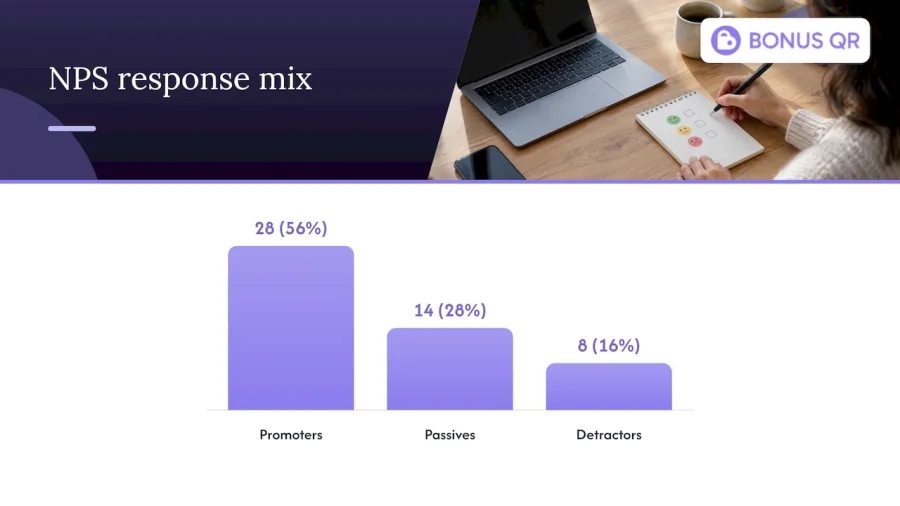
A quick worked example: you collect 50 answers in a month. 28 are promoters (56%), 14 are passives (28%) and 8 are detractors (16%). Your NPS is 56 minus 16, which is 40. The number matters less than its direction over several months, and less still than the comments attached to the low scores.
Always follow the score with one open question: “What is the main reason for your score?” That sentence is where the useful information lives.
Questions about the experience
Pick the ones that match your business:
- “How was your visit today?” (a simple 1 to 5 or emoji scale)
- “What is one thing we could do to make your next visit better?”
- “Was anything harder than it should have been, such as ordering, booking, paying or finding what you wanted?”
- “How did you hear about us?” (useful for first-time members)
Questions about the program itself
These tell you whether the loyalty program is working or just costing you margin:
- “Is the reward we offer something you actually want?”
- “How close do you feel to your next reward?” (reveals whether your threshold is too far away)
- “Would you have bought from us today if we did not have a rewards program?”
That last one deserves attention. The Perspective template argues that redemption is not incrementality: members often redeem because they were shopping anyway, so asking the counterfactual question is a practical way to test whether a reward actually changed behavior without building a control group. If most members say they would have come anyway, your reward may be too generous, or aimed at the wrong people. For the cost side of that question, see our margin-first approach to loyalty analysis.
Questions to avoid
- Leading questions such as “How amazing was our service today?”
- Double-barreled questions such as “How were the food and the service?” Split them or pick one.
- Long matrices of ten rating scales. They are fine for a market research firm and fatal for a coffee shop.
- Anything you will not act on. If you cannot change the thing, do not ask about it.
Channels: where members answer
The best channel is the one members already use with you. For a QR-based program, that is usually the phone moment right after scanning. Options for small businesses, from lowest effort to highest:
| Channel | Best for | Watch out for |
|---|---|---|
| Prompt right after a scan or reward | Quick scores, one-tap ratings | Keep it to one question |
| Push notification | Reminding members about a recent visit | Do not overuse; one per month is plenty |
| Slightly longer feedback, follow-ups | Lower open rates, so keep the subject specific | |
| In-store QR on the receipt or table | Walk-in and anonymous customers | You cannot link answers to a member unless they log in |
| Personal follow-up (call or message) | Detractors and your top regulars | Time-intensive, so reserve for high-value cases |
If your program has a review module, use it as the public end of the funnel: send happy members (high scores) to leave a public review, and route unhappy members to a private message to you first. That way the loop catches problems before they hit a review site, and it does not suppress honest opinions, because everyone can still post publicly.
Email and notification examples you can adapt
Short, specific and signed by a real person works best. Adapt these to your own voice.
After a visit (notification or email)
Subject: How was today?
Thanks for stopping by, [Name]. One quick question: on a scale of 0 to 10, how likely are you to recommend us to a friend? Tap your score and tell us why in a sentence if you like. It takes 20 seconds and we read every answer.
After a reward redemption
Subject: Was your reward worth it?
You just redeemed [reward]. We would like to know if it was what you hoped for. What reward would you rather earn next?
Win-back check-in
Subject: We have missed you
It has been a while, [Name]. Was there something we could have done better? Reply to this message and tell us. We will read it ourselves, and there is a small thank-you waiting on your next visit.
Recovering a bad score
Subject: Let us make this right
You gave us a [score] and we are sorry we missed the mark. Could you tell us what happened? We would like to fix it, and we will reply personally within two days.
Closing the loop
Subject: You asked, we changed it
Several of you told us [problem]. As of this week, [change]. Thank you for being direct with us.
That last email is the one most businesses never send, and it is the one that makes people answer the next survey.
Rewards for feedback: how to avoid biased answers
Should you pay members to answer? Often yes, in small amounts, but with care. A study of online reviews found that combining financial incentives with social norms was more effective at generating both volume and depth of feedback than money alone. In practice, that means pairing a small reward with a message that tells members how many other regulars have already weighed in and that their input shapes what you do.
The same body of research warns about sentiment bias: incentives can push ratings upward when the business itself offers them. To protect the quality of your data:
- Reward completion, not the score. Say “thanks for sharing your honest opinion” and give the same bonus whether the answer is 2 or 10.
- Keep the reward small. One bonus point or one extra stamp is enough. A big prize attracts people who answer to win.
- Say plainly that negative answers are welcome. Members are surprisingly willing to criticize when they believe someone will read it.
- Do not tie rewards to public reviews. Rewarding a review invites inflated ratings and can break the rules of review platforms.
There is also a deeper point. Ogilvy’s research on loyalty argues that points and perks are often mistaken for real loyalty, and that lasting commitment rests on four dimensions: principle, potential, culture and community. Asking for opinions and acting on them speaks directly to community: it tells members they have a say. A feedback request that feels like a favor between neighbors will beat one that feels like a transaction.
Turning answers into action
Collecting feedback is the easy part. A simple weekly routine keeps it from becoming a dead spreadsheet.
- Read every comment on a fixed day. Fifteen minutes every Monday is enough for most small businesses.
- Tag each comment with a theme: speed, price, staff, product, cleanliness, rewards, app or card experience.
- Reply to detractors personally within two days. A real reply from the owner often turns a low score into a loyal member.
- Pick one change per month. Do not try to fix everything. Choose the theme that appears most often and affects your best customers.
- Announce the change to members through a notification or email, using the “you asked, we changed it” format above.
- Re-measure the same question next month and compare.
Segment your answers too. Compare promoters and detractors by visit frequency, average spend and reward tier. If your newest members score you lower than your regulars, you may have an onboarding problem. If your highest spenders score you lower than everyone else, that is an urgent signal. Our guide to customer loyalty types can help you decide which groups deserve the most attention.
Consistency matters here more than occasional heroics. McKinsey’s research argues that a consistent customer journey matters more than occasional “wow” moments, and notes that top-quartile banks on journey consistency are trusted 30% more than bottom-quartile ones. That finding comes from banking, so treat it as a principle, not a promise for your shop. Still, feedback is how you find the places where your own experience is inconsistent.
For the follow-up side, particularly following up with dissatisfied customers and using what you learn to improve the product or service, this overview of feedback-driven revenue growth walks through workflows you can borrow.
Our perspective: ask less, answer faster
We build BonusQR for small businesses, and the same pattern shows up again and again: owners overbuild their feedback process. They plan a twelve-question survey, send it once a quarter, and get a handful of replies from the loudest customers.
We believe the better model is smaller and constant. A loyalty program is already the place where a customer interacts with your business after every purchase. That makes it the natural home for one question, a light reward and a quick reply. The program does the remembering, so you do not have to chase people.
Two things we advise owners to protect. First, never let rewards for feedback become rewards for good scores. Honest data is worth more than a flattering average. Second, close the loop in public: when members see that a suggestion became a change, the next round of feedback gets better without any extra incentive.
Automation helps because small teams do not have time for manual follow-up. That is why we built notifications, review tools and analytics into the platform rather than leaving them for separate software, so you can focus on running the business while the system handles the repetitive work.
— Michal Palus
Setting this up with BonusQR
If you want a loyalty program that can carry this kind of feedback loop without a POS integration, BonusQR is built for it. Customers earn points, stamps or cashback by scanning a QR code, and you get push and email notifications, a review module, analytics and automated customer segmentation to see which groups respond and how they behave.
You can start on the Free plan, move to Basic at €19 per month or to Premium at €69 per month. Compare what each includes on the BonusQR pricing page. If you want your own branded app, see the white-label option or custom app development.
Still choosing a platform? Our comparison of the best loyalty program software lays out what to look for, and our practical guide to getting customer feedback on your rewards program goes further on tactics.
Common mistakes to avoid
- Surveying only your happiest members. If you only ask after redemption, you hear from people who already like you. Include lapsed and first-time members.
- Chasing the score. An NPS of 40 with no comments teaches you less than an NPS of 25 with fifty specific complaints.
- Ignoring small samples. With 20 answers a month, one detractor moves your score noticeably. Read the words, not just the number, and track trends over at least a quarter.
- Asking too often. Fatigue lowers response rates and annoys your best customers.
- Staying silent after feedback. If customers never hear back, they stop talking.
- Treating all feedback equally. Weigh comments by who gave them and how often a theme repeats.
FAQ
How many questions should a loyalty feedback survey have?
For a small business, two to four. Use one scored question such as NPS, one open comment asking why, and optionally one or two questions about the visit or the rewards. Every extra question lowers the share of members who finish.
How often should I ask loyalty members for feedback?
No more than about once a month per member for routine requests. Trigger them after specific events, like a first visit, a redemption or a return after a long gap. The exception is a personal recovery message after you learn about a bad experience.
Should I reward customers for giving feedback?
A small reward, like a bonus point or stamp, usually helps response rates. Give it for completing the survey, not for a particular score, and say that honest criticism is welcome. Research suggests incentives offered by the business itself can lift ratings, so keep the reward modest.
What is a good NPS for a local business?
There is no universal benchmark worth trusting, because scores vary by industry and survey method. Track your own score monthly and focus on the trend and on the reasons behind low scores. Compare like with like: the same question, the same timing, the same channel.
How do I get feedback from customers who are not loyalty members?
Place a QR code on receipts, tables or the counter that leads to the same short question. You will not be able to link answers to purchase history, but you will hear from people the program has not reached yet. Use those answers to improve the offer that gets them to join.
Sources
- Customer Engagement: The Key to Long-term Loyalty and Impact (Cornell)
- The strategic principles of repeatability (Bain & Company)
- Turning your consumers into die-hard fans (Bain & Company)
- Loyalty Program Effectiveness Survey Template (Perspective)
- Stimulating Online Reviews by Combining Financial Incentives and Social Norms
- The Four Dimensions of Loyalty (Ogilvy)
- The three Cs of customer satisfaction: consistency, consistency, consistency (McKinsey)
- Customer feedback drives revenue growth strategies


