
 Deutsch
 Español
 Français
 Italiano
 Magyar
 Polski
 Slovenčina
 Čeština
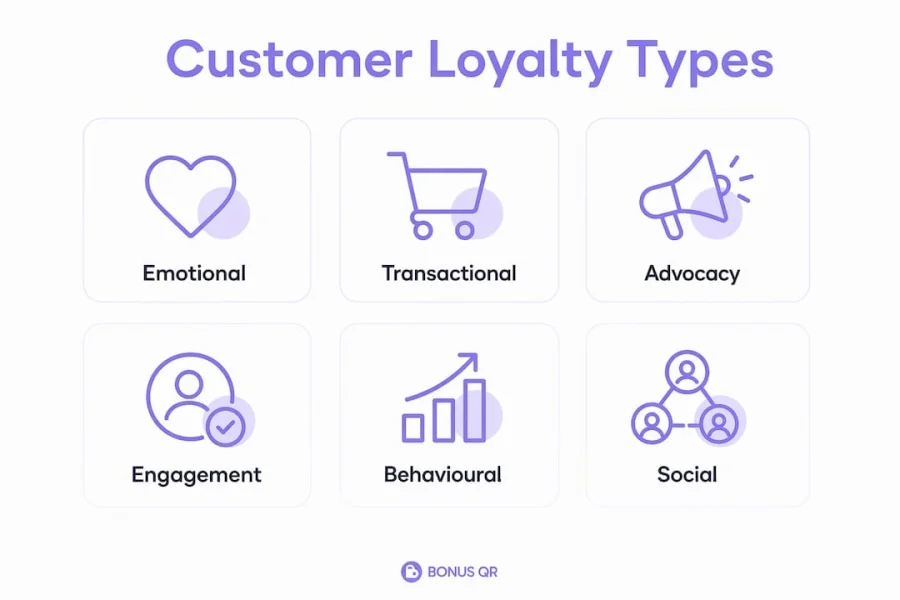
Customer loyalty falls into six distinct types: emotional, transactional, advocacy, engagement, behavioural, and social. Each one explains a different reason why customers return, and each demands a different response from your business. Understanding which type you are dealing with is the starting point for any retention strategy worth building.
The six types are not mutually exclusive. A customer can be emotionally attached to your brand and also respond to a well-timed discount. What matters is knowing which loyalty type dominates in your customer base, because that shapes everything from your programme mechanics to your KPIs. The classification framework identifying these six primary loyalty types gives marketers a practical lens for segmenting customers and designing programmes that actually hold.
Here is a quick reference for the six types:
- Emotional loyalty: attachment rooted in feelings, trust, and brand identity
- Transactional loyalty: driven by rewards, discounts, and price incentives
- Advocacy loyalty: customers who actively recommend and promote your brand
- Engagement loyalty: built through ongoing interaction beyond the point of purchase
- Behavioural loyalty: habitual repeat purchasing, often driven by convenience or routine
- Social loyalty: shaped by peer influence, community belonging, and social identity
What makes emotional loyalty so powerful?
Emotional loyalty is the type most businesses aspire to but fewest deliberately build. It forms when customers feel a genuine connection to your brand, not just satisfaction with a product. Trust, shared values, and consistent positive experiences are the psychological foundations. A customer who feels understood by a brand will stay through a price increase, forgive a delivery delay, and tell friends about you without any incentive to do so.
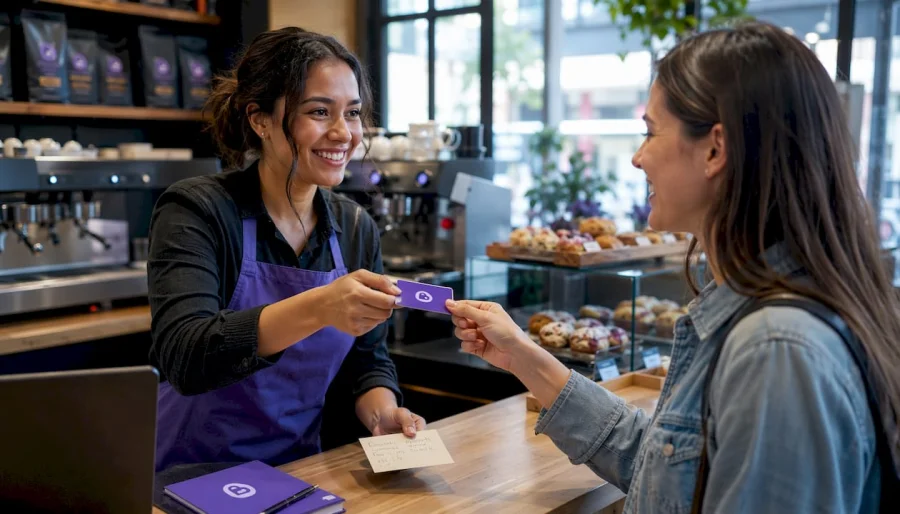
The contrast with transactional loyalty is stark. Transactional customers leave the moment a competitor offers a better deal. Emotionally loyal customers stay because switching feels like a loss, not just an inconvenience. True loyalty stems from deep emotional connection and trust, providing the greatest long-term return and competitive advantage of any loyalty type.
Programmes that build emotional loyalty tend to share a few characteristics:
- Personalised rewards tied to individual preferences, not generic points balances
- Recognition moments such as birthday offers, anniversary messages, or milestone celebrations
- Consistent brand experience across every touchpoint, from app to in-store
- Values alignment where the brand’s stated mission matches what customers care about
A coffee shop that remembers your usual order and sends a personalised offer on your loyalty anniversary is doing more for emotional loyalty than any generic stamp card. The mechanics matter less than the feeling they create.
Transactional loyalty: useful but fragile
Transactional loyalty is the most common type and the easiest to acquire. It is also the shallowest. Customers in this category return because of a reward, a discount, a coupon, or a points balance they want to redeem. Remove the incentive and many will leave.

Incentive-driven loyalty is the most sensitive type, easily swayed by competitor pricing. That is not a reason to avoid transactional mechanics entirely. Points programmes, stamp cards, cashback offers, and digital coupons all serve a legitimate purpose: they lower the barrier to a first repeat purchase and give you data on buying behaviour. The strategic mistake is treating transactional loyalty as the destination rather than the starting point.
Common transactional loyalty tactics include:
- Points collection rewarding spend with redeemable credits
- Stamp cards encouraging repeat visits to reach a reward threshold
- Cashback schemes returning a percentage of spend as credit
- Time-limited coupons creating urgency around a specific offer
- Tiered discounts that increase with purchase frequency
Pro Tip: Use transactional mechanics to acquire loyalty data early, then use that data to personalise communications and shift customers toward emotional loyalty over time.
The loyalty programme mistakes most businesses make in retail often centre on over-relying on discounts without building any emotional connection alongside them. Transactional loyalty is a tool, not a strategy.
Advocacy loyalty: turning customers into promoters
Advocacy loyalty is what happens when emotional loyalty reaches its highest expression. Advocates do not just return; they recruit. They post reviews, recommend your business to colleagues, and defend your brand in conversations you are not part of. For small and medium businesses in Central Europe, word-of-mouth advocacy remains one of the most cost-effective acquisition channels available.
The relationship between advocacy and emotional loyalty is direct. Customers who feel genuinely attached to a brand are far more likely to recommend it. The key is giving them a reason and a mechanism to do so.
Tactics that build advocacy loyalty:
- Referral incentive programmes rewarding customers for bringing in new ones
- Review prompts sent at the right moment, typically after a positive experience
- Community recognition such as featuring loyal customers in social content
- Exclusive early access to new products or services for top advocates
- Ambassador tiers within a loyalty programme that carry social status
Measuring advocacy loyalty relies heavily on Net Promoter Score (NPS), which gauges how likely customers are to recommend your brand on a 0–10 scale. NPS is an attitudinal metric, meaning it captures intent rather than behaviour, so pair it with actual referral tracking to get the full picture.
Converting a satisfied customer into an active advocate usually requires one thing above all: a frictionless way to share. If your referral programme takes five steps to complete, most customers will not bother, regardless of how much they like you.
Engagement loyalty: building bonds beyond the transaction
Engagement loyalty develops when customers interact with your brand outside the moment of purchase. That interaction can take many forms: using a loyalty app, participating in a social media challenge, attending a brand event, or completing a survey. Each touchpoint reinforces the relationship and makes the customer feel like a participant rather than just a buyer.
Engagement loyalty arises from interactions such as app usage, social media activity, and brand events, reinforcing emotional bonds and repeat buying. Brands that invest in engagement see a compounding effect: engaged customers tend to become emotionally loyal, and emotionally loyal customers tend to become advocates.
Practical engagement tactics worth building into your programme:
- Gamification such as challenges, streaks, or bonus point events within a loyalty app
- Feedback loops where customers are asked for opinions and see those opinions acted on
- Exclusive content or early access available only to loyalty programme members
- Community spaces such as member forums or local events
- Push notifications timed to relevant moments rather than broadcast to everyone
Bonusqr supports engagement loyalty directly through its push notification tools, real-time analytics, and campaign automation. Rather than waiting for customers to return on their own, you can prompt interaction at the right moment with a relevant offer or message. The customer engagement strategies that work without a large budget tend to rely on timing and personalisation rather than spend.
Behavioural and social loyalty: habit and community
Behavioural loyalty
Behavioural loyalty is the most measurable type. It shows up in purchase frequency, average order value, and visit cadence. A customer who buys from you every two weeks is demonstrating behavioural loyalty, even if they have no strong emotional attachment. Habit and convenience are the primary drivers. The risk is that this type of loyalty is vulnerable to disruption: a new competitor opening nearby, a change in routine, or a single bad experience can break the habit.
Behavioural loyalty is demonstrated by repeat purchases and habit formation, while social loyalty relates to customers’ identification with brand communities and peer influence. These two dimensions are complementary and often reinforce each other. A customer who shops habitually and also belongs to a brand community is far more resistant to switching than one driven by habit alone.
Mechanics that reinforce behavioural loyalty include:
- Visit-based rewards that trigger after a set number of check-ins
- Spend thresholds unlocking a benefit at a defined purchase level
- Subscription models that build routine into the customer relationship
- Automated re-engagement messages when a customer’s visit frequency drops
Social loyalty
Social loyalty is shaped by belonging. Customers who identify with a brand community, feel recognised by peers within it, or see their social circle using a brand are more likely to stay loyal. This is particularly relevant for businesses in Central Europe where community ties and local reputation carry real weight.
Building social loyalty means creating spaces where customers feel part of something. A loyalty tier with a visible status, a members-only event, or a referral programme that rewards both parties all contribute. Social proof, such as displaying how many local customers have joined your programme, reinforces the sense that choosing your brand is the socially validated choice.
Loyalty vs retention: why the distinction shapes your strategy
Loyalty and retention are not the same thing, and confusing them leads to programmes that look active but deliver little. Retention is a quantitative measure: did the customer buy again? Loyalty explains why. Confusing loyalty with retention leads to strategies that rely too heavily on transactional incentives, producing customers who stay only as long as the deal lasts.
The practical implication is that a business can have high retention and low loyalty. Customers may keep buying because switching is inconvenient, not because they prefer you. That is a fragile position. The moment a better option appears, those customers leave.
The loyalty continuum runs from transactional at one end to true loyalty at the other. Tiered retention strategies aim to move customers from easy-to-acquire transactional loyalty toward enduring true loyalty, yielding higher long-term value. The practical path is to use transactional mechanics to acquire and retain, while investing in emotional and engagement tactics to deepen the relationship over time.
Strategic takeaways for 2026:
- Map your customer base against the six loyalty types before designing any programme
- Avoid programme-washing, where a loyalty scheme exists in name but drives no real attachment
- Align your loyalty model to your industry: a discount-led retailer and a mission-driven brand need different approaches
- Use NPS alongside behavioural metrics to track both attitudinal and behavioural loyalty
- Invest in customer retention strategies that address the emotional dimension, not just the transactional one
- Review your programme mechanics regularly to check whether they are building the type of loyalty you actually want
Different industries require genuinely different loyalty models. A grocery retailer competing on price needs strong transactional mechanics. A boutique hotel in Prague or Vienna builds loyalty through emotional connection and personalised recognition. Applying the wrong model to your context produces what researchers call “spurious loyalty”: customers who buy regularly but feel no attachment and will leave without hesitation when a better offer appears.
Bonusqr’s platform is built to support all six loyalty types within a single system. Whether you need stamp cards for behavioural loyalty, push notifications for engagement, or referral tools for advocacy, the loyalty platform features are modular enough to match your specific strategy without forcing you into a one-size-fits-all structure.
Key takeaways
Understanding the six loyalty types is the foundation of any retention strategy that moves beyond short-term discounting toward lasting customer relationships.
| Point | Details |
|---|---|
| Six distinct loyalty types | Emotional, transactional, advocacy, engagement, behavioural, and social loyalty each require different programme mechanics. |
| Transactional loyalty is fragile | Incentive-driven loyalty is easily lost to a competitor offering a better deal; use it as a starting point, not an end goal. |
| True loyalty delivers the greatest return | Deep emotional connection and trust provide the strongest competitive advantage of any loyalty type. |
| NPS measures advocacy loyalty | Net Promoter Score gauges customers’ likelihood to recommend, making it the key attitudinal metric for advocacy. |
| Loyalty and retention are not the same | Loyalty explains why customers stay; retention only measures whether they do. Confusing the two leads to ineffective strategies. |