
 Deutsch
 Español
 Français
 Italiano
 Magyar
 Polski
 Slovenčina
 Čeština
Zero-party data is information customers willingly and intentionally share with a business, such as their preferences, favourites, or purchase intentions. In UK marketing, it gives 100% accuracy and consent when the customer explicitly states what they want, which makes it especially useful for personalisation and privacy-first loyalty.
A lot of small business owners already know their regulars by face. The problem is that recognition isn't the same as understanding. A café owner might know that a customer comes in every Tuesday, but not whether they prefer oat milk, want offers by SMS, or would come back more often for a birthday reward. A salon might remember the haircut, but not the hair concerns, product interests, or preferred booking times.
That gap matters because generic marketing wastes attention. Paper punch cards helped with repeat visits, but they didn't tell a business anything useful about the person carrying the card. They created transactions, not relationships.
What is zero-party data? In simple terms, it's the information a customer chooses to tell a business directly. Not guessed from clicks. Not bought from another company. Not pieced together from browsing behaviour. Shared on purpose.
For local businesses, that's a big shift. It means a coffee shop can ask for a favourite drink. A gym can ask about fitness goals. A beauty salon can ask about hair type or treatment interests. If the exchange is clear and useful, many customers are happy to answer because they see the benefit straight away.
This matters even more in a physical business, where staff often have strong in-person relationships but weak customer data. That's where a practical, QR-led approach changes things. A customer scans, joins a simple loyalty flow, answers one or two useful questions, and gets something valuable in return. No awkward clipboard. No long form. No guesswork.
The Customer You See But Don't Know
Most local businesses have this problem, even if they don't describe it that way.
The team sees familiar faces every day. They know who orders the flat white before work, who books the same stylist every month, and who always buys the same post-workout drink. But beyond those surface habits, they don't know much. They can't greet people by name consistently, send relevant offers, or tailor rewards around what customers care about.
That creates a strange blind spot. The business has footfall, repeat visits, and regular customers, but still operates with a weak picture of customer intent.
What zero-party data actually means
According to TermsFeed's explanation of zero-party data, zero-party data is information customers voluntarily and proactively share with a company, such as preferences, interests, habits, or product wishes. The same source also notes that in the UK, this can count as personal data under UK GDPR if it relates to an identified or identifiable person, so businesses still need to handle it transparently and responsibly.
That definition matters because it clears up a common confusion. If a customer tells a café they prefer decaf after lunch, that's zero-party data. If the café notices they often buy decaf after lunch and makes an assumption, that's not.
Practical rule: If the customer said it clearly, it's zero-party data. If the business guessed it from behaviour, it isn't.
Why this matters more than another loyalty trend
Old loyalty systems usually stop at the reward. A stamp card records visits. A points scheme records spend. Useful, yes, but limited.
Zero-party data adds context. It helps a business understand who the customer is, what they want, and how they want to be treated. That's also why customer profiling works better when it's based on declared preferences rather than assumptions. For businesses trying to sharpen their segmentation, this guide on what are user personas for businesses gives a useful way to think about customer groups without turning people into vague marketing labels.
A small business doesn't need a giant database to benefit from this. It only needs a few honest answers that lead to better service, better offers, and better timing.
The Data Spectrum Explained Simply
The easiest way to understand zero-party data is to compare it with the other kinds of data businesses hear about all the time.
Think of a barista trying to learn about a new regular.
The barista analogy
If the barista buys a broad audience list that says someone is probably interested in coffee, that's third-party data. It's distant, broad, and often too generic to be useful in a neighbourhood shop.
If a partner business shares its own customer information, that's second-party data. It can be more relevant than bought data, but the shop still didn't hear it directly from the customer.
If the barista watches what the customer orders every week, that's first-party data. It's collected from direct interactions with the business, and it's valuable, but it still depends on observation. The business is interpreting behaviour.
If the barista asks, "What's your favourite drink?" and the customer answers, that's zero-party data.
According to Usercentrics on zero-, first-, and third-party data, zero-party data is self-reported information that a customer intentionally and proactively shares with a brand. The same source describes it as the "future of marketing" and says it's rich in contextual intent, including preferences, purchase intentions, and personal context.
Why zero-party data stands apart
Zero-party data isn't better because it's fashionable. It's better for certain jobs because it removes a layer of interpretation.
A coffee order tells a business what someone bought. It doesn't always tell the business what they prefer. Maybe the customer chose the cheapest option that day. Maybe their usual item was out of stock. Maybe they were buying for someone else.
A direct answer is cleaner. That's why what is zero-party data has become such an important question for small businesses trying to personalise without becoming intrusive.
Data Types at a Glance
| Data Type | How You Get It | Example | Key Challenge |
|---|---|---|---|
| Zero-party data | The customer tells the business directly | "I prefer oat milk" | The business has to ask clearly and offer a good reason to answer |
| First-party data | The business observes actions on its own channels | Purchase history or visit behaviour | It can be easy to misread behaviour |
| Second-party data | A partner shares its own customer data | A partner brand shares audience preferences | It still isn't direct from the customer |
| Third-party data | Data is purchased or sourced externally | A broad audience segment like "coffee drinkers" | It's usually too broad and less trusted |
What local operators should pay attention to
For a small business, the true test isn't which label sounds smartest. It's which data helps staff make better decisions next week.
Zero-party data helps answer practical questions:
- Product choice: What flavour, service, or category does the customer like?
- Channel preference: Do they want updates by email or SMS?
- Timing: Are they planning a purchase soon, later, or only seasonally?
- Personal context: Do they have dietary restrictions, budget limits, or treatment preferences?
Those answers become much more useful when paired with rewards platform metrics, because a business can compare what customers say with how they engage over time.
A good local loyalty strategy doesn't need more data. It needs clearer data.
Why Zero-Party Data Is a Game-Changer for Local Businesses
Zero-party data became far more important when privacy rules changed and tracking became harder to justify. Quikly's overview of the term notes that Forrester Research officially coined "zero-party data" in 2018, the same year GDPR came into force. That timing matters because it marks a shift away from passive observation and towards data customers choose to provide.
For a local business, this isn't theory. It's a practical advantage.
Personalisation that feels local, not corporate
Big chains often personalise with scale. Independent businesses win by being relevant.
A café can ask whether a customer prefers hot drinks or iced drinks. A salon can ask whether a client is more interested in colour care, repair, or styling. A gym can ask whether the member's goal is strength, mobility, or general fitness.
Those answers let the business send offers that fit the person's stated preference, not generic promotions blasted to everyone.
Here, small operators have the edge. They already have direct customer contact. Zero-party data gives that relationship structure.
Trust becomes easier to earn
Customers are much more willing to share information when the exchange is obvious. They know what they're giving, why they're giving it, and what they'll get back.
That lowers the "how did they know that?" feeling that often makes digital marketing feel invasive. In a local setting, this matters even more because trust is personal. A salon owner can't afford to feel sneaky. A neighbourhood café can't hide behind a giant brand.
A direct question with a clear reason is easier to accept than silent tracking.
When a business asks plainly and uses the answer well, the customer usually sees it as service, not surveillance.
Less wasted marketing
Most small businesses don't have the time or budget to send irrelevant campaigns.
Zero-party data helps cut wasted effort because the business can target people based on what they declared. If a customer says they only want updates about weekend specials, weekday lunch offers are noise. If a client says they care about sensitive skin treatments, promotions for unrelated services can wait.
That doesn't mean every message will land perfectly. It does mean the business starts from a stronger signal.
Better fit for a privacy-first market
A lot of loyalty and marketing advice still assumes an online-only model. Physical businesses often need something simpler. Staff need a fast way to ask, collect, store, and use customer preferences without extra hardware or a complicated setup.
For local operators, zero-party data works because it fits the reality of the shop floor:
- It can start with one question, not a full profile.
- It doesn't rely on hidden tracking, so it feels more transparent.
- It supports opt-in communication, which is easier to explain to customers.
- It works in person, where many relationships already begin.
Why this matters for coffee shops, salons, gyms, and retailers
Each of these businesses runs on repeat custom. Repeat custom grows when the customer feels recognised.
A coffee shop can recognise drink preferences. A salon can recognise service interests. A gym can recognise goals. A retailer can recognise shopping preferences and buying intentions.
That kind of recognition doesn't require invasive systems. It requires a simple process and a useful question.
Four outcomes local businesses can expect
- Sharper offers: Promotions can match stated interests instead of broad assumptions.
- Better conversations: Staff can ask follow-up questions that feel helpful, not random.
- Stronger retention: Customers are more likely to return when the experience feels customized.
- Cleaner consent practices: The business knows what was shared voluntarily and why.
Zero-party data won't fix a weak offer or poor service. It won't turn a bad loyalty programme into a good one on its own either.
What it does do is remove guesswork. For a local business competing on relevance, that changes a lot.
How to Collect Zero-Party Data Without Being Creepy
The biggest mistake small businesses make is asking for too much, too soon.
Customers usually don't mind sharing a preference. They do mind filling out a long form with no clear payoff. Collection works best when the question is easy, the reason is obvious, and the reward feels immediate.
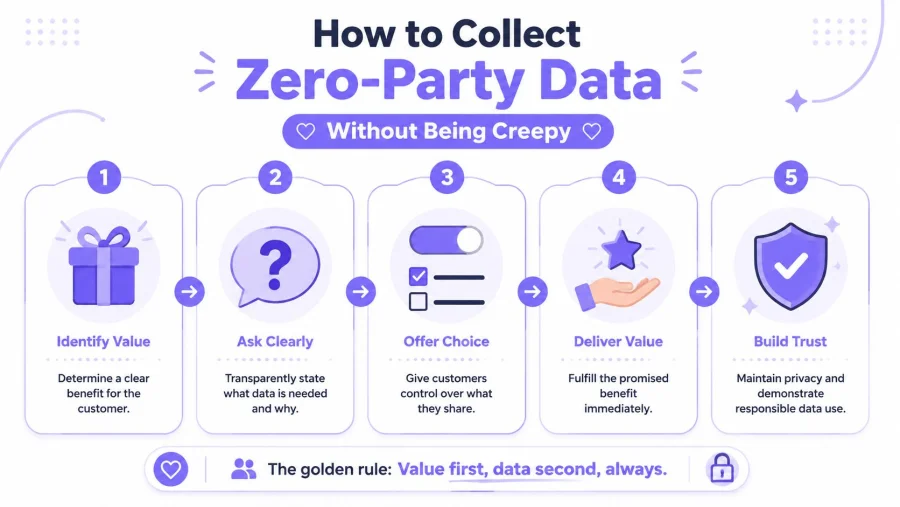
According to Qualtrics on zero-party data strategy, interactive experiences such as polls and surveys can significantly improve participation when paired with meaningful value exchange incentives. The same source says zero-party data is considered the "Holy Grail" of marketing because it removes guesswork.
Start with the value exchange
People don't share data out of charity. They share it because the exchange makes sense.
For an offline business, that usually means one of these:
- Welcome reward: A new customer scans a QR code and gets a first stamp, discount, or bonus.
- Better recommendations: A café asks for a favourite drink style, then uses that answer to tailor offers.
- Useful reminders: A salon asks how often someone wants to hear about openings or treatment updates.
- Exclusive access: A gym asks what class category matters most, then notifies members about the right sessions.
The reward doesn't have to be huge. It does have to feel fair.
One hard rule: If the business asks for detailed personal preferences, the customer should get something useful right away.
Keep the first ask short
The first interaction shouldn't feel like an application form.
A local business usually gets the best response by asking one or two questions at sign-up, then collecting more later if the customer keeps engaging. That's especially important in physical spaces where attention is short and the customer is standing at a counter, not sitting at a desk.
Good first questions are specific and low-friction.
Strong opening questions for different businesses
Coffee shops and cafés
- Favourite drink: Latte, flat white, cappuccino, tea, or something else
- Milk preference: Dairy, oat, soy, almond, or no preference
- Best contact channel: Email or SMS
Beauty salons and wellness centres
- Main interest: Cut, colour, treatment, nails, brows, massage
- Hair or skin concern: Dryness, repair, maintenance, sensitivity
- Preferred update type: Offers, reminders, or new services
Gyms and fitness studios
- Primary goal: Strength, fat loss, flexibility, general fitness
- Preferred class time: Morning, lunch, evening
- Update preference: Classes, promotions, or both
Retail and specialty stores
- Favourite product category: Ask by department or product family
- Shopping trigger: Gifts, weekly essentials, personal use
- Interest timing: Browse now, buy soon, buy seasonally
Use collection moments that feel natural
The timing matters as much as the wording.
A physical business doesn't need a formal survey campaign to collect zero-party data. It can use normal customer moments:
At first scan
The customer joins the loyalty programme and answers one optional question in exchange for a welcome benefit.After purchase
A short form asks, "How did you hear about us?" or "Want offers based on your favourites?"During a seasonal promotion
A business asks which product or service category the customer wants to hear about this month.Inside a preference update
Existing customers get a simple chance to update communication choices or interests.
A useful companion to this thinking is marketing insights from The Pulse Morristown, especially for businesses that want to turn declared preferences into emails customers want to open.
What doesn't work
Some approaches create resistance fast.
Avoid these collection mistakes
- Asking for too much detail at once: Long forms feel nosy, especially on a phone at the till.
- Using vague wording: "Help us personalise your experience" is weaker than "Tell us your favourite drink so we can send relevant offers".
- Hiding the reward: Customers shouldn't have to guess what they get for answering.
- Bundling every permission together: Give people choices. Some may want rewards updates but not broader promotions.
- Collecting answers and ignoring them: If a customer says they only want email, don't text them.
A simple script staff can use
Staff often need a sentence that doesn't sound robotic. This works well:
"If you'd like, scan here to join the loyalty programme. You can add your preferences so we send offers that actually match what you like."
That's clear, soft, and useful. It tells the customer what to do, why it helps, and what kind of outcome to expect.
The goal isn't to gather everything. The goal is to gather enough declared information to make the next interaction better.
Putting Your Zero-Party Data to Work with BonusQR
This is the part many guides skip. Collecting zero-party data is only half the job. The value comes from using it in a way that feels timely and relevant.
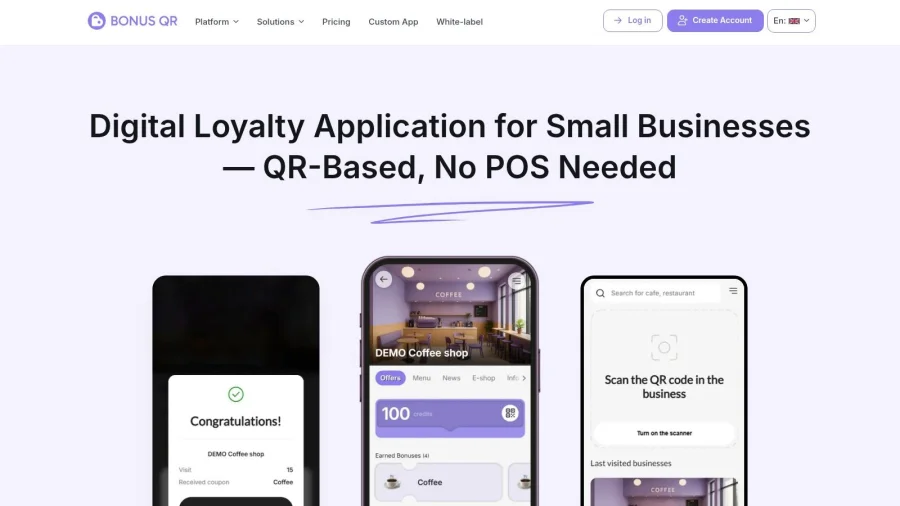
For local businesses, that usually means pairing a simple QR-based loyalty flow with a small set of customer-declared preferences. The practical gap is important here. As noted in Salesforce's discussion of zero-party data for personalisation, many guides define intentional sharing well but don't explain how brick-and-mortar businesses can legally capture it without POS integration under GDPR, especially through physical QR-based value exchanges.
That offline reality is where a QR loyalty system makes the concept usable.
Use case one for a salon
A salon asks new loyalty members one optional question during sign-up: "Which service are you most interested in?" The options include colour, repair treatments, cuts, and styling.
A customer chooses repair treatments.
That answer becomes useful later when the salon launches a treatment-focused campaign. Instead of pushing the same message to the entire database, the salon sends the offer to people who already declared interest in that category. The message feels relevant because it matches a stated need.
This also helps front-desk staff. When the customer returns, the team has more context for conversation and can recommend products or appointments with more confidence.
Use case two for a restaurant or café
A restaurant captures birthday month and communication preference during loyalty enrolment. The birthday field is optional, and the customer knows why it's being asked.
Closer to that date, the business can send a celebratory reward or special invitation. That works because the customer volunteered the information and expects something better because of it.
This is also where a digital loyalty profile is more useful than a paper card. It can store the customer's declared details in one place and trigger a reward without staff having to remember it manually.
Use case three for a coffee shop
A coffee shop asks one simple question after sign-up: "What's your favourite drink category?" A customer picks iced coffee.
Weeks later, that customer hasn't visited for a while. Rather than sending a generic "we miss you" message, the shop can send a more relevant nudge tied to iced drinks, seasonal flavours, or a matching reward.
That message isn't based on guesswork. It's based on what the customer said.
The best re-engagement campaigns don't just ask customers to come back. They give them a reason that fits their preference.
Why QR matters in physical businesses
Digital-first advice often assumes the customer journey starts on a website. Local businesses know that's often false. Instead, the starting point is a counter, a treatment room, a studio desk, or a takeaway queue.
A QR-led loyalty process works because it fits that environment:
- No extra hardware: Staff don't need a complex till setup.
- Fast join flow: The customer can scan and sign up on the spot.
- Declared preferences: Questions can appear during or after enrolment.
- Simple redemption: Rewards can be scanned and redeemed in the same workflow.
For shops and hospitality businesses also trying to tighten how products are presented digitally, this guide on how to list your products offers useful ideas for making mobile-facing product information easier to browse.
From data collection to action
A lot of local owners stop at collection because they worry the next step will be technical. It doesn't have to be.
A useful action model looks like this:
| Collected preference | Practical action | Customer-facing result |
|---|---|---|
| Favourite drink | Send category-specific offer | More relevant café promotion |
| Birthday month | Trigger timely reward | Better return visit opportunity |
| Service interest | Segment by treatment type | More targeted salon campaign |
| Preferred channel | Send only by chosen method | Fewer unwanted messages |
That small structure is enough to make zero-party data practical. It turns a static list into a working loyalty asset.
Businesses that want to set this up cleanly can use a dedicated guide to starting a rewards system to map the offer, sign-up flow, and follow-up messages before launch.
Your Simple Zero-Party Data Strategy for 2026
The easiest way to start is not to build a giant data programme. It's to build one useful loop.
Choose one goal. Offer one clear reward. Ask one smart question. Then use the answer.
Step one is to define a single outcome
Don't begin with "collect more customer data". That's too vague.
Begin with a business need:
- More repeat visits from first-time buyers
- Better campaign relevance for existing customers
- Higher redemption on a seasonal offer
- Cleaner communication preferences for future outreach
A specific outcome makes it easier to choose the right question.
Step two is to choose a fair exchange
The reward should match the ask.
If the business only needs one preference, a welcome perk, loyalty bonus, or targeted recommendation is often enough. If it asks for more detail, the value should be more obvious.
Customers don't need a lecture about data strategy. They need a clear reason to participate.
Step three is to ask one question that leads to action
In this context, many businesses overcomplicate things.
A strong zero-party data question has three traits:
- It helps the customer: The answer improves offers, reminders, or recommendations.
- It helps the business act: The answer supports a real campaign or segmentation decision.
- It stays simple: The customer can answer in a few seconds.
Examples include favourite drink, preferred appointment type, birthday month, product interest, or preferred contact channel.
Keep the first question small enough that a busy customer can answer it while standing at the till.
Step four is to launch, measure, and refine
The first version doesn't need to be perfect. It needs to be live and useful.
A QR-based rewards system is one of the simplest ways to test this in a physical business because it combines enrolment, declared preferences, reward delivery, and follow-up in one customer journey. BonusQR is built for exactly that kind of setup. It gives brick-and-mortar businesses a fast way to run QR loyalty without POS integration, collect customer preferences through a clear value exchange, and use those insights to send more relevant rewards and messages.
For businesses comparing options, Affordable rewards program pricing makes it easier to see what can be launched without taking on the cost or complexity of an enterprise platform.
A coffee shop doesn't need enterprise software to learn what regulars drink. A salon doesn't need a custom tech stack to remember treatment interests. A gym doesn't need a complicated app to ask members what they want help with.
They need a clean offer, a simple question, and a system that helps them act on the answer.
Zero-party data isn't complicated once the jargon is stripped away. It's customer information shared on purpose, with a clear benefit on both sides. For local businesses, that's one of the most practical ways to build better loyalty, stronger trust, and more relevant marketing without relying on guesswork.
BonusQR gives cafés, salons, gyms, restaurants, and retailers a straightforward way to do that with QR-based rewards, customer profiles, automated campaigns, and measurable results. The fastest next step is to start with one question, one reward, and one live campaign.