Loyalty in marketing is defined as the ongoing emotional and behavioural commitment of customers to a brand, sustained by consistent value, trust, and personalised experience rather than transactions alone. European loyalty programme membership averages 63.3% across the continent in 2026, with Great Britain reaching 86.1% and Finland leading at 88.7%. Those figures confirm that loyalty programmes are now mainstream infrastructure, not a differentiator on their own. What separates winning brands is the depth of connection they build. 93% of marketers identified personalised customer experience as the most critical loyalty trend in 2025/2026, a 40-point increase over the previous year. That shift signals a fundamental change in what loyalty marketing actually requires.
What is loyalty in marketing, and why does it matter now?
Loyalty in marketing describes the discipline of designing, measuring, and sustaining customer commitment to a brand over time. The industry term is customer loyalty management, and it covers everything from reward mechanics to relationship-building communications. Understanding what drives this commitment is the starting point for any effective retention strategy.
Customer loyalty matters because retaining an existing customer costs significantly less than acquiring a new one. Loyal customers also spend more per transaction, refer others, and provide more useful feedback. The impact of loyalty on sales compounds over time: a customer who returns consistently generates far greater lifetime value than a one-time buyer attracted by a discount.

Loyalty marketing tactics have evolved considerably. The discipline now spans points programmes, stamp cards, cashback schemes, tiered membership, early access rewards, and personalised communications. Each tactic serves a different purpose, and the most effective programmes combine several of them. The goal is not simply to incentivise repeat purchase. The goal is to make customers feel that the brand understands and values them.
Measuring customer loyalty requires both behavioural and attitudinal data. Behavioural metrics include purchase frequency, average order value, and churn rate. Attitudinal metrics include Net Promoter Score and brand sentiment. Neither set of metrics tells the full story alone. A customer who buys regularly but would switch brands for a 10% discount is not truly loyal.
What differentiates transactional and emotional loyalty in marketing?
Transactional loyalty is built on logical, financial incentives. A customer returns because they receive points, a discount, or a cashback reward. The relationship is conditional: remove the incentive and the customer leaves. This type of loyalty is easy to launch but fragile.
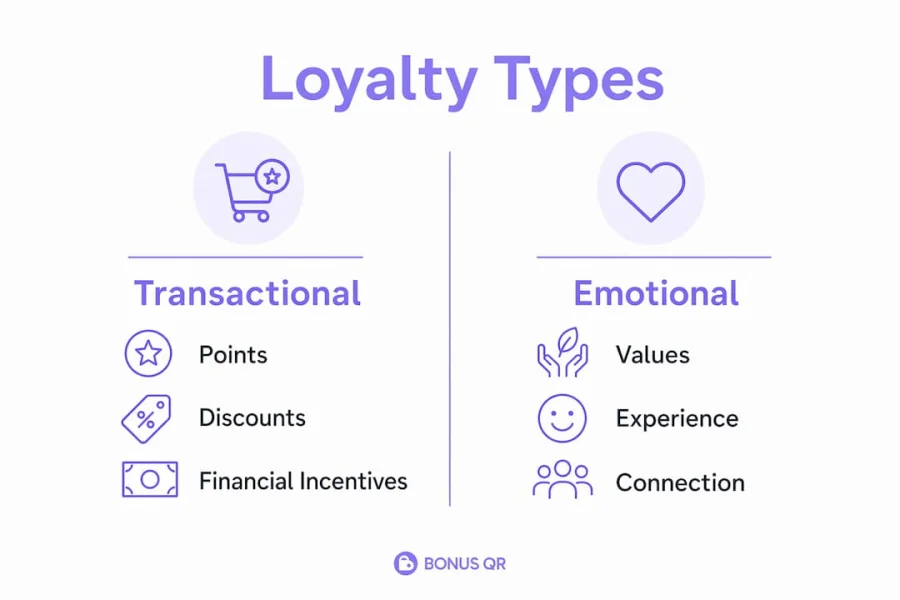
Emotional loyalty operates differently. It is built on values alignment, consistent positive experience, and the feeling of being recognised as an individual. Emotional loyalty creates brand advocates who remain committed even during price changes or supply disruptions, unlike transactional loyalty which evaporates the moment a competitor offers a better deal.
The distinction matters practically. Consider two coffee shop customers. The first visits every week because they collect stamps toward a free drink. The second visits every week because the staff know their order, the atmosphere suits their routine, and they trust the brand’s sourcing ethics. If the stamp card disappears, the first customer may not return. The second almost certainly will.
Emotional loyalty also produces advocacy. Customers who feel genuinely connected to a brand recommend it without prompting. That word-of-mouth effect reduces acquisition costs and attracts higher-quality new customers who arrive with a positive predisposition. 41.9% of European programme members say loyalty programmes increase their loyalty, but only 33.3% feel more emotionally connected to the brand. That gap represents the opportunity most businesses are currently missing.
- Transactional loyalty: driven by discounts, points, and cashback; effective short-term but vulnerable to competitor offers
- Emotional loyalty: driven by values, recognition, and consistent experience; produces advocacy and long-term retention
- The gap: most programmes deliver transactional mechanics but fail to build emotional connection
- The opportunity: brands that close this gap gain customers who stay, spend more, and refer others
Pro Tip: Build at least one non-financial element into every loyalty programme. Status recognition, early access to new products, or a personalised birthday reward costs little but signals to customers that you see them as individuals, not just repeat buyers.
How do cultural and regional differences shape loyalty strategies in Europe?
Loyalty is not universal. Cultural differences shape loyalty motivations strongly across regions, which means a programme designed for one market will often underperform in another. Marketers planning European campaigns need to treat cultural context as a design constraint, not an afterthought.
Polish consumers respond strongly to instant rewards and emotional engagement. They want to feel the benefit immediately and appreciate programmes that communicate warmth and community. German consumers prefer transparent, logical reward structures where the value exchange is clear and the rules are unambiguous. British consumers favour programmes that integrate smoothly into existing routines, such as supermarket apps or contactless payment-linked schemes, with minimal friction at the point of redemption.
These differences affect not just reward mechanics but communication style, frequency, and channel. A push notification that feels friendly and spontaneous to a Polish customer may feel intrusive to a German one. A loyalty email that explains programme rules in detail reassures a German audience but may feel overly formal to a British one.
| Market | Primary loyalty driver | Preferred reward type | Key design principle |
|---|---|---|---|
| Poland | Emotion and instant gratification | Immediate rewards, community feel | Warmth in communication |
| Germany | Logic and transparency | Clear value exchange, structured tiers | Unambiguous rules |
| Great Britain | Routine integration | Frictionless redemption, app-linked | Convenience above all |
| Finland | High programme penetration | Broad participation, digital-first | Accessibility and simplicity |
| Romania / Bulgaria | Lower penetration | Growth opportunity markets | Education and onboarding |
The membership data reinforces this point. Finland’s 88.7% membership rate reflects a market where digital loyalty infrastructure is deeply embedded in daily life. Romania’s 44.5% and Bulgaria’s 44.4% rates indicate markets where customer retention strategies are still maturing and where early movers have a significant advantage.
Pro Tip: When expanding a loyalty programme across European markets, do not translate the programme. Redesign the communication logic and reward triggers for each country. The mechanics can stay the same; the emotional framing must change.
Why are traditional points and discount programmes no longer sufficient on their own?
Points and discounts remain useful, but they have become the baseline expectation rather than a competitive advantage. Points and discounts are now entry-level loyalty incentives and do not secure lasting emotional attachment on their own. Customers expect them. They do not inspire gratitude or advocacy.
The shift in what drives loyalty is clear. Customers now weigh the total experience of dealing with a brand, not just the financial return. A programme that offers generous points but a frustrating redemption process, slow customer service, or inconsistent product quality will not retain customers. The experience surrounding the reward matters as much as the reward itself.
True loyalty is built by reducing customer effort and consistently delivering high-quality experience beyond financial rewards. This means removing friction from every touchpoint: easy sign-up, clear programme rules, instant reward visibility, and simple redemption. The harder it is to use a loyalty programme, the less loyalty it generates.
Modern loyalty programmes address this by combining multiple reward types with experience design:
- Status and recognition: tiered membership that signals a customer’s value to the brand publicly
- Experiential rewards: early product access, exclusive events, or behind-the-scenes content
- Personalised offers: rewards triggered by individual behaviour, not generic segments
- Effort reduction: frictionless sign-up, mobile-first redemption, and automatic reward crediting
- Relationship communications: messages that acknowledge milestones, preferences, and history
The brands gaining ground in 2026 treat their loyalty programme as a customer experience layer, not a discount mechanism. Every interaction within the programme is an opportunity to reinforce why the customer chose this brand. That framing changes how programmes are designed, measured, and communicated.
What practical strategies can marketers use to build lasting loyalty in 2026?
Building lasting loyalty requires a structured approach that goes beyond launching a points scheme. The following strategies reflect current best practice for marketing professionals and business owners who want measurable results.
-
Make personalisation the baseline, not the premium. 93% of marketers now treat personalised experience as the top loyalty driver. Use purchase history, visit frequency, and preference data to tailor every communication. A customer who receives a reward relevant to their actual behaviour is far more likely to act on it than one who receives a generic offer. Platforms like Bonusqr support this through real-time analytics and segmented push notifications.
-
Audit your programme continuously, not annually. Data-driven dynamic loyalty programmes tailored to customer behaviour and seasonality improve retention and budgeting efficiency. Set a monthly review cadence. Identify which reward types are being redeemed, which customer segments are disengaging, and which communications are driving visits. Adjust mechanics based on evidence, not assumption.
-
Balance automation with human communication. AI and automation must be balanced with human relationship-building. Automated messages are efficient, but robotic communication alienates customers. Use automation for timing and personalisation triggers, but write communications in a voice that reflects your brand’s character. A birthday message that reads like a system notification misses the point entirely.
-
Combine financial and non-financial rewards. Effective loyalty programmes integrate status, experience, early access, and recognition alongside discounts and points. Map your customer segments and identify what each group values most. High-frequency buyers may value status recognition. Occasional buyers may respond better to a surprise reward that re-engages them. You can explore relationship marketing approaches to understand how non-financial value builds deeper commitment.
-
Treat loyalty as an operational process, not a project. Loyalty should be managed with dynamic adjustments for product launches, seasonality, and customer segment activity. This means assigning ownership, setting KPIs, and reviewing performance on a fixed schedule. A loyalty programme that launches and then runs unchanged for two years is not a loyalty strategy. It is a discount scheme with extra steps.
-
Measure both behaviour and attitude. Track purchase frequency and churn alongside Net Promoter Score and programme satisfaction. Behavioural data tells you what customers do. Attitudinal data tells you why. Both are needed to understand whether your programme is building genuine loyalty or simply incentivising repeat purchase. For practical guidance on customer retention metrics, focus on the combination of both data types.
-
Design for your specific market. Apply the cultural insight from the regional analysis above. A programme built for British consumers should prioritise frictionless integration. One built for Polish consumers should lead with emotional warmth and instant reward visibility. Generic programme design produces generic results. You can also review retail loyalty trends in 2026 to align your programme with current market expectations.
Pro Tip: Use customer retention strategies that combine programme mechanics with service quality improvements. The best loyalty programme in the world cannot compensate for a poor customer experience.
Key takeaways
Loyalty in marketing is built on emotional connection and consistent value, not points and discounts alone. Programmes that close the gap between transactional mechanics and genuine emotional engagement produce the strongest retention and advocacy results.
| Point | Details |
|---|---|
| Emotional loyalty outperforms transactional | Customers with emotional connection stay loyal through price changes and supply disruptions. |
| Personalisation is now the baseline | 93% of marketers rate personalised experience as the top loyalty driver in 2026. |
| Cultural context shapes programme design | Polish, German, and British consumers have distinct reward preferences that require tailored approaches. |
| Points and discounts are entry-level only | Lasting loyalty requires effort reduction, experience quality, and non-financial rewards alongside incentives. |
| Loyalty is an ongoing process | Continuous auditing, data analysis, and dynamic adjustment are required for sustained programme performance. |
Why I think most loyalty programmes are solving the wrong problem
After working across loyalty strategy for a number of years, the pattern I see most often is this: businesses invest in the mechanics of a loyalty programme and then wonder why retention does not improve. They add more points, more tiers, more discount codes. The programme grows more complex, and customer engagement stays flat.
The problem is not the mechanics. The problem is that most programmes are designed to reward purchase rather than to build a relationship. Those are different objectives, and they require different designs.
The cultural dimension compounds this. I have seen European businesses launch a single programme across multiple markets and then attribute poor performance in one country to “low loyalty culture” when the real cause is a mismatch between the programme’s emotional logic and the local consumer’s expectations. A German customer who cannot understand the points calculation is not disloyal. They are confused.
The brands I find most credible in this space are the ones that treat loyalty as an operational discipline with a dedicated owner, a monthly review cycle, and a clear distinction between what the data shows and what the team assumes. They are also the ones that resist the temptation to automate everything. A well-timed, genuinely personal message from a brand is still one of the most effective loyalty tools available. No algorithm produces that without human editorial judgement behind it.
The risk of relying solely on transactional rewards is not just that customers leave when the discount stops. It is that you never learn what they actually value. And without that knowledge, you cannot build anything that lasts.
— Michal
How Bonusqr supports your loyalty marketing strategy
Bonusqr is a SaaS platform built for businesses that want to launch and manage digital loyalty programmes without complex POS integration or long development timelines. The platform supports points collection, stamp cards, cashback, coupon distribution, and visit-based rewards, giving you the flexibility to combine financial and non-financial incentives in one place.
For businesses focused on personalisation, Bonusqr’s mobile and web application delivers real-time analytics, segmented push notifications, and automated campaign tools that respond to individual customer behaviour. Larger businesses can access white-label loyalty app solutions with full branding control. Whether you are building your first customer loyalty card programme or refining an existing one, Bonusqr provides the tools to move from transactional incentives to genuine customer relationships.
FAQ
What is loyalty in marketing?
Loyalty in marketing is the ongoing emotional and behavioural commitment of customers to a brand, sustained by consistent value, trust, and personalised experience. It is managed through customer loyalty programmes, communications, and experience design.
What drives customer loyalty in 2026?
Personalised customer experience is the top loyalty driver in 2026, identified by 93% of marketers as critical. Reducing customer effort and delivering consistent quality across every touchpoint are equally important.
What is the difference between transactional and emotional loyalty?
Transactional loyalty is based on financial incentives such as points and discounts and is lost when a competitor offers a better deal. Emotional loyalty is based on values alignment and genuine connection, producing advocacy and resilience to competitive pressure.
How do you measure customer loyalty effectively?
Effective measurement combines behavioural metrics such as purchase frequency and churn rate with attitudinal metrics such as Net Promoter Score and programme satisfaction. Neither set of data tells the full story without the other.
Why do points and discounts alone not build lasting loyalty?
Points and discounts are now entry-level expectations rather than differentiators. Lasting loyalty requires non-financial rewards, effort reduction, and consistent experience quality that makes customers feel valued beyond the transaction.


