Customer segmentation is defined as the practice of dividing your customer base into distinct groups that share common characteristics, so you can deliver targeted marketing and improve business outcomes. These groups, known as customer segments, are built around factors such as demographics, purchasing behaviour, needs, and geography. Brands using personalised marketing via granular segmentation earn 40% more revenue than competitors. That figure alone makes segmentation one of the highest-return activities available to a small or medium-sized enterprise. Whether you run a café, a boutique, or a professional services firm, understanding how to segment customers is the foundation of every effective marketing decision you will make.
What is customer segmentation and how does it work?
Customer segmentation is the process of sorting your existing customers into groups based on shared traits, then using those groups to shape your messaging, offers, and channels. The customer segmentation definition most widely used in marketing practice covers five core bases: demographics, behaviour, needs, values, and geography. Each base answers a different question about who your customers are and what they want.
Demographic segmentation groups customers by age, gender, income, or occupation. A gym targeting women aged 25–40 with disposable income uses demographic segmentation. Behavioural segmentation groups customers by purchase frequency, brand loyalty, or product usage. A coffee shop identifying customers who visit five or more times per week is applying behavioural logic.

Psychographic segmentation goes deeper, grouping customers by values, lifestyle, and personality. A sustainable fashion brand separating eco-conscious buyers from trend-driven buyers is using psychographic data. Needs-based segmentation identifies what problem each group is trying to solve, regardless of who they are. Value-based segmentation ranks customers by their revenue contribution, separating high-value accounts from occasional buyers.
Here is a quick comparison to help you choose the right starting point:
| Segmentation type | Primary data source | Best for SMEs when… |
|---|---|---|
| Demographic | Age, income, occupation | You have basic customer profile data |
| Behavioural | Purchase history, visit frequency | You have a loyalty programme or POS data |
| Psychographic | Surveys, social listening | You sell lifestyle or values-driven products |
| Needs-based | Customer feedback, support tickets | You offer multiple product lines |
| Value-based | Revenue per customer | You want to prioritise retention spend |
| Geographic | Location, postcode | You operate across multiple areas or regions |
Pro Tip: Start with behavioural segmentation if you already collect transaction data. It requires no surveys and delivers immediate, measurable results.
Why is customer segmentation essential for SMEs?
Treating all customers as a single group leads to irrelevant communication, customer frustration, and lost revenue. This is the core risk that segmentation removes. For an SME with a limited marketing budget, sending the wrong message to the wrong person is not just ineffective. It actively damages your relationship with that customer.
The business case for segmentation is well established. A European retail bank applied granular segmentation to its checking account customers and recorded a 20% increase in revenues within that product line. That result came not from acquiring new customers, but from communicating more relevantly with existing ones. For an SME, the same principle applies at a smaller scale with equally meaningful impact.
“Segmentation is no longer a marketing-only activity. It requires alignment across your entire organisation to create cohesive customer journeys.” — Databricks
This insight matters because many SMEs treat segmentation as a campaign tactic rather than a business-wide discipline. When your sales team, customer service staff, and marketing function all operate from the same customer data, your communications feel consistent and personal. When they operate in silos, customers receive contradictory messages and lose confidence in your brand.
The importance of customer segmentation also shows up in customer retention. Customers who receive relevant offers are more likely to return, spend more, and refer others. Segmentation is therefore not just a tool for acquisition. It is a direct driver of lifetime customer value, which is the metric that matters most for long-term SME growth.
Analytics-driven segmentation delivers measurably better ROI than undifferentiated marketing. The reason is straightforward: when you know which customers respond to discounts, which respond to loyalty rewards, and which respond to early access offers, you stop wasting spend on the wrong incentives.
How does customer segmentation compare to market segmentation?
Customer segmentation and market segmentation are related but distinct disciplines. Confusing them leads to misaligned strategy and wasted resources. Customer segmentation focuses on existing customers using first-party data you already own, while market segmentation covers the wider potential market using third-party research and external data sources.
Market segmentation asks: “Who could buy from us?” Customer segmentation asks: “Who already buys from us, and how do we keep them?” The goals are different, the data sources are different, and the decisions they inform are different.
| Dimension | Customer segmentation | Market segmentation |
|---|---|---|
| Focus | Existing customers | Potential market |
| Data type | First-party (your own CRM, loyalty data) | Third-party (industry research, surveys) |
| Primary goal | Retention, upsell, personalisation | Market entry, product development |
| Typical SME use | Loyalty campaigns, targeted promotions | Launching a new product or entering a new area |
For most SMEs, customer segmentation delivers faster returns because you are working with people who already trust you. Market segmentation is more relevant when you are planning a new product launch or considering expansion into a different region or demographic.
Pro Tip: Run customer segmentation first. Once you understand your best existing customers in detail, use that profile to inform your market segmentation and find more people who look like them.
The two approaches work best together. Your customer segments reveal which types of buyer generate the most value. Your market segmentation then tells you where to find more of them. This sequence prevents the common SME mistake of chasing new audiences before fully understanding the ones already in your database.
How can SMEs implement effective customer segmentation strategies?
Effective customer segmentation strategies follow a clear sequence. Skipping steps leads to segments that look good on paper but fail to drive results. Here is a practical framework you can apply regardless of your business size or sector.
1. Collect and unify your customer data
Start by gathering data from every customer touchpoint: your point-of-sale system, loyalty programme, email platform, website analytics, and customer service records. Successful segmentation requires unifying data across product, service, and sales to create a consistent customer view. Without this unified picture, your segments will be incomplete and your targeting will miss the mark.
Tools like Google Analytics 4, Mailchimp, and a well-configured CRM such as HubSpot or Zoho CRM give SMEs the data infrastructure needed to begin. You do not need enterprise-level technology. You need consistent data collection across your key channels.
2. Choose the right segmentation model
Select the segmentation type that matches the data you already have. If you have purchase history, start with behavioural segmentation. If you have postcode data, geographic segmentation is immediately available. Avoid building segments around data you do not yet collect. That approach delays results and creates gaps in your analysis.
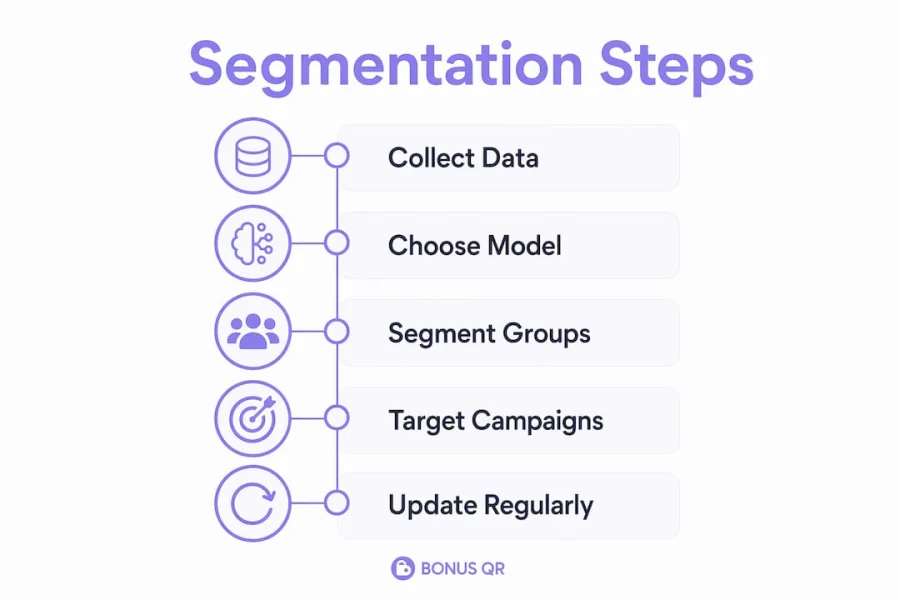
3. Start with 3–5 segments
Over-segmenting leads to high management costs that outweigh any revenue lift. The practical advice from experienced practitioners is to begin with 3–5 segments, prove the return on investment for each, and then expand. This keeps your campaigns manageable and your team focused.
A local restaurant, for example, might start with three segments: regular weekly diners, occasional visitors, and lapsed customers who have not returned in 90 days. Each group receives a different message. Regulars get a loyalty reward. Occasional visitors get a midweek offer. Lapsed customers get a win-back incentive. That is a complete segmentation strategy built from simple data.
4. Build targeted campaigns for each segment
Once your segments are defined, create specific offers, messages, and channels for each one. A customer who visits every week does not need a discount. They need recognition and an exclusive reward. A customer who bought once six months ago needs a reason to return. Matching the message to the segment is where the revenue impact becomes visible.
Retail communication best practices confirm that personalised messaging by segment consistently outperforms generic broadcast campaigns. The difference is not subtle. Segmented email campaigns, for instance, generate significantly higher open rates and conversion than unsegmented sends.
5. Update your segments regularly
Static customer lists become outdated quickly. Customer behaviour changes, spending patterns shift, and new customers enter your database. AI-driven segmentation updates customer groups automatically in real time as new data arrives across touchpoints. For SMEs without AI tools, a monthly or quarterly review of your segments is sufficient to keep them accurate and relevant.
Pro Tip: Set a calendar reminder to review your segments every quarter. Check whether customers have moved between groups and update your campaigns accordingly. This single habit prevents your segmentation from becoming stale.
Customer engagement in retail improves measurably when segmentation is treated as an ongoing process rather than a one-time exercise. The businesses that see the strongest results are those that treat their segments as living groups, not fixed lists.
Key takeaways
Customer segmentation is the single most direct way for an SME to increase marketing relevance, reduce wasted spend, and grow customer lifetime value.
| Point | Details |
|---|---|
| Definition is clear | Customer segmentation divides existing customers into groups by shared traits to enable targeted marketing. |
| Start small | Begin with 3–5 segments using data you already own, then expand once ROI is proven. |
| Segmentation beats undifferentiated marketing | Brands using granular segmentation earn 40% more revenue than those sending generic messages. |
| Customer vs. market segmentation | Customer segmentation uses first-party data for retention; market segmentation uses external data for acquisition. |
| Keep segments current | Review and update your segments at least quarterly to reflect changing customer behaviour. |
Segmentation works when you treat it as a business discipline, not a campaign trick
I have worked with dozens of SME owners who tried segmentation once, saw modest results, and concluded it was not worth the effort. In almost every case, the problem was not the segmentation itself. It was that they built their segments once, ran one campaign, and moved on.
The businesses I have seen get the most from segmentation are the ones that treat it the way they treat their accounts: as something that needs regular attention, honest review, and adjustment. They do not obsess over having ten perfectly defined segments. They start with three, learn from the results, and refine from there.
The other mistake I see constantly is treating segmentation as a marketing department activity. Your sales team knows things about your best customers that your email platform never will. Your customer service staff hears the complaints that reveal unmet needs. When those insights feed into your segments, the quality of your targeting improves dramatically. When they do not, you end up with segments that look logical but miss the human reality of why people buy from you.
My honest advice: pick one segmentation type, apply it to your existing data this week, and run one targeted campaign. The results will tell you more than any framework. From there, loyalty trends in 2026 show that the SMEs pulling ahead are those combining segmentation with structured loyalty programmes, because loyalty data is the richest source of behavioural insight available to a small business.
— Michal
How Bonusqr helps SMEs put segmentation into practice
Bonusqr is built for exactly the kind of segmentation work described in this article. Its loyalty platform captures first-party customer data across every visit, purchase, and reward interaction, giving you the unified customer view that effective segmentation requires. You can track visit frequency, spending thresholds, and reward redemption patterns without needing a POS integration or a dedicated data team. Explore the full range of loyalty system features to see how Bonusqr supports points collection, stamp cards, cashback, and automated campaign triggers. Each feature generates the behavioural data that turns a generic customer list into actionable segments you can market to with precision.
FAQ
What is the customer segmentation definition in simple terms?
Customer segmentation is the process of dividing your customers into groups based on shared characteristics such as age, buying behaviour, or location. Each group receives marketing tailored to their specific needs and preferences.
What are the main types of customer segmentation?
The main types are demographic, behavioural, psychographic, needs-based, value-based, and geographic segmentation. Behavioural and demographic segmentation are the most practical starting points for SMEs with existing transaction data.
How many customer segments should a small business start with?
Start with 3–5 segments. Practitioners advise against over-segmenting early, as the management costs can outweigh the revenue gains until each segment’s return on investment is proven.
How does customer segmentation differ from market segmentation?
Customer segmentation uses your own first-party data to better serve existing customers. Market segmentation uses external research to identify potential new customers in the broader market.
How often should customer segments be updated?
Segments should be reviewed at least quarterly. Customer behaviour changes over time, and outdated segments lead to irrelevant messaging. AI-driven platforms update segments automatically; manual reviews work well for SMEs using standard CRM tools.


