A referral program is a structured marketing strategy that rewards existing customers for recommending a business’s products or services to others. Also known as a customer referral programme, it is one of the most cost-effective customer acquisition tools available to business owners and marketers today. Platforms like Salesforce and Shopify have documented how referral programmes consistently outperform paid media on lead quality, and the data from 2026 confirms that trend is accelerating. Whether you run a local retail shop or a growing ecommerce brand, understanding how referral programmes work gives you a direct advantage in acquiring customers who are already primed to buy.
What is a referral program and how does it work?
A referral programme operates on a simple principle: your existing customers become your most credible sales channel. The mechanics, however, require careful design to function reliably at scale.

At its core, the process begins when a business gives each participating customer a unique referral link or code. That customer shares the link with friends, family, or colleagues. When a new person clicks the link and completes a qualifying action, such as signing up or making a purchase, the system records the conversion and triggers a reward. Referral links use unique URLs with embedded codes or UTM parameters, which allow precise attribution of every sale back to the referring customer. This removes the need for manual tracking and reduces errors significantly.
Cookies play a supporting role in this process. When a prospect clicks a referral link, a cookie is stored in their browser. If they return to complete a purchase within the defined conversion window, the system still attributes that sale to the original referrer. The length of that window matters. Too short, and legitimate referrals go unrewarded. Too long, and the data becomes unreliable.
Referral programmes fall into two main categories:
- One-sided programmes reward only the referrer. The new customer receives no direct incentive. This model works well when the product itself is highly desirable and the referrer is motivated by status or loyalty points.
- Two-sided programmes reward both the referrer and the new customer. Two-sided programmes generate more engagement because they create a win-win outcome that motivates both parties to participate. Zendesk and Salesforce both advocate this model for businesses focused on volume and retention.
Reward triggers vary by business type. Common triggers include completing a registration, making a first purchase, or reaching a minimum spend threshold. Choosing the right trigger directly affects your conversion rate and the perceived fairness of the programme.
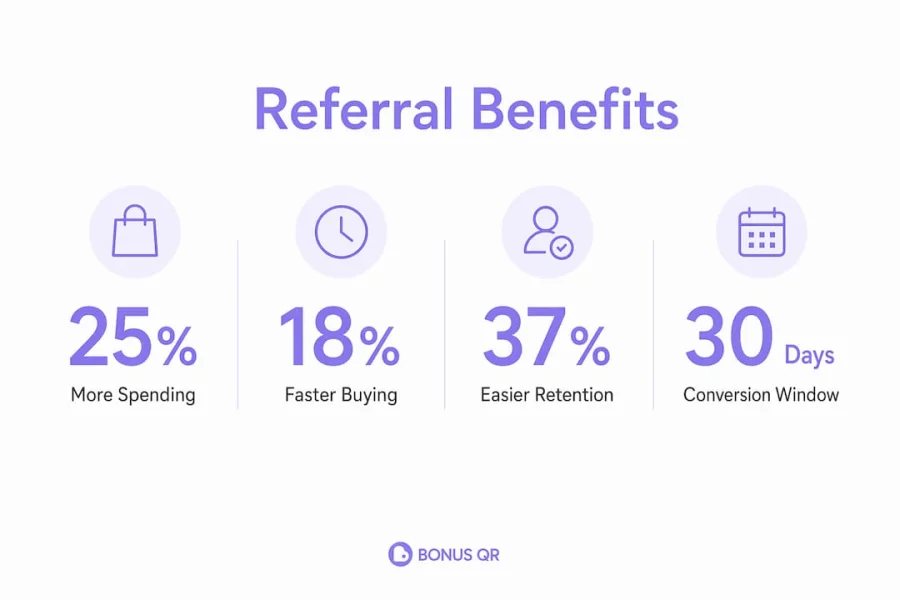
Pro Tip: Set your conversion window to at least 30 days. Most referred customers do not convert on their first visit, and a short window will cause your system to miss legitimate referrals, which erodes participant trust over time.
What are the proven benefits of referral programs for businesses?
Referral marketing delivers measurable advantages that most other acquisition channels cannot match. The benefits extend well beyond the initial sale.
Referred customers spend more and stay longer
Referred customers buy 18% faster, spend 25% more, and are 37% easier to retain than customers acquired through paid channels. Those three figures together mean a referred customer is worth considerably more over their lifetime than a customer you paid to acquire through advertising. Tremendous documents this pattern across multiple industries, and it holds true for both retail and service businesses.
The reason is straightforward. A referred customer arrives with a pre-existing level of trust. A friend or colleague has already vouched for the business, so the new customer skips the scepticism that typically slows down a first purchase.
Lower acquisition costs through performance-based rewards
Referral marketing reduces upfront acquisition costs by operating on a pay-for-performance model. You only issue a reward when a referral converts. This is fundamentally different from paid media, where you spend money regardless of whether a click becomes a customer. For small businesses with limited marketing budgets, this distinction is significant.
The table below compares referral marketing against traditional paid acquisition on the metrics that matter most to business owners.
| Metric | Referral marketing | Paid media |
|---|---|---|
| Cost model | Pay on conversion | Pay per click or impression |
| Lead quality | High (trust-based) | Variable |
| Customer retention | 37% easier to retain | Average |
| Speed to purchase | 18% faster | Average |
| Scalability | Grows with customer base | Requires increased spend |
The referral contagion effect
The most underappreciated benefit of referral programmes is what researchers at the American Marketing Association call the referral contagion effect. Referred customers generate 31%–57% more referrals themselves compared to customers acquired through other channels. This creates a compounding multiplier effect across multiple generations of referrals.
The practical implication is significant. If you measure your referral programme only by first-order conversions, you are undervaluing it. Ignoring multi-wave referral behaviour leads to undervaluation of programmes by 20%–36%. Marketers who account for downstream referrals make better decisions about how much to invest in their incentive structures.
How to design effective referral incentives and reward structures
The incentive is the engine of any referral programme. Get it wrong, and participation stays low. Get it right, and your customers do your marketing for you.
One-sided versus two-sided rewards
The choice between one-sided and two-sided reward structures is the first decision you need to make. One-sided programmes reward only the referrer, which keeps costs lower but reduces the motivation for the new customer to act quickly. Two-sided programmes reward both parties, and the evidence consistently shows they generate higher participation rates.
The table below outlines the practical differences between the two models.
| Feature | One-sided | Two-sided |
|---|---|---|
| Who receives a reward | Referrer only | Both referrer and new customer |
| Participation rate | Moderate | Higher |
| Cost per referral | Lower | Higher |
| Best suited for | Premium or high-margin products | Volume-driven or competitive markets |
| Customer trust signal | Moderate | Strong |
Types of referral incentives
The most common referral incentives fall into four categories:
- Discounts on future purchases, offered to the referrer, the new customer, or both. These work well for businesses with repeat purchase cycles.
- Store credit added directly to a customer account. Store credit keeps the value within your business and encourages a follow-up purchase.
- Gift cards or prepaid cards provide a tangible, flexible reward. Tremendous notes that small incentives such as $20 prepaid cards can successfully convert referred customers in competitive markets.
- Free products or services work particularly well for subscription businesses or those with low marginal costs per unit.
The key principle is to make the reward feel meaningful without eroding your profit margin. A discount of 10%–15% on a future purchase is typically sufficient to motivate action without significantly cutting into revenue.
Pro Tip: Avoid making your reward too complicated to claim. If a customer has to jump through multiple steps to redeem their incentive, they will abandon the process. Automated referral links that apply discounts at checkout, as Shopify recommends, remove that friction entirely.
What are some examples and best practices of successful referral programs?
Knowing the theory is useful, but seeing how referral programmes work in practice is what helps you build one that actually delivers results.
Attributes of programmes that consistently work
The most effective referral programmes share a set of common characteristics. Understanding these attributes helps you avoid the most common design mistakes.
- Ease of sharing. The referral link or code must be simple to copy, share via messaging apps, and use on mobile. If sharing requires more than two taps, participation drops.
- Clear communication. Customers need to know exactly what they will receive, when they will receive it, and what the new customer needs to do. Ambiguity kills participation.
- Relevant rewards. The incentive must match what your customers actually value. A coffee shop offering a free drink for a referral is more compelling than a generic discount code.
- Timely reward delivery. Delays between conversion and reward delivery reduce trust. Automated systems that trigger rewards instantly perform significantly better than manual processes.
- Multi-channel promotion. Successful programmes promote the referral opportunity across email, SMS, in-app notifications, and at the point of sale. Customers who are reminded regularly are far more likely to participate.
For practical referral programme ideas for small businesses, the most effective formats in retail include refer-a-friend discounts, loyalty point bonuses for referrals, and stamp card rewards tied to new customer sign-ups.
Tracking multi-generation referrals for accurate ROI
Most businesses track only first-order referrals. This is a measurement error that leads to underinvestment in programmes that are actually performing well. Marketers should value long-term referral cascades, because downstream referrals amplify ROI well beyond the initial conversion.
Practically, this means your tracking system needs to record not just who referred a new customer, but whether that new customer subsequently referred others. Platforms that support multi-generation attribution give you a far more accurate picture of your programme’s true value. You can find working referral programme examples that demonstrate this approach across different retail formats.
Technology tools that support programme management
Managing a referral programme manually is not sustainable beyond a handful of participants. Dedicated loyalty and referral platforms automate link generation, reward distribution, and reporting. Bonusqr, for example, supports electronic rewards, stamp cards, and push notification campaigns that can be configured to trigger referral rewards automatically. For a step-by-step approach to building your own programme, the guide to building a refer-a-friend programme covers the setup process in practical detail.
Key takeaways
A referral programme delivers its highest return when it combines two-sided incentives, automated tracking, and measurement that accounts for multi-generation referral effects.
| Point | Details |
|---|---|
| Core mechanics | Unique referral links automate attribution and reduce reward errors across sessions. |
| Two-sided incentives | Rewarding both referrer and new customer consistently produces higher participation rates. |
| Referred customer value | Referred customers buy 18% faster, spend 25% more, and are 37% easier to retain. |
| Referral contagion | Referred customers generate 31%–57% more referrals, compounding your programme’s ROI. |
| Measure beyond first order | Ignoring multi-generation effects undervalues your programme by 20%–36%. |
Why referral programmes outperform most channels: a practitioner’s view
The honest truth about referral programmes is that most businesses set them up and then forget to measure them properly. I have seen this pattern repeatedly. A business launches a refer-a-friend offer, tracks first-order sign-ups, decides the numbers look modest, and quietly shelves the programme. What they missed is the second and third wave of referrals that their initial cohort generated.
The referral contagion research from the American Marketing Association changed how I think about programme ROI. When you account for the downstream referrals that referred customers generate themselves, the true value of a single successful referral is substantially higher than the first conversion suggests. Businesses that measure only first-order results are, in effect, making budget decisions based on incomplete data.
There is also a trust dimension that paid advertising simply cannot replicate. A recommendation from a friend carries a credibility signal that no banner ad or sponsored post can match. That trust shortens the buying cycle, and the data on referred customers buying 18% faster reflects exactly that dynamic.
My practical advice is this: invest in your tracking infrastructure before you invest in your incentive budget. Accurate referral attribution across sessions is the foundation everything else depends on. A generous incentive attached to a broken tracking system will cost you money and damage participant trust at the same time. Fix the plumbing first, then turn on the tap.
Customer expectations around incentives are also shifting. Customers increasingly expect two-sided rewards. A programme that only rewards the referrer feels one-sided in a way that customers now notice and comment on. If your current programme is one-sided, testing a two-sided structure is the single highest-impact change you can make this year.
— Michal
How Bonusqr supports your referral programme
Bonusqr is a loyalty platform built for businesses that want to run referral and reward programmes without complex technical setup. The electronic reward platform lets you configure automated reward triggers, distribute digital incentives, and track customer activity in real time. You can attach referral rewards to sign-up events, purchases, or spend thresholds, and the system handles attribution automatically. For businesses that prefer a physical touchpoint, the stamp card loyalty programme integrates referral incentives into a familiar format that customers already understand. Both solutions require no POS integration, and setup takes hours rather than weeks. If you are ready to put a referral programme in place, Bonusqr gives you the tools to do it properly from day one.
FAQ
What is a referral program in simple terms?
A referral programme is a marketing strategy where a business rewards existing customers for recommending its products or services to new customers. The reward is triggered when the new customer completes a qualifying action, such as a purchase or sign-up.
How do referral programs work technically?
Each participant receives a unique referral link or code. When a new customer clicks the link and converts, the system attributes the sale using cookies or URL parameters and automatically triggers the reward. Accurate tracking across sessions is what makes this process reliable.
What are referral incentives?
Referral incentives are rewards given to customers who successfully refer others. Common formats include discounts, store credit, gift cards, and free products. Two-sided programmes reward both the referrer and the new customer, and they consistently produce higher participation rates.
Are referral programs worth it for small businesses?
Referral programmes are particularly well suited to small businesses because they operate on a pay-for-performance model. You only pay a reward when a referral converts, which keeps acquisition costs low. Referred customers also spend 25% more than customers from paid channels, improving the return on every reward issued.
How do I measure the ROI of a referral program?
Measure ROI beyond first-order conversions by tracking whether referred customers go on to refer others. Research shows that ignoring multi-generation referral effects leads to undervaluation of programmes by 20%–36%. Use a platform that supports multi-generation attribution for accurate results.


