A loyalty programme in marketing is a structured system that rewards customers for repeat purchases, visits, or specific behaviours, with the goal of increasing retention and lifetime value. The term “loyalty programme” is the standard industry label; you may also encounter “loyalty marketing” or “customer retention programme” used interchangeably in practice. As of 2026, 59.5% of European adults agree that loyalty programmes effectively reward customers, with participation exceeding two thirds of consumers in several markets. That level of acceptance makes loyalty marketing one of the most validated tools in a marketer’s toolkit. Whether you run a single café or manage a national retail chain, understanding what is a loyalty program in marketing is the first step to building a customer base that stays, spends more, and refers others.
What is a loyalty programme in marketing and how does it work?
A loyalty programme is a formal marketing mechanism that tracks customer behaviour and delivers rewards based on predefined actions. Those actions typically include purchases, visits, referrals, reviews, or reaching a spending threshold. The programme collects data at every interaction, which gives you a clear picture of who your best customers are and what motivates them to return.

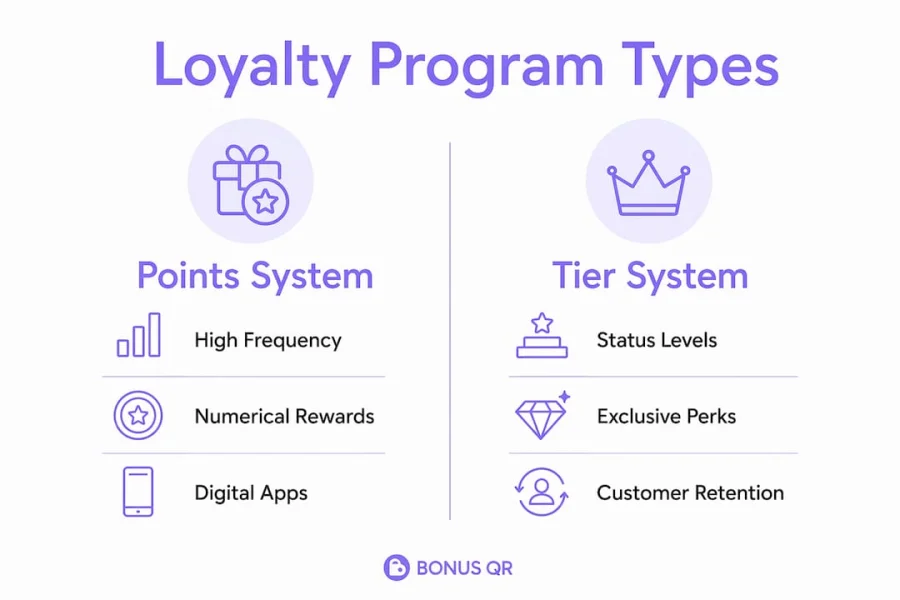
The mechanics vary by format. Points systems assign a numerical value to each purchase; customers redeem accumulated points for discounts or free products. Stamp cards, both physical and digital, reward customers after a set number of visits. Cashback programmes return a percentage of spend as credit. Tier systems create status levels, such as Silver, Gold, and Platinum, where higher tiers unlock better rewards. Each format suits a different business model and customer expectation.
Mobile apps now serve as the primary access point for most modern loyalty programmes. They handle enrolment, reward tracking, push notifications, and personalised offers in one place. This shift from physical cards to digital platforms means you capture richer data and communicate with customers between purchases, not just at the till.
Comparing the main programme types
| Programme type | Best suited for | Primary benefit | Engagement method |
|---|---|---|---|
| Points system | Retail, e-commerce | Encourages higher spend per visit | Points balance visible in app |
| Stamp card | Cafés, salons, quick service | Simple, low barrier to entry | Digital or physical stamp |
| Cashback | Grocery, fuel, subscription | Tangible financial reward | Automatic credit to account |
| Tier system | Travel, hospitality, fashion | Status motivation, aspirational | Progress indicators and perks |
| Referral rewards | Any sector | Low-cost customer acquisition | Unique referral links or codes |
| Reward for visit | Restaurants, gyms, clinics | Drives frequency | Visit-triggered automatic reward |
Pro Tip: Choose your programme type based on purchase frequency. High-frequency businesses such as coffee shops benefit most from stamp cards or visit rewards. Low-frequency, high-value businesses such as furniture retailers gain more from points or tier systems that build long-term engagement.
How effective are loyalty programmes? Evidence and key metrics
The business case for loyalty marketing is well supported by current research. 41.9% of programme members feel more loyal to a brand after joining, 35% increase their spending, 33.3% report a stronger emotional connection, and 34.5% say they are more likely to recommend the brand. These are not marginal gains. They represent a compounding effect: a customer who spends more and refers others delivers far greater value than one who simply returns occasionally.
“Data-driven loyalty programmes can recover up to 50% of wasted promotional budgets and achieve up to 5% incremental margin growth by personalising rewards to the right customers at the right time.”
That figure reframes how you should think about loyalty investment. Most businesses treat loyalty programmes as a cost centre. The data shows they function as a margin recovery tool when built around personalisation rather than blanket discounts.
Measuring programme health requires four core metrics. Customer Lifetime Value (CLV) shows the total revenue a customer generates over their relationship with your business. Customer Retention Rate (CRR) tracks the percentage of customers who return within a defined period. Customer Acquisition Cost (CAC) measures what you spend to gain each new customer, which referral programmes directly reduce. Net Promoter Score (NPS) captures how likely members are to recommend you. Regular audits using CLV, CRR, CAC, and NPS drive 30–40% operational cost savings and improve engagement over time. That is a significant efficiency gain from a process that requires no additional headcount, only disciplined measurement.
Understanding what brand loyalty means in practice goes beyond repeat purchases. It includes emotional preference, resistance to competitor offers, and willingness to pay a slight premium. Programmes that build emotional connection alongside transactional rewards consistently outperform those that rely on discounts alone.
What challenges and pitfalls do businesses face with loyalty programmes?
The biggest loyalty challenge in 2026 is driving active engagement rather than simply growing a member list. Many businesses celebrate enrolment numbers without asking how many members actually redeem rewards or change their behaviour. A large inactive membership is not a loyalty asset. It is a database with no commercial return.
The most costly and overlooked pitfall is rewarding purchases customers would make regardless of any incentive. Discounting products customers would buy anyway erodes margins without generating incremental sales. Targeted incentives directed at at-risk customers, by contrast, increased engagement by 24%, transactions by 4%, and incremental margin by 5% in documented cases. The difference between a profitable programme and a costly one often comes down to whether you are rewarding loyalty or subsidising existing behaviour.
Building emotional resonance is harder than building a points balance. Customers who feel genuinely valued by a brand behave differently from those who simply collect stamps. Emotional connection drives referrals, forgiveness when things go wrong, and resistance to competitor promotions. Most programmes invest heavily in the transactional mechanics and underinvest in communication, personalisation, and the moments that make customers feel recognised.
Common pitfalls to avoid:
- Passive enrolment without activation. Signing customers up is not enough. Build an onboarding sequence that explains the programme and delivers an early reward to establish the habit.
- One-size-fits-all offers. Sending the same promotion to every member ignores purchase history and preference. Segment your members and tailor rewards accordingly.
- Ignoring your data. Every transaction is a signal. Businesses that do not audit their programme data regularly miss the patterns that reveal which rewards drive behaviour and which do not.
- Rewarding without communicating. Customers who do not know their balance or upcoming rewards disengage quickly. Push notifications and regular balance updates keep the programme visible.
- Setting and forgetting. A loyalty programme is not a one-time launch. It requires ongoing refinement based on redemption rates, churn signals, and seasonal shifts in customer behaviour.
Good customer engagement in retail depends on treating loyalty as a continuous conversation, not a static reward structure.
How are loyalty programmes evolving in 2026?
The fixed percentage reward model is no longer the standard. The “ideal percentage” model is now considered obsolete; leading brands use flexible, seasonal reward scenarios adapted to product launches, at-risk group activation, and promotional calendars. This shift reflects a broader move from static programme design to dynamic, data-led management.
Four trends define loyalty programme best practice in 2026:
-
Dynamic reward scenarios. Rewards now flex with business goals. A retailer might double points during a slow trading period, offer a bonus reward to customers who have not visited in 60 days, or create a limited-time tier upgrade tied to a product launch. Dynamic rewards adapted to sales goals consistently outperform static percentage-based models in profitability.
-
Loyalty audits as standard practice. The most effective operators treat programme audits as a routine operational process, not an annual review. Monthly or quarterly audits using CLV, CRR, and NPS allow you to catch disengagement early and adjust before members lapse entirely.
-
B2B and B2B2B programme growth. Loyalty mechanics are expanding beyond consumer markets. Manufacturers are building programmes that reward distributors, wholesalers, and trade customers. These programmes use the same points and tier logic as consumer versions but are calibrated to longer sales cycles and higher transaction values.
-
Referral programmes as acquisition tools. Referral programmes have grown into one of the most cost-effective customer acquisition channels available. A satisfied member who refers a friend costs a fraction of a paid acquisition and delivers a customer who arrives with existing trust in the brand.
Pro Tip: When building a referral component, make the reward double-sided. Give both the referrer and the new customer an immediate benefit. This removes friction for the referrer and gives the new customer a reason to make their first purchase quickly.
Knowing how to increase customer retention through these evolving mechanisms requires treating your programme as a living system rather than a fixed structure. The businesses seeing the strongest results in 2026 are those that combine simplicity in the customer experience with sophistication in the data analysis behind it.
Key takeaways
A loyalty programme in marketing delivers measurable returns only when it combines personalised rewards, active engagement strategies, and regular data-led audits.
| Point | Details |
|---|---|
| Define your programme type clearly | Match the format (points, stamps, cashback, tiers) to your purchase frequency and customer expectations. |
| Measure with the right metrics | Track CLV, CRR, CAC, and NPS regularly; audits drive 30–40% operational cost savings. |
| Personalise to avoid margin erosion | Targeted offers to at-risk customers outperform blanket discounts and protect your margins. |
| Build emotional connection | Members with emotional brand loyalty spend more, refer others, and resist competitor offers. |
| Treat the programme as ongoing | Dynamic rewards and regular audits outperform static, set-and-forget programme designs. |
Why most loyalty programmes underperform (and what I have learned from it)
After working with businesses across retail, hospitality, and services, the pattern I see most often is this: a business launches a loyalty programme with genuine enthusiasm, watches enrolment climb, and then quietly stops paying attention to it. Six months later, the redemption rate is low, the data is unused, and the programme has become a cost with no measurable return.
The uncomfortable truth is that a loyalty programme is not a product you launch. It is a process you manage. The businesses I have seen get the most from their programmes are not necessarily the ones with the most sophisticated technology. They are the ones that look at their data every month, ask why certain members stopped visiting, and adjust their rewards accordingly.
The emotional side of loyalty is also consistently underestimated. Businesses spend considerable effort designing the points mechanics and almost no effort on the communication that makes a customer feel valued. A well-timed message acknowledging a customer’s anniversary with your brand, or a personalised reward on their birthday, does more for retention than a marginal increase in points per pound spent.
My honest view is that the gap between a loyalty programme that works and one that does not is rarely about the technology or the reward structure. It is about whether the business treats loyalty as a strategic priority or as a background feature. The data is clear: brands showing measurable ROI through personalisation and emotional resonance lead their markets. The investment required is not large. The discipline required is.
— Michal
How Bonusqr supports your loyalty programme from day one
Bonusqr is a SaaS platform built for businesses that want to launch and manage a digital loyalty programme without complex POS integration or lengthy setup. The Bonusqr loyalty platform supports points collection, stamp cards, cashback, and reward-for-visit programmes, alongside coupon management and automated push notifications. You can configure multiple loyalty modules to match your business model, set up onboarding promotions, and track performance through real-time analytics. The mobile and web application gives your customers a branded experience on any device, while you manage everything from a single dashboard. For businesses that want a fully branded presence, Bonusqr also offers white-label and custom app development options.
FAQ
What is a loyalty programme in marketing?
A loyalty programme in marketing is a structured system that rewards customers for repeat purchases or specific behaviours, with the goal of increasing retention and lifetime value. It typically uses points, stamps, cashback, or tier-based rewards to incentivise ongoing engagement.
What does brand loyalty mean for a business?
Brand loyalty means customers consistently choose your business over competitors, spend more over time, and are more likely to recommend you to others. Research shows that 41.9% of loyalty programme members feel more loyal to a brand after joining.
What are the main types of customer loyalty programmes?
The main types are points systems, stamp cards, cashback programmes, tier systems, referral rewards, and visit-based rewards. Each suits a different purchase frequency and customer expectation.
How do you measure whether a loyalty programme is working?
Measure programme performance using Customer Lifetime Value, Customer Retention Rate, Customer Acquisition Cost, and Net Promoter Score. Regular audits using these metrics drive 30–40% operational cost savings and improve engagement.
What is loyalty marketing and how does it differ from standard promotions?
Loyalty marketing is a long-term strategy focused on retaining existing customers through ongoing rewards and personalised communication. Standard promotions target short-term sales; loyalty marketing builds cumulative value and emotional connection over time.


