Welcome Bonus Offer: What It Is and How to Use One
The counter is quiet, a new-customer offer is ready to print, and the owner is wondering whether a free coffee will bring anyone back. A discount might attract attention, but it won't explain why someone should choose that business again next week.
A useful welcome bonus offer connects the first reward to a reason to return. For a small business, that means choosing an affordable benefit, making the conditions clear and keeping marketing permission separate from the customer's decision to join.
Welcome Bonus Offer Formats at a Glance
A welcome bonus offer rewards someone's first sign-up, scan or visit, and most small businesses can start with one of these five formats.
Welcome offer formats and UK customer appeal
| Format | How it works | UK customer appeal |
|---|---|---|
| Free item on first visit | A drink, pastry or treatment added after sign-up | 67% found freebies appealing |
| Money-off voucher | Fixed amount or percentage off the next purchase | Discounts 85%, monetary rewards such as vouchers 82% |
| Bonus stamps or points | Extra stamps or points on the first purchase | 67% found point accumulation appealing |
| Exclusive perk or early access | Members-only benefit or priority access | 52% sought exclusive perks |
| Flexible points for later use | Points redeemable on a future visit | 49% preferred points, compared with 30% preferring a one-time discount |
The discount, voucher, freebie and point-accumulation figures come from a YouGov survey of 1,019 adults in Great Britain conducted from 15–22 May 2024. The exclusive-perk and flexible-points findings appear in Wunderkind's 2025 UK Consumer Insights Report, so the table compares different measures rather than a single ranking.
Choosing a manageable starting point
These figures don't mean one format wins everywhere. A free pastry might suit a bakery with spare production capacity, while priority booking could suit a salon whose customers value convenient appointments more than a discount.
The right choice matches the next action the owner wants. A stamp-based approach, for example, can connect an initial bonus with repeat-visit rewards for coffee shops, rather than making every purchase cheaper.
- Check fulfilment: Staff should be able to explain and honour the benefit during a busy shift.
- Check relevance: The reward should relate to something the customer already wants to buy.
- Check affordability: The business should be comfortable funding redemption, not merely issuing vouchers.
A practical shortlist contains two formats the business could operate this month, with a note beside whichever benefit its own customers already respond to.
What a Welcome Bonus Offer Is and Why It Works
A welcome bonus is like a free tasting at a market stall. The shopper gets a small, specific invitation to try something before committing to a larger purchase.
For a local business, it's a one-time reward triggered by a first action, such as registration, a QR-code scan or an initial purchase. A loyalty programme is different: it rewards an ongoing pattern of visits or spending, rather than just the introduction.
From unfamiliar business to familiar choice
A poll of 2,000 UK adults, reported by Cardlytics, found that 54% preferred returning to a restaurant they'd already visited rather than trying a new alternative; the same proportion said a discount voucher or cashback rewards system made them more likely to visit a new restaurant.
Consider an independent lunch café. Someone passing the door might hesitate because they don't know the food, service or atmosphere. A clearly described welcome reward gives that person a reason to test the café, but the meal and experience still need to justify another visit.
The sequence is straightforward:
- Trial: The newcomer chooses the business rather than walking past.
- Reward: Staff deliver the promised benefit without an awkward negotiation.
- Return: The customer sees a relevant reason to come back, supported by a good experience.
The BonusQR cafe rewards insights offer further context for connecting rewards with returning customers.
A welcome reward is an introduction, not a substitute for service worth repeating.
A well-designed offer lowers the perceived risk of the first visit, gives a genuine reason to act within its stated window and creates an opportunity to collect necessary registration details transparently. Optional marketing permission belongs alongside that process, not hidden inside it.
Matching the Reward to the Behaviour You Want
What should the customer do next week? That question is more useful than deciding how large a discount looks impressive.
Goal, reward and trade-off
| Goal | Reward that fits | Trade-off |
|---|---|---|
| First purchase | Immediate discount or free item | Encourages one transaction but can teach customers to wait for coupons |
| Second visit | Points or a stamp whose benefit becomes available on return | Supports frequency but pays off more slowly |
| Higher basket value | Free add-on above a minimum spend | Encourages a larger bill but needs an understandable threshold |
| Off-peak traffic | Offer valid only during quiet weekday hours | Targets spare capacity but needs plainly stated hours |
| Referral | Bonus when a newcomer brings a friend who also joins | Extends reach but relies on members sharing |
An immediate benefit suits a business struggling to turn interest into a first purchase. The owner should still consider whether customers would have bought without it, particularly when the offer is displayed at checkout after the buying decision.
A return-based reward makes more sense when first-time visits are healthy but repeat visits are weak. Flexible points can give customers control over a later benefit, while a members-only perk may suit customers who value access rather than a cheaper bill.
Keeping the trade-off visible
For basket-building offers, the qualifying spend should be achievable without making the customer buy unwanted extras. For off-peak offers, availability matters as much as generosity: a reward that can't be used when its audience is free has little practical value.
Referral rewards need their own checks. The business should distinguish a new friend from an existing member creating another account.
Further loyalty ideas for cafés and salons can help an owner find a benefit that fits daily operations.
A manageable experiment uses one goal and one reward for an illustrative four-week test. The owner compares return behaviour and margin, rather than treating the first offer as a permanent price cut.
Conditions, Consent and Clear Wording
A customer shouldn't need to ask the cashier what a welcome offer means. The headline, conditions and checkout amount should tell the same story.
Say a café advertises a free coffee for new members. If the small print excludes takeaway orders, limits redemption to weekday mornings, or expires in a week, each hidden condition becomes a small argument at the till. Arguments at the till do not produce second visits.
The government's draft price transparency guidance explains that targeted reductions must not mislead customers about the price they'll pay, and the qualifying audience must be explicit when the offer is presented.
The offer checklist
- Reward: Specify the item, discount or points benefit.
- Eligibility: Explain whether the offer is for new customers, new members or another defined group.
- Validity: State the expiry date and any permitted redemption hours.
- Spending conditions: Show minimum spend, exclusions and the relevant undiscounted reference price.
- Redemption limit: Make the single-use rule visible before registration.
That last point matters more than it looks. A customer who assumes the voucher works twice, and discovers otherwise at the till, leaves with the discount and a grievance. The system should check eligibility at redemption rather than relying on staff recognising every customer. A unique customer identifier and redemption timestamp help prevent duplicate claims, while the checkout should show the final payable amount before confirmation.
Permission isn't part of the price
The Information Commissioner's Office guidance on legitimate interests explains the importance of customer expectations when relying on that lawful basis. The practical question for a small business is simple: did the customer agree to be marketed to, or only to receive the reward?
Those are two different agreements, and treating them as one is where welcome offers go wrong. Registration should explain data use and communication choices prominently. Optional promotional emails should be distinguishable from necessary account information, with a clear way to withdraw permission.
Message type also needs care. A voucher-balance message may be administrative, but adding sales material can change its character. Expiry reminders shouldn't automatically be treated as non-marketing because they concern an existing coupon.
Consent check: A customer who declines promotional messages should still understand what happens to the reward and membership.
A larger incentive can attract registrations while leaving customers unhappy about unexpected follow-up. The first reward wins the first visit; the wording and the messages that follow decide whether there is a second one. Clear choices protect the relationship the business is trying to start.
How to Build Your First Welcome Offer Step by Step
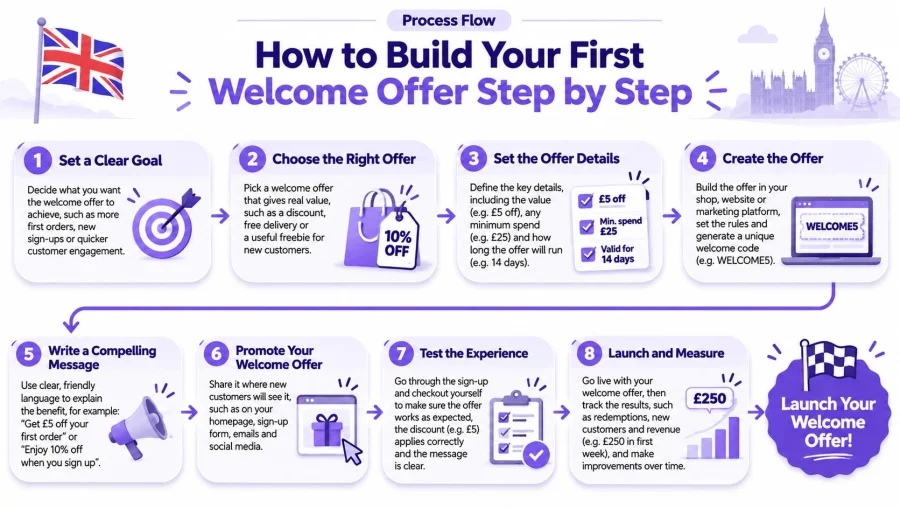
A workable launch begins with a short written offer specification. Staff need the same answer to what qualifies, what gets issued and what happens at redemption.
Build the offer before promoting it
Choose one goal. A second visit is a clearer objective than increasing loyalty generally, because it identifies an observable action. The common mistake is trying to improve acquisition, basket size and referrals with the same coupon.
Pick a recognisable format. A free add-on or bonus stamp should be explainable without a demonstration. Combining points, cashback and exceptions makes a first offer harder to operate.
Set the value against margin. Reward cost per new customer equals the reward's unit cost multiplied by the share of sign-ups who redeem it. In a hypothetical example, a drink costing £1.20, redeemed by 60 of 100 sign-ups, costs £72 overall, or £0.72 per sign-up; the owner should expect enough contribution from additional visits to cover that cost.
Write down the limit and expiry. An illustrative rule might allow one redemption within 30 days, provided that suits the business's buying cycle. Leaving the deadline to staff judgement creates inconsistent treatment.
Set the automatic trigger. Registration or an eligible first scan should initiate delivery without staff remembering an extra task. The owner should test both a fresh account and an existing account before launch, so the wrong customers don't receive a new-member reward.
Write the customer-facing sentence. A café's version could say that new members receive a free standard coffee with their first qualifying food purchase, with the expiry and exclusions displayed beside it. If the sentence needs several qualifications, simplifying the offer is usually better than shrinking the text.
Launch and record the outcome. An illustrative four-week launch gives the owner a defined review point, with consistent eligibility throughout. Changing the reward halfway through without recording the change makes comparisons difficult.
Check the economics beyond the free item
The drink calculation isn't a complete profitability forecast. Extra packaging, staff time and purchases that would have happened anyway also affect whether the offer makes commercial sense.
A reward should therefore be budgeted before the QR code reaches the counter. By the end of the test, the owner should be able to identify whether customers did something different afterwards, not whether the business distributed coupons.
Welcome Offers in Cafés, Salons and Gyms
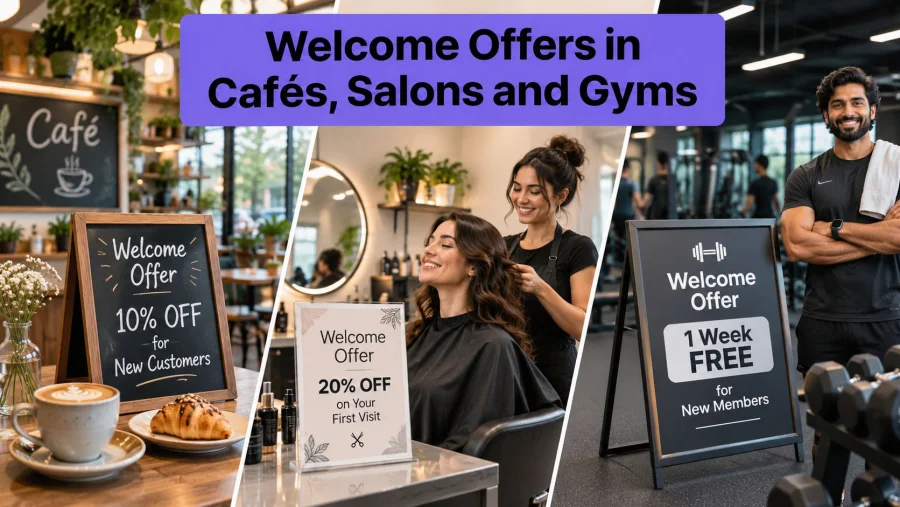
The following illustrations show how an owner could adapt the mechanism to different buying routines. Their example validity windows are test choices, not industry benchmarks.
Everyday visits and booked appointments
Café illustration. A first-drink bonus plus an extra registration stamp could remain valid for 14 days. Gift Card and Voucher Association findings reported by Electronic Payments International found that 35% of loyalty-scheme users received rewards alongside regular coffee purchases, making a routine-based benefit a relevant starting point.
Measure: Whether recipients make another paid visit, rather than only collecting the drink.
Salon illustration. A first-visit treatment upgrade could be discounted for 30 days, excluding products already on promotion. The booking confirmation should identify the eligible add-on so the customer doesn't arrive expecting a discounted appointment.
Measure: Whether recipients rebook a service and whether the upgrade remains profitable.
Trial, return and basket-building
- Gym or studio illustration: A free introductory class or member perk during the first fortnight lets a newcomer assess the teaching and environment without reducing the main membership price. Measure: Whether attendees return for another session, not just reserve a free place.
- Restaurant illustration: A first-visit voucher could be paired with a separate reward for returning within 30 days. Staff should explain the return benefit after the meal without making the guest feel pressured. Measure: Whether diners return for another paid meal.
- Shop illustration: A money-off voucher could require a minimum spend, exclude sale items and show the undiscounted price. The threshold should fit a plausible basket rather than force unnecessary spending. Measure: Whether voucher users return and maintain worthwhile basket margins.
The closest fit is usually the example that works with the customer's existing routine, not the most generous-looking reward.
The owner can select the nearest trade example and write its one-line version before choosing graphics or printing materials. If staff can't explain that version consistently, the offer still needs work.
Launch Your First Welcome Bonus Offer This Month
Registrations show interest, but they don't establish that an offer is working. A useful review follows customers from claiming the reward through to returning and remaining comfortable with the communication they receive.
Measures to track during the test
| Measure | What it shows | Warning sign |
|---|---|---|
| Activation | Share of sign-ups who claim the reward | Few claims suggest an unclear or hard-to-find offer |
| First redemption | Share of claims used on the first visit | Unused claims suggest friction or a weak benefit |
| Second-visit rate | Share of customers who return after the first reward | Flat returns suggest no change in behaviour |
| Average spend | Typical bill for reward users compared with others | Falling spend warrants checking for discount dependence |
| Reward cost against margin | Reward cost per new customer alongside contribution | Costs exceeding available contribution erode profit |
| Opt-out and complaint rate | Sign-ups withdrawing consent or complaining | Rising rates suggest unexpected follow-up |
These are warning signs, not proof of cause. Owners should compare customers with similar time to return and avoid judging a salon on a coffee shop's purchasing rhythm.
Make one decision from the results
An illustrative two-week check can identify delivery problems or confusing wording early. If return visits remain weak once customers have had a realistic chance to come back, the owner should reconsider the benefit or timing before deepening the discount.
For fitness businesses, Locals Jiu Jitsu Alexandria's first class for adult beginners provides a useful example to examine when describing an introductory experience. The practical question is whether a newcomer can understand the first action without specialist knowledge.
BonusQR offers a straightforward way to run the registration-to-reward step. After registration, the system automatically sends the chosen welcome coupon, such as a free coffee, welcome drink or discount; a free account requires no credit card, and loyalty-programme setup takes 5 minutes.
A shop owner's next step is to create a BonusQR account, set one affordable welcome reward and share the QR code at the counter this week. That starts a measurable test of whether a first-time visitor becomes a returning customer, without committing the business to an ongoing discount.


