For most Central European SMBs and hospitality businesses, the shortlist of top customer retention tools in 2025 comes down to five categories: digital loyalty platforms, CRM-led service hubs, marketing automation and lifecycle messaging tools, customer data platforms, and in-app engagement tools. Among these, Bonusqr stands out as the recommended first choice for retailers, restaurants, hotels, and service businesses across Central Europe thanks to its rapid setup, no POS integration requirement, and GDPR-aware deployment. The Europe loyalty programmes market is projected to grow 15.2% to reach US$19.64 billion in 2025, making the choice of platform more consequential than ever.
Why this shortlist fits 2025:
- Personalisation at scale: Buyers need tools that support tiered cashback, special occasion rewards, and automated notifications, not flat points schemes.
- Omnichannel delivery: Push notifications, email, SMS, and mobile wallet support are now baseline expectations.
- GDPR-aware hosting: Central European buyers face real compliance obligations; platforms with EU data residency options reduce procurement risk.
- Fast time-to-value: Decision-makers want pilots live within days, not months.
How do the top customer retention platforms compare?
| Tool / Category | Best for | Core features | GDPR / data hosting | Ease of setup | Pricing band | Scalability |
|---|---|---|---|---|---|---|
| Bonusqr | SMBs, hospitality, retailers in Central Europe | Stamp cards, cashback, coupons, push/email automation, analytics, white-label apps | EU-focused deployment, GDPR-aware | Very fast, no POS needed | Freemium → paid tiers; white-label setup fee | SMB to mid-market |
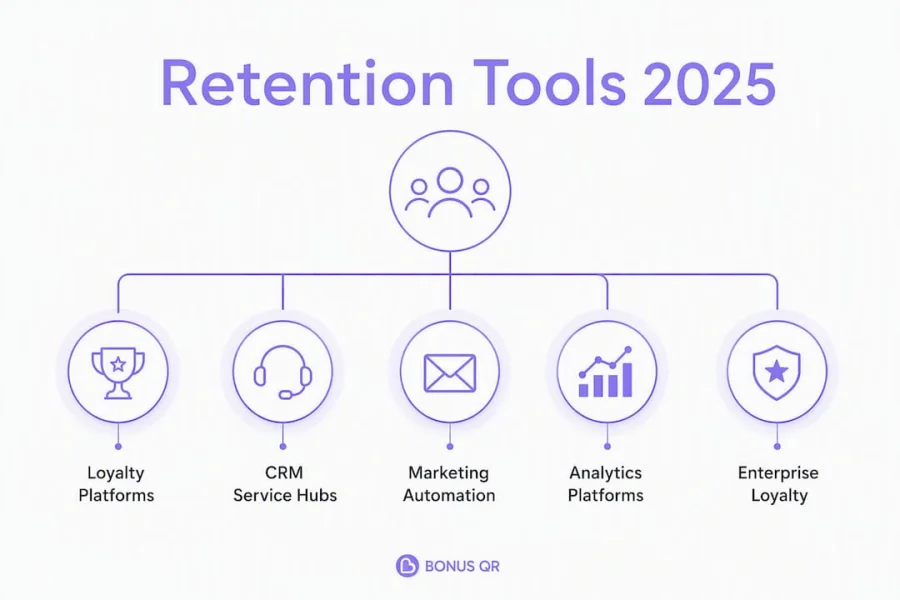
| CRM-led service hubs (HubSpot Service Hub, Zendesk, Freshdesk Omni, Zoho Desk, Gorgias, Intercom, Salesforce) | Service teams needing support-led retention | Ticketing, omnichannel CS, CRM workflows, SLA management | Varies; EU data centres available on paid tiers | Moderate; CRM onboarding required | Free tiers → enterprise contracts | SMB to enterprise |
| Marketing automation & lifecycle messaging (Customer.io, Klaviyo, Braze, Optimove, Endear, Recharge, Podium) | Subscription apps, e-commerce, lifecycle churn reduction | Email/push/SMS automation, A/B testing, segmentation, lifecycle flows | Varies; EU hosting available | Moderate; flow-building takes time | Subscription-based; usage pricing | SMB to enterprise |
| Customer data & analytics platforms (Segment, Amplitude, Mixpanel, KissMetrics, Hotjar, Crazy Egg, Qualaroo, ProfitWell) | Data-driven teams needing cohort analysis | Behavioural analytics, segmentation, CDP, heatmaps, funnel analysis | Varies; GDPR controls available | Moderate to complex | Free tiers → enterprise | Mid-market to enterprise |
| Enterprise loyalty & coalition platforms (Open Loyalty, LoyaltyLion, Yotpo, Nosto, Optimizely, Loyally.ai) | Large retailers, banks, multi-brand groups | Coalition programmes, complex tiers, partner integrations, personalisation | Varies; enterprise SLAs | Complex; long implementation | Mid-market → enterprise bespoke | Mid-market to enterprise |
| In-app engagement & product analytics (Appcues, Pendo, Gainsight, Totango, Whatfix, SurveySparrow, Medallia, Intercom) | SaaS and app-led businesses | In-product onboarding, feature adoption, NPS, customer success workflows | Varies; EU options on request | Moderate | Subscription; per-seat or usage | SMB to enterprise |
Pro Tip: Before booking demos, shortlist no more than three tools. Running more than three demos in parallel dilutes your evaluation focus and makes scoring inconsistent.
Profiles of the leading retention tools and platform categories
The tools below are grouped by category. Each profile covers what the platform does, who it suits best, and what to watch for in a Central European procurement context.
1. Bonusqr
Bonusqr is a SaaS loyalty platform built for businesses that need a working programme fast. Its core capabilities include digital stamp cards, points collection, tiered cashback, fixed discounts, coupon management, special occasion rewards, and automated push and email notifications. The mobile and web app integration supports Apple Wallet and Google Wallet, so customers engage through channels they already use. White-label and fully custom app builds are available for businesses that want a branded experience.
For Central European SMBs, the practical advantage is that setup requires no POS hardware or deep IT involvement. A hotel, café, or gym can have a live loyalty programme within days. Bonusqr’s customer retention guide for SMBs documents this rapid-deployment model, and the platform’s hotel-specific loyalty flows make it a strong fit for hospitality operators across the region.

Pricing shape: Freemium entry tier; paid subscription tiers unlock advanced automation and analytics; white-label app setup is a one-time fee.

2. CRM-led service hubs
This category covers HubSpot Service Hub, Zendesk, Freshdesk Omni, Freshdesk, Zoho Desk, Zoho CRM, Gorgias, Intercom, and Salesforce.
- Core features: Omnichannel ticketing, CRM contact records, SLA management, knowledge bases, live chat, and basic retention workflows.
- Best for: Businesses where customer support is the primary retention lever, particularly those with high inbound query volumes.
- Pros: Deep CRM integration; strong reporting; large partner ecosystems.
- Cons: Loyalty mechanics are limited or absent; retention features are secondary to support tooling.
- Central Europe availability: All major vendors have EU data centre options, though these are often gated behind higher-tier plans. Confirm data residency in writing before signing.
HubSpot Service Hub and Salesforce are the most feature-complete for enterprise buyers. Zoho Desk and Freshdesk offer competitive pricing for SMBs. Gorgias is purpose-built for e-commerce support teams on Shopify.
3. Marketing automation and lifecycle messaging platforms
This category covers Customer.io, Klaviyo, Braze, Optimove, Endear, Recharge, and Podium.
- Core features: Email, push, and SMS automation; lifecycle flow builders; multivariate A/B testing; AI content optimisation; subscription management.
- Best for: E-commerce brands and subscription businesses where lifecycle messaging drives repeat purchase and reduces churn.
- Pros: Highly effective at personalised, triggered communication; strong analytics on campaign lift.
- Cons: Not loyalty platforms; require a separate data source or CDP for deep segmentation.
- Central Europe availability: Klaviyo and Braze have EU data processing agreements. Confirm DPA terms and sub-processor lists for GDPR compliance.
Klaviyo is the dominant choice for Shopify-based retailers. Braze suits larger organisations with complex omnichannel needs. Customer.io is popular with SaaS and subscription app teams.
4. Customer data and analytics platforms
This category covers Segment, Amplitude, Mixpanel, KissMetrics, Hotjar, Crazy Egg, Qualaroo, and ProfitWell.
- Core features: Event tracking, behavioural cohort analysis, funnel visualisation, heatmaps, session recording, NPS surveys, revenue analytics.
- Best for: Teams that need to understand why customers churn before they can act on it.
- Pros: Deep insight into product and purchase behaviour; strong integration with messaging tools.
- Cons: These are insight tools, not retention execution tools; they require pairing with a messaging or loyalty platform.
- Central Europe availability: Segment and Amplitude offer EU data residency. Hotjar (acquired by Contentsquare) is headquartered in Malta and processes EU data by default.
Amplitude and Mixpanel are the standard choices for product analytics. Hotjar and Crazy Egg suit UX and conversion teams. ProfitWell (now part of Paddle) specialises in subscription revenue metrics.
5. Enterprise loyalty and coalition platforms
This category covers Open Loyalty, LoyaltyLion, Yotpo, Nosto, Optimizely, and Loyally.ai.
- Core features: Coalition programme management, complex tier structures, partner reward integrations, AI-driven personalisation, referral and review modules.
- Best for: Large retailers, banks, and multi-brand groups running cross-sector schemes.
- Pros: Purpose-built for scale; support for gamification, subscription loyalty, and ESG-linked rewards.
- Cons: Long implementation timelines; bespoke commercial models; often overkill for SMBs.
- Central Europe availability: Open Loyalty is a Polish-founded platform with strong regional presence and EU data hosting. LoyaltyLion and Yotpo serve European markets with GDPR-compliant configurations.
Open Loyalty is worth particular attention for Central European buyers: it is API-first, headless, and designed for organisations that need a loyalty engine they can connect to any front-end system.
6. In-app engagement and product analytics tools
This category covers Appcues, Pendo, Gainsight, Totango, Whatfix, SurveySparrow, and Medallia.
- Core features: In-product onboarding flows, feature adoption tracking, NPS and CSAT surveys, customer success health scores, digital adoption platforms.
- Best for: SaaS companies and app-led businesses where in-product behaviour is the primary retention signal.
- Pros: Excellent for correlating feature usage with churn risk; Gainsight and Totango are the standard for B2B customer success teams.
- Cons: Limited relevance for physical retail, hospitality, or service businesses.
- Central Europe availability: Most vendors serve EU customers; confirm sub-processor and data-hosting details for regulated industries.
How do you choose the right retention tool for your business?
The right platform depends on your business model, your team’s technical capacity, and the retention problem you are actually trying to solve. Use the checklist below to score candidates before demos.
Evaluation criteria checklist
- Business outcome fit: Does the tool directly address your primary churn driver (low repeat visit rate, poor post-purchase engagement, weak loyalty mechanics)?
- Data model and GDPR: Where is customer data hosted? Does the vendor offer a Data Processing Agreement (DPA) covering EU/EEA requirements? Can you export all data on request?
- Integration readiness: Does it connect to your existing POS, e-commerce platform, CRM, or email tool without a costly custom build?
- Automation capabilities: Can it trigger personalised messages based on customer behaviour (e.g. lapsed visit, birthday, spend threshold)?
- Loyalty feature depth: Does it support the mechanics you need: stamp cards, tiered cashback, coupons, referral, or coalition points?
- Analytics and reporting: Can you measure NPS, churn rate, repeat purchase frequency, and campaign lift from within the platform?
- Support and training: Is local-language support available? What is the SLA for critical issues? Is onboarding included?
- Total cost of ownership (TCO): Have you accounted for subscription fees, setup costs, integration work, and ongoing campaign management?
Vendor demo questions to ask
- Which EU data centres host our customer data, and can you provide documentation?
- What does data export look like if we switch vendors?
- What is your SLA for platform downtime, and what compensation applies?
- How long does a typical implementation take for a business of our size?
- Do you have existing customers in Central Europe we can speak with?
Red flags during demos
- Closed or undocumented APIs that make future integrations expensive.
- Pricing that changes significantly once you add integrations or exceed a contact threshold.
- No clear answer on data residency or sub-processor lists.
- Implementation timelines quoted in months for a tool marketed as “quick to deploy.”
Pro Tip: Run a 30–60 day paid pilot with real customers before committing to an annual contract. Measure one specific metric, such as repeat visit rate or 90-day retention rate, so you have a concrete signal rather than a subjective impression.
What does a retention tool actually cost in Central Europe?
Pricing across the category spans a wide range. The table below uses illustrative bands rather than vendor-specific figures, since list prices vary by region, contract length, and feature tier.
| Tier | Typical monthly cost | What is usually included | Central Europe notes |
|---|---|---|---|
| Freemium / startup | — | Basic loyalty mechanics, limited contacts, standard templates | Good for pilots; check contact limits carefully |
| SME subscription | — | Full loyalty features, automation, analytics, standard support | Most SMBs land here; white-label setup is extra |
| Mid-market | — | Advanced segmentation, API access, priority support, custom branding | Budget for integration and onboarding costs |
| Enterprise / bespoke | — | Coalition features, dedicated CSM, SLA, custom development | Expect 3–6 month implementation timelines |
TCO factors to budget for:
- Subscription or licence fee (monthly or annual)
- Initial setup and customisation (including white-label app build if required)
- Third-party integration costs (CRM, POS, e-commerce platform)
- Staff time for campaign management and reporting
- Data hosting and compliance documentation (DPA, privacy impact assessments)
- Support and training (onboarding sessions, documentation, ongoing helpdesk)
- Campaign creative (design, copywriting for push and email flows)
A note on Central Europe specifics: VAT rates vary by country (e.g. 23% in Poland, 21% in the Czech Republic, 27% in Hungary), so always compare vendor quotes on a VAT-exclusive basis. Localisation costs for Polish, Czech, Slovak, or Hungarian language support can add to the total if the vendor does not include them in the base tier.
What do the 2025 trends tell us about the Central European market?
The European loyalty market is not just growing; it is changing shape. Digital-first, personalised, and sustainability-linked programmes are replacing flat points schemes across the region. Gamification features such as leaderboards, challenges, and subscription loyalty models are gaining traction among European brands. Mobile-first apps and AI-driven personalisation are no longer differentiators; they are baseline expectations.
For Central European buyers specifically, regional market intelligence covering Poland and neighbouring markets documents growing vendor spend and deployment activity, confirming that the region is investing in loyalty infrastructure at pace. This matters for procurement: it means more vendors are actively competing for Central European contracts, which gives buyers negotiating leverage on pricing and SLA terms.
IMRG’s 2025 retention strategy guidance highlights that AI tools now analyse customer support conversations in real time, surfacing packaging, shipping, and product issues faster than manual review. This capability is increasingly embedded in retention platforms rather than sold as a separate analytics add-on.
“One-size-fits-all points programmes are declining. Successful European brands are moving to hyper-personalised, digital-first ecosystems. Platforms that support tiered cashback, special occasion rewards, and automated notifications match this shift.” — Europe Loyalty Programs Intelligence Report 2025, ResearchAndMarkets.com
Key feature priorities that follow from these trends:
- QR code and mobile wallet support (Apple Wallet, Google Wallet) for contactless engagement
- Automated notifications triggered by behaviour (lapsed visit, birthday, spend milestone)
- Tiered reward structures that reward frequency and spend, not just enrolment
- ESG or sustainability-linked reward options for brands targeting younger demographics
- Omnichannel integration so loyalty data flows into email, push, and in-store touchpoints
Pro Tip: When evaluating a vendor’s GDPR claims, ask for their Data Processing Agreement, their sub-processor list, and evidence of their last security audit. A vendor who cannot produce these documents within 48 hours of a request is a procurement risk, regardless of how good the product demo looked.
Retail and hospitality buyers in Central Europe increasingly favour platforms that combine loyalty mechanics with lifecycle messaging and regional GDPR compliance. Prioritise this combination in your procurement process, and you will narrow the field to a manageable shortlist quickly.
What are customer retention tools?
Customer retention tools are software platforms and features that help businesses keep existing customers buying, visiting, or subscribing over time. They range from loyalty programme platforms that reward repeat visits to CRM systems that automate post-purchase follow-up, and from analytics tools that identify at-risk customers to in-app engagement platforms that guide users towards the features that make them stay. The common thread is that they all address the same business problem: reducing churn and increasing the lifetime value of customers you have already acquired.
Why does retention matter more than acquisition in 2026?
Acquiring a new customer costs significantly more than retaining an existing one, and the gap has widened as digital advertising costs have risen. Existing customers spend more per transaction, refer others more readily, and are more forgiving of occasional service failures. For Central European SMBs operating on tight margins, even a modest improvement in repeat visit frequency can have a material impact on revenue without requiring additional marketing spend.
The practical implication is straightforward: if you are allocating budget between acquisition and retention tools, retention delivers a faster return for most established businesses. A loyalty programme that brings a customer back one additional time per quarter compounds quickly across a customer base of even a few hundred people.
How are Central European businesses using these tools?
Across Central Europe, the most visible adoption patterns in 2025 involve hospitality and retail businesses deploying digital loyalty programmes to replace paper stamp cards and one-off discount vouchers. Hotels in Poland and the Czech Republic are using mobile loyalty apps to drive direct bookings and repeat stays, reducing dependence on OTA commissions. Independent retailers in Hungary and Slovakia are adopting QR-based loyalty programmes that require no hardware investment, making the economics work even for single-location businesses.
The top retail loyalty programmes to watch in the region share a common pattern: they combine a simple earning mechanic (stamp or points) with automated re-engagement messages and a personalised reward at a meaningful milestone. Businesses that add a birthday or special occasion reward to this structure see measurably higher redemption rates and stronger emotional connection with their loyalty programme. For a practical look at how these mechanics are evolving, the analysis of customer loyalty technology trends for the coming years is worth reviewing alongside your vendor shortlist.
Key takeaways
The strongest retention platforms for Central European SMBs in 2025 combine digital loyalty mechanics, automated lifecycle messaging, and GDPR-compliant EU data hosting in a single, fast-to-deploy package.
| Point | Details |
|---|---|
| Lead with loyalty mechanics | Stamp cards, tiered cashback, and special occasion rewards drive repeat visits more reliably than generic points schemes. |
| GDPR compliance is non-negotiable | Always request a Data Processing Agreement and sub-processor list before signing any vendor contract in Central Europe. |
| Budget for full TCO | Subscription fees are only part of the cost; include setup, integration, localisation, and campaign management in your budget. |
| Pilot before committing | A 30–60 day pilot measuring one specific metric (repeat visit rate or 90-day retention) gives you a real signal before an annual contract. |
| Bonusqr for SMBs and hospitality | Bonusqr’s freemium entry tier, no-POS-required setup, and white-label app options make it the practical first choice for Central European SMBs and hotels. |
Why Bonusqr is worth serious consideration for Central European buyers
The conventional wisdom in retention software procurement is to start with the biggest brand name you recognise, usually Salesforce or HubSpot, and work backwards from there. For large enterprises with existing CRM infrastructure, that logic holds. For the majority of Central European SMBs and hospitality operators, it leads to over-engineered, over-priced solutions that take months to implement and require dedicated technical staff to maintain.
What most small and mid-sized businesses actually need is a loyalty programme that works reliably, communicates automatically with customers, and does not require a POS upgrade or a developer to get live. Bonusqr is built around exactly that requirement. The platform’s white-label app option means a hotel or restaurant group can present a fully branded loyalty experience without commissioning a custom build from scratch. The push notification and email automation features handle re-engagement without manual campaign management. And because the platform is designed with Central European deployment in mind, the GDPR compliance conversation is straightforward rather than a procurement obstacle.
The honest caveat is that Bonusqr is not the right choice if your primary retention challenge is enterprise-scale coalition management or deep SaaS product analytics. For those use cases, Open Loyalty or Amplitude respectively are better fits. But for the broad middle of the Central European market, the combination of fast setup, practical loyalty mechanics, and regional focus is genuinely difficult to match at a comparable price point.
Bonusqr: a practical starting point for Central European retention
Most Central European businesses looking to improve retention do not need a six-month implementation project. They need a loyalty programme that is live within days, communicates automatically with customers, and grows with the business. Bonusqr delivers exactly that: digital stamp cards, cashback tiers, coupon management, push and email automation, and a full analytics dashboard, all without requiring POS integration or a technical team to maintain it.
For hospitality operators, the hotel loyalty application covers the specific flows that drive direct repeat bookings. For retailers and service businesses, the customer loyalty card platform provides a fast, flexible entry point. Businesses that want a fully branded experience can explore the white-label app option. Pricing starts at a freemium tier, with paid subscriptions unlocking advanced features and a one-time setup fee for white-label builds. Start your free account or book a demo to see how quickly a live programme can be running for your business.
Further reading and sources
- Europe Loyalty Programs Intelligence Report 2025: Market to Grow by 15.2% to Reach $19.64 Billion — ResearchAndMarkets.com via BusinessWire. Supports market size, growth rate, and trend claims throughout the article.
- 10 Top Strategies to Retain Customers in 2025 — IMRG. Supports the evaluation criteria, AI analytics claims, and loyalty programme optimisation guidance.
- Poland Loyalty Programs Market Report 2025 — Bytes Europe. Supports the Central Europe regional availability and vendor spend callout.
- The Value of Keeping the Right Customers — Harvard Business Review. Supports the retention vs. acquisition cost argument.
- Customer Retention Tools: A Practical Guide for SMBs — Bonusqr. Platform capabilities, rapid setup, and white-label documentation.
- Mobile & Web Application Feature — Bonusqr. Documents mobile/web integration, Apple Wallet and Google Wallet support, and hotel-specific loyalty flows.
- Customer Loyalty Technology Trends 2026 — Bonusqr. Forward-looking trend analysis supporting the research and feature priority sections.
- 12 Best Retail Loyalty Programmes to Watch in 2025 — Bonusqr. Regional programme examples supporting the Central Europe case study section.


