What if the best restaurant app for a small venue isn't an app guests must download at all? Many owners start by listing features, then discover guests ignore notifications, staff forget scans, and marketplace orders still dominate. A clearer starting point is the job that needs doing. Does the venue need first-time orders from strangers, faster repeat visits from regulars, or fewer phone bookings during service?
That question separates a useful tool from an expensive icon on a phone. A café with steady morning regulars, a quick-service site chasing lunch frequency, and a full-service restaurant filling tables on Friday night don't need the same setup. The options below compare cost, effort and customer ownership in plain terms, so the choice rests on visits and margin rather than novelty.
Restaurant App Options at a Glance
A restaurant app is a branded channel where guests see the menu, order or book, collect rewards and receive messages, usually from a phone. It doesn't have to mean a custom build in an app store. For many small venues, a browser page reached by QR code does the same practical job with far less friction.
Four Routes to the Same Guest
Marketplace listings on Uber Eats, Deliveroo and Just Eat bring demand from people already searching for food. The trade-off is commission on each order and a customer relationship held by the platform. A free QR loyalty app works the other way round. It keeps the menu, rewards and visit history under the restaurant's control, and guests can offer rewards through a mobile browser without installing anything first.
A paid branded web app adds reservations, a PDF menu or price list, and push or email campaigns for venues that need bookings and regular communication. A white-label app places the venue's own icon, logo and colours in Google Play and the App Store. A fully custom app goes further still, with bespoke functions and links to POS or CRM systems for groups with complex operations.
Restaurant app options compared
| Option | Who Owns the Customer | Setup Effort | Cost Pattern | Best Fit |
|---|---|---|---|---|
| Third-party marketplace listing | Platform | Low | Commission on each order | Takeaway-heavy venues |
| Free QR loyalty app | Restaurant | Low | Free plan with paid upgrades | Cafés and quick-service venues |
| Paid branded web app | Restaurant | Low to medium | Monthly plan | Venues wanting reservations and menus |
| White-label app under your icon | Restaurant | Medium | One-off setup plus plan | Groups wanting their own brand |
| Fully custom app | Restaurant | High | Project fee plus running costs | Venues needing POS or CRM links |
Matching the Option to Staff Time and Budget
Setup effort matters as much as price. A marketplace listing needs menu photos, opening hours and a tablet by the pass. A QR loyalty route needs a printed sign, one clear reward rule and two minutes of staff briefing. A custom build needs a developer, testing across phones, app store approvals and ongoing maintenance after launch.
BonusQR suits coffee shops, restaurants, services, hair salons, gyms, small businesses, wellness centers, gas stations, hotels, retail, grocery stores, and beauty salons. Its Free plan includes web, iOS, and Android apps, Google Wallet, Apple Wallet, a mobile QR scanner that does not require POS integration, in-app news, visit and reward statistics, and printable QR promotional materials. That combination lets a small venue test demand before paying for reservations or campaigns.
Decision rule: Choose reach when strangers don't know the venue exists. Choose a direct channel when regulars already walk past the door.
The Question That Decides Most Choices
Owners often ask which option is cheapest. The better question is this. Does the venue want more visits from people already nearby, or more first orders from strangers searching a marketplace? Those goals point to different tools, and confusing them leads to paying commission to retain guests who would have returned anyway.
A 40-seat café usually starts with repeat visits, because the same faces buy coffee several times a week. A new takeaway in an unfamiliar postcode may need marketplace discovery first. A full-service restaurant with a waiting list needs bookings more than delivery reach. Each starting point is legitimate, and none requires buying every feature at once.
Core Features a Restaurant App Should Include
Four pillars carry most of the value in a restaurant app. Menus, ordering, reservations and loyalty each solve a different moment in the guest journey. Venues that start with one pillar and add the next only when staff feel the gap usually launch faster and confuse fewer guests.
The Four Pillars Guests Actually Use
- Digital menus: A menu should open in a browser or app without a second QR scan, show prices clearly, flag allergens and update in one place when a dish changes. Customers can check the menu or price list in the loyalty app without scanning another QR code, which removes a common point of friction at the table.
- Ordering: Pickup, own-channel delivery or table ordering should show the total before payment, with customisation options written in plain words. Guests abandon orders when extras, fees or collection times appear only at the final screen.
- Reservations: A booking page should confirm availability instantly and send a reminder before the visit. That confirmation loop reduces no-shows on busy evenings and cuts phone calls during service.
- Loyalty: A visit or spend record, a visible progress bar and staff redemption in seconds tie the other pillars together. Venues with a till system can connect loyalty rewards to your POS where that integration exists, while smaller sites can scan codes on a phone or tablet.
Supporting features earn their place after the pillars work. News and events announce a new brunch menu without printing flyers. Coupon management controls who receives an offer and when it expires. Visit statistics show which days run quiet, so a Tuesday reward targets empty seats rather than discounting a full Saturday.
How the List Changes With Venue Size
A small café may only need a menu, a digital loyalty card and a QR code at the till. Staff scan, the guest sees progress, and the system records the visit. Adding table ordering to a counter-service café adds complexity without removing a queue that doesn't exist.
A larger restaurant faces different pressure. Reservations protect peak tables, table ordering speeds up drinks rounds, and reviews pulled from Google Maps help new guests trust the booking page. The feature list grows because the operational problems grow, not because a longer list looks more impressive.
A guest should reach the menu or a reward from a phone in under two taps. Any extra step needs a reason staff can explain in one sentence.
A Short Must-Have Checklist
- Readable menu: Prices, allergens and sold-out items updated in one place.
- Clear totals: The full amount visible before payment or booking confirmation.
- Visible reward progress: Guests can see stamps, points or credit without asking staff.
- Fast redemption: Staff confirm a reward on screen, with no paper voucher to file.
- Basic reporting: Visits, redemptions and quiet days visible at a glance.
Features outside that list, such as games or complex tiers, can wait. Guests judge an app on whether the basics work during a busy lunch, not on how many screens it contains.
Loyalty Rewards That Bring Guests Back
Loyalty works when guests understand the reward at a glance and believe the next visit moves them closer to it. In a 2025 SMG survey of 947 UK consumers, 82% said loyalty programmes encouraged them to visit more often, and 60% said it encouraged two or more additional visits. The same survey found that two-thirds of respondents belonged to at least two loyalty programmes, while only 14% belonged to none.
That last point sets the design bar. Guests already juggle several schemes, so complicated tiers and unclear expiry rules create friction they won't tolerate from a neighbourhood café. A digital stamp card, a transparent visit counter and a timely notification when a reward is ready solve the usability problem directly.
Choosing a Mechanic That Fits the Visit Pattern
Reward mechanics and what to measure
| Mechanic | Works Best For | Behaviour It Drives | Metric to Track |
|---|---|---|---|
| Stamp card | Cafés and coffee bars | Frequent small visits | Visits per guest per month |
| Points per spend | Full-service restaurants | Higher average spend | Average order value |
| Visit threshold reward | Quick-service and takeaway | Reaching a set number of visits | Reward redemption rate |
| Spend threshold reward | Higher-ticket restaurants | Ordering above a set amount | Share of orders above threshold |
| Birthday or welcome offer | Any venue type | First return and celebration visits | Visits from the offer |
| Cashback credit | Venues with healthy margins | Returning to spend credit | Credit redeemed versus expired |
A stamp card suits frequent, low-value purchases because progress feels fast. Points per spend suit full-service dining, where one guest might order a starter and wine while another orders only a main. Spend thresholds need care, because a threshold set far above the typical bill feels unreachable, while one set below it discounts normal behaviour.
Practical guidance on pairing rewards with email and guest Wi-Fi appears in the restaurant loyalty programme marketing guide from Purple Engage, which helps owners connect sign-up moments with follow-up messages. Owners comparing structures can also find effective restaurant loyalty programs and adapt the mechanic to local visit patterns rather than copying a national chain.
A Worked Example From a Café Counter
Say a café runs a ten-stamp card for six weeks. Staff scan each visit, guests watch stamps fill, and the tenth coffee is free. At the end of the trial, the owner counts redemptions and compares visits per regular guest with the six weeks before launch. Registrations alone prove little, because a guest who signs up once and never returns adds no revenue.
BonusQR shows customers their current progress and the rewards they can get next, which keeps the target visible between visits. Its loyalty system features include Coupon Management, Visit History Tracking, Staff Access Control and Analytics & Stats, so redemption and visit counts sit in one dashboard rather than in a notebook by the till.
Rules That Prevent Disputes and App Fatigue
Run one mechanic at a time. Write the rule in one sentence, state what counts as a visit, and print the expiry date where guests can see it. When staff and guests read the same rule, redemption takes seconds and arguments at the till disappear.
Message timing matters as much as the reward itself. A notification that a stamp landed or a reward is ready arrives at a moment that matters. A weekly generic offer trains guests to mute the channel. Fewer, better-timed messages protect attention for the occasions when a reward genuinely changes a decision.
When a Direct App Beats Third-Party Marketplaces
A marketplace listing isn't free. It brings reach to people who aren't yet guests, and that reach helps a new venue. The cost is commission on each order, plus a customer record that stays with the platform, so the restaurant pays again to reach the same person next time.
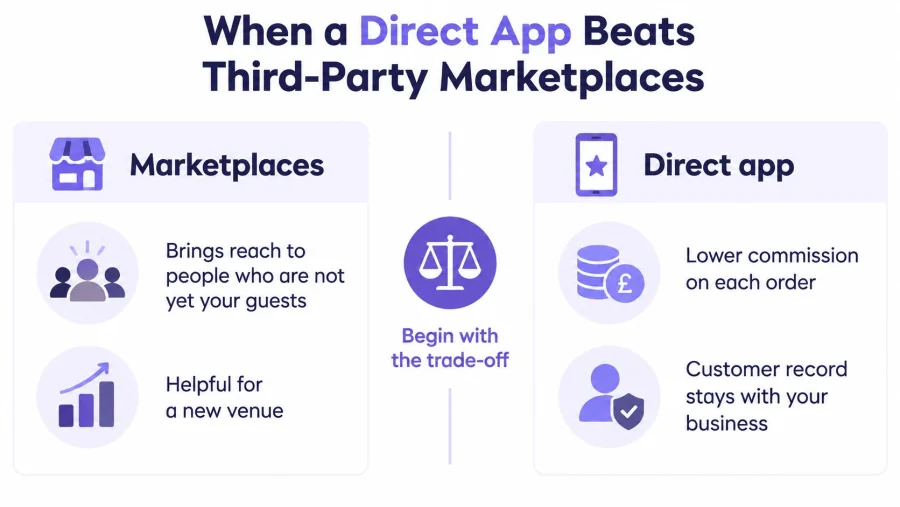
UK ordering habits show why both channels still matter. In a survey of 2,000 UK consumers reported by CI&T, 56% ordered through platforms such as Uber Eats, Deliveroo, or Just Eat for takeaway orders eaten at home, compared with 36% ordering directly through a restaurant's app or website. The same survey found that 63% believed apps made it easier to see all menu options and decide what to order.
Three Benefits of a Direct Channel
- Margin stays with the venue: Direct orders carry no marketplace commission, so the same dish earns more.
- The guest list belongs to the restaurant: A direct system gives businesses a list of loyal customers, including the nicknames customers choose in the app, visit history, collected points, and used coupons.
- Offers cost nothing per order: A quiet-Tuesday reward or a win-back message goes to opted-in regulars without buying placement on a platform.
Those benefits compound when regulars form the core of trade. A guest who wants a loyalty stamp, a familiar booking slot or a usual takeaway order doesn't need a marketplace search page. A direct restaurant app shortens a journey that already exists.
Channel cost and customer ownership
| Channel | Cost per order | Who keeps the customer | Best use |
|---|---|---|---|
| Marketplace delivery | Commission at the rate in the platform contract | Platform | New customer reach |
| Direct app on free QR plan | No per-order commission | Restaurant | Repeat visits from nearby guests |
| Direct paid web app | Monthly plan fee, no per-order commission | Restaurant | Reservations and campaigns |
When a Marketplace Still Wins
Honesty about the trade-off helps. A venue opening in a new area, with low brand awareness and a delivery-heavy menu, often needs marketplace discovery before a direct channel can retain anyone. Removing that listing too early can cut orders faster than loyalty sign-ups replace them.
The practical answer for many venues is a hybrid approach. Marketplaces handle discovery, while the direct app handles retention through stamps, bookings and wallet passes. Tracking which channel brings the first visit versus the tenth keeps the decision factual rather than emotional.
Per-order cost check: Multiply a typical order value by the commission rate on the actual platform contract, then compare that figure across a month of orders with the monthly fee of a direct plan.
That simple calculation shows which channel earns its place first. It also reveals how many regular orders must move direct before a paid plan pays for itself, which is a far more useful number than a headline monthly price.
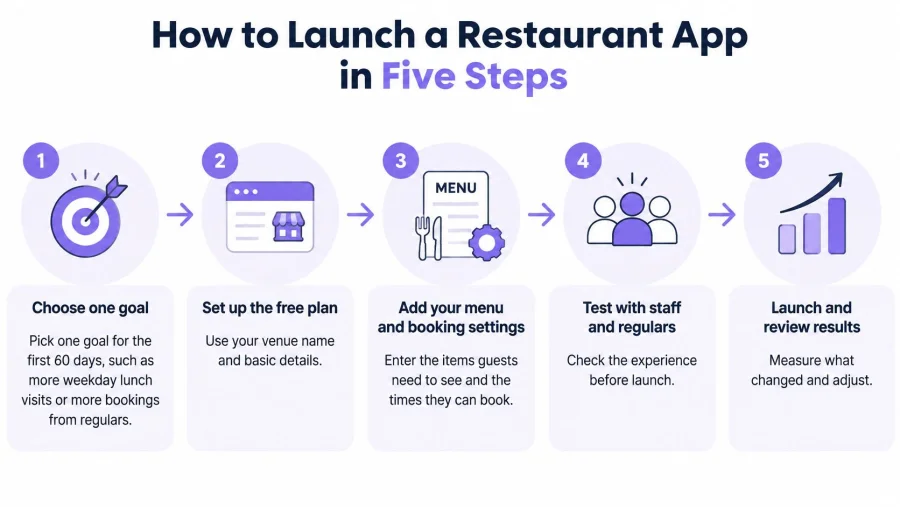
How to Launch a Restaurant App in Five Steps
A launch succeeds on small, repeatable habits rather than a big announcement. Each step below includes its reason and its most common slip, because knowing where launches stall saves more time than any feature list.
The Five Steps in Order
- Choose one goal for the first 60 days: More weekday lunch visits or more bookings from regulars both work, because a single goal makes results readable. The common slip is chasing downloads, which measures curiosity rather than revenue.
- Set up the free plan: Add the venue name, logo and brand colours, then load the menu or price list. Signing up for BonusQR requires no credit card, so setup can start before any budget decision.
- Pick one reward mechanic: Write its rule in one sentence, including what counts as a visit and when rewards expire. The common slip is launching stamps, points and a birthday offer together, then being unable to tell which one changed behaviour.
- Print and place the QR sign: A ready-to-print sign with the business's QR code and brand belongs next to the till, on each table or by the entrance. Hiding it behind the menu is the classic slip, because guests can't join a scheme they never see.
- Brief staff for two minutes: Guests show a code, staff scan it, redeem the reward and confirm on screen. Skipping the scan during a rush breaks the visit count and makes every later report unreliable.
What the Guest Experiences
Customers scan a QR code at the store to immediately see available rewards, create an account with one click and receive a personal QR code. They present that code to staff on each visit to earn rewards and redeem them easily, while staff can see every detail of the process. No POS integration is needed for this free QR approach, which keeps the first version simple enough for any till setup.
Venues considering a fully custom build instead face a different project, with developers, timelines and app store submissions. The Continuum Solutions guide to hiring developers outlines what that hiring process involves, which helps owners compare a custom route against a ready-made platform before committing money.
The Seven-Day Check
After one week, three numbers tell the story. How many guests scanned, how many came back, and where exactly the process stalls. A stall usually sits in one of three places. Guests don't see the sign, staff forget to scan, or the reward rule takes too long to explain.
Fixing one stall at a time keeps the launch manageable. Moving a sign to eye level costs nothing. Rewriting a reward rule into one sentence costs nothing either, and both fixes often lift participation more than adding a new feature would.
Privacy, Consent and Serving Guests Who Avoid Apps
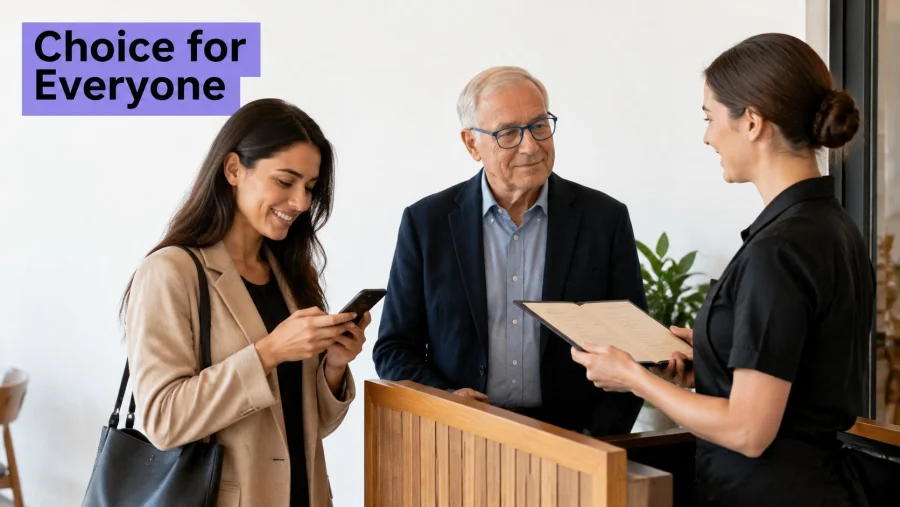
Not every guest wants an account, and a good restaurant app respects that choice instead of punishing it. Research reported by Restaurant Online in February 2021 found that nearly two-thirds of people aged 18 to 34 had used order-and-pay technology since lockdown, compared with only 20% of people aged over 65. That gap is a design brief, not a footnote.
Keep a Route That Needs No App
Three alternatives keep every guest served. A QR code can open a browser page with the menu and reward balance. A staff-assisted route lets a server take the order and add the visit manually. A printed menu remains available for anyone who prefers paper. Guests who feel locked out rarely complain loudly. They eat somewhere else next time.
Collect Less, Explain More
A fair data rule is simple. Collect a name, mobile number or email only when the venue will send something useful, such as a reward, a booking reminder or a birthday offer. Marketing consent belongs in a separate tick box from loyalty membership, and unsubscribing should take a single tap. Owners writing a privacy notice can use practical guidance on disclosing SDK data collection in your policy from LetsDeployIt to describe third-party tools in plain language.
Three consent models cover most venues:
- Anonymous offers: A QR code carries the reward, with no profile required.
- Optional profiles: Guests add preferences, such as a favourite dish, only if they choose to.
- Explicit opt-in campaigns: Guests actively join a mailing list for events or seasonal menus.
Four metrics show whether the balance is right. Redemption rate shows relevance, unsubscribe rate shows message fatigue, repeat frequency shows value, and complaints show where trust is thinning. UK GDPR applies throughout, so data stays limited, clearly explained and deletable on request.
Confirm Your Plan and Start With a Free Pilot
Three questions settle the decision. Which goal matters most this quarter? Which option fits the budget and staff time available? Which reward mechanic can staff explain in one sentence? Answers to those questions point to a starting point far more reliably than a feature comparison alone.
A Simple Decision Rule
When repeat visits matter most and the venue is a café or quick-service site, a free QR loyalty card with a visit or stamp reward is the natural start. The Free plan costs $0 forever, with no card and no commitment required, so the trial risks staff attention rather than money.
A full-service restaurant with regular bookings may need a paid plan sooner. The online store for pre-selling coupons and gift cards, reservation system, PDF menu or price list, HTML widget, and WooCommerce, Shopify, and Zapier integrations are included in Basic and Premium, but not in Free. Paying makes sense only when reservations or campaigns are the stated goal, not as a default upgrade.
The 30-Day Test
Run one mechanic for 30 days and track three numbers. Redemptions show the reward landed, visits per regular guest show behaviour changed, and new sign-ups show the sign and staff prompts worked. At the end of the month, the choice is concrete. Keep the mechanic, change the reward value, or add a second mechanic for a different guest group.
Skipping the test and buying a full setup first reverses the sensible order. Real visit data from a free pilot tells an owner whether guests want stamps, bookings or faster ordering, and that evidence makes every later spending decision calmer.
Start the pilot this week. Create a free BonusQR account with no card details, add the menu, choose one stamp or visit reward with a rule staff can say in one sentence, and print the QR sign for the till, tables and entrance. Run it for seven days, count scans, return visits and redemptions, then decide on a paid plan using real numbers from actual guests rather than guesswork.


