A café owner has a shoebox of loyalty cards behind the till. Regulars bring friends in, but when the cards come back, nobody can tell which customer made the introduction or whether the friend was new. A salon faces the same puzzle when a client recommends a stylist to someone else: the recommendation may be valuable, but its result is hard to trace.
Referral program software can make that recommendation easier to record. The useful question isn't how many people shared a code. It's whether the new visits and repeat business paid for the rewards and software.
What Referral Program Software Actually Does
At a café, a customer can scan a QR code to share a referral with a friend. If the friend visits and meets the offer's conditions, the software records who introduced them and issues the agreed reward. The business can then compare the reward cost with the value of the new customer's visits. That makes the tool useful for measuring whether referrals pay, not just for making offers easier to share.
Referral program software is a digital “tell a friend” system that records who referred whom, checks whether the friend qualifies, and issues rewards under rules the business sets.
The QR code or link acts like a receipt for the recommendation. In a salon, for example, a client shares a link, a new visitor books and completes a qualifying treatment, and the system connects that visit to the referrer. The record helps the salon see which referrals led to completed appointments.
The reward still needs to make financial sense. A café might offer a free item to both customers, but if the reward costs more than the new customer's resulting business, the referral can lose money. The software tracks the activity and reward cost; the owner must decide whether the customer's spend justifies the offer.
Referral tracking can run alongside existing stamps or points. A café could keep its usual stamp card while adding a reward for introducing a first-time customer. A gym with several locations could apply the same referral rules across branches and compare results by venue.
The same tracking method does not settle every question. In the UK, a business-triggered “invite a friend” button can raise consent concerns if it sends a marketing message on the customer's behalf. A referral tool can record activity, but the business still needs to check how invitations are sent and whether its process follows applicable rules.
Quick self-check: if a café, salon or gym cannot link a new customer to the person who referred them, the software may solve a tracking gap. Whether it solves a profit problem depends on reward costs and the value of the visits that follow.
Core Features Every Referral Tool Needs
A useful referral tool should make the programme easy to explain, straightforward to run at the counter and clear enough to evaluate afterwards. This checklist covers eight features and why a small venue will notice each one.
| Feature | What It Does | Why a Small Business Needs It |
|---|---|---|
| Unique QR code or referral link | Gives each customer a personal code to share | Staff see who brought in each friend |
| Reward rules | Sets fixed discounts, visit thresholds, points, cashback or free items | The offer can be explained in one sentence at the counter |
| Referral attribution | Links the new customer to the person who referred them | Stops self-referrals and duplicate claims |
| Qualifying-event trigger | Issues the reward only after a first visit or minimum spend | Protects margin on people who never buy |
| Staff scan and redeem | Confirms visits and rewards in the app, with no extra hardware | Works on one phone or tablet at one counter |
| Customer profile and wallet passes | Holds rewards and visit history, with Apple or Google Wallet passes | Customers keep the offer where they already look |
| Analytics dashboard | Shows referrals, redemptions, reward cost and top customers | Shows which offer actually pays back |
| Campaign messaging | Sends push or email reminders and feedback requests | Brings lapsed referrers back before their reward expires |
The first three features establish trust. A customer needs a personal code, a rule they can understand and accurate credit for the introduction. If attribution is unreliable, someone may earn a reward for a visit they didn't generate, or a genuine referrer may be missed.
The last three features help the programme get used after launch. A customer profile gives people a place to check their rewards; a dashboard helps the owner see what has happened; and messages can remind customers about an offer. However, a café with one counter usually needs a fast scan-and-redeem screen more than a complex dashboard. A feature is useful only if staff can operate it during a busy shift.
Counter test: if a feature can't be explained to a customer in one sentence, staff are unlikely to use it consistently at the till.
How a Referral Moves From Share to Reward
A referral programme works best when the customer, friend and staff member can each see what happens next. The order below keeps the introduction connected to a real visit, rather than treating every share as a successful referral.
The customer opens a personal QR code or wallet pass and shares it. The personal code ties the recommendation to the customer from the start.
The friend scans, signs up and chooses whether to consent to marketing separately. This records the referral without treating participation as permission to send promotions.
The system links the friend to the referrer and checks for duplicates or self-referrals. This helps prevent the same person from triggering multiple rewards.
The friend makes the qualifying visit. The programme might require a first purchase above a set amount, so merely signing up doesn't earn a reward.
Staff scan the friend's code at the till to confirm the visit. That scan records the qualifying event while the transaction is happening.
The system issues a reward to both people, with an expiry date. Clear timing helps each person understand when and how to use the offer.
The referrer redeems their reward on a later visit, and staff scan it closed. The second scan keeps the reward record up to date.
The dashboard records the conversion and reward cost. The owner can check what the introduction cost, not just how often a code was shared.
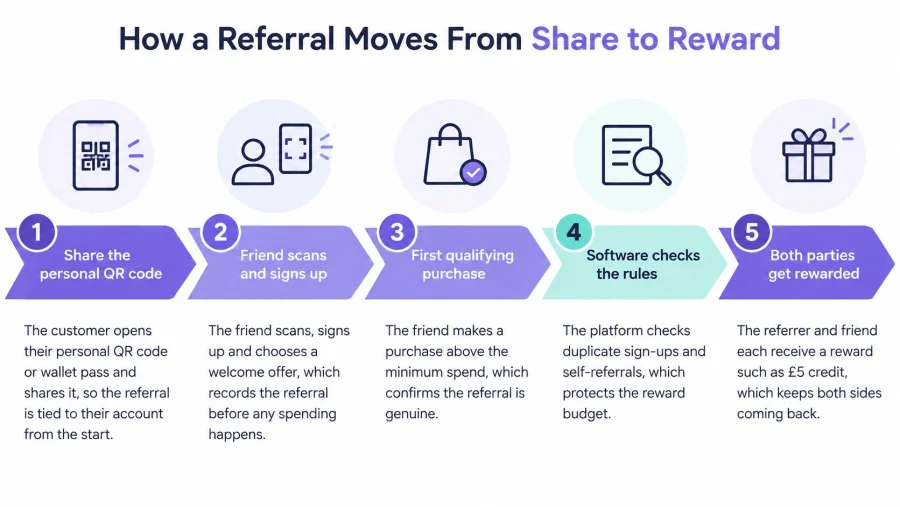
The weak point is often between steps four and five. A friend may make a qualifying purchase, but if staff forget to scan the code, the visit may never count. A short till prompt, such as “Scanned your friend's code?”, gives staff a reminder at the moment it matters.
A 14-day first-visit window can keep the offer moving: the friend has a defined period to visit, and the business doesn't leave an open reward waiting indefinitely. The window should appear plainly in the offer terms, alongside any minimum spend or exclusions.
Referral Use Cases for Cafés, Salons, Gyms and Retail
A café owner offers a free drink to anyone who brings in a new customer. The offer attracts visits, but does it bring in enough extra profit to cover the drinks? Referral software is useful here as a way to measure the cost and result of each offer, not just to count shares. Choose a qualifying action that reflects real business value, then set a reward the business can afford.
| Business | Reward That Works | Qualifying Action | Watch-Out |
|---|---|---|---|
| Café or coffee shop | Free drink or pastry for both people | Friend's first purchase within 14 days | Low-cost items protect margin better than percentages |
| Hair or beauty salon | £10 off the next treatment for both people | First treatment completed, not just booked | No-shows should never trigger a reward |
| Gym or fitness studio | One free class or a week of membership | Friend's first paid month or fourth visit | Free trial passes can inflate referral counts |
| Independent retailer | 10% off the next basket or a points bonus | Spend above a set threshold | Discounts on sale stock erode margin fast |
At a café, a free drink or pastry is easy to explain at the counter, and the owner can estimate the cost of each item. A percentage discount is less predictable because a larger basket can mean a larger reward. Compare the reward cost with the extra sales it brings, so a busy promotion does not disguise a weak return.
At a salon, a fixed discount on a later treatment can reward both the referring client and the new customer. Count a completed treatment as the qualifying action, rather than a booking. A no-show has not brought in the expected revenue, so rewarding it can turn the offer into a cost without a corresponding sale.
For a gym, the new member might need to complete a paid month or reach a visit threshold before either person earns a reward. A free trial pass can draw interest, but it does not show whether the introduction became a paying membership. The salon's completed-treatment rule follows the same principle: measure the action that creates revenue.
An independent retailer could offer points or a discount on a later basket. A spending threshold links the reward to a meaningful transaction, while excluding sale stock can protect thin margins. For every business, check the reward's cost against the profit from the qualifying purchase and any later visits. A generous reward can wipe out the gain if its cost is greater than the extra profit.
The UK consent risk also depends on how referrals are sent. A business-triggered “invite a friend” button may send a marketing message to someone who has not agreed to receive it. Keep the customer in control of sharing, and get appropriate consent before the business sends a message on their behalf.
Customers' willingness to switch makes a clear, easy-to-explain reward more useful than vague goodwill. It still needs to work financially: the café can price a drink reward, while the salon can compare its treatment discount with the profit from a completed appointment.
Before launch, choose a reward whose cost can be stated per referral.
How to Compare Referral Software Providers
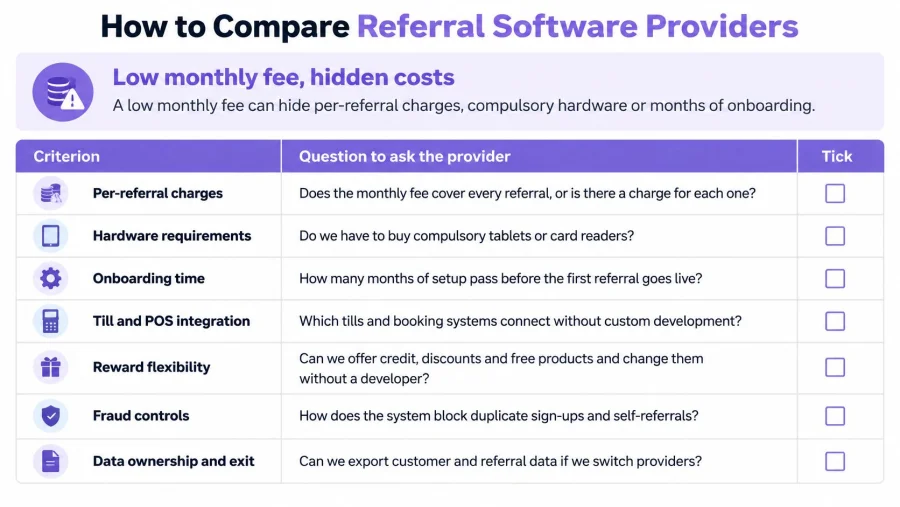
A café can get plenty of referral shares and still lose money if rewards go to people who would have visited anyway, or if one person claims the offer more than once. Compare referral software by how clearly it tracks each introduction from invitation to qualifying purchase, and by whether the reward cost is visible.
| Criterion | Question to Ask the Vendor | Red Flag |
|---|---|---|
| Referral attribution | How does the system connect an invitation to a new customer's purchase, in person and online? | It cannot show which referral link or code led to the purchase |
| Self-referral and duplicate controls | How does it detect a customer referring themselves or using multiple accounts? | The same person can claim rewards repeatedly |
| Qualifying-event triggers | Can a reward depend on a completed, paid transaction rather than a booking or signup? | Rewards issue before the business receives the qualifying sale |
| Referral-level analytics | Can we see invitations, referred customers, completed purchases and rewards for each referral? | Reporting shows only total shares or total rewards |
| Matched-group reporting | Can we compare referred customers with similar customers who were not referred? | Results show sales but cannot help separate referral impact from ordinary visits |
| Total cost | What fees apply to the platform, referrals and reward processing? | Charges are unclear or rise without a clear relationship to results |
| Data export and consent | Can we export referral records and record referral consent separately from marketing consent? | Records are locked in, or consent choices are bundled |
A salon can use these questions to check whether a referral counts only after a new client completes a paid treatment. That is different from checking whether someone shared a link: the software should connect the introduction to the event that makes the reward due. Ask the vendor to demonstrate a normal referral, a duplicate claim and a referral that does not qualify.
Then inspect a sample report. It should make it possible to follow a referral from source to outcome and compare referred customers with a suitable non-referred group. This does not prove that every referred visit was caused by the programme, but it gives the owner a more useful comparison than a share count alone. A generous reward can erase the gain, so check whether the software records reward costs alongside referral outcomes.
For small businesses also comparing broader loyalty tools, getting started with loyalty software from BonusQR offers a related starting point. Judge any provider by the referral controls and reporting it can demonstrate, rather than by a feature label.
Measuring ROI and the KPIs That Matter
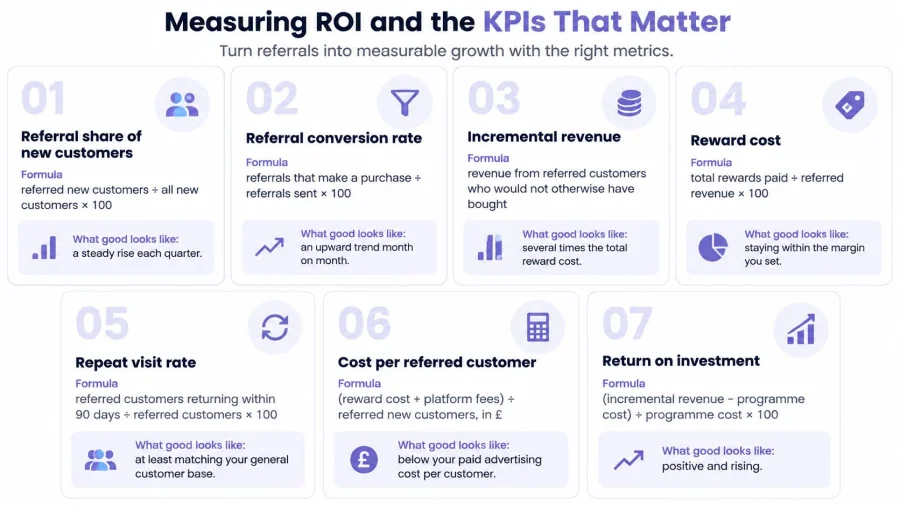
A referral count is not a profit measure. The café needs to know whether referred customers spent more than comparable customers who weren't referred, and whether that extra gross profit covered rewards and software costs.
| Measure | How to Calculate | What Good Looks Like |
|---|---|---|
| Referral share of new customers | Referred new customers ÷ all new customers | Rising trend; a DMA survey averaged 11.3% across industries, a directional benchmark |
| Referral conversion rate | Qualifying referrals ÷ invitations or shares | Compare against your own control group, not a universal benchmark |
| Incremental revenue | Referred spend minus matched non-referred spend | Positive after rewards are paid |
| Reward cost | Rewards issued × value of each reward | Set a ceiling per referral before launch |
| Repeat visit rate | Referred customers with a second visit within 30 days ÷ referred customers | Higher than the comparison group |
| Customer lifetime value | Average spend per visit × visits per year × years retained | Rising for referred customers |
| Programme ROI | (Incremental gross profit − reward cost − software cost) ÷ software cost | Above zero after every cost |
A UK DMA survey of 208 organisations found that businesses acquired an average 11.3% of new customers through referrals; 30% reported getting more than 15% this way, while 23% had a customer-acquisition referral programme (DMA and Mention Me referral-marketing report). This is directional evidence across industries and business sizes, not a promised result for a local venue.
The dashboard should distinguish a new referral from an ordinary repeat visit. A café can record a referrer, the friend, the campaign, the location, the first qualifying visit, transaction value and reward status. It should also exclude self-referrals, duplicate claims and transactions that are later refunded. Tracking a scan alone doesn't prove that the programme acquired a customer.
A café example
Suppose 25 referred customers each spend £3 more in their first 30 days than a matched group. That gives £75 in incremental spend. At a 70% gross margin, the incremental gross profit is £52.50.
Now subtract £30 for free drinks and a £20 monthly plan. The programme nets £2.50 in this example. The positive result is very thin, so the café could test a less generous reward or a qualifying action that encourages another visit. These are example figures for showing the calculation, not a forecast for any particular business.
Measure the extra value, not the activity. A discount on a customer who would have visited anyway is a cost, not proof that the referral created growth.
To build a matched group, compare referred customers with similar new customers who didn't receive the referral invitation during the same period. Keep the comparison within the same venue and account for obvious differences such as existing customer status, day of visit and transaction type. A small business can then assess whether referred customers return, spend and use rewards differently, rather than assuming that every code redemption represents incremental revenue.
Businesses seeking a wider view of retention can use these measures to measure customer loyalty.
Staying Lawful in UK Refer-a-Friend Campaigns
A referral incentive isn't automatically harmless from a privacy and marketing perspective. When a business actively encourages customers to send marketing messages to friends or family, the ICO says the business is likely to be instigating those messages and must consider PECR, even if the customer presses send (ICO guidance on businesses instigating electronic marketing). A “invite a friend” button can therefore raise a compliance question, especially if the business sends the text or email on the customer's behalf.
Practical safeguards for a referral flow:
- Keep participation and marketing consent separate. Never make promotional consent pre-ticked or a condition of joining the referral programme.
- Record consent evidence. Store the timestamp, wording version, channel and named organisation, along with the customer's choice.
- Prefer customer-sent sharing. A personal QR code or phone share sheet avoids the business directly sending an invitation, although the overall design still needs review.
- Issue rewards after the qualifying visit. This keeps the reward tied to a recorded event rather than an unverified sign-up.
- Include an unsubscribe route in marketing messages. Customers need a clear way to stop future promotional emails or texts.
- Make opting out as easy as opting in. A withdrawal should be simple to complete and respected across campaign channels.
The ICO's soft opt-in is limited. It applies when a customer bought or negotiated to buy a similar product or service, had a clear chance to opt out when providing contact details, and receives a simple opt-out in every subsequent marketing message. An e-receipt choice doesn't automatically count as marketing consent, and loyalty customers should be told what messages they'll receive. The ICO's direct-marketing planning guidance provides further detail on planning compliant communications.
For teams shaping a campaign, The AI CMO referral program tool can help organise the offer and sharing flow; any customer messaging still needs to be checked against the business's legal obligations.
This is a practical overview, not legal advice. Before launch, check the ICO guidance and get appropriate advice for the specific campaign.
Launch One Referral Test This Month
A small, defined test can show whether a referral offer brings in useful visits without committing the business to a permanent discount. The café can pick one reward, such as a free drink after a friend's first visit, and set a clear qualifying action and 14-day window.
Track referred customers against similar new customers who didn't receive the invitation. Record the reward cost for each qualifying referral, then review the results on day 30: keep the offer if incremental gross profit is positive, adjust the reward if the margin is thin, or stop if referrals aren't converting.
A simple QR-based setup can help a local business turn loyal customers into referral advocates. Sign up for free with BonusQR and run the 30-day test during the next quiet month, using its QR rewards and built-in analytics to keep the trial manageable without extra till hardware.


