Push notifications are defined as real-time, permission-based messages delivered directly to a user’s device, and their role in customer loyalty is to create timely, relevant touchpoints that keep your brand present between purchases. The 2026 OneSignal State of Customer Engagement Report confirms that 75.8% of teams rate push notifications as the single channel with the greatest impact on long-term retention within the first 30 days after app install, outperforming both email and in-app messaging combined. That finding alone reframes how business owners and marketing professionals should think about mobile notifications. Used correctly, they are not an interruption. They are the mechanism that turns a one-time buyer into a repeat customer.
The role of push notifications in customer loyalty programmes
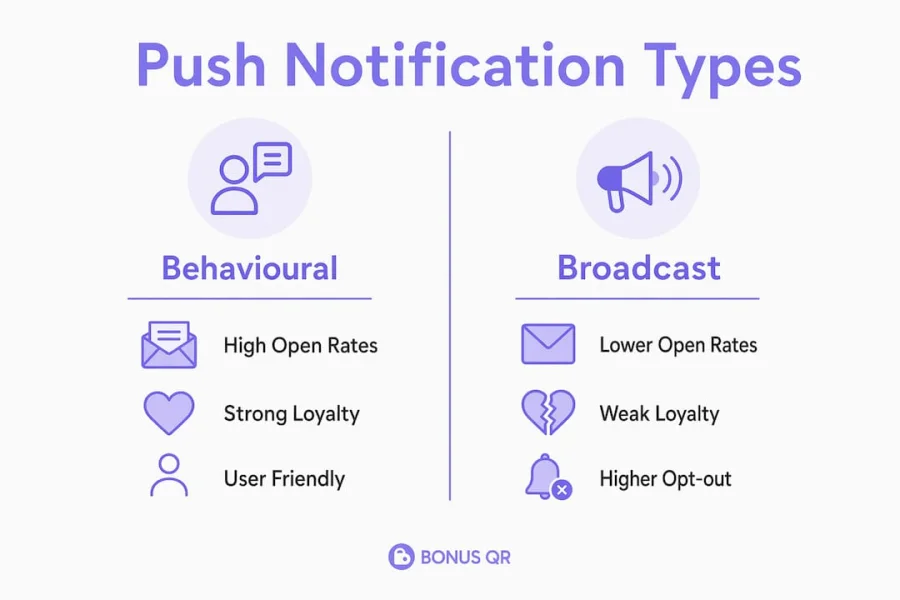
The core mechanism is straightforward: push notifications reduce the gap between a customer’s last purchase and their next one by delivering the right message at the right moment. Platforms like OneSignal and Klaviyo have built entire product lines around this principle, and the data supports the investment. Behaviour-triggered notifications outperform standard broadcast sends by 4 to 9 times on click-through rate, which means a message triggered by a customer earning loyalty points will generate far more engagement than a generic weekly promotion sent to your entire list.
Personalisation is the second pillar. Segmented campaigns achieve open rates of around 16.3% compared to 4.7% for unsegmented sends. That gap represents a significant difference in how many customers actually see your loyalty offer, redeem a reward, or return to your app. Lifecycle relevance matters here: a notification telling a customer they have reached Gold tier status lands very differently from a generic “Don’t miss out” message.

Effective loyalty triggers include replenishment reminders (sent when a customer’s typical purchase cycle suggests they are running low on a product), tier change alerts, reward expiry warnings, and milestone celebrations such as a first anniversary with your programme. Each of these connects to a moment the customer already cares about, which is why they convert at a higher rate than promotional blasts.
Comparing push notification types by loyalty impact
The table below shows how different notification types perform across key loyalty metrics, based on industry data and engagement benchmarks.
| Notification type | Typical open rate | Loyalty impact | User tolerance |
|---|---|---|---|
| Behaviour-triggered (e.g. points earned) | High (up to 16%+) | Very high: directly reinforces programme value | High |
| Transactional (e.g. reward redeemed) | High | High: confirms value exchange, builds trust | Very high |
| Personalised promotional (e.g. birthday offer) | Moderate to high | High: creates emotional connection | Moderate to high |
| Generic broadcast promotion | Low (around 4.7%) | Low: easily ignored or causes opt-out | Low |
| Re-engagement (e.g. lapsed user reminder) | Moderate | Moderate: recovers at-risk customers | Moderate |
Pro Tip: Segment your push audience by loyalty tier before sending any campaign. A message relevant to a Bronze member is rarely relevant to a Platinum member, and sending the same notification to both wastes the channel’s credibility with your most valuable customers.
What are the risks of push notifications for loyalty programmes?
Push notifications carry real risks when mismanaged, and understanding those risks is what separates programmes that sustain engagement from those that erode it. The most immediate risk is frequency fatigue. Research shows that sending 2 to 5 pushes per week causes 10% opt-out rates, while increasing to 3 to 6 per week drives opt-out rates as high as 40%. Once a customer opts out, you lose that channel permanently unless they actively re-enable notifications, which very few do.
Privacy is the second risk, and it is growing in significance. The Electronic Frontier Foundation has documented how push notifications expose sensitive data on lock screens and through operating system caching, meaning that loyalty programme details such as account balances, redemption codes, or personal identifiers can be visible to anyone who picks up a customer’s phone. For loyalty programmes that handle financial data or personal rewards, this is a genuine trust issue.
Practical risk mitigation requires attention to both content and cadence. Consider the following guardrails:
- Limit lock screen detail. Show a useful but non-revealing message such as “You have a new reward waiting” rather than “Your 2,450 points expire on Friday, John.” The EFF specifically recommends limiting lock screen previews to protect user privacy.
- Respect frequency caps. Set a maximum of one to two promotional pushes per week per user, and track opt-out rates by frequency band to find your programme’s specific threshold.
- Separate transactional from promotional. Transactional notifications (order confirmed, points added, reward redeemed) carry much higher user tolerance than promotional messages. Mixing the two in a single stream trains customers to ignore everything.
- Audit notification content regularly. Review what appears on a lock screen before any campaign goes live. If the preview reveals account-specific financial details, rewrite it.
- Monitor permission rates. If your opt-in rate drops below 50% for new users, your onboarding messaging around notifications needs revision.
Pro Tip: Run a monthly audit of your notification content against a locked test device. What you see on that screen is exactly what your customers see, and it is often more revealing than you intended.
The dual-stream approach of separating transactional and promotional push streams is one of the most effective ways to protect channel health. Customers who receive a transactional notification confirming their points balance are far less likely to opt out than customers who receive a promotional push they did not expect. Keeping these streams distinct preserves the credibility of your most important loyalty messages.
How do you measure push notifications for loyalty success?
Measuring the impact of push notifications on customer loyalty requires looking beyond open rates. Open rate tells you whether a message was noticed. It does not tell you whether it changed behaviour. The metrics that matter for loyalty are incremental retention in pushed cohorts versus opt-out cohorts, repeat purchase rate among active push subscribers, and unsubscribe trend over time.
Cohort analysis is the most reliable method. Compare the 90-day repeat purchase rate of customers who receive push notifications against those who have opted out. If the pushed cohort shows meaningfully higher retention, your programme is working. If the gap is small or reversed, your notifications are either irrelevant or too frequent. This analysis also reveals whether push engagement accelerates app use and search activity before it translates into purchases, which is a leading indicator worth tracking.
The two-metric dashboard recommended by advanced practitioners focuses on incremental retention in actual receivers and unsubscribe trends. Together, these two numbers tell you whether your push programme is growing or eroding its own audience. A rising unsubscribe trend is an early warning sign that frequency or relevance has gone wrong, and catching it early is far less costly than rebuilding a depleted subscriber list.
Practical best practices for continuous improvement include:
- A/B test message copy and timing on every campaign, not just occasionally. Small copy changes can shift click rates significantly.
- Track reachability as a health metric. Reachability is the percentage of your loyalty base that still has push enabled. A declining reachability score means your programme is losing its ability to communicate with customers over time.
- Use engagement rate, not just open rate. Engagement rate measures whether the customer took the intended action after opening the notification, such as redeeming a reward or completing a purchase.
- Review opt-out rates by notification type. If promotional pushes are driving opt-outs but transactional pushes are not, that is a clear signal to reduce promotional frequency.
- Set quarterly benchmarks. Loyalty push programmes need regular recalibration. What worked in Q1 may not work in Q3 if your customer base or product mix has changed.
Connecting push performance data to your loyalty programme’s broader analytics gives you a complete picture. Platforms that integrate push notifications with retail loyalty data allow you to see exactly which messages drive repeat visits and which ones go unnoticed.
Practical push notification strategies that drive loyalty and engagement
The most effective push notification strategies for loyalty programmes share three characteristics: they are timely, they are relevant to the individual customer’s position in the loyalty journey, and they are sent through a clearly segmented stream. Here is how to build that structure in practice.
-
Split your push streams from day one. Create two separate notification categories within your platform: transactional and promotional. Transactional includes points earned, rewards redeemed, tier changes, and expiry alerts. Promotional includes offers, events, and campaigns. Customers who opt out of promotional pushes should still receive transactional ones. This separation protects your most important communications.
-
Trigger on lifecycle moments, not calendar dates. A notification sent because a customer just reached 500 points is far more relevant than one sent because it is Tuesday. Map your loyalty programme’s key milestones and set automated triggers for each. Replenishment reminders, tier upgrade alerts, and reward expiry warnings are all lifecycle triggers that drive customer engagement without feeling intrusive.
-
Optimise send timing using your own data. A Yahoo! Japan study found that timing optimisation alone produced a 60.7% increase in click rate. Most push platforms allow you to send at the time each individual user is most active, rather than at a fixed time for your entire list. Use this feature. The difference in engagement is substantial.
-
Use milestone alerts to create emotional connection. A message celebrating a customer’s one-year anniversary with your programme, or congratulating them on reaching a new tier, does something a discount code cannot: it makes the customer feel recognised. Recognition is a core driver of loyalty, and push notifications are one of the few channels that can deliver it in real time.
-
Integrate push with your other owned channels. Push notifications work best as part of a coordinated communication strategy. A customer who receives a push alert about a new reward, followed by an email with full details, is more likely to act than one who receives either message alone. Platforms that connect push with SMS, email, and in-app messaging allow you to build cohesive loyalty experiences across every touchpoint.
-
Personalise beyond first name. True personalisation in loyalty push means referencing the customer’s actual programme status, their preferred product categories, or their purchase history. “You are 50 points away from a free coffee” is personalised. “Hi Sarah, check out our latest offers” is not.
Pro Tip: Before launching any new push campaign, test the full customer journey from notification receipt to reward redemption on a real device. Friction in that journey, such as a slow-loading app or a broken redemption link, will cost you the engagement the notification worked hard to generate.
For retail businesses specifically, the combination of customer engagement strategies and well-timed push notifications can produce measurable lifts in repeat visit frequency without requiring a large marketing budget. The key is consistency: customers who receive relevant, timely notifications are more likely to return, and improving customer retention by even a small percentage has a compounding effect on revenue over time.
Key takeaways
Push notifications drive customer loyalty most effectively when they are behaviour-triggered, personalised to the individual’s loyalty journey, and managed within strict frequency and privacy guardrails.
| Point | Details |
|---|---|
| Behaviour-triggered messages outperform broadcasts | Triggered notifications achieve 4 to 9 times higher click-through rates than generic sends. |
| Personalisation multiplies open rates | Segmented campaigns achieve open rates of 16.3% versus 4.7% for unsegmented sends. |
| Frequency control protects channel health | Sending more than 5 pushes per week can drive opt-out rates as high as 40%. |
| Privacy design builds customer trust | Avoid sensitive loyalty details on lock screens to protect customer data and programme credibility. |
| Cohort analysis reveals true loyalty impact | Compare repeat purchase rates between pushed and opted-out cohorts to measure real retention value. |
What I have learned about push notifications and loyalty
From my experience working with loyalty programmes across retail and hospitality, the biggest mistake I see business owners make is treating push notifications as a broadcast channel rather than a relationship tool. The temptation to send more messages when engagement drops is almost universal, and it is almost always wrong. More messages do not fix a relevance problem. They accelerate it.
The shift I have seen work consistently is moving from a campaign mindset to a trigger mindset. Instead of asking “what should we send this week?”, the better question is “what has this specific customer just done, and what would be genuinely useful for them to know right now?” That reframe changes everything about how you design a push programme.
Privacy is the issue I expect to dominate push strategy over the next two years. Operating systems are giving users more granular control over notification permissions, and customers are increasingly aware of what appears on their lock screens. Programmes that design for privacy from the start, keeping notification content useful but non-revealing, will retain permission at much higher rates than those that treat privacy as an afterthought.
The permission to send push notifications is not a right you earn once at sign-up. It is something you re-earn with every message you send. Programmes that understand this, and that measure their performance accordingly, are the ones that still have an engaged push audience two years from now.
— Michal
How Bonusqr helps you use push notifications for retention
Bonusqr’s loyalty platform is built around the principle that push notifications should do real work for your business, not just fill a customer’s notification tray. The platform’s electronic reward programme includes built-in push notification tools that trigger automatically on loyalty events such as points earned, tier changes, and reward availability. You can also manage coupon distribution with targeted push alerts, sending personalised discount codes to the customers most likely to redeem them. Bonusqr supports both transactional and promotional push streams, giving you the segmentation structure that protects channel health from day one. If you are ready to build a push-driven loyalty programme that keeps customers coming back, Bonusqr provides the tools to do it without requiring complex technical setup.
FAQ
What is the role of push notifications in customer loyalty?
Push notifications support customer loyalty by delivering timely, personalised messages that keep customers engaged with a loyalty programme between purchases. Behaviour-triggered notifications, such as points earned or reward expiry alerts, are particularly effective at reinforcing programme value.
How often should you send push notifications to loyalty members?
Research indicates that sending more than 5 push notifications per week causes 10% opt-out rates, with rates rising to 40% at higher frequencies. One to two promotional pushes per week is a safe starting point, with transactional notifications sent as events occur.
Do personalised push notifications really improve retention?
Segmented, personalised push campaigns achieve open rates of around 16.3% compared to 4.7% for generic sends. That difference in reach directly affects how many customers engage with loyalty rewards and return for repeat purchases.
What privacy risks do push notifications carry for loyalty programmes?
Push notifications can display sensitive loyalty data on lock screens and through operating system caching, making personal details visible to third parties. The EFF recommends limiting lock screen content to non-revealing messages to protect customer privacy.
How do you measure whether push notifications are improving loyalty?
The most reliable method is cohort analysis: compare the repeat purchase rate of customers who receive push notifications against those who have opted out. Track unsubscribe trends alongside engagement rate to monitor the long-term health of your push programme.


