Loyalty points and stamp cards are two distinct customer retention mechanics: points accumulate proportionally to spend and fund a redeemable rewards catalogue, while stamp cards track visits or transactions and unlock a single fixed reward once a set threshold is reached. Understanding which system suits your business is not a minor operational detail. It directly shapes how often customers return, how quickly they engage with your programme, and whether your loyalty investment pays off. This article gives you a clear, practical breakdown of both formats so you can make a confident decision.
How do loyalty points and stamp cards work in practice?
Points systems and stamp cards follow different earning logic, and that difference matters from day one of your programme.
How points programmes work
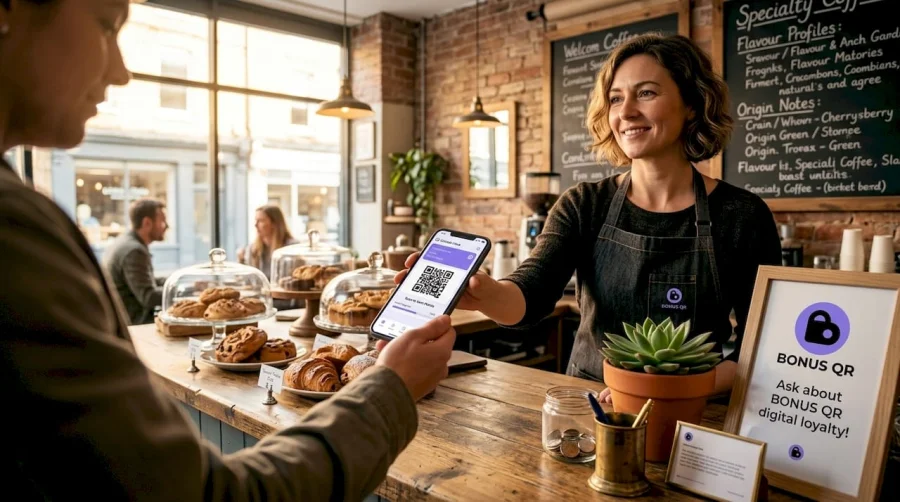
A points programme assigns a numerical value to every purchase. A customer who spends £10 might earn 100 points, and those points accumulate in a digital wallet until they reach a threshold worth redeeming. The rewards catalogue can include discounts, free products, exclusive experiences, or cashback. Because points scale with spend, a customer who buys more always earns more. This makes points programmes well suited to businesses with variable transaction sizes, such as retail shops, restaurants, or online stores. The flexibility is genuine, but it comes with a cost: customers must mentally track an abstract number and understand the conversion rate before they feel any tangible benefit.
How stamp cards work
Stamp cards reward visit frequency by awarding one stamp per visit or qualifying transaction, then unlocking a free reward after a fixed number of stamps. Barnes & Noble, for example, issues a virtual stamp for every $10 spent, with 10 stamps converting to a $5 reward within 24 hours. The mechanic is immediately legible to any customer: you can see exactly how many stamps you have and how many you need. That transparency reduces cognitive load and removes the confusion that sometimes undermines points programmes.
Comparing the core mechanics
| Feature | Points programme | Stamp card |
|---|---|---|
| Earning logic | Proportional to spend | Fixed per visit or transaction |
| Reward variety | Broad catalogue | Single fixed reward |
| Customer clarity | Moderate (requires conversion understanding) | High (progress is visible) |
| Best for | Variable spend, scalable businesses | Consistent transactions, high-frequency visits |
| Operational complexity | Higher | Lower |
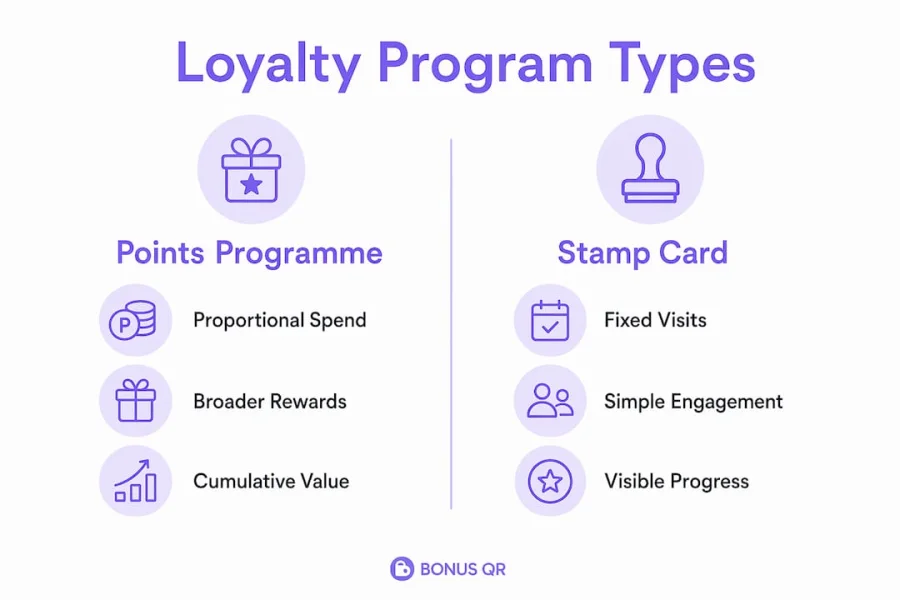
Points systems fund broader rewards catalogues, but stamp cards perform best where transaction values are consistent and purchase frequency is stable. This is not a flaw in either system. It is simply a signal about which business model each format was designed to serve.
Pro Tip: When setting up a stamp card, keep the reward threshold achievable within four to six visits. A threshold that takes months to reach will not change customer behaviour at all.
What are the key differences in customer engagement and business suitability?
The mechanics above explain how each system works. The engagement differences explain why customers actually respond to them.
Stamp cards and the psychology of visible progress
Stamp cards answer one specific customer question: “Am I close to a free item?” That question is powerful because it creates a clear, short-term goal. Customers visiting a café or salon can see their card filling up, and that visible progress motivates the next visit. Each mechanic suits different emotional triggers and buying behaviours, and the stamp card’s strength is precisely this short feedback loop. For businesses with consistent transaction values and regular visit patterns, such as coffee shops, barbers, nail salons, or dry cleaners, stamp cards are the more natural fit.
Points programmes and the psychology of cumulative value
Points programmes answer a different question: “What status or cumulative benefits do I have?” This appeals to customers who make larger, less frequent purchases and want to feel that their overall spending is being recognised. A customer buying furniture, electronics, or clothing does not visit weekly, but they do want to feel rewarded for the size of their spend. Points programmes also allow you to offer tiered status, which creates a longer-term aspiration that stamp cards cannot replicate.
Comparing suitability by business type
| Business type | Recommended mechanic | Reason |
|---|---|---|
| Coffee shop or café | Stamp card | High frequency, consistent spend per visit |
| Hair salon or barber | Stamp card | Regular appointments, predictable transaction value |
| Independent retailer | Points or hybrid | Variable basket sizes, occasional visits |
| Restaurant | Either, depending on model | Frequency and spend both relevant |
| Service business | Points | Varied service values, relationship-based retention |
The activation problem both systems share
One challenge applies equally to points and stamp cards: activation. Only 10 to 20% of new members complete the first earning activity within a few months of joining. That figure is striking because it means the majority of people who sign up for your loyalty programme never actually use it. Programmes designed to produce a first earned reward within 14 to 30 days improve activation and subsequent engagement significantly. This is why your onboarding design matters as much as your choice of mechanic.
- Design your stamp card so a customer can earn their first stamp on the same visit they sign up.
- For points programmes, offer a welcome bonus that gives new members a head start toward their first redemption.
- Use push notifications or SMS to remind members of their progress, particularly in the first two weeks.
- Keep the sign-up process short. Every additional step reduces the number of customers who complete it.
Pro Tip: Pair your loyalty sign-up with an onboarding promotion that gives new members an immediate reason to return. A double-stamp offer on the first three visits, for example, can dramatically improve your activation rate.
Can stamp cards and points programmes be combined?
The short answer is yes, and the combination is often more effective than either mechanic alone.
Combining stamp cards with points or tier programmes addresses different customer needs and buying cycles without adding friction. Stamps drive immediate visit frequency by giving customers a short-term goal they can achieve quickly. Points reward longer-term customer value and can build a sense of status over time. Together, they cover both the customer who visits twice a week and the customer who makes a large purchase once a month.
David Schneider of Loyalty & Reward Co notes that each mechanic suits distinct customer questions and emotional triggers, which means a single-mechanic programme will always leave some customers underserved. A hybrid approach lets you speak to both the frequency-driven customer and the high-value spender within the same programme.
“Stamp card programmes answer the customer question ‘Am I close to a free item?’, while points and tier programmes answer ‘What status or cumulative benefits do I have?’ Pairing both can improve retention across different customer segments.” — David Schneider, Loyalty & Reward Co
Practical pairing strategies worth considering include:
- Stamps for visits, points for spend. Award a stamp each time a customer visits and points based on how much they spend. A café customer earns stamps toward a free coffee and accumulates points toward a larger reward like a merchandise item or a discount on a catered order.
- Stamps as a fast-track onboarding tool. Use a stamp card for new customers to get them to their first reward quickly, then transition them to a points programme once they are engaged.
- Seasonal stamp campaigns alongside a permanent points programme. Run a limited-time stamp card promotion during quieter trading periods to drive visit frequency, while your points programme runs year-round.
The operational consideration is keeping the programme legible. If customers cannot understand what they are earning and why, the complexity will work against you. Digital platforms that display both stamp progress and points balance in a single app view solve this problem cleanly.
How should small businesses decide between points and stamp cards?
The right choice depends on four factors: your transaction value consistency, your customers’ visit frequency, the cognitive load you want to place on customers, and your capacity to manage the programme operationally.
Work through these steps before committing to a format:
-
Assess your transaction value. If most customers spend a similar amount per visit, a stamp card is the simpler and more transparent choice. If basket sizes vary significantly, a points programme rewards higher spenders more fairly.
-
Measure your visit frequency. Stamp cards work best when customers visit at least once or twice a month. If visits are infrequent, the stamp card threshold will feel distant and the programme will not change behaviour. Points programmes tolerate lower visit frequency because the accumulation is tied to spend, not time between visits.
-
Consider your customers’ familiarity with loyalty schemes. Stamp cards require almost no explanation. Points programmes require customers to understand earning rates and redemption thresholds. If your customer base includes older demographics or people who are not regular loyalty programme users, simplicity is a competitive advantage.
-
Evaluate your operational capacity. Points programmes require more infrastructure: you need a system that tracks spend accurately, calculates points correctly, and manages a rewards catalogue. Stamp cards can be run with a simple digital tool and minimal staff training. Stamp card effectiveness is well documented for high-frequency, low-complexity businesses, and the lower operational burden is a genuine benefit for small teams.
-
Plan your activation strategy before launch. Activation predicts customer lifetime value and programme profitability more reliably than enrolment numbers. A programme with 200 active members outperforms one with 2,000 inactive ones. Build your first-reward moment into the programme design from the start, not as an afterthought.
Many small businesses find that starting with a stamp card and adding a points layer once the programme is established is the most practical path. You build customer habit first, then add depth. Trying to launch a full points programme with a tiered catalogue from day one often results in operational strain and low activation.
Pro Tip: Look at your best retail loyalty programmes for inspiration, but do not copy them directly. A programme designed for a national chain has different economics than one designed for a single-location business. Scale your ambition to your operational reality.
Many brands treat stamp cards as a legacy format and underinvest in their development. Digital refinement and smart gamification of stamp cards can increase visit frequency and engagement distinctly. A well-designed digital stamp card with push notifications, progress reminders, and a clear reward is not a simple tool. It is a retention system.
Key takeaways
Both points programmes and stamp cards work, but they work for different businesses, different customers, and different retention goals. Choosing the right mechanic and designing for early activation is what separates a loyalty programme that changes behaviour from one that sits unused.
| Point | Details |
|---|---|
| Stamp cards suit high-frequency businesses | Use stamp cards when transaction values are consistent and customers visit regularly, such as cafés or salons. |
| Points programmes reward variable spend | Points are fairer for businesses with different basket sizes, rewarding higher spenders proportionally. |
| Activation is the critical success factor | Design your programme so customers earn their first reward within 14 to 30 days of joining. |
| Hybrid programmes address more customer needs | Combining stamps for visits and points for spend covers both short-term and long-term customer motivations. |
| Simplicity drives adoption | The easier your programme is to understand, the more customers will actually use it. |
Why I think most small businesses get this decision backwards
Most small business owners I speak with start by asking “Which is better: points or stamps?” That is the wrong question. The right question is “What behaviour do I want to change, and which mechanic creates that change most directly?”
I have seen cafés launch elaborate points programmes with tiered rewards and conversion rates, only to find that customers were confused and staff were overwhelmed. The same businesses would have been better served by a clean digital stamp card with a clear reward. Conversely, I have seen independent retailers dismiss points programmes as too complex, when a simple spend-based system would have meaningfully increased average basket size.
The detail that most SMBs overlook is activation. Signing up 500 customers means nothing if 400 of them never earn a single stamp or point. The first earning moment is the moment your programme becomes real to a customer. If you do not engineer that moment to happen quickly, you are spending money on a programme that exists only on paper.
The other thing worth saying plainly: digital stamp cards are not a lesser version of a points programme. They are a different tool with genuine commercial elegance. The transparency of visible progress, the simplicity of the mechanic, and the low operational overhead make them a strong choice for many small businesses. Do not dismiss them because they seem simple. Simple, well-executed programmes outperform complex, poorly-activated ones every time.
My practical advice is to start with the mechanic that matches your transaction pattern, design your onboarding to produce a first reward quickly, and then consider adding a second layer once you have evidence that customers are engaging.
— Michal
How Bonusqr supports both points and stamp card programmes
Bonusqr is built for exactly the decision you are working through. The platform lets you run a digital stamp card, a points programme, or a combination of both, without needing to integrate with your point-of-sale system. You can customise reward thresholds, set up onboarding promotions, and send push notifications to members who are close to their next reward. The setup is fast, and the dashboard gives you real-time data on which customers are active and which need re-engagement. If you want to see the full range of programme options available, the Bonusqr loyalty features page gives a detailed breakdown of every module, from stamp cards and points to cashback, coupons, and visit-based rewards.
FAQ
What is the main difference between points and stamp cards?
Points programmes reward customers based on how much they spend, accumulating a redeemable balance across purchases. Stamp cards reward visit frequency or transaction count, unlocking a single fixed reward once a set number of stamps is collected.
Which loyalty scheme works best for a small café or coffee shop?
Stamp cards are the stronger choice for cafés because transaction values are consistent and customers visit regularly. The visible progress toward a free coffee creates a clear short-term goal that drives repeat visits.
How quickly should customers earn their first reward?
Programmes designed to produce a first earned reward within 14 to 30 days improve activation and long-term engagement. Waiting longer risks losing new members before they develop a loyalty habit.
Can a small business run both a stamp card and a points programme at the same time?
Yes. Combining both mechanics lets you address different customer motivations: stamps drive short-term visit frequency while points reward cumulative spend and build longer-term value. Digital platforms like Bonusqr make it practical to manage both in one place.
Are stamp cards still effective in 2026?
Stamp cards remain commercially effective, particularly for high-frequency businesses. Digital versions with push notifications and progress tracking outperform paper cards, and smart programme design can increase visit frequency measurably.


