Most advice about a mobile application for restaurants starts with the wrong question: which features should it include? The better question is whether customers need another app at all. A restaurant should invest in easier visits and profitable returns, not a digital brochure that guests download for a discount and never reopen.
Why Restaurant Apps Must Earn Their Place
A restaurant app must justify the effort it asks customers to make. Downloading software, creating an account and remembering another password are costs, even when the app itself is free. Owners should demand something useful in return: easier ordering, simpler rewards or a more convenient next visit.
Digital quality does influence brand perception. In CI&T's October 2024 research, 82% of surveyed UK adults said the digital experience reflected a food or beverage brand's overall quality, while 93% agreed that the best brands usually had a good app or website. The sample comprised adults who regularly ate or drank outside the home and ordered digitally, so those findings shouldn't be treated as representative of every diner.
Service before software
The right comparison is a well-run host. A good host recognises regulars, remembers useful details and makes the visit easier. A poor host interrupts every conversation with another promotion.
An app should follow the same standard:
- Reduce customer effort: Make a menu, booking or earned reward easier to access.
- Reduce staff administration: Avoid manual reward calculations and repeated explanations at the till.
- Support a useful decision: Show whether a campaign brought customers back profitably, rather than merely attracting registrations.
Practical rule: If a feature doesn't improve a customer action or an operational decision, it belongs outside the launch scope.
For operators considering bespoke development, Arch's 2026 restaurant app build guide is a useful resource to review alongside a written requirements list. That list should describe customer problems before specifying screens.
The commercial test remains straightforward. Customers should find the restaurant easier to use, and staff should find the programme easier to run. A polished interface without either outcome isn't a retention strategy.
How a Restaurant Mobile Application Works
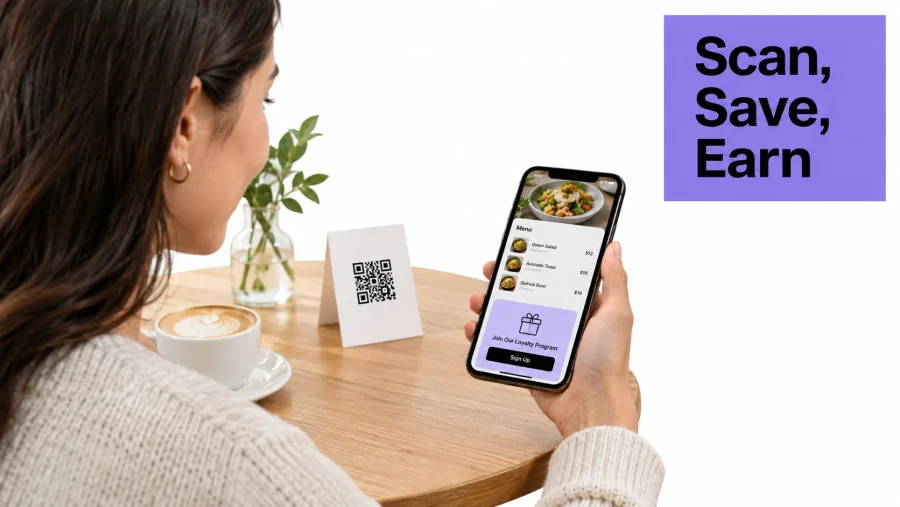
Consider a café guest scanning a code beside the till. The guest opens the menu, saves the café's details and joins its loyalty programme. On a later visit, an available reward appears in the same profile, ready for staff to validate.
That journey can run through different types of software. An ordering app handles food selection and checkout. A loyalty app manages customer identity and rewards, while a reservation channel handles availability and bookings. A lightweight web profile can provide access without an installation.
Core restaurant app jobs
| Capability | Customer job | Restaurant outcome |
|---|---|---|
| Menu | Check dishes, prices and options | Maintain accessible information |
| Ordering | Select and pay for food | Receive a clear order |
| Reservations | Request or confirm a table | Manage expected arrivals |
| Rewards | See progress and redeem benefits | Recognise qualifying activity |
| Customer profile | Keep relevant details together | Maintain consistent records |
| Promotions and messages | Find useful updates | Communicate with permission |
| Analytics | Receive correctly applied benefits | Understand customer actions |
The guest-facing interface and restaurant dashboard must describe the same event. If staff redeem a reward, the customer's balance should update accordingly. If a connection fails, the system should show whether the redemption succeeded rather than inviting staff to guess.
Consistency matters more than screen count
Authentication means confirming which customer is using the service. Reward validation means checking whether that customer qualifies before changing the balance. Both should happen without asking a regular guest to register again during every visit.
An owner exploring loyalty tools for cafés and salons should examine this entire journey, not just the customer's opening screen.
- Customer view: Are eligibility, progress and expiry understandable?
- Staff view: Can an employee confirm the correct customer and reward quickly?
- Owner view: Does the dashboard distinguish an earned reward from a completed redemption?
A dependable mobile application for restaurants connects those views. Attractive screens don't compensate for inconsistent balances or uncertain transactions.
Essential Features for Independent Restaurants
The essential feature is the one that solves the restaurant's actual bottleneck. A café with a clear counter-service routine may need loyalty rather than mobile ordering. A dining venue struggling with booking enquiries may need dependable reservation handling before promotional messages.
Separate service essentials from optional extras
A digital menu should load promptly, display readable prices and make categories easy to move through. Owners should request a live demonstration of changing availability. A photograph-heavy menu that delays browsing is less useful than a plain, organised version.
Reservations need equally practical scrutiny. A booking request isn't necessarily a confirmed table. Staff need clear ownership of confirmations, changes and cancellations, without monitoring another disconnected inbox.
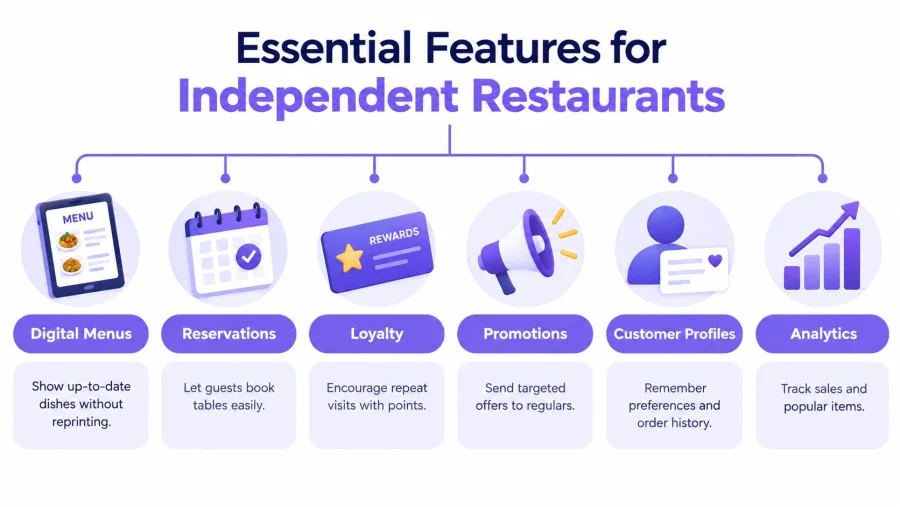
Feature decision matrix
| Feature | Primary purpose | Strongest benefit | Question to ask |
|---|---|---|---|
| Digital menu | Explain the offer | Easier browsing | Who updates prices and availability? |
| Reservations | Organise bookings | Clearer confirmation | Where do changes reach staff? |
| Loyalty | Recognise qualifying activity | A reason to return | Can the rules fit existing service? |
| Promotions | Encourage a chosen action | More relevant offers | Can eligibility and exclusions be controlled? |
| Customer profiles | Retain useful information | Less repeated entry | Which fields are genuinely necessary? |
| Analytics | Assess results | Better campaign decisions | Can results be exported and checked? |
| Ordering and payment | Complete purchases | Convenient checkout | How are failed payments handled? |
Ordering deserves a performance test, not a tick in a feature checklist. A 2025 Paytronix benchmark reported order completion up to four times faster in native restaurant and convenience apps than in browsers, with an approximately 40.4% first-party-app completion rate. Those results aren't a forecast for an individual UK restaurant.
Match the reward to the behaviour
Stamps and visit thresholds suit a clear return-visit proposition. Points and spend thresholds can reflect purchasing activity, but staff must be able to explain how customers earn them. Cashback requires an understandable balance and redemption policy.
Welcome bonuses address enrolment. Seasonal coupons address a particular occasion. Neither should become an automatic entitlement that customers receive regardless of whether the incentive changes their behaviour.
Wallet access is another consideration. The BonusQR loyalty feature provides an example of Apple Wallet integration for keeping loyalty access handy.
The buying conversation should finish with operational questions. Who corrects a mistaken award? Can a manager change a rule without affecting previously earned rewards? What happens when a customer disputes a balance?
Those answers matter more than an impressive list of functions.
How Menus Rewards and Reservations Work Together
A useful customer journey doesn't feel like movement between departments. Guests shouldn't have to understand whether they're using the menu module, loyalty module or booking module. They should be able to complete the visit they came for.
The following examples are suggested service designs, not claims about measured restaurant results.
The café guest
A guest scans the table code to browse breakfast options. After ordering, the guest sees an optional invitation to join the café's rewards programme, with the earning rule displayed before registration.
A welcome benefit could encourage a return rather than discount the purchase already underway. A visit threshold could then provide a visible goal. Staff should explain what counts as a qualifying visit and which purchases are excluded.
The menu remains accessible even if the guest declines membership. Joining loyalty shouldn't become the entrance fee for finding a sandwich price.
The independent dining guest
A diner checks a seasonal menu, makes a reservation and receives a clear confirmation. After the meal, a feedback request arrives through the customer's chosen communication channel.
A later seasonal offer could provide a reason to book again. Birthday rewards are another option, but collecting a date of birth should serve that stated purpose rather than becoming an unexplained registration requirement.
A venue assessing loyalty for table reservations should establish whether rewards relate to making a booking, attending it or completing a qualifying purchase. Those events aren't interchangeable.
The takeaway regular
A takeaway customer keeps a wallet pass accessible and checks reward progress before returning. A spend-based benefit may suit varied baskets, while a fixed discount may be easier to explain for a narrowly defined offer.
- Welcome offer: Encourage a meaningful next action, not an empty registration.
- Spend threshold: Define qualifying items and treatment of refunds.
- Feedback request: Ask after service, without making a positive review a condition of reward.
These mechanics already sit within wider restaurant promotion activity. QSR Media's first-quarter 2025 findings reported that 20% of restaurant promotions ran through apps, and 40% of those app promotions were reward-based.
Where supported, a shared profile can hold menu access, news, visit history, reviews and reservations. The point isn't to fill that profile with destinations. It's to keep the next useful action obvious.
What UK Restaurant App Trends Mean for Owners
UK adoption evidence supports designing for familiar phone interactions. It doesn't support assuming every restaurant needs a bespoke ordering platform.
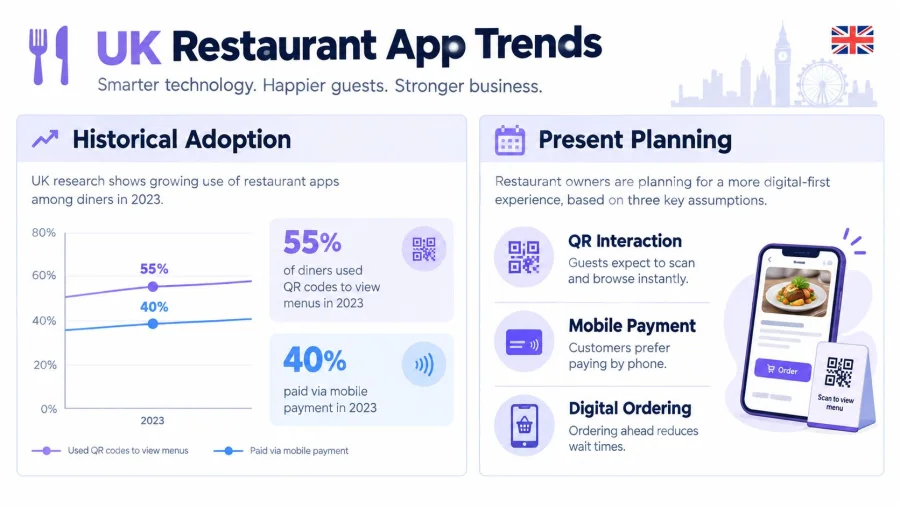
UK hospitality technology reporting states that 84% of diners used QR codes to view menus or pay by 2022, while roughly 72% of restaurants planned investment in QR menu, ordering or payment systems by 2025. The former describes reported behaviour; the latter describes historical intentions, not verified completed installations.
The accompanying visual separates adoption from planning. Its illustrative chart values shouldn't be used as evidence for a business case; the linked figures above provide the basis for decisions.
Translate adoption into design checks
A familiar QR code only helps when the destination works. A guest scanning at a pavement table may have a weak connection, bright sunlight and little patience for an animated introduction.
Owners should test the journey in those conditions:
- Fast opening: Show useful content before large decorative images.
- Clear destination: Label whether the code opens a menu, payment page or loyalty registration.
- Readable interaction: Check text size, contrast and button labels on smaller screens.
- Recoverable errors: Explain what happened when a page or transaction fails.
- Payment continuity: Keep order status clear when customers move into a wallet or authentication screen.
Payment-enabled apps should support suitable wallet options, including Apple Pay and Google Pay. A compliant payment provider should handle tokenised credentials rather than leaving the restaurant to store raw card details.
Familiar doesn't mean universal
A guest may recognise QR codes and still prefer a printed menu. Another may use a phone confidently but struggle with a poorly labelled interface or inaccessible registration form.
A digital channel should remove a queue, not create a new eligibility test for being served.
That distinction also affects analytics. A successful scan isn't necessarily a successful menu visit, and a completed checkout isn't proof that the customer found it easy.
Owners should inspect where customers stop, then observe the same task in service. Technical measurements can identify the troublesome screen; staff and customer feedback can explain what made it troublesome.
The practical implication is narrower than "build an app". Build a dependable mobile route around the tasks customers need.
How to Choose a Restaurant Loyalty App
The most useful sales demonstration starts at the counter. An employee should enrol a test customer, award progress, redeem a reward and correct a mistake using the equipment available during a normal shift.
A provider that can only demonstrate a prepared customer screen hasn't demonstrated the operating process.
Check the service and commercial terms
A buying checklist should cover more than reward design:
- Access: Confirm mobile and web entry, personal QR codes and optional wallet passes.
- Rules: Check stamps, points, spend conditions, exclusions, expiry and manager overrides.
- Staff workflow: Establish whether redemption needs POS integration, a dedicated scanner or only an existing phone.
- Communication: Review campaign controls, feedback requests and customer preferences.
- Launch support: Ask about setup guidance, printable materials and staff training.
- Full cost: Include subscriptions, messaging, branding, support, additional venues and data export.
- Exit arrangements: Confirm what customer and campaign records can be retrieved when leaving.
Security needs a separate demonstration. The provider should explain how its server checks eligibility, blocks repeated use of the same redemption and records the transaction. A screenshot of an old reward must not be sufficient evidence that it remains valid.
Owners should also ask about employee permissions and an audit trail identifying the venue, staff device, customer account and redeemed offer.
Make equivalent access a requirement
Good Things Foundation's digital-inclusion evidence reports that around 3% of UK adults, approximately 1.6 million people, lack a smartphone, tablet or laptop. Web access helps customers who dislike installations, but it doesn't solve lack of device access.
Physical or staff-assisted rewards therefore belong in the operating plan. Customers should receive readable instructions and a clear way to ask for help without losing access to the programme.
Accessibility testing should cover screen readers, text scaling, contrast, keyboard navigation and confusing or unnecessary steps. Marketing permission should be separate from the information needed to administer rewards.
Require a testable pilot
Before a long commitment, the restaurant should run a limited pilot with clear success criteria. The provider should demonstrate reporting for scan-to-sign-up, first qualifying visit, completed redemption and intervals between visits.
The pilot also needs a failure test. Staff should practise an unavailable connection, an expired reward and an attempted duplicate redemption.
A smooth demonstration under perfect conditions is useful. A controlled recovery during service is more revealing.
Matching Restaurant Needs to the Right Solution
Different restaurant problems require different products. A reservation bottleneck calls for booking management. Confusing takeaway checkout calls for an ordering and payment solution. Neither problem automatically requires a new loyalty app.
An independent venue primarily concerned with repeat visits should assess a loyalty layer that fits its existing service. Replacing working ordering software merely to add rewards can introduce unnecessary migration work and staff retraining.
Choose the narrowest effective solution
| Main constraint | Suitable starting point | Main trade-off |
|---|---|---|
| Customers can't find current information | Mobile-friendly menu and website | Limited retention functionality |
| Staff struggle with booking administration | Reservation platform | Another channel needs clear ownership |
| Direct takeaway ordering is difficult | Ordering and payment platform | More checkout and kitchen workflow complexity |
| Regulars receive inconsistent rewards | Configurable loyalty platform | Reward economics still require management |
| Established systems need unusual connections | Custom development | Ongoing maintenance and integration responsibility |
For small operators, the simplest, most cost-effective route to test is usually the loyalty-only option when loyalty is the actual problem. The platform behind the wallet feature linked earlier offers configurable stamps, points, cashback, visit and spend thresholds, fixed discounts, welcome bonuses and seasonal coupons.
Customers can use mobile or web access and receive personal QR codes. Staff can scan and redeem without POS integration or extra hardware, while wallet passes provide another access route. This describes a low-overhead loyalty approach, not a replacement for software that takes food orders and processes payment.
Avoid buying expensive discount distribution
Investment appetite doesn't establish profitability. UKHospitality reported that 71% of restaurant leaders planned to increase loyalty or rewards investment, while 63% of consumers had reduced restaurant spending.
Under those conditions, a busy redemption report can conceal a weak commercial result. A restaurant may be discounting visits that would have happened anyway.
Commercial test: The relevant outcome is additional contribution after reward and campaign costs, not the largest possible membership list.
Owners should compare total operating effort as carefully as subscription fees. A cheaper licence may require more manual reconciliation; a broader platform may charge for capabilities the restaurant never uses.
The right recommendation is therefore conditional but decisive: choose lightweight loyalty for a retention problem, specialist ordering for a purchase problem and custom development only for requirements that standard tools can't meet.
Launch Measure and Improve Your Restaurant App
A launch should begin with a service problem stated in plain English. Customers might forget their rewards, staff might struggle to recognise qualifying purchases, or occasional guests might lack a clear reason to return.
That problem should determine the initial configuration. A restaurant doesn't need to activate every available mechanic before placing a QR card on the counter.
Prepare the smallest useful launch
- Define the intended behaviour: Specify whether the programme should encourage another visit, reactivate lapsed guests or support a particular purchasing occasion.
- Publish understandable rules: State eligibility, exclusions and redemption conditions where customers can find them.
- Prepare the team: Give staff a short explanation and a procedure for exceptions.
- Check launch materials: Test printed codes in their actual positions, including glare and scanning distance.
- Preserve customer choice: Keep assisted access available and respect communication preferences.
Convenience remains the foundation. Square's restaurant trends research reported that 60% of customers would probably not return to a restaurant lacking convenient ordering and payment methods; owners investing in loyalty also reported higher order sizes and repeat visits. Those reported outcomes don't remove the need for local measurement.
Measure the journey and the margin
| Measure | What it helps assess |
|---|---|
| Scan-to-sign-up | Whether the invitation and registration work |
| Sign-up-to-first qualifying visit | Whether enrolment produces usable participation |
| Reward views and redemption rate | Whether benefits are understood and accessible |
| Repeat-visit intervals | Whether return behaviour changes |
| Campaign performance | Which messages produce relevant actions |
| Reward and campaign cost | Whether the activity is commercially worthwhile |
High reward views with few redemptions may indicate unclear eligibility or a difficult redemption process. Weak return behaviour may call for better timing rather than a larger discount.
Operosus's practical conversion rate optimisation tips provide an additional resource for reviewing unnecessary steps and unclear prompts. Restaurant owners should apply changes selectively, then test whether the intended action becomes easier.
For profitability, compare enrolled customers with a suitable non-member group matched on previous behaviour where possible. Separate new, active and lapsed guests, and account for reward costs, campaign costs and contribution from additional purchases. Membership alone doesn't prove that the programme caused extra visits.
Operators ready to launch straightforward QR loyalty should evaluate the platform described above against a real counter-service trial. Start with a clear reward, train staff to handle exceptions and review both repeat visits and margin before expanding. That approach gives the restaurant a practical route to easier recognition and measurable retention without committing to an unnecessary ordering rebuild.


