Membership Management Software: A Simple Guide for 2026
A customer arrives convinced their membership includes today's visit. The receptionist checks a spreadsheet, searches an email and asks the owner whether the latest payment went through. Meanwhile, another customer waits to book.
Membership management software should remove that uncertainty. It connects a person's record to clear rules about payment, benefits and access. For a small business, the useful test isn't how many features appear on a sales page. It's whether the team can run those rules during a busy shift, without a complicated installation.
The Core Features Membership Software Covers
Membership management software keeps a record of each member, what they've paid for, which tier they sit in and whether they can use the service today. Think of it as a rules engine, not a digital address book.
A member's status should affect what staff can authorise. A valid subscription might permit entry, a treatment allowance might permit a booking, and an earned reward might permit a discount.
Core features at a glance
The examples below illustrate possible business rules, not standard settings every product includes.
| Feature | What it does | Example in practice |
|---|---|---|
| Billing | Takes recurring payments, retries failed payments and sends renewal reminders | Gym collects a monthly Direct Debit on the first of each month |
| Membership tiers | Groups members into levels with different rights | Salon Silver tier includes two treatments a month |
| Access control | Grants or blocks entry, booking or discounts by status | Gym gate opens only for active members |
| Analytics | Reports visits, renewals, cancellations and spend | Café sees which members haven't visited in 30 days |
| Communications | Sends welcome, renewal and lapse messages | Email reminder seven days before renewal |
| Staff permissions | Limits what each team member can change | Front desk can check members in but can't change tiers |
A member self-service portal supports these functions. Members can update details, inspect benefits and manage supported bookings without asking staff to handle every change.
A gym needs access control first, while a salon needs tiers and booking. A café needs analytics that turn purchases or visits into useful follow-up decisions.
Separate customer access from employee permissions
These features sound similar but do different jobs. Customer access controls entitlement; employee permissions control who can edit records or approve actions.
BonusQR's loyalty features include Coupon Management, Visit History Tracking, Staff Access Control and Analytics & Stats. Those support rewards operations, but employee permissions shouldn't be mistaken for physical door control.
For hospitality businesses considering a customer-facing pass, digital cards for restaurant members provide a useful starting point. A card displays identity or benefits; the underlying software still needs the appropriate rules.
Club operators considering more complex entitlements can also consult golf club software advice from GolfRep when preparing their requirements.
The basic test: If the software can't show who is active today, it's a database, not membership management.
How Billing, Tiers, Access and Analytics Fit Together
Consider a hypothetical member, Priya, joining a gym on its standard tier for a monthly fee. Her experience shows why separate features must work together rather than leave staff reconciling conflicting records.
- Sign-up records the agreement. Her profile stores the standard tier, included benefits and first payment.
- Billing follows the schedule. In this example, the gym collects her Direct Debit on the first of each month.
- Access checks current status. The turnstile opens while her membership reads active.
- Failed payments follow an agreed policy. A failed collection moves her into a grace period. If unresolved, her membership becomes lapsed and the gate closes.
- Analytics records attendance. Staff notice her activity falling from three visits a week to one.
- Communications follow the membership terms. A renewal message goes out seven days before the next term.
This diagram summarises the sequence.
Tiers are the price list, billing is the till, access control is the door policy and analytics is the attendance register. Each answers a different question. A payment receipt alone doesn't explain which benefits Priya bought.
The grace period also needs an owner. Staff should know who can resolve a disputed payment, authorise an exception and restore access after payment clears. Otherwise, automation moves confusion onto the reception desk.
Turn attendance into a useful action
Industry reporting from Savills indicates that around 75% of UK gym members visit twice weekly, while roughly 5% struggle to attend even once. That makes attendance worth investigating, not just counting.
A practical workflow distinguishes different situations:
- Missed expected visit: A member with an established routine might need a friendly check-in.
- Falling weekly frequency: Staff can ask whether timetable changes or service problems are getting in the way.
- No visit after joining: A welcome conversation or help with the first booking may be more relevant than a discount.
Visit counts flag risk; they don't prove why someone stopped attending. Staff should test whether a reminder, incentive or quick call leads to a return visit, rather than credit every improvement to the campaign.
Employee accountability matters too. Front-desk staff can have permission to check members in without changing tiers. The loyalty platform's Basic and Premium plans show who scanned, with history by employee.
For businesses translating entitlements into simpler hospitality benefits, membership tier ideas for cafés can help keep the offer understandable.
Use Cases for Salons, Gyms, Cafés and Shops
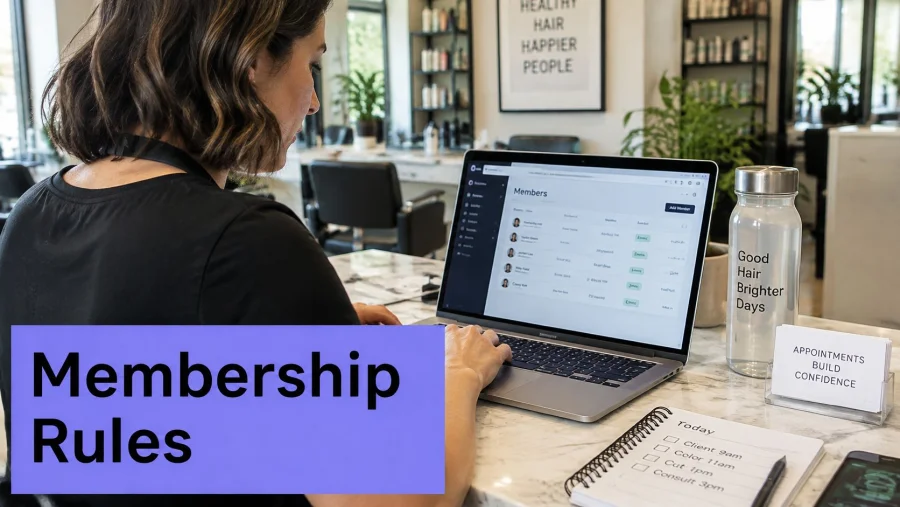
Salons must enforce treatment allowances. A membership that bundles monthly appointments needs a usage counter and a written rule for unused sessions. Staff should establish whether an appointment consumes the allowance at booking or completion, and what happens after a cancellation.
For a member such as Priya, the important screen would show remaining treatments before the receptionist confirms the next appointment. The useful metric is sessions used per member, not appointments booked.
The salon workflow should remain clear enough to handle at reception.
Match the rules to the service
Gyms and studios must enforce eligibility to attend. Gate check-in, holiday freezes and a fixed cancellation notice period belong in the buying checklist. A freeze should have clear start and end conditions so staff don't have to reconstruct an agreement from messages.
Cafés and restaurants must validate visits or spending before issuing benefits. A hypothetical coffee offer might award a free drink after ten visits. Staff need a scan log showing who recorded the activity and when, plus a menu or booking route customers can find easily.
For restaurants, table booking is a must-have workflow, whether supplied by the loyalty platform or a connected reservation tool. The platform described here supports table booking and reservations, and customers can be automatically sorted into groups.
Independent retailers must apply the correct member price at each till. Paid clubs may offer early access or tier-specific prices. Separate staff or location logins help establish where a benefit was issued, while multi-site operators need central oversight without mixing up individual shops.
Core rule and metric by business type
| Business type | Core rule the software must enforce | Key metric |
|---|---|---|
| Salons | Bundled treatments per month with usage counters and rules for unused sessions | Sessions used per member |
| Gyms and studios | Gate check-in, holiday freezes and a fixed cancellation notice period | Visits per member per week |
| Cafés and restaurants | Visit- or spend-based rewards with a scan log, plus table booking for restaurants | Visits or spend per member |
| Independent retailers | Paid clubs with tier pricing and member prices at each till | Renewal rate |
Phone handling is a separate operational need. A business evaluating a virtual receptionist app from SkipCalls should keep call handling distinct from the system that confirms membership benefits.
A business selling time or sessions needs access and usage tracking. A business selling goods needs tiers and member pricing.
The buying requirement should finish as a plain sentence: The software must prevent this specific benefit from being used outside these agreed conditions.
Membership Software and Loyalty Platforms Compared
Membership software manages who is a member and what they're entitled to, while loyalty platforms reward repeat behaviour such as visits or spend.
The distinction matters because a digital card can represent either relationship. Its appearance doesn't reveal whether the underlying software handles subscriptions, validates admission or merely records rewards.
Membership software versus loyalty platform
| Factor | Membership software | Loyalty platform |
|---|---|---|
| Main job | Manages members, their status and entitlements | Rewards repeat customers for visits or spend |
| Money flow | Recurring fees, memberships and renewals | Usually free to join; rewards cost the business |
| Access rules | Opens doors, restricts bookings and sets tiers | Usually no access control; rewards and discounts only |
| Typical fit | Gyms, clubs and salons with paid memberships | Cafés, shops and restaurants with repeat visits |
| Core metric | Renewal rate and churn | Visit frequency and reward redemption rate |
A loyalty card can exist without paid membership. A paid membership usually needs access and renewal rules that a rewards tool alone may not provide.
A café can run both a paid club and an ordinary stamp card. In that case, staff need a clear distinction between benefits included in the subscription and rewards earned through purchases. Otherwise, customers may receive duplicate benefits or conflicting explanations.
Choose the smaller tool when it covers the job
Collinson's 2025 Loyalty Landscape found that 56% of surveyed UK businesses tracked retention and 49% tracked engagement in their loyalty programmes. Enrolment totals alone therefore make a poor operating target.
A better test asks whether members return, use rewards and generate enough value to justify the reward cost. Staff should also review unredeemed rewards and unusual redemption patterns before changing the offer.
BonusQR is a QR-based loyalty platform supporting stamps, points, cashback and visit thresholds, without POS integration or extra hardware. That makes it a practical option for cafés and shops seeking repeat visits rather than a full subscription-management system.
A loyalty programme can be set up in a few minutes, and signing up requires no credit card. That reduces the commitment needed to test a simple offer, but doesn't establish whether it suits every paid-membership requirement.
Choose membership software when access, renewals or tiers drive revenue. Choose a loyalty platform when the main objective is repeat visits from customers who don't pay a membership fee. Buying a full membership system merely to run a stamp card adds administration without necessarily improving the customer experience.
Consent and Data Rules for Member Records
Sending promotional emails or texts to individual customers without the required permission creates legal risk and damages trust. Joining a membership or loyalty scheme doesn't automatically mean agreeing to every future offer.
Under the ICO's direct marketing guidance, PECR generally requires prior consent for electronic marketing to individual subscribers. Consent must be freely given, informed, unambiguous and specific to the channel, so permission for email doesn't automatically cover text messages.
Build permission into enrolment
- Separate marketing from the terms. Acceptance of membership conditions shouldn't double as an unclear promotional opt-in.
- Offer separate email and text choices. Unticked boxes give customers a clear affirmative action for each channel.
- Record the permission trail. Keep the scope, channel, consent date and any withdrawal against the customer record.
- Include an unsubscribe route. Staff need a process that applies withdrawals to future promotional messages.
- Keep service messages separate. Booking confirmations and necessary renewal notices shouldn't become a vehicle for unrelated offers.
The ICO's small-business marketing guidance describes a limited soft opt-in for similar products or services when details were collected directly during a sale or expression of interest, with an easy opportunity to refuse both at collection and in every subsequent message. It isn't blanket permission to market to every contact in a database.
The ICO's guidance on marketing lists and loyalty schemes also requires clarity about the messages members will receive and the participating businesses involved. A shared scheme doesn't authorise unrelated additional marketing without clear consent.
Collect only information staff can use responsibly
For Priya's record, attendance and benefit usage may help staff provide the service. Extensive demographic profiling may add maintenance work without helping anyone make a useful decision.
A sensible starting profile contains permission records, visits, rewards and redemptions, alongside information needed to administer the membership. The operator should document why each field is needed, who can access it and when it should be removed.
Permission isn't an entitlement: Customers who decline marketing should still receive the service and benefits they've purchased.
Staff should also check the content of automated messages. Calling an email a service notification doesn't make promotional material non-promotional.
What Membership Software Costs by Plan
Plans and what each includes
These are BonusQR loyalty plans, not prices for a complete gym billing or gate-access installation. Unconfirmed paid prices should be checked before budgeting.
| Plan | Price | Logins | Programme types | Key extras |
|---|---|---|---|---|
| Free | $0 forever, no card needed | 1, manager only | 7 | Stamp card, cashback, visit rewards, fixed discount |
| Basic | Check current published price | 1 manager plus 5 employees | Free options plus additional Basic programmes | Multi-store, custom link, reservations, PDF menu, notifications |
| Premium | Check current published price | Unlimited access accounts per shift and business | 12 | Everything in Basic plus referral, tiered cashback and special occasion rewards |
Free has no commitment requirement. It suits an owner testing a reward rule before involving employees or introducing a broader operating process.
Basic adds practical team and site-management tools. Its manager and employee accounts make it more suitable when several people need to record activity, while the reservation system and PDF menu or price list support customer-facing administration.
Premium expands the available reward mechanics. Referral rewards and tiered cashback make sense when the business has a clear reason to use them, not because they appear in a higher plan.
Budget for the team, not just the subscription
Billing every three months saves up to 11%, every six months saves up to 16%, and annual billing saves up to 22%. A longer billing commitment should follow a successful operational test rather than precede it.
Before making a budget, the owner should write down:
- Team size and access needs: Count the people who need separate logins.
- Number of sites: Include planned locations that must share an account.
- Training work: Allow time for practice, exception handling and shift handovers.
- Required reward mechanics: Distinguish essential rules from optional promotions.
The owner can then compare loyalty platform pricing against that exact setup. Paid subscription amounts aren't confirmed in the table.
The upgrade rule is straightforward: start with Free for an owner-led, single-site test; consider Basic when staff accounts or another site become necessary; consider Premium when referrals or tiered rewards have a defined purpose. Staff time remains a real cost even when the subscription is free.
Choose Your Software and Start With One Membership
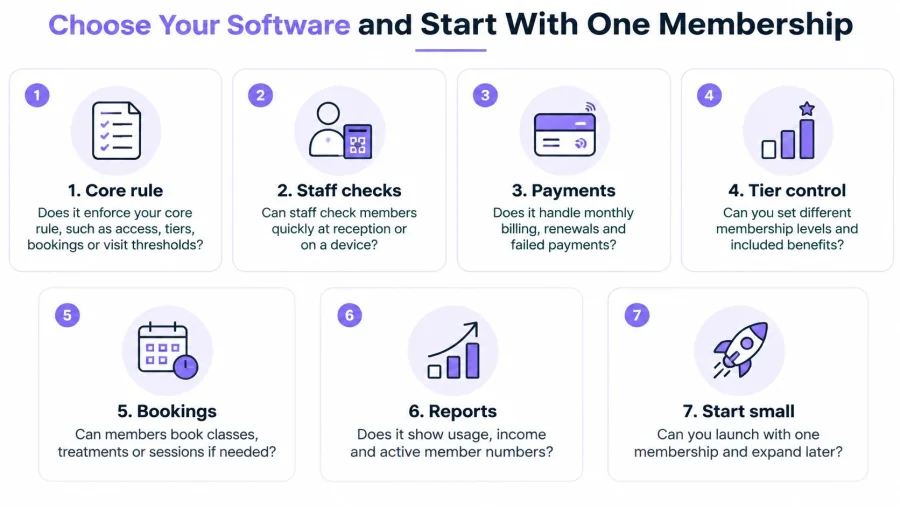
A useful trial recreates a normal shift, including awkward situations. Staff should test a disputed benefit, an unavailable manager and a customer who declines marketing, not just a successful sign-up.
Seven questions for the shortlist
- Core rule: Does the product enforce the required access, tiers, bookings or visit thresholds?
- Staff checks: Can staff check members in on a phone without buying new hardware?
- Current status: Can reception distinguish active members from lapsed members immediately?
- Permission handling: Can the business keep marketing consent separate from service communications?
- Site coverage: Does the selected plan support every location that needs access?
- Exit route: Can the business export its member data in a usable format?
- Annual operating cost: What will the actual team setup cost, including training time?
A structured software trial checklist for teams from KeenVerdict can help turn those questions into observable tasks rather than impressions.
The visual checklist adds payment, tier and booking checks for businesses with fuller membership requirements.
Keep the first trial deliberately small
For a hypothetical pilot, the owner could enrol about 20 real members, define one tier and one rule, and run the test for two weeks, reviewing the visit report on day 14. These are suggested trial settings, not performance benchmarks.
For a loyalty pilot, that tier can mean a clearly defined customer group. It shouldn't imply that the platform supplies recurring billing or door control.
The Free plan includes seven programme types: Stamp Card, Cashback, Reward for the amount spent, Reward for Visit, Fixed Discount, Custom Offer and Onboarding Promo. Multi-store management and a custom page link require Basic or Premium, so the operator should establish the upgrade path before expanding.
The first-week success criterion is operational: can staff enrol someone, record activity, explain the benefit and resolve an exception without calling the owner? A clear answer matters more than a long feature list.
For a café, salon, gym or shop testing repeat-visit rewards, open a Free BonusQR Manager Account and launch a small pilot with real customers before paying for anything. Start with a benefit staff can explain in a sentence, practise scanning and redemption, then review actual visit activity before expanding the programme.


