A regular reaches the café till, orders a coffee and remembers the free drink they've been working towards. Then they realise the paper stamp card is at home. The barista recognises their face, but can't check how many stamps they've earned or show whether that person comes in more often than before.
That small moment captures the challenge for coffee shops, restaurants, salons, gyms and independent retailers. A stamp programme has three jobs: make the next visit feel closer, make the reward clear before someone joins, and help the owner distinguish extra visits from familiar faces who would have come anyway.
A finished card can signal customer engagement, but it doesn't prove extra profit. And moving the card onto a phone doesn't automatically make customers trust the scheme. A good programme has to feel straightforward and fair at the counter, while giving the business a sensible way to check whether it's working.
The useful starting point is the mechanism itself: one clear action earns visible progress towards a reward the customer already understands.
Why Loyalty Stamp Cards Still Matter
At a small café, points can create a job for the person behind the till: explain how the balance works, what it is worth and when it can be spent. A stamp card makes the exchange easier to see. Buy the stated item, earn a stamp, work towards a named reward. The customer can judge the offer without learning a separate points system.
That simplicity is useful where one person serves, takes payment and answers questions. A clear rule also reduces awkward disputes: staff can check whether a purchase qualifies before adding a stamp, rather than explaining an exception after the customer expects credit.
Stamp cards can fit businesses with different visit patterns, provided the qualifying action matches the service. A salon might give one stamp for each paid appointment, with a reward after a set number of visits. A gym could award a stamp for an attended class, so members see progress even when their weekly routine changes. A shop might limit stamps to a named product range, stated on the card, rather than leave customers guessing which purchases count.
The trade-off is measurement. A completed card shows that a customer reached the reward, not that the offer caused extra visits. Compare repeat visits during the scheme with the pattern before it, and check whether visits rise in the quieter periods the offer targets. Keep that check separate from the stamp total: the card records progress, while till records or appointment history can help show whether behaviour changed.
Fairness matters in both the offer and the evidence. Give customers progress they can see, and avoid asking for more personal details than the scheme needs. A local business usually needs to record eligible purchases or visits, not build a broad profile of each customer. Paper cards keep the exchange simple but can be lost; a QR card keeps progress on a phone, though scanning and sign-up add steps.
For a small operator, a stamp card still earns its place when it makes the reward understandable, the rule consistent and the result measurable.
How a Stamp Card Earns the Next Visit
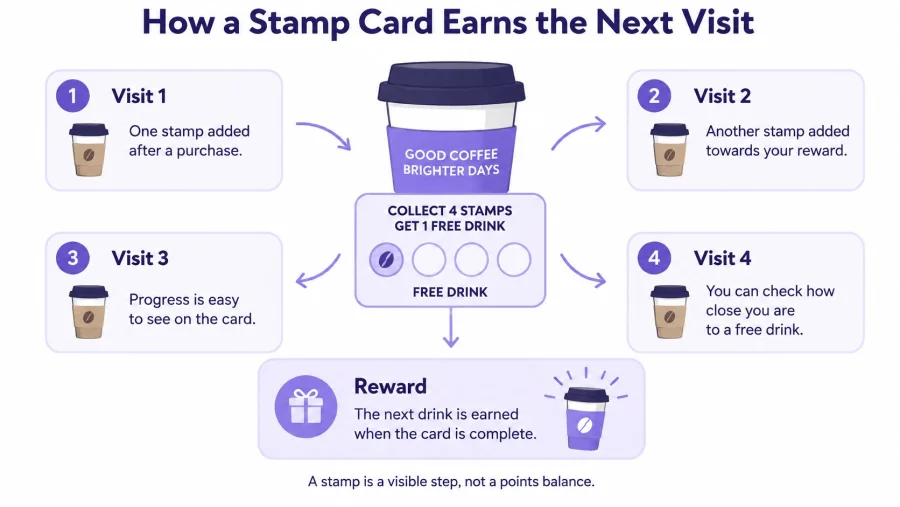
A stamp card turns an eligible purchase into a visible step towards a known reward. Think of the progress like a row of circles filling up as a coffee cup fills with each visit. The customer shouldn't need to calculate a points balance or ask staff to interpret a complicated rule.
The loop is simple:
- Qualifying visit: The customer buys the product or service named in the offer.
- Stamp added: Staff add the stamp after the purchase, using the stated rule.
- Progress checked: The customer can see how far they are from the reward.
- Reward redeemed: Once the card is complete, staff confirm the reward and mark it as claimed.
The idea has a long history in Britain. Richard Tompkins introduced Green Shield Stamps in 1958, and Tesco joined in 1963. Participating retailers typically issued one stamp for every 6d spent. Customers pasted the stamps into books and exchanged completed books for goods. A typical book held 1,280 stamps, and at its peak the scheme reportedly operated through more than 36,000 stores. Historical accounts report that roughly half the British public collected the stamps in the 1960s and early 1970s (Green Shield Stamps history).
The point isn't to copy the old catalogue system. It's that customers could see collection progress long before mobile phones existed.
For a café, a plain rule might be one stamp per qualifying drink, with a free drink after the stated number of stamps. A spend-based version might award a stamp when the purchase reaches a stated minimum. The first rewards a visit; the second rewards spending. The choice affects both the customer experience and the information the business needs to administer the offer, a distinction that matters when setting privacy rules.
For the behavioural thinking behind a straightforward coffee offer, see how coffee rewards encourage repeat visits.
What Repeat Visits Are Worth Locally
A regular's fifth visit may look like a win, but the stamp card did not necessarily cause it. To value the programme, compare customer visits before and after joining, then check whether the change covers the cost of rewards.
YouGov surveyed 1,000 British consumers about whether loyalty schemes encourage repeat purchases and brand loyalty. Agreement was 64% among 18–24-year-olds, 77% among 25–34-year-olds, 78% among 35–44-year-olds, 69% among 45–54-year-olds, and 65% among people aged 55 and over. These are general attitudes to loyalty schemes, not evidence about stamp cards or a particular café (YouGov's UK loyalty-schemes survey).
Start with a simple comparison. Record visits per customer over a set period before joining, then compare them with visits over a similar period after joining. Also track average spend per visit and the reward's cost to the business. For a café, estimate the reward cost using its ingredient and serving costs, then compare that with the extra gross margin from additional visits. If margin from those visits exceeds the reward cost, the offer may be paying its way.
Keep the test fair: compare customers who joined with a similar group who did not, over the same period. A completed card is not proof of an extra visit. It may reward visits the customer would have made anyway. Look for a rise in visits per customer, not just more stamps redeemed.
A familiar face creates goodwill. Extra visits show whether the offer changed behaviour.
To test different offers, divide customers by the offer they receive, not by assumptions about their age. Give one group a visit-based reward and another a clear money-saving offer. Compare visits per customer, average spend and reward cost for each group. The stronger offer brings in enough additional margin to cover its reward cost without reducing visits or spend elsewhere.
A simple reward is easier to explain at the counter. “Complete the card and claim this item” shows the customer what they are working towards, while giving staff a clear rule to apply. For more ways to grow customer value through loyalty rewards, consider the whole relationship, not only the free item. A local business can also check site traffic with Expressify AI, though online traffic does not show whether stamp-card members return in person.
Paper Cards or QR Stamps at the Counter
A customer reaches the till with a coffee in hand and no loyalty card in their pocket. The format you choose should make progress easy to see and give staff a fair way to handle missed stamps, lost cards and failed scans.
Paper and QR cards can offer the same reward. Paper is simple to check at the counter and works without a phone or signal, but it can be lost or forgotten. A QR scheme can keep a customer's progress on their phone, though scanning and sign-up must stay straightforward. A UK loyalty-programme survey found that complicated sign-up and rewards that take too long can put customers off. The useful lesson is to make the first stamp visible quickly and keep the route to a reward clear.
| Job at the counter | Paper card | QR stamp |
|---|---|---|
| Remembering the card | Easy to carry, but can be left at home or lost | A profile or wallet pass can keep progress on the customer's phone |
| Seeing progress | Staff and customer check the printed stamps | The customer can check recorded progress |
| Identifying the customer | The card may not identify its holder | A customer profile can connect visits to a customer record |
| Fixing a missed stamp | Staff agree how to correct the paper card | Staff need a clear process for correcting the digital record |
| Working when a phone fails | Works without a phone or signal | Needs a fallback if the customer cannot open the code or staff cannot scan it |
A mixed approach may suit a local business better than choosing one format for everyone. Keep paper cards available for customers who prefer them or cannot use a phone, while offering QR stamps to those who want progress stored digitally. Set the same reward rules for both, and tell staff how to correct a missed stamp in either version.
The format also affects what you can measure. A completed card shows that someone reached the reward, not whether the programme caused an extra visit. Track visits before and after launch, then compare patterns rather than treating every completed card as proof of added business. Keep the record limited to what you need to administer the stamps.
BonusQR is one QR option for brick-and-mortar businesses. Customers can join on mobile or web, receive a personal QR code and track stamps, rewards and visits. Staff scan and redeem through the merchant app. The platform supports wallet passes and offers based on stamps, points, visits or spending. Businesses can also add loyalty rewards to Apple Wallet. Check that any setup you choose fits your counter routine, gives customers a clear view of progress and leaves a practical fallback when a scan cannot happen.
Keeping Stamp Rewards Fair and Private
A customer at the till may wonder whether a stamp scheme is fair, or what happens to their details after they scan. Ipsos found that 54% of Britons believe supermarket loyalty cards benefit retailers more than customers, 64% think supermarkets raise prices to make discounts look better, and 38% feel uncomfortable about the amount of data collected (Ipsos on supermarket loyalty-card trust).
Those findings relate to supermarkets, not independent cafés or salons. They don't show that customers distrust local schemes. They do give owners a reason to explain how stamps work and what information the scheme collects.
Data minimisation means asking for only the information needed to run the reward. A visit-based card may need a way to recognise the customer and record each visit. A spend-based offer may need purchase details to check whether someone qualifies. Collecting extra details “just in case” can make the scheme harder to explain and less fair in customers' eyes.
The ICO guidance linked here discusses legitimate interests as one lawful basis organisations may assess under data protection law. It also explains that people have the right to object to direct marketing. The guidance is not a ruling on loyalty schemes, so don't treat it as proof that a particular scheme or data use is permitted (ICO guidance on loyalty schemes and legitimate interests). Make marketing a clear choice rather than implying that joining the reward means agreeing to every promotional message.
Staff need a simple answer ready at the counter: “Your account keeps your stamps and the details needed to run the reward. The rules explain when stamps expire. Marketing messages are optional, and you can opt out while keeping your reward.”
A useful notice tells customers what is collected, why it is used, and how to ask questions or exercise their rights. The privacy information for pickleball players is an example of published privacy information, though a café or salon should write its own notice to match its actual practices.
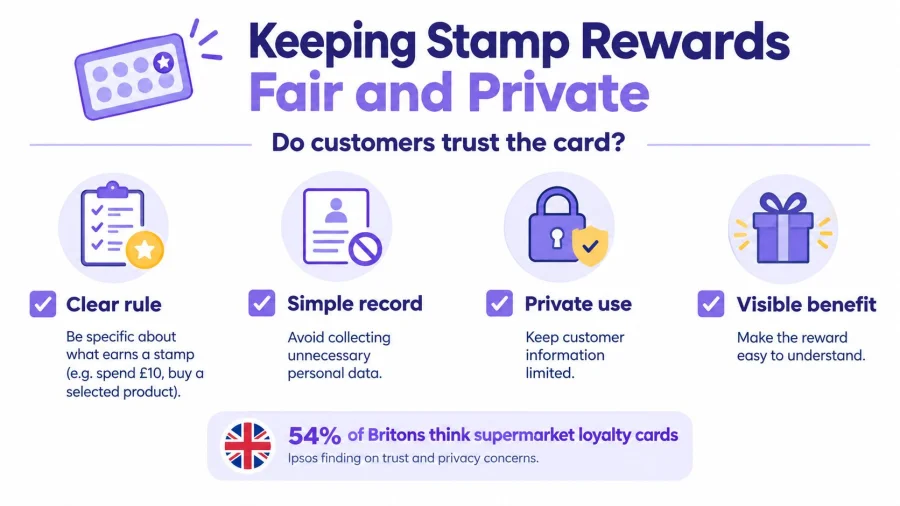
Before launch, make sure customers can see:
- The earning rule: Which purchase or visit earns a stamp?
- The data purpose: What details are stored, and why?
- The reward terms: What does a completed card earn, and when do stamps expire?
- The messaging choice: Can customers opt out of marketing and still collect stamps?
Clear rules help customers judge the offer as they go, rather than only when they reach the reward. They also give staff a consistent answer when someone asks what a scan records.
Rewards People Can Finish and You Can Check
At a busy café counter, a customer asks whether their drink earns a stamp while the next order is already waiting. A clear rule lets the customer understand the offer and helps staff apply it the same way each time. These examples show how to keep rewards specific and manageable.
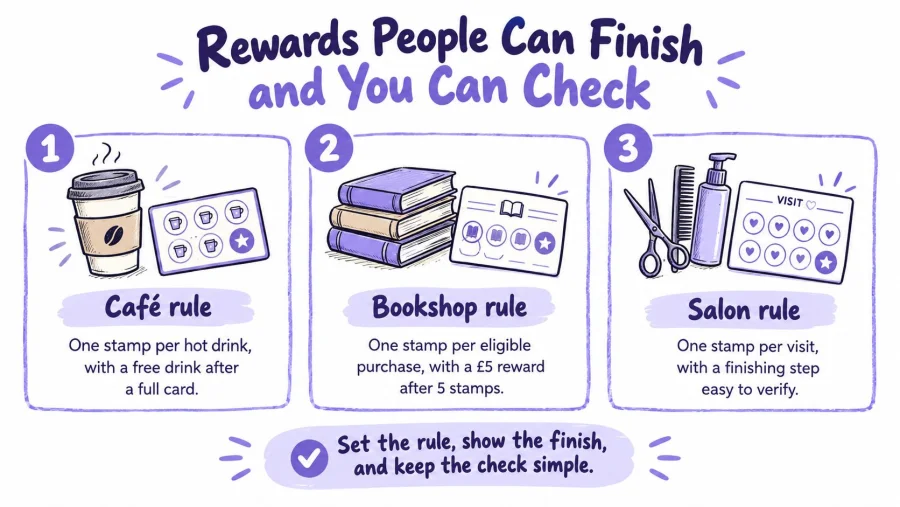
- Café: Give one stamp for each qualifying hot drink, then a free drink after the stated number of stamps. Show the rule before the customer joins. If a scan fails, staff use the agreed correction method and record the missed stamp.
- Salon: Give one stamp per qualifying appointment, with a named treatment add-on as the reward. Explain which appointments count and what the add-on includes. If a customer loses their phone, follow the identity-check and record-correction process rather than issuing a stamp from memory.
- Gym or independent shop: Set a visit threshold and a clear reward, and show any expiry before sign-up. Explain what counts as a visit, with a non-phone option for customers who cannot scan.
The first reward should feel within reach. A long climb can make customers lose interest before they get there. Offer a physical alternative where practical, explain how customers can recover access, and give staff a reliable way to correct a missed stamp. These steps make the offer fair when something goes wrong.
For a small business, record only what the stamp scheme needs: the qualifying visit, the stamp issued and the reward redeemed. This follows data minimisation, just as a till receipt records what is needed for a purchase. Avoid collecting extra details, such as location or product category, unless the reward rule depends on them. A UCL thesis examines loyalty-card data (UCL thesis on loyalty-card data); a local café does not need grocery-scale records to check whether its own offer is working.
Then compare visits before and after customers join, where possible. A completed card shows that someone used the scheme, not that the reward caused an extra visit. Check changes in visits per customer, spend per visit, time until the next visit, reward cost against extra margin, and whether customers return after redeeming. Read enrolment and scan rates alongside completions, since regular scanners may not represent every walk-in.
A stamp card is also a measuring tool, but only if staff record each qualifying visit consistently. BonusQR's analytics can hold visit and coupon events and display visit trends and top customers. Treat those reports as a view of recorded activity, not proof on their own that the scheme created extra business.
Launch a Stamp Programme This Week
A workable launch starts with a small set of decisions the owner and counter team can repeat without checking a long policy document. Keep the first offer simple enough to explain during a normal transaction.
Set the rule and test the routine:
- Choose what earns a stamp. Decide whether the offer rewards a qualifying visit or a stated level of spend.
- Write the promise in one sentence. State the reward and any expiry before a customer joins.
- Plan for a phone-free visit. Decide how staff will help someone who has no phone, has lost access or can't complete a scan.
- Train the counter team. Staff should know when to issue a stamp, how to correct a missed one and how to redeem the reward.
- Put the rule where customers can see it. A clear sign near the queue gives people time to understand the offer before ordering.
After the first fortnight, review joins, scans, first redemptions and whether familiar customers returned sooner than their usual pattern. Don't judge the programme by how many cards were printed. That number shows distribution, not whether customers used the offer or came back because of it.
For broader hospitality ideas that can sit alongside a simple rewards offer, see this collection of practical inspiration for hospitality operators.
A free start with BonusQR gives a business a way to set up QR stamps without POS integration or extra hardware. Customers can keep a QR profile and wallet pass, while the business uses visit and coupon reports to check how the programme performs. Optional push or email offers can remain separate from the reward itself, and ready-to-print materials support promotion at the counter.
Start with one clear stamp rule, explain it before sign-up and make sure staff can handle a missed scan fairly. Launch the offer this week, then use the first returns to decide whether it deserves to grow.
Give regulars a clear reason to come back. Start a free stamp programme at BonusQR, make the reward easy to understand, and check whether it brings customers through the door again.


