A regular reaches the till, pats a pocket, checks a wallet, then gives up. The stamp card sits at home on the kitchen counter. Staff know the face. The customer knows the free coffee is close. Nobody can prove it, so the moment passes and the queue moves on. That small failure sums up many loyalty programmes for small businesses. The idea's sound. The record keeping isn't.
Why Loyalty Still Feels Broken at the Counter
Paper works until it doesn't. A card gets lost, washed, or left in another coat. A customer asks staff to trust memory. Staff either hand over a freebie without proof or refuse and leave a loyal person feeling doubted. Neither outcome helps the business.
The owner gets even less from the exchange. A punch hole confirms that a purchase happened. It doesn't show who came in, what that person bought, how often visits happen, or who used to visit weekly and hasn't returned for a month. The busiest regulars and the drifters look identical on card stock.
Familiarity Isn't the Same as Results
Customers don't need loyalty explained from scratch. A SumUp survey of 2,000 UK adults found that 73% of British consumers believe loyalty cards provide good value for money, while 70% say loyalty cards actively encourage them to return to the same shops. The same source reports that 70% of British consumers belonged to at least one programme, members belonged to an average of four programmes, and membership declined from 77% before the pandemic to 70% during it.
Those numbers point to a crowded wallet, not an empty one. People already carry schemes for supermarkets, pharmacies, airlines and coffee chains. An independent business doesn't win attention by adding one more card. It wins by making the benefit obvious and the redemption painless.
Membership proves someone signed up. It doesn't prove the scheme changed a single visit.
Two Jobs, Not One Vague Promise
Most broken programmes share one flaw. Owners describe the goal as loyalty in general, then pick a reward and hope. That hope hides two separate jobs.
- Getting people back sooner: shortening the gap between visits, or turning a first visit into a second one.
- Earning a little more per visit: adding a pastry, a treatment upgrade, or one extra item to the basket.
A scheme can do either job well. Trouble starts when a single blunt discount tries to do both and subsidises people who'd have paid full price anyway. The sections ahead separate those levers, starting with the basic mechanics, then covering reward design, tool choice, promotion and measurement. Each step ends in one practical decision an owner can make before spending anything.
What a Small Business Loyalty Programme Actually Does
The useful parts of loyalty are old, and they're simple. Big brands proved the mechanics decades ago, long before independent shops had the tools to copy them.
A Short UK History With a Practical Point
The Drum's history of UK loyalty programmes records that British Airways launched a loyalty programme in 1994, Tesco introduced Clubcard in 1995, and Boots followed with its scheme in 1997. The first major UK multi-brand programme, Nectar, launched in 2002. An industry analysis also reported that 73% of loyalty programmes use points that customers accumulate and exchange for rewards or free products or services.
Strip away the national scale and three enduring mechanics remain.
- Recognise the returner: know that this person has visited before.
- Attach value to behaviour: give a visit or an amount of spend a visible worth.
- Offer a clear benefit: state the reward in one sentence a regular could repeat to a friend.
The Same Idea, Different Triggers
Points are the common design, but they're only one shape. Digital stamps count visits. Cashback returns a portion of spend as credit. Visit and spend thresholds earn a reward at a set level. Fixed discounts, welcome bonuses and birthday or seasonal coupons all follow the same logic with a different trigger. The format matters less than whether customers understand it at a glance.
Local main streets offer useful parallels, and owners curious about place-based approaches can see how districts encourage repeat business in downtown Jenks through coordinated local offers. A single shop doesn't need a district scheme, though. A QR code or wallet pass now does the identifying work that once needed printed cards and national infrastructure.
The one-sentence test: if staff can't explain the benefit between taking payment and handing over change, the scheme's too complicated.
Before picking software, an owner needs one plain sentence. Something like this works. Regulars earn a stamp per visit, and the eighth coffee is free. That sentence names who earns, what earns it, and what arrives at the end. Everything else is decoration.
How to Design Rewards That Do Not Eat the Margin
A universal discount feels generous and costs more than owners expect. It cuts the price on every transaction, including the Saturday regular who'd queue anyway. Better design starts with one blunt question. Would this purchase have happened without the reward?
Perceived Value Decides Whether Behaviour Changes
Retail Economics research on UK shopper loyalty found that 62% of UK consumers who are not loyalty members still doubt the value of memberships, while 70% of existing members say membership makes them shop more with a retailer. The same source reports that 61% of consumers usually spend about the same amount on each local-business visit, while 27% tend to spend more.
That contrast carries the lesson. Having a scheme isn't the achievement. Relevance is. Non-members doubt value because offers look thin or fiddly. Members who find value change behaviour. Owners weighing reward formats can compare cashback's impact on café loyalty against stamps before committing to either.
Simplicity also wins on preference. YouGov research on what Britons want from loyalty programmes found discounts were the most appealing benefit at 85%, followed by monetary rewards such as vouchers at 82%, and freebies earned after collecting points or making purchases at 67%. The same research found 87% considered easy reward redemption important. Plain rewards beat clever tiers.
Reward Mechanics by the Job They Do
| Objective | Simple mechanic | Margin risk to watch |
|---|---|---|
| Repeat visits | Digital stamps toward a free item | Rewarding visits that were certain anyway |
| Off-peak demand | Coupon valid only during quiet hours | Pulling full-price peak visits into discount slots |
| Average transaction value | Spend threshold, such as 10 visits = £5 off | Thresholds set below the usual basket |
| Reactivation | Welcome-back or second-visit bonus with an expiry | Paying lapsed customers who redeem once and vanish |
Cost the Threshold Before Launch
Because most customers spend a similar amount each visit, visit thresholds suit the frequency lever. Spend thresholds and add-on offers suit the basket lever. Mixing both goals into one reward usually serves neither.
Targeted benefits protect margin better than blanket cuts. A welcome reward costs money once and can pull a newcomer back for a second visit. An off-peak incentive fills chairs that'd otherwise sit empty, so the discount runs against near-zero lost revenue. A birthday offer feels personal and expires on its own.
Before launch, owners should cost one redemption. Take the product cost of the free item, divide it across the paid visits needed to earn it, and check the margin still works at full redemption. If the maths only works when customers forget to redeem, the scheme's built on breakage, not loyalty. Shorten the path or shrink the reward until full redemption still pays.
Loyalty Ideas for Cafés Salons Gyms and Shops
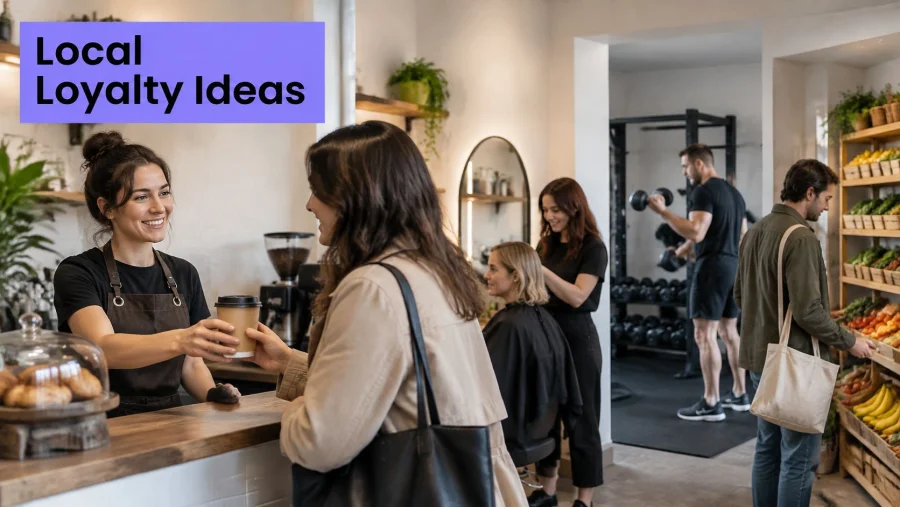
Local habit already does half the work. Metro Bank research on shopping locally, based on a 2024 survey of 1,029 UK adults conducted online from 28 to 30 August 2024 by Research Without Barriers, found that 64% visit independent businesses at least weekly. The same survey found 70% regularly frequent local cafés or restaurants, 52% use local grocery stores, and 39% use hair or beauty salons, while 79% report feeling more valued when shopping locally.
Frequent baseline behaviour is the raw material. It gives owners enough visits to spot patterns and step in before a regular drifts.
One Workable Idea per Venue
- Café: a digital stamp per drink, with a small second-visit reward for new joiners. The stamp protects the margin on daily regulars. The early reward teaches newcomers the habit. Watch enrolment-to-second-visit conversion.
- Restaurant: a visit threshold for regulars, plus a coupon restricted to quiet early-week evenings. One mechanic rewards loyalty. The other fills empty tables. Watch whether off-peak covers grow without peak nights shrinking.
- Salon: a birthday or seasonal treatment add-on rather than money off the standard cut. Discounting the cut everyone already books gives margin away. An add-on feels like a treat and introduces a higher-value service. Watch the gap in days between appointments.
- Gym or studio: a return incentive triggered when attendance lapses, such as a guest pass or a free class for a friend. Cheaper memberships reward people already attending. A lapse trigger spends money only where behaviour's slipping. Watch visit frequency after the offer lands.
- Retail or grocery: points on spend, or a small threshold tied to add-ons rather than the whole basket. Watch average transaction value, not just till count.
Well-known programmes share one habit worth borrowing. They place the reward inside the moment of payment, so earning feels instant. A stamp that appears on a phone at the till beats points explained in a leaflet. Access and clear free items also beat tier mazes. A free treatment upgrade reads as a gift. A bronze-silver-gold ladder reads as homework.
Each idea names its own measuring stick, and that's deliberate. An owner who can't say which number should move can't tell whether the offer earned its cost.
How to Choose a Loyalty Tool That Stays Simple
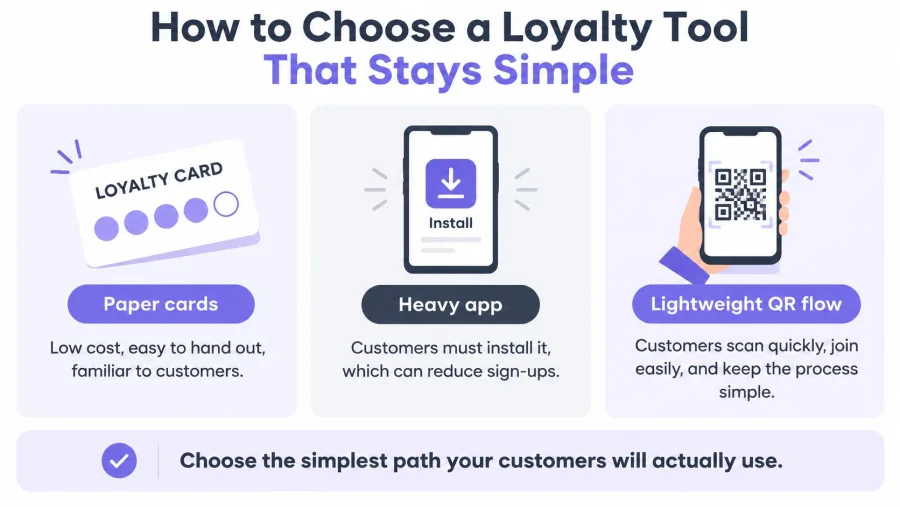
Three paths face most small UK businesses. Paper cards cost little and everyone understands them, but they record nothing and get lost. A dedicated app can do plenty, yet asking customers to install software for one café is a big request at a busy till. A lightweight QR flow sits between them. Customers scan, join in a browser or wallet, and staff scan back at each visit.
Judge the Tool at the Queue, Not the Desk
Age isn't the barrier many owners assume. UK loyalty engagement reporting by Fashion Network found 94% of people aged 66 and over and 81% of those aged 18 to 25 were engaged in at least one loyalty scheme. The same research identifies complexity, privacy concerns and weak perceived value as barriers to engagement.
So practical tests matter. How long does sign-up take with three people waiting? Can staff redeem a reward in seconds? What happens when a customer has no phone, a flat battery, or needs help? Staff will abandon a tool that slows the queue within a fortnight, whatever its feature list promises. Owners comparing platforms can work through choosing rewards software for cafés and shops as a criteria checklist before trialling anything.
What a QR-Based Option Looks Like in Practice
BonusQR is one example of the lightweight path. It lets a business run stamps, points, cashback, visit and spend thresholds, fixed discounts, welcome bonuses and birthday or seasonal coupons, mixed to fit the venue. Customers join on mobile or web, receive a personal QR code, and see points, rewards and visit history in one profile that can also hold a menu or price list, news, reviews and reservations.
Staff scan and redeem inside an app, with no POS integration or extra hardware required. Google Wallet and Apple Wallet passes keep the card on the phone customers already carry. Built-in analytics cover top customers, coupon performance and visit trends, while push and email send offers and feedback requests.
Commercially, businesses can start free, move to a white-label app under their own icon in about 14 days, or commission a fully custom app. Ready-to-print materials and GDPR-safe data handling come as part of the setup.
Choose the simplest path customers will actually use. A perfect scheme nobody joins retains nobody.
Promote the Programme and Measure What Changed
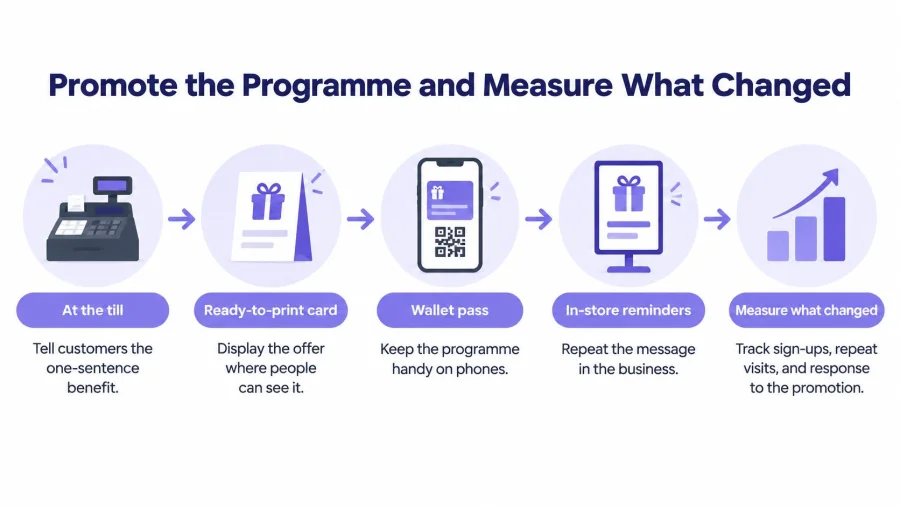
Promotion isn't a separate campaign. It's the one-sentence benefit, repeated where people already look. Staff mention it at the till during payment, when attention is highest. A ready-to-print card on the counter repeats it. The wallet pass keeps it visible between visits, and a timely message after a visit reminds customers what the next stamp earns. Owners stuck for wording can borrow formats from loyalty campaign examples for small businesses and adapt the language to their own counters.
Why Regulars Deserve the Attention
Square's UK Local Economy Outlook defines regulars as customers returning to the same business at least four times annually. It reports that regular customers generate at least five times the annual revenue of transient customers nationally, and in Sheffield the difference reaches 10 times.
That gap explains the measurement priorities. Moving a customer from two visits a year to four matters more than squeezing one extra redemption from a daily regular. Frequency is where the money sits.
Measure Increment, Not Applause
Redemption volume flatters weak schemes. A busy coupon can mean the business paid people who were coming anyway. Honest measurement compares enrolled customers against a pre-enrolment baseline or a simple control group, then reports a short list.
- Incremental visits: extra visits beyond the baseline pattern.
- Revenue per customer and average transaction value: whether spend per head and per visit moved.
- Reward cost: the product cost of everything given away.
- Gross-margin-adjusted return: extra margin earned minus reward cost.
QR scans and visit history supply the raw events for this cohort view without any POS link. Each scan timestamps a visit, so patterns emerge week by week.
Three numbers deserve a weekly glance. Enrolment-to-second-visit conversion shows whether joiners ever return. Median days between visits shows whether the gap is shrinking. Visit frequency by reward exposure shows whether people who received an offer behave differently from those who didn't.
An offer that doesn't move those numbers needs changing, not decorating. Adjust the threshold, the timing, or the audience. Keep the sentence simple and test one variable at a time.
Launch This Week Without Breaking Trust
A first week needs five decisions, none of them expensive.
- Write the benefit in one sentence and test it on staff.
- Pick one objective, either sooner returns or a larger basket, not both.
- Set a threshold the margin survives at full redemption.
- Separate joining from marketing permission and record each choice.
- Decide the fallback for customers with no app, no phone, or a lost device, such as staff looking the account up manually.
Consent, in Plain Language
ICO guidance on direct marketing and data protection states that electronic marketing to individual subscribers generally requires consent unless a specific soft opt-in applies. That exception requires details collected during a sale or expressed interest, messages only about similar products or services, and a clear and easy opt-out at collection. Every marketing message must identify the sender and provide a way to unsubscribe.
In practice, that means no pre-ticked boxes, a recorded choice for every member, and an obvious unsubscribe in every campaign. Joining a stamp scheme isn't consent to receive texts. Treating those as separate questions protects the business and respects the customer. Later, opt-in rate, redemption rate and unsubscribe rate should be read as three separate signals, since each one diagnoses a different problem.
The practical start is modest. Set up the free QR flow, print the counter materials, scan the first visits, and review top customers and visit trends before adding a second offer. A white-label app only earns consideration once the basic flow is already part of the till routine.
Start this week with one sentence, one objective and one affordable threshold. Set up a free QR loyalty programme, put the printed card by the till, scan the first regulars through, and check enrolment-to-second-visit conversion after the first month. If that number moves, the scheme's working. If it doesn't, change the offer before spending another pound on promotion.


