
 Deutsch
 Español
 Français
 Italiano
 Magyar
 Polski
 Slovenčina
 Čeština
A loyalty program UK operators launch today sits in a market where loyalty is already part of everyday shopping behaviour. In UK consumer research, 88% of adults belong to at least one loyalty scheme, while other UK-focused research puts active participation at about 80% of adults, and the loyalty market is worth over £4.5 billion annually UK loyalty programme statistics. For a small café, salon, gym, or local shop, that means the question is no longer whether customers understand loyalty, but whether a programme is simple enough, rewarding enough, and friction-free enough to earn use.
A café owner can feel this gap on a busy Friday afternoon. Regulars keep coming back, but the till doesn't know who they are, staff can't tell who visited last week, and a paper stamp card gets forgotten in a coat pocket. The business keeps giving away value without learning much in return.
That's why modern loyalty has moved from a nice extra to a practical growth tool. It helps a local business capture repeat visits, understand behaviour, and keep rewards visible without adding hardware headaches or heavy admin. It also forces better decisions, because a programme only works when the reward feels immediate, the margin still makes sense, and the setup doesn't create more work than it solves.
Introduction to Loyalty Programs in the UK
A local café in Manchester can serve the same customer ten times and still miss the pattern if the loyalty system lives on paper. Staff may recognise familiar faces, but memory does not create usable customer history, segment data, or reliable follow-up. A proper loyalty program UK businesses can run needs to make repeat behaviour visible, because visibility is what turns casual return visits into something you can measure and improve.
That matters in a market where loyalty is already part of normal shopping behaviour. UK-focused research shows that 88% of adults belong to at least one loyalty scheme, with active participation also reported at about 80% of British adults UK loyalty programme statistics. In grocery retail, supermarket-led schemes such as Tesco Clubcard and Nectar have helped make loyalty feel routine across everyday shopping trips and convenience purchases.
Why small businesses can't treat loyalty as optional
For independent businesses, loyalty is no longer a nice extra that only large chains can justify. UK market commentary places the loyalty market at over £4.5 billion annually, which shows how firmly reward behaviour has become part of everyday buying habits. That scale matters because customers already know what these schemes should feel like, simple sign-up, clear progress, and a reward that arrives without fuss.
Local merchants face a different problem from supermarkets. A café, salon, or gym usually cannot absorb deep discounting or complicated admin, so the programme has to stay lean. QR-based systems fit that need because they avoid extra hardware and reduce setup friction while still keeping the customer journey easy to understand.
Practical rule: If customers need an explanation at the till every time, the programme is too complicated.
A useful way to view this market is as a habit economy. The businesses that do well are the ones that make return visits feel natural, visible, and easy to redeem. For owners comparing options, a useful retention resource is customer retention marketing strategies, because loyalty only works when the offer and the follow-up support each other.
Understanding Loyalty Program Concepts and Benefits
A loyalty programme is basically a digital handshake. A customer visits, buys, or engages, and the business gives a small return that says, “Come back, and we'll recognise you.” The best schemes don't feel like accounting, they feel like a short path from first visit to meaningful reward.
The simplest model is a digital replacement for the old coffee stamp card. Instead of ink and paper, the customer's visits are tracked in a profile, and the business can see progress, redemption, and repeat frequency. That shift matters because it turns a reward from a memory game into a measured system.
What the business actually gains
The first gain is better customer insight. A business can see who returns often, which reward gets used, and which offers are ignored. That makes it easier to stop guessing and start segmenting, which is important for local businesses that can't waste margin on broad discounts.
The second gain is stronger repeat behaviour. A customer who can see progress tends to return sooner than one who only hears about a reward in vague terms. A visible reward path, especially one with a clear next step, helps create a habit loop rather than a one-off promotion.
The third gain is competitive differentiation. Many local businesses sell similar products, similar services, and similar price points. A loyalty programme gives a shop another reason to be remembered, especially if the reward feels immediate and the sign-up process is frictionless.
The benefits that matter most for local venues
- Deeper customer insight, because each visit can be tied to a person instead of staying anonymous.
- Higher repeat intent, because progress toward a reward creates a reason to return sooner.
- Clearer marketing, because birthday offers, welcome bonuses, or return nudges can be personalized.
- Better retention economics, because the business can reward behaviour without relying only on blanket discounting.
- Stronger differentiation, because a simple loyalty flow can make a small venue feel more organised and more personal.
For businesses that want a more structured setup, customizable loyalty points show how points can be adapted to fit different visit patterns and customer expectations. The point isn't to make the programme clever. It's to make it obvious, quick, and worth using.
UK Legal Data Privacy and Tax Requirements
A loyalty programme collects customer information, so it can't be treated like a paper stamp card with a nicer interface. UK businesses need to think about consent, privacy notices, storage, and the way data is used in marketing. If those parts are vague, the programme becomes a compliance problem before it becomes a growth tool.
The first rule is simple. Collect only the data the programme needs, and tell customers why it's being collected. For most local businesses, that means a short privacy policy, clear opt-in language, and a straightforward explanation of how rewards, reminders, and optional marketing messages work together.
What needs to be in place before launch
A useful compliance checklist starts with four questions. What data is being captured, who can see it, how long it's kept, and whether the customer can withdraw consent or update preferences easily. If staff can't answer those questions confidently, the programme is probably too loose.
Gift vouchers, discount codes, and reward redemptions also need basic record-keeping discipline. The accounting treatment depends on the structure of the reward and how it is issued, so merchants should document the rules clearly and keep redemption records tidy for audit readiness. That kind of clarity helps avoid confusion later when finance, tax, or customer service teams need to check what was promised.
Compliance habit: Write the rules for customers first, then make the back office match them.
For businesses that want support drafting documents, LegesGPT's AI legal document generator can help produce a starting point for privacy, terms, and policy language. That said, any generated document still needs review against the business's own process, because a loyalty programme only stays safe when its words and its workflows line up.
The practical takeaway is that compliance should be built into the programme design, not patched on later. QR-based systems can help here because they make enrolment, tracking, and consent flows more transparent than a stack of paper forms or ad hoc staff notes. When the data path is clean, the business can focus on selling repeat visits instead of untangling admin.
Loyalty Program Types and Mechanics
The right loyalty mechanic has to fit the business model as closely as the menu or service list. A café with quick, low-value transactions needs a different structure from a salon offering birthday perks, and a gym usually needs a different setup again. Margin, visit frequency, and how much explanation staff can give at the counter all shape the choice.
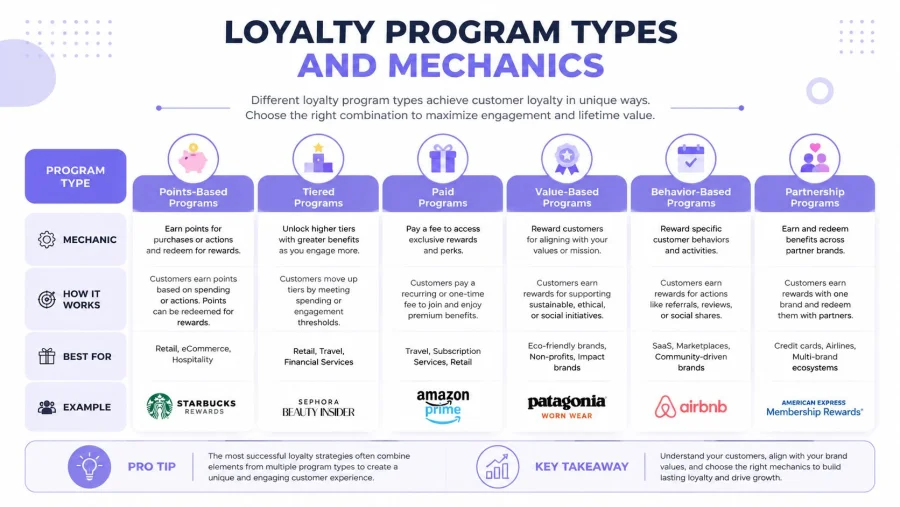
Market coverage in the UK shows that 80% of consumers engage with at least one loyalty programme, and 55% join primarily for partner brand rewards UK loyalty programs market report. For local businesses, that points to a simple reality. Customers already understand loyalty schemes, and they respond well when the reward feels useful rather than purely promotional.
Choosing the right structure
Paper-stamp replacements are often the simplest place to start. They suit cafés, bakeries, and quick-service counters because the process is easy to explain, collect visits, redeem a free item, and move on. The weakness is just as clear, because paper cards get lost, stamping is hard to track, and the business ends up with little useful data.
Points-based programmes give more flexibility. They can support spend-based rewards, tiered access, and different redemption values, which makes them useful when a business wants more control over the customer journey. For owners who want a ready-made digital setup, customizable loyalty points can reduce the admin involved in tracking rewards while avoiding the need for physical cards.
Cashback and exclusive perks are common because customers can grasp them quickly. Cashback feels direct, while perks suit salons, gyms, and boutiques that want to add value without significantly reducing the main service price. Visit-threshold rewards are often the clearest option for low-margin local businesses, because the customer only needs to know how many visits remain before the reward is ready.
Decision rule: If the reward needs more than one sentence to explain, simplify the mechanic before launch.
Paid membership clubs and wallet passes sit higher up the complexity ladder. They can work well when a venue already has a loyal core audience and wants to build a stronger sense of belonging. The key is to match the format to the business model, rather than copying a supermarket, a national chain, or a subscription brand with very different economics.
Designing Rewards and KPIs
The best loyalty reward is not always the biggest reward. For low-margin businesses, a giant freebie can create excitement and damage margin at the same time. A better approach is to make the reward feel immediate, easy to understand, and light enough to sustain over time.
UK consumer research shows 49% of schemes use cashback and 32% use exclusive perks, while 59% of customers prefer immediate rewards over delayed payoffs Marketing Week. That combination matters because it explains why many programmes win attention with familiar mechanics, but still risk becoming too generic. A small business usually needs the speed of immediate value without copying a supermarket's discount logic.
How to balance value and margin
A strong reward structure starts with the economics. A free coffee after several visits can work in a café because the business understands ingredient cost and visit frequency. A salon might prefer a birthday add-on, a small service upgrade, or a priority booking perk because those rewards feel personal without cutting deep into core revenue.
The right question is not, “What will customers love?” It's, “What will customers love that the business can still afford to repeat?” That mindset keeps the scheme alive after launch, which is where many loyalty programmes struggle.
A useful KPI set for small businesses includes repeat purchase rate, average order value, and customer lifetime value. Redemption rate matters too, because a reward has no business value if customers never use it. The point of the KPI set is to connect each reward to a commercial outcome, not just a happy feeling.
| KPI | What it shows | How to use it |
|---|---|---|
| Repeat purchase rate | Whether customers come back | Compare before and after launch |
| Average order value | Whether basket size changes | Watch for reward-driven upsell patterns |
| Customer lifetime value | Whether the programme improves long-term worth | Review by customer segment |
| Redemption rate | Whether rewards are actually being used | Replace weak rewards quickly |
Margin rule: A reward should feel generous to the customer and manageable to the business on the third month, not just the first week.
If a programme needs a tune-up, the reward mix should change before the whole thing gets written off. That's where clear KPI tracking helps, because it shows whether the issue is the offer, the reminder, or the redemption path. For most local operators, the simplest programme is the one that survives long enough to learn.
Implementation Roadmap and Timeline
A loyalty launch goes smoother when the work is sequenced properly. A business that writes the offer first, collects data second, and trains staff last usually ends up fixing avoidable problems during service hours. A cleaner path is to define the rules, set up the data flow, test the reward journey, and only then promote the programme to customers.
UK loyalty-tech stacks can cost £25,000–£70,000+ when they combine CRM, POS integrations, wallet passes, analytics, and compliance features loyalty app tech stack. That figure matters because it shows why many small merchants hesitate to go beyond a simple stamp card. It also explains why QR-based setups that skip hardware and deep integrations are attractive for local businesses that need control without a large build.
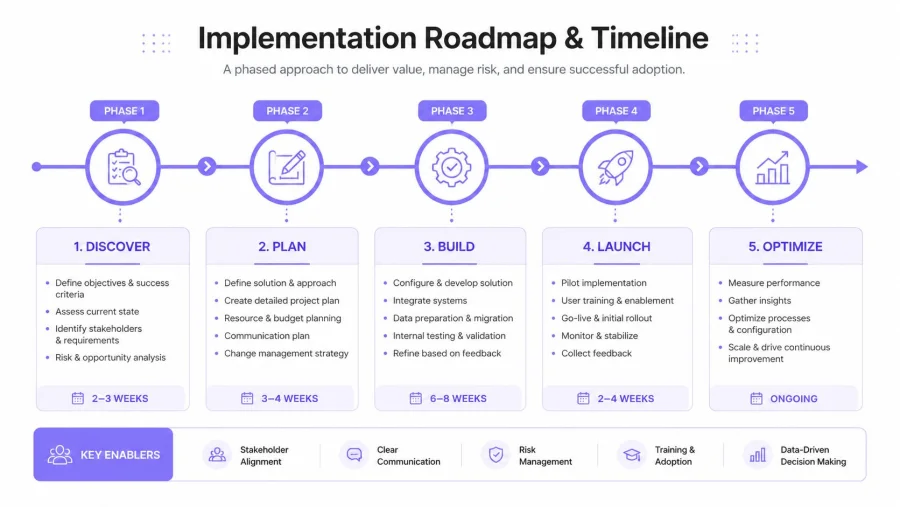
A practical launch sequence
The first step is rule design. Decide what the customer earns, when the reward triggers, and what staff need to see at the counter. Keep the offer compact, because every extra rule creates another chance for confusion.
The second step is data setup. That means privacy language, consent capture, and a clean record of how customer details move through the system. A good programme makes this part invisible to customers while keeping it defensible for the business.
The third step is customer-facing setup. Branded QR codes, wallet passes, and clear on-screen instructions should all point to the same place. If sign-up happens in one channel and redemption in another, the customer journey starts to leak.
The fourth step is staff training. Team members should know how to enrol, how to redeem, and how to answer the most obvious question, “How does it work?” If staff hesitate, customers hesitate too.
- Draft the offer rules, keeping the reward simple enough for staff to explain quickly.
- Prepare the privacy notice, consent flow, and retention rules before launch.
- Test enrolment and redemption, ideally from a real customer device.
- Train staff on exceptions, such as forgotten phones or failed scans.
- Print launch materials, so the programme is visible at the point of sale.
For merchants comparing options, subscription prices for merchants show how a QR-based approach can be explored without committing to heavy infrastructure on day one. A key benefit is operational, because a system that doesn't demand new hardware is much easier to roll out in a busy venue.
Promotion Strategies and Measurement Tips
A loyalty programme doesn't grow because it exists, it grows because customers see it, understand it, and remember to use it. That means promotion has to happen at the till, in post-purchase messages, on social profiles, and through any digital pass the customer opens. If the offer stays hidden, the programme becomes invisible too.
A practical issue in the UK is that 30% of customers forget their loyalty cards, so automated reminders can recover engagement SumUp loyalty programme survey. That's not just a convenience problem. It's lost value at the point of sale, which is why reminder mechanics matter just as much as reward design.
How to keep the programme top of mind
The strongest launch campaigns are simple. Put the sign-up message where people already look, at the counter, in order confirmations, and in follow-up emails. Then keep the programme visible with progress updates, reward reminders, and seasonal prompts that feel useful rather than noisy.
Automation helps because staff won't remember every nudge on a busy day. A reminder that says a customer is close to a reward can do more to drive return visits than another generic discount blast. For businesses that want digital reminder tools built into the workflow, BonusQR loyalty platform features can support push-style prompts without adding more manual work.
| KPI | Definition | Target | Review Frequency |
|---|---|---|---|
| Repeat purchase rate | Share of customers who return | Rising trend | Every 90 days |
| Average order value | Average spend per visit | Stable or improving | Every 90 days |
| Customer lifetime value | Long-term revenue per customer | Rising trend | Every 90 days |
| Redemption rate | Share of rewards used | Healthy and sustainable | Every 90 days |
A 90-day review cycle is useful because it stops the business from overreacting to a weak week or a strong promotion. If a reward underperforms, the next move should be to adjust the offer or the reminder, not abandon the whole programme. The businesses that improve fastest are the ones that keep the dashboard simple and the response plan even simpler.
Sector Examples and Next Steps
A café does not need the same loyalty logic as a salon, but the decision process follows the same pattern. The owner starts with customer behaviour, matches a reward to that behaviour, and then removes friction from sign-up and redemption. A good programme changes shape by sector while keeping the same basic logic.
A neighbourhood coffee shop may use a visit-threshold reward, where the customer earns a free upgrade after enough returns. A salon may rely on birthday coupons and service add-ons, because those rewards feel personal and do not always require discounting the core service. A gym could use a member perk or a referral-style offer to reinforce attendance and support retention.
Mini examples from local businesses
A café that serves regular morning commuters usually benefits from a quick, visible reward path. The customer understands the offer at once, and staff can explain it in a sentence. That simplicity keeps redemption high because there is less room for confusion.
A salon with appointment-based traffic can use loyalty to reduce quiet periods and reward repeat bookings. Birthday offers, rebooking prompts, and small add-ons often feel more thoughtful than blunt percentage discounts. The goal is to create repeat habit without training customers to wait for sales.
A retail shop can use digital stamps, spend thresholds, or seasonal perks to keep the relationship active between purchases. A gym may prefer membership-style loyalty, because the value is often tied to commitment and routine rather than one-off transactions. Each model works best when the reward matches the way customers already use the business.
For merchants ready to move, BonusQR offers a QR-based loyalty setup that businesses can launch without extra hardware, with options for stamps, points, cashback, visit thresholds, welcome bonuses, birthday offers, and seasonal coupons. That makes it practical for local operators who want a structured programme without buying a complicated tech stack.
Start with one simple reward, one clear redemption rule, and one visible reminder path. If those three parts work, the rest of the programme becomes much easier to improve.
For a local UK business that wants a loyalty programme without hardware headaches, the next step is to test a QR-based setup on real customers. Start with a simple reward, keep the rules easy to explain, and launch a branded flow that staff can use on day one.