Loyalty program automation is defined as the use of software to track customer actions, calculate rewards, and credit accounts automatically, removing the need for manual data entry or staff intervention. Automated workflows cover everything from member enrolment and point tracking to reward fulfilment, including automated discounts applied at checkout. This guide to loyalty program automation gives small and medium-sized business owners a practical roadmap for choosing the right tools, setting up triggers, and measuring results. Stores running fully automated loyalty workflows see a 25% increase in repeat purchase rates and 67% higher average order values from loyalty members compared to non-members. Those numbers represent real revenue, not theoretical gains.
What tools and technologies power loyalty program automation?
The automation of loyalty marketing depends on a specific set of technologies working together. Understanding what each component does helps you choose a platform that fits your business rather than one that overwhelms it.
- Receipt scanning and OCR. Optical Character Recognition, used by platforms such as Doxis, reads purchase receipts digitally and extracts transaction data without manual input. This is the foundation of any offline-to-online loyalty system, particularly for retailers who do not use a connected point-of-sale terminal.
- AI-powered data analysis and fraud detection. Artificial intelligence reviews transaction patterns to flag duplicate submissions, suspicious receipt uploads, or unusual redemption spikes. Without this layer, loyalty budgets leak through abuse.
- Automated point accrual and tier management. Rules-based engines calculate points per pound spent, apply multipliers for specific product categories, and move members between tiers without any staff action. Salesforce Einstein, for example, uses behavioural data to personalise these rules at scale.
- Consent and compliance automation. Automated consent management tools handle GDPR and CCPA requirements by offering real-time updates, cookie lifecycle control, and location-based user experiences. For any business collecting EU customer data, explicit opt-in consent for non-essential tracking is a legal requirement, not a preference.
- Integration capabilities. A good platform connects to your e-commerce store, email marketing tool, and CRM via API or webhook. Smile.io, for instance, publishes benchmarks showing that programmes integrated with Klaviyo or Shopify see significantly higher member engagement than those running in isolation.
Pro Tip: Before selecting a platform, list every customer touchpoint where a purchase or engagement could trigger a reward. If your chosen tool cannot connect to at least 80% of those touchpoints via native integration or API, you will spend more time on workarounds than on growing your programme.
The right technology stack does not need to be expensive. Many SME-focused platforms offer modular pricing, so you pay only for the features you actually use. The priority is coverage: every purchase, visit, or referral that goes untracked is a missed retention opportunity.

How to set up an automated loyalty programme step by step
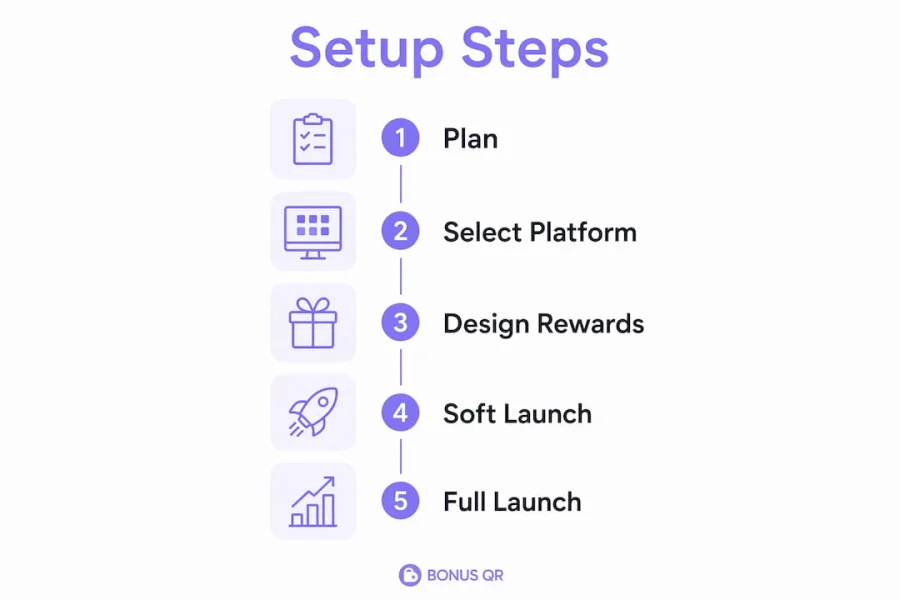
Setting up a loyalty programme correctly from the start saves significant rework later. Follow these steps in order, and you will have a functioning automated system within days rather than months.
-
Design your points economy and tier structure. Decide how many points a customer earns per pound spent, what actions beyond purchases earn points (reviews, referrals, social shares), and how many tiers your programme will have. Keep it simple: three tiers work well for most SMEs. Complexity at this stage creates confusion for customers and configuration errors in your platform.
-
Build an automated enrolment pipeline. Auto-enrolment at first purchase produces participation rates of around 85%, compared with just 28% when customers must manually opt in. Set your platform to enrol customers automatically on their first confirmed transaction, then trigger a welcome email containing their points balance and their next reward target.
-
Configure point accrual triggers. Map every event that should generate points: purchase confirmation, birthday, product review, referral sign-up. Each trigger should fire a webhook or API call that updates the member’s ledger in real time. Event-driven webhook processing at point confirmation is best practice for financial accuracy, avoiding the batch-delay errors that cause customer complaints.
-
Schedule bonus point events. Automated bonus events, such as double-points weekends or category multipliers, drive a 34% lift in order volumes during the event and sustain a 12% uplift for 30 days afterwards. Build these into your annual calendar and schedule them in advance so the platform handles activation and deactivation automatically.
-
Set up automatic tier upgrades and status communications. When a member crosses a tier threshold, the platform should upgrade them instantly and send a congratulatory message with a summary of their new benefits. Delayed tier upgrades are one of the most common causes of member dissatisfaction and support tickets.
-
Automate reward redemption and expiration workflows. Define how members redeem points (discount codes, free products, cashback) and set expiration rules. Automated expiration reminders sent 14 and 7 days before points expire consistently recover redemption activity that would otherwise be lost.
-
Implement referral automation. Assign each member a unique referral link or code. When a referred customer makes their first purchase, the platform should automatically credit both parties and send confirmation messages. This closes the referral loop without any manual verification.
| Setup stage | Common pitfall | How to avoid it |
|---|---|---|
| Points economy design | Overly complex tier rules | Limit to three tiers with clear spend thresholds |
| Enrolment pipeline | Requiring manual opt-in | Auto-enrol at first purchase confirmation |
| Bonus events | Forgetting to schedule deactivation | Set start and end times in the platform calendar |
| Tier upgrades | Delayed status notifications | Use real-time webhooks, not nightly batch jobs |
| Referral automation | Duplicate credit on self-referrals | Apply fraud detection rules at referral confirmation |
Pro Tip: Run a soft launch with a small segment of your most loyal customers before going live with your full database. Their feedback on the enrolment email, points display, and redemption flow will surface UX problems that no amount of internal testing reveals.
How does AI improve loyalty strategies beyond basic rewards?
Basic points-and-tiers programmes are table stakes in 2026. AI-powered loyalty automation shifts the model from reactive to predictive, and that shift is where the real retention gains live.
The biggest unlock from AI-powered loyalty automation is timing. Personalised interventions occur before customers churn, not after. AI-driven next best action systems use churn probability models built on declining purchase frequency and falling email engagement to trigger targeted retention actions automatically. A customer who has not purchased in 45 days and whose email open rate has dropped by 60% receives a personalised discount or tier upgrade offer without any human decision-making in the loop.
Beyond churn prevention, AI enables individual-level personalisation that was previously only available to enterprise retailers. Behavioural signals, including browsing history, purchase timing, and category preferences, combine with zero-party data (preferences customers share directly) to generate offers that feel genuinely relevant. A customer who always buys coffee on Monday mornings does not need a Friday afternoon promotion for tea.
Omnichannel data integration is the infrastructure that makes this work. When your in-store, e-commerce, and app purchase data feed into a single member profile, AI can identify patterns that siloed systems miss entirely. A member who browses online but purchases in-store is a different retention risk than one who does both digitally.
“The shift from reactive to predictive loyalty is not a technology upgrade. It is a fundamental change in how you think about customer relationships. You stop waiting for customers to leave and start acting on signals they are already giving you.”
Security is the less-discussed side of AI in loyalty. AI-based fraud detection and behavioural biometrics identify account takeover attempts and point manipulation in real time, protecting both your budget and your members’ trust. For SMEs, fraud losses on a poorly protected loyalty programme can erode the entire financial benefit of running one.
Explore retail loyalty programme examples to see how leading brands apply these principles in practice.
How do you measure and optimise an automated loyalty programme?
Measurement is where most SME loyalty programmes fall short. The automation is running, points are accruing, but without the right metrics, you cannot tell whether the programme is driving genuine retention or simply rewarding customers who would have returned anyway.
The critical KPIs for any automated loyalty programme are repeat purchase rate, average order value among members versus non-members, and tier progression rate. Tier progression rate is particularly telling: if members are not moving up through your tiers, your points economy is either too generous (members reach the top tier too quickly and disengage) or too demanding (members give up before reaching meaningful rewards).
| Metric | What it measures | Target benchmark |
|---|---|---|
| Repeat purchase rate | How often members return to buy again | 25% higher than non-members |
| Average order value | Spend per transaction among members | 67% higher than non-members |
| Tier progression rate | Members moving up tiers over 90 days | Above 15% of active members |
| Redemption rate | Points redeemed vs points issued | 60–80% (low rate signals poor reward relevance) |
| Referral conversion rate | Referred customers who make a purchase | Above 30% of referral clicks |
Real-time webhook processing gives you accurate, up-to-the-minute data on point accrual and redemption. Batch processing, by contrast, introduces delays that distort your daily metrics and can cause members to see incorrect balances. SAP Emarsys uses a webhook on a loyalty points confirmation event to update accrual ledgers instantly, and the same principle applies regardless of which platform you use.
Analyse member engagement patterns monthly. Look for segments with high point balances but low redemption: these members are accumulating without engaging, which often signals that your reward catalogue does not match their preferences. Adjust the catalogue, send a targeted reminder, and track whether redemption rates recover within 30 days.
For customer retention strategies that complement your loyalty data, a broader retention framework helps you contextualise what your programme metrics are telling you.
Key takeaways
Loyalty programme automation delivers measurable retention gains only when the technology, setup, and measurement framework work together from day one.
| Point | Details |
|---|---|
| Auto-enrolment is non-negotiable | Automating enrolment at first purchase lifts participation from 28% to 85%. |
| Real-time webhooks beat batch processing | Instant point updates prevent balance errors and member complaints. |
| AI shifts loyalty from reactive to predictive | Churn interventions triggered before disengagement are far more effective than win-back campaigns. |
| Measure tier progression, not just points issued | Low tier progression signals a broken points economy before revenue impact becomes visible. |
| Vendor selection affects total cost of ownership | Full-service providers handle strategy, compliance, and fulfilment; SaaS tools require more internal resource. |
My honest assessment of loyalty automation for SMEs
I have seen a consistent pattern across SME loyalty implementations: businesses underestimate the importance of the first 90 days and overestimate how much automation alone will do for them.
The technology works. Auto-enrolment, real-time point accrual, and AI-driven churn alerts are all proven. The failure point is almost always the points economy design and the reward catalogue, both of which require human judgement that no platform can replace. I have watched businesses launch technically perfect automation on top of a rewards structure that customers found confusing or underwhelming, and the result is a programme that runs flawlessly while delivering no measurable retention lift.
My recommendation is a phased approach: crawl, walk, run. In the first phase, automate enrolment and basic point accrual only. Get your data flowing cleanly and your member communications right. In the second phase, add tier management and bonus events. In the third phase, layer in AI-driven personalisation and predictive churn tools. Businesses that try to implement everything at once typically go live late, with configuration errors, and with staff who do not understand the system well enough to troubleshoot it.
On vendor selection, the choice between a SaaS-only platform and a full-service loyalty provider is more consequential than most SME owners realise. SaaS tools are cheaper and faster to launch, but they place the burden of strategy, compliance, and optimisation entirely on you. Full-service providers cost more but deliver faster time-to-value for businesses without a dedicated marketing operations team.
Compliance deserves more attention than it typically receives. GDPR consent management is not a one-time setup task. It requires ongoing monitoring as your data collection evolves. Build compliance review into your quarterly programme audit from the start.
The businesses I have seen succeed with loyalty automation share one trait: they treat the programme as a customer experience product, not a marketing tactic. The technology is the infrastructure. The experience is what keeps members engaged.
— Michal
How Bonusqr supports your loyalty automation goals
If you are ready to put this guide to loyalty program automation into practice, Bonusqr gives you the tools to do it without complex POS integration or a large technical team. The electronic reward platform handles automated point crediting and redemption across your customer base, with real-time analytics and push notification capabilities built in. For businesses starting with a simpler model, the stamp card programme offers automated loyalty tracking that requires no specialist setup. Bonusqr’s modular approach means you can start with the features you need now and add AI-driven personalisation and omnichannel integration as your programme matures. Explore the platform and see which configuration fits your business.
FAQ
What is loyalty programme automation?
Loyalty programme automation is the use of software to handle member enrolment, point calculation, tier management, and reward fulfilment without manual input. It replaces spreadsheets and staff-managed processes with rules-based and AI-driven workflows.
How does auto-enrolment affect participation rates?
Automating enrolment at a customer’s first purchase produces participation rates of around 85%, compared with 28% when customers must manually opt in. The difference is significant enough to affect the entire financial case for running a programme.
What KPIs should I track for my loyalty programme?
The three most important metrics are repeat purchase rate, average order value among members versus non-members, and tier progression rate. A redemption rate below 60% typically signals that your reward catalogue does not match member preferences.
Do I need to integrate with my POS system?
Not necessarily. Platforms like Bonusqr operate without POS integration, using digital receipt scanning, QR codes, or app-based check-ins to track purchases. This makes automation accessible to businesses that use legacy or standalone till systems.
How do I stay compliant with GDPR when automating loyalty data?
Use an automated consent management tool that handles real-time consent updates and cookie lifecycle control. Review your data collection scope quarterly, as GDPR compliance requirements apply to every new data point you collect, not just your initial setup.


