
 Deutsch
 Español
 Français
 Italiano
 Magyar
 Polski
 Slovenčina
 Čeština
The best loyalty model is the one customers use. A programme can still fail if shoppers can't remember how to earn, don't understand the reward, or face too much friction at redemption. The strongest loyalty marketing programs examples solve a simple commercial problem: they give customers a clear reason to return, then make the next reward easy to reach.
UK consumer behaviour shows why simplicity matters. 88% of UK adults belong to at least one loyalty scheme, while the average UK consumer belongs to 4.7 loyalty programmes, according to UK loyalty programme statistics from LoyaltyPass and Antavo's UK loyalty statistics. A café, salon, gym, restaurant, or independent shop must therefore offer something customers can understand faster than they forget it.
The examples below cover points, stamps, cashback, thresholds, memberships, birthdays, exclusive access, and seasonal offers. Each model translates a large-brand idea into a lean small-business template, with practical reward rules, promotion ideas, measurement priorities, and a realistic BonusQR implementation path.
The repeatable framework is straightforward. Choose the behaviour to change, set a reward the margin can support, promote it at the right moment, and track visits, spend, redemptions, and retention. BonusQR gives brick-and-mortar businesses a practical way to launch with QR codes, without POS integration or extra hardware.
1. Starbucks Rewards and the gold standard of point-based loyalty
Starbucks made points-based loyalty feel like part of the purchase rather than a separate marketing activity. Customers earn toward a future benefit, while the mobile experience keeps the balance, ordering process, payment, and reward access close together.
The lesson for a smaller café isn't to copy an enterprise app. It's to remove the pause between buying and understanding the benefit. A customer should know what they've earned before leaving the counter, and staff should be able to validate the reward without slowing service.
A lean café template
A café can award points for each visit or for spend, then keep the first reward within a realistic purchasing cycle. For example, the business might give points for every qualifying transaction and offer a free upgrade, add-on, or selected drink after the customer reaches the chosen threshold. The exact rule should reflect margin and visit frequency, not a competitor's structure.
Tiered rewards can work when customers have meaningful differences in value. A regular customer might earn a birthday drink or early access to a seasonal menu, while a higher tier receives a complimentary pastry with a qualifying purchase. Tiers should remain easy to explain at the till.
The BonusQR points program for shops can support this structure without requiring a café to build a mobile application from scratch.
Promotion and measurement
Staff should mention the programme after payment, not before the queue has moved. QR prompts can appear on receipts, table cards, counter signage, and takeaway packaging. A welcome reward gives customers an immediate reason to enrol, while a birthday or seasonal coupon creates a later visit opportunity.
Track enrolment, active members, repeat visits, redemption rate, average spend, and inactive-member recovery. Points that accumulate but never get used aren't creating the full retention effect.
2. Sephora Beauty Insider and loyalty through access
Sephora's Beauty Insider model demonstrates that loyalty doesn't need to rely entirely on price. Points create a familiar earning mechanic, but exclusive access, product discovery, consultations, samples, and personalised recommendations make membership feel useful between purchases.
That matters for salons, skincare clinics, barbers, wellness centres, and independent beauty retailers. Customers often value recognition and access as much as a discount. A reward that costs little to deliver can still feel valuable if it solves a real customer need.
Build a beauty programme around recognition
A salon could offer a free consultation after a defined number of bookings, early access to a new treatment, or a members-only product demonstration. A skincare retailer might provide samples matched to previous purchases. A wellness business could invite active members to a small education session or product preview.
The programme should combine one predictable transactional benefit with one distinctive experience. A fixed discount is easy to understand, but an early booking window or personalized recommendation gives customers a reason to stay engaged.
Manage coupons can help a beauty business organise welcome offers, birthday rewards, treatment incentives, and seasonal promotions in one customer-facing system.
Practical rule: Use customer information to make rewards more relevant, not merely more frequent.
Keep personalisation useful
Personalisation doesn't require a complex data science team. Staff can record broad preferences such as hair services, skincare categories, treatment types, or appointment patterns. Campaigns can then focus on what a customer has already shown interest in, while avoiding over-communication.
A simple promotion might offer a product sample after a treatment, a birthday coupon, or early booking for a popular seasonal service. The business should measure redemption by campaign, repeat booking behaviour, average customer spend, and the time between visits.
The strongest reward isn't always a cheaper service. It may be convenience, priority, discovery, or a feeling that the business remembers the customer.
3. Chipotle Rewards and the power of frequency
Chipotle's model points toward a useful distinction: a restaurant doesn't always need to reward high spend. If the commercial problem is quiet periods or inconsistent visits, the programme should reward frequency instead.
A quick-service restaurant can use a visit threshold, a simple stamp card, or points linked to qualifying transactions. Customers should reach an initial reward within a period that feels achievable. If the threshold is too distant, the reward becomes an abstract promise.
A repeat-visit template for restaurants
A restaurant might offer a free side after a chosen number of qualifying visits, a fixed discount after a spend threshold, or a member-only add-on during quieter periods. The reward should protect the core margin. A free low-cost extra may be more sustainable than a discount on the entire order.
Personalised promotions can build on purchase patterns. A customer who repeatedly orders a particular meal could receive a relevant add-on offer, while a customer who hasn't returned for some time could receive a reactivation coupon.
The BonusQR restaurant loyalty setup gives restaurants a QR-based route to enrolment and redemption without making customers download a dedicated app.
Remove the friction at the counter
QR codes should appear where the customer already looks, including receipts, collection points, menus, and table signage. Staff need one short explanation, such as, “Scan this to collect today's visit and earn your next reward.”
A restaurant should review visits per member, redemption timing, average spend for members and non-members, and campaign conversion. The business can then test whether a visit reward, a basket threshold, or a targeted add-on produces the healthiest repeat behaviour.
4. Dunkin' Loyalty and convenience as the reward
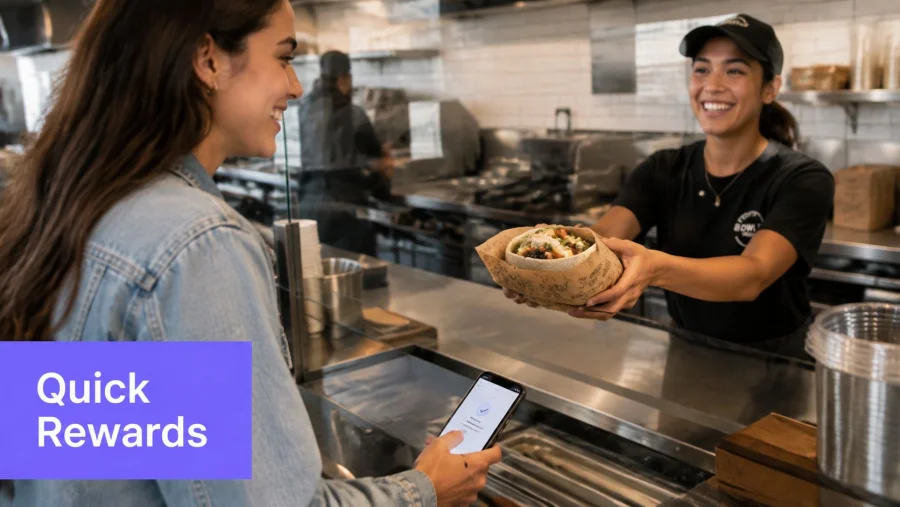
Dunkin' shows how speed can become part of the loyalty proposition. Customers who are buying coffee, breakfast, or a snack often care about a quick transaction as much as the reward itself. Complicated rules undermine that value.
For a local café, convenience can mean a visible balance, a reward that's valid on the next visit, a scan completed in seconds, or a preselected offer that doesn't require staff to interpret conditions.
Design for the morning rush
A coffee shop could reward a sequence of qualifying visits, provide a morning-only member offer, or give a free size upgrade after the selected threshold. The mechanic should work when staff are serving quickly and customers are carrying phones, bags, and coffee.
A business shouldn't send every promotion to every member. A morning offer suits a commuter, while an afternoon snack promotion may suit a different visit pattern. Automated campaigns can help the operator communicate at useful moments instead of relying on manual reminders.
BonusQR's QR enrolment and scan-to-redeem flow suits businesses that want digital access without app development or POS integration. Customers can use a personal QR code, while staff validate the reward inside the system.
Measure service impact, not only sign-ups
A programme can attract sign-ups yet fail to change behaviour. The café should compare repeat visits, reward redemptions, average transaction value, and inactive-customer recovery. It should also watch whether scanning creates a queue problem.
The best redemption process is the one staff can perform consistently. If a reward requires several checks or exceptions, the business should simplify the rule before adding more benefits.
5. Ulta Beauty Rewards and the hybrid loyalty model
Ulta Beauty combines points, tiers, birthdays, services, and exclusive experiences. That hybrid structure works because it recognises two different motivations. Some customers want a clear financial reward, while others want status, access, or a more personal service experience.
A smaller beauty business can borrow the architecture without recreating the complexity. The programme can start with one earning rule, one immediate reward, and one premium benefit for customers who engage more often.
A practical tier structure
A salon might begin with a standard member level, then move to a higher tier after a chosen number of appointments or a defined amount of spend. Benefits could include priority booking, a complimentary consultation, a treatment add-on, or access to a members-only event.
The higher tier must offer a benefit customers value. A vague promise of “exclusive perks” won't motivate behaviour. The customer should understand exactly what changes after reaching the next level.
Birthday rewards and special events can provide emotional recognition without permanently reducing prices. A business can also partner with a complementary provider, such as a skincare specialist, fitness studio, or local retailer, to create a relevant experience.
Avoid the hybrid trap
Hybrid programmes often fail when they combine too many earning rules. Customers shouldn't need to remember whether visits, referrals, reviews, spend, and social activity all earn different amounts.
Start with the behaviour most connected to revenue. BonusQR can support a tiered structure with digital rewards and automated campaigns, while the business uses analytics to identify top customers and assess which benefits encourage return visits.
6. Panera Bread MyPanera and useful personalisation
MyPanera illustrates how purchase history can make loyalty communications more relevant. A customer who regularly chooses a certain product category is more likely to respond to a related offer than to a generic discount sent to everyone.
Small businesses can apply the same principle with much less infrastructure. A café may identify customers who buy breakfast, an independent grocer may distinguish regular product categories, and a salon may separate treatment preferences. The segmentation only needs to be useful enough to improve the next message.
Turn records into better offers
A restaurant could send a relevant add-on offer to a customer who regularly buys a particular meal. A café could invite a customer to try a seasonal version of a familiar drink. A salon could remind a customer about a service they book regularly, while avoiding irrelevant promotions.
The offer should have a clear purpose. It might reactivate an inactive member, increase a quieter day's traffic, introduce a complementary product, or encourage a customer to reach a reward threshold.
Measure relevance and restraint
Track campaign conversion, redemption by customer segment, repeat purchase behaviour, and average spend after an offer. A high redemption rate isn't automatically positive if the reward gives away margin to customers who would have purchased anyway.
BonusQR analytics can help reveal top customers, coupon performance, and visit trends. Automated push and email campaigns can then support targeted communications, but the business still needs a clear consent process. The ICO says marketing lists should use opt-in boxes wherever possible, businesses need specific consent for email and text marketing, and they must keep consent records plus a do-not-contact list in line with ICO guidance on using marketing lists.
Operational messages, such as a points balance or reward confirmation, should be kept distinct from promotional marketing.
7. Planet Fitness PF Black Card and membership loyalty
Planet Fitness shows how the membership itself can create loyalty. Recurring access and tier-based benefits replace rewards tied to individual purchases. The model fits gyms, fitness studios, salons, wellness centres, and other businesses where customers return for an ongoing service.
Predictable revenue comes with a delivery obligation. Members must continue to see value after signing up, or cancellations will outweigh the benefit of recurring billing.
Build a clear value ladder
A gym could offer a standard plan and a higher tier with guest access, premium facilities, priority booking, or specialist sessions. A salon might include regular maintenance appointments, preferred booking windows, or member pricing on selected products.
Make the difference between tiers concrete. Customers should understand what an upgrade provides, while the business must confirm that added benefits will not exceed available capacity.
Membership also needs prompts that encourage use. Welcome messages, unused-benefit reminders, birthday offers, and lapsed-visit campaigns can help members receive value from what they have paid for.
For a small business, start with one paid tier or combine a free visit programme with a paid service plan. Set rules for included visits, rollover limits, cancellation, booking priority, and excluded services before launch. Promote the membership after a completed visit, during quieter periods, and when a customer reaches a repeat-use threshold.
Use membership carefully
Paid or recurring loyalty suits businesses that can reliably provide the promised access. It is a poor fit when appointment availability changes often or customers use the service infrequently.
UK loyalty data shows that free-to-join schemes remain the largest model at 41%, while hybrid schemes account for 31% and paid schemes 28%, according to Collinson's Loyalty Landscape 2025. The mix supports testing a free tier before asking customers to commit to paid membership.
Track active members, visit frequency, benefit usage, cancellations, and margin after included rewards. BonusQR can support visit and spend thresholds, tiered rewards, and automated campaigns, giving smaller businesses a membership-like path without building a full membership platform.
8. Target RedCard and immediate-benefit loyalty
Target RedCard connects the payment method with the reward. Customers receive an immediate benefit when they use the card, which makes the programme easy to understand and reinforces the habit at every purchase.
An independent retailer doesn't need banking infrastructure to use the underlying idea. The practical lesson is that customers respond to a benefit they can see now, not only to points that may become valuable later.
Give customers a reason to use the programme today
A shop could offer a fixed discount on selected purchases for members, a member price on a rotating product, or cashback credit for a future visit. The business might also combine an immediate benefit with a longer-term reward, such as a small checkout discount plus progress toward a larger coupon.
Cashback requires careful rules. The business needs to define whether credit can be used on all products, whether it can combine with other offers, and whether it protects minimum margins. Fixed discounts are often easier for staff to explain and customers to redeem.
Link the reward to purchase behaviour
A retailer can use QR prompts at the till, on receipts, and in packaging. Customers sign up through mobile or web access, receive a personal QR code, and can track rewards and visit history in one profile.
BonusQR's points, cashback, fixed-discount, and threshold options can recreate the immediate-benefit principle without payment-card integration. The retailer should measure member sales, average basket value, reward cost, redemption rate, and repeat purchase behaviour.
The strongest offer is not necessarily the biggest discount. It's the one that brings customers back without training them to wait for a sale.
9. SoulCycle Unlimited and usage-based loyalty
SoulCycle's Unlimited model ties loyalty to usage. Customers pay for ongoing access, then receive more value as they attend and build a routine. The emotional side matters too. Instructor relationships, community, progress, and peer motivation can make attendance feel like a habit rather than a series of isolated purchases.
Fitness businesses can adapt this model even if they aren't ready for unlimited access. A studio might offer a class bundle, a visit-based reward, or a tier that recognises consistent attendance.
Reward the habit
A fitness studio could provide a complimentary class after a selected number of visits, offer a priority booking benefit after regular attendance, or offer a guest pass to members who bring in a new customer. A salon could apply the same principle to maintenance appointments, while a wellness centre might reward a consistent treatment routine.
Community rewards can be more sustainable than discounts. A members-only workshop, progress review, guest session, or instructor event may encourage attendance without reducing the price of every booking.
Community is a retention mechanic when customers have a reason to return for people, progress, and access, not only for a lower price.
Watch capacity and churn
Usage-based programmes can create operational pressure if too many customers claim benefits at peak times. The business should set sensible booking rules and review attendance patterns before promising unlimited access.
BonusQR can support visit and spend thresholds, automated reminders, referral prompts, and campaign-based reactivation. Track visits per member, inactive members, reward usage, booking patterns, and renewal or repeat behaviour. A reward should encourage the desired habit without filling the busiest session with heavily discounted visits.
10. CVS ExtraCare and loyalty across connected needs
CVS ExtraCare shows how a loyalty programme can connect related purchase occasions. Pharmacy, personal care, household products, digital coupons, and personalised offers sit within one customer relationship.
A local business can apply this approach by connecting categories that customers already buy together. A grocery shop might link fresh food with meal ingredients. A salon might connect appointments with home-care products. A gym might connect membership visits with classes, merchandise, or wellness services.
Use cross-category rewards
A retailer could reward a purchase in one category with a coupon for a complementary category. A beauty business might provide a product offer after a treatment. A café could give a pastry or lunch incentive to customers who usually visit only for drinks.
The offer should feel relevant rather than forced. Cross-selling becomes intrusive when the business promotes products that don't match a customer's behaviour.
Multiple redemption routes can improve accessibility. A customer may discover an offer through a receipt, see it in a digital profile, and redeem it through a QR scan at the till. BonusQR supports digital coupons, points, visit history, customer profiles, wallet access, and automated campaigns without requiring healthcare-grade infrastructure.
Make the reward easy to claim
Redemption friction can damage a programme. Retail Rewired reported that 26% of loyalty points go unspent and 12% expire before use, contributing to £3 billion in missed loyalty savings for UK shoppers, as reported in its analysis of unclaimed loyalty savings.
A small business should keep thresholds visible, explain expiry clearly, send reminders, and avoid requiring several steps to redeem. The key measures are redemption rate, cross-category purchase behaviour, repeat visits, average spend, and inactive-member recovery.
Top 10 Loyalty Programs Comparison
| Program | Implementation complexity 🔄 | Resource requirements ⚡ | Expected outcomes 📊 | Key advantages ⭐ | Tips 💡 |
|---|---|---|---|---|---|
| Starbucks Rewards | High, mobile app + POS + tier logic | High, engineering, POS, marketing spend | Strong repeat visits; large CLV uplift (40%+ transactions) | Proven ROI; frictionless mobile ordering & tiered engagement | Use tiers + mobile ordering; personalize offers |
| Sephora Beauty Insider | High, personalization engine + sample logistics | High, inventory for samples, CRM, events | High experiential engagement; VIB/Rouge drive majority revenue | Emotional engagement via samples & exclusive access | Layer samples/consults with points; set aspirational tiers |
| Chipotle Rewards | Medium, simple points + app integration | Moderate, app, order history, promo ops | Increased visit frequency; rapid redemptions (drives digital orders) | Simplicity; low thresholds boost repeat visits | Reward frequency over spend; keep redemption low |
| Dunkin' Loyalty | Medium, simple points + mobile ordering | Moderate, app dev, push messaging | High engagement for convenience seekers; strong transaction share | Speedy redemption; high mobile adoption | Prioritize fast redemption; time-targeted pushes |
| Ulta Beauty Rewards | High, hybrid points + services + tiers | High, service ops, personalization, staff training | Broad engagement across transactional & experiential metrics | Combines discounts with services for deep loyalty | Combine points with services; clear tier progression |
| Panera MyPanera | High, analytics-driven personalization + subscriptions | High, data platform, automation, subscription ops | Strong personalization ROI; subscription stickiness (50%+ transactions) | Highly targeted offers; subscription revenue | Personalize by purchase history; test subscription offers |
| Planet Fitness PF Black Card | Medium, membership billing + app check-in | Moderate, billing systems, facility ops, staff | Predictable recurring revenue; lower churn for paid tier | Recurring billing creates stickiness and upsell paths | Make tier value clear; use app check-ins to engage |
| Target RedCard | Very high, payments/banking integration | Very high, banking relationships, compliance | Increased share-of-wallet; immediate purchase uplift (40%+ usage) | Immediate discount drives adoption and habitual use | Offer debit & credit options; combine with personalized offers |
| SoulCycle Unlimited | Medium, subscription + booking app | Moderate, instructors, class ops, community features | High visit frequency and retention; predictable revenue | Community-driven habit formation; high LTV | Build community & social features; incentivize referrals |
| CVS ExtraCare | High, cross-category personalization + healthcare integration | High, analytics, regulatory compliance, clinic integration | Strong cross-category lift; high coupon redemptions | Pharmacy + retail integration drives emotional loyalty | Personalize across pharmacy & retail; multi-channel redemption |
Turn the example into your next repeat visit
The strongest loyalty programme isn't the one with the most mechanics. It's the one that matches the customer's normal buying pattern and gives the business a financially sustainable way to encourage another visit.
Frequency-led cafés and salons should start with stamps or visit thresholds. Customers understand the exchange quickly, and staff can explain it in one sentence. Businesses with varied baskets should consider points or spend thresholds, especially when a higher basket matters more than a simple visit count.
Retailers may prefer cashback or fixed discounts when immediate value is the main attraction. Fixed discounts are easy to communicate, while cashback can encourage customers to return and use their accumulated credit. Memberships suit gyms, studios, and service providers with recurring demand, but they require reliable delivery and clear value differences between tiers.
Birthdays and seasonal coupons work best as reactivation tools rather than the entire programme. They give businesses a reason to contact customers at a relevant moment, particularly when a member hasn't visited recently. UK research supports the importance of visible value. 83% of UK consumers join loyalty frameworks primarily to save money, according to Antavo's UK loyalty statistics. Retail Economics also reports that 70% of members shop more with a retailer because of membership, while 71% switch to products with membership pricing, in its Know Your Shopper loyalty report.
A practical launch sequence keeps the project manageable:
- Define one target behaviour: Choose repeat visits, higher spend, quieter-day traffic, category adoption, or lapsed-customer recovery.
- Choose a margin-safe reward: Use a low-cost add-on, fixed discount, service upgrade, experience, or carefully controlled cashback offer.
- Set up BonusQR: Select stamps, points, cashback, tiers, coupons, visit rules, or spend thresholds that fit the chosen behaviour.
- Place QR prompts at checkout: Add them to receipts, menus, packaging, tables, appointment desks, and other high-attention locations.
- Train staff to scan and redeem: Give the team one clear explanation and one consistent redemption process.
- Review the right measures: Monitor enrolment, active members, repeat visits, redemption rate, average spend, campaign conversion, and inactive-customer recovery.
A business shouldn't launch every reward type at once. One clear offer provides cleaner data and makes it easier to see whether the programme changes behaviour. Later, BonusQR analytics can show which customers return, which coupons perform, and which visit trends justify a new tier or campaign.
Businesses looking for more specific retention ideas can also review these customer retention tips for medspas, particularly when designing appointment-based rewards and reactivation campaigns.
Start free with BonusQR, choose the loyalty mechanic that fits the next repeat visit, and place a QR prompt where customers already complete their purchase. The platform can help a café, restaurant, salon, gym, or retailer launch digital rewards without POS integration or extra hardware, then use analytics and automated campaigns to improve the programme as real customer behaviour becomes visible.