A customer is standing at your till with a worn paper loyalty card, and your team is trying to decide whether an old stamp still counts. It happens every day in independent cafés, salons, takeaways, and shops across the UK. The card feels simple, but the admin behind it is not. Staff make judgement calls, customers lose track, and you still cannot see which visits turned into repeat spend.
Low-cost paper systems often create expensive blind spots.
What works better for growing independents is a custom setup built around how people buy. That might mean a digital stamp card, a points rule for higher-margin products, a birthday reward, or a QR sign-up that gets regulars into your database without slowing the queue. If you want to implement a stamp card program, the card itself is only one decision. The bigger job is choosing a format that your staff can run consistently and your customers can use without asking questions.
This matters even more in the UK, where many small businesses are trying to move existing regulars off paper without losing momentum. That transition is where a lot of programmes stall. A paper card can only handle one fixed reward path. A digital system like BonusQR gives you more room to set mixed rules, track redemptions, and migrate customers gradually instead of forcing an all-at-once switch.
The strategic shift is not about replacing cardboard with a QR code for the sake of it. It is about getting a loyalty programme you can measure, adjust, and trust.
Why Your Business Needs More Than a Generic Punch Card
A customer reaches the till, wants their stamp, and then realises the card is in yesterday's coat pocket. Your staff either wave it through, scribble a note, or ask them to start again. None of those options is good. One slows service, one creates confusion, and one irritates a regular.
That is the weakness in a generic punch card. It looks simple from the customer's side, but it pushes the awkward parts onto your team.
The usual problems show up quickly:
- Cards get lost or forgotten: staff end up making exceptions at the counter.
- Every customer follows the same reward path: there is no easy way to reward higher spenders differently from occasional buyers.
- You cannot track behaviour properly: you know cards are being handed out, but not which customers came back, redeemed, or dropped off.
- Abuse is hard to control: extra stamps, replacement cards, and verbal promises all chip away at margin.
For a very small operation with one straightforward offer, paper can work for a while. I have seen it hold up in single-site businesses with loyal regulars and stable staff. It usually breaks once the business gets busier, adds team members, or wants to run more than one reward rule at the same time.
What customers now expect
UK customers are already used to loyalty schemes from larger brands, so local businesses are judged against that experience whether they like it or not. People expect quick sign-up, visible progress, and a reward that makes sense. They do not want a programme that depends on carrying a bit of card around and hoping the stamp is still legible in three weeks.
That expectation creates pressure for independents, but it also creates an opening. A well-set-up digital programme feels easier to join and easier to use. It also provides the business with a record of what is happening after the first visit.
Practical rule: if staff can explain the offer in one sentence and the customer can join in under a minute, take-up is usually stronger.
Why custom matters
Custom does not mean printing your logo on a nicer card. It means matching the reward rule to how your business trades.
A coffee shop may do well with visit stamps. A salon often needs spend thresholds because visits are less frequent and ticket values vary. A takeaway might want one reward for repeat orders and another for quieter days. A retailer may need points for general purchases, plus fixed offers to move specific lines. Trying to force all of that through a generic paper card creates workarounds, and workarounds usually fail at the till.
Businesses that want to implement a stamp card program often start there because the model is familiar. That is reasonable. The mistake is stopping there. Once you move the tracking and redemption into a QR-based system such as BonusQR, you can keep the simplicity of stamps while adding controls that paper cannot handle well, especially if you need mixed rules or want to move existing regulars over gradually instead of all at once.
The modern approach
Loyalty works best when it is treated as an operating system for repeat business, not a stack of giveaways.
A digital-first setup gives you cleaner redemptions, fewer disputes at the counter, and a better view of who is returning. It also gives you room to adjust the programme when customer behaviour changes. That matters for independent UK businesses because the hardest part is rarely launching the first offer. It is keeping the scheme clear for staff, useful for customers, and flexible enough to improve without starting from scratch.
Planning Your Custom Loyalty Programme Strategy
A typical mistake looks like this. A shop prints cards, offers a freebie after ten visits, and hopes repeat trade improves. Three months later, staff are making exceptions, regulars are asking whether larger purchases count for more, and nobody can say if the offer changed customer behaviour or just gave away margin.
Planning fixes that.
Start with the business outcome, not the reward. If the goal is a second visit within 14 days, build for that. If the problem is low average spend, reward spend. If Tuesdays are dead, attach the reward to Tuesday. Owners who skip this step usually end up with a card that feels busy but solves nothing.
Start with one business problem
A first programme should answer one operational question clearly.
Examples:
- Low repeat visits: use visit-based rewards.
- Small basket size: use spend thresholds or points linked to order value.
- Quiet midweek trade: use day-specific offers or limited-time rewards.
- Weak first-to-second visit conversion: use a join offer that brings the customer back quickly.
One problem is enough for launch. You can add complexity later if the data supports it.
Choose rewards customers can understand in seconds
If a reward needs too much explanation, staff stop mentioning it properly and customers stop caring. Clear value beats clever mechanics.
Research published on PMC found that practical benefits such as discounts and points are more strongly linked with customer satisfaction and recommendation than softer perks such as exclusivity or convenience features, according to the UK loyalty research published on PMC. For a small business, that usually means sticking to rewards a customer can price in their head without help.
Reward types that usually hold up well
- Simple discounts: easy to explain and easy to value
- Points accumulation: useful for retail, salons, and businesses with variable basket sizes
- Visit milestones: good for coffee shops, lunch trade, and other habitual purchases
- Spend-trigger rewards: effective where one customer may spend twice as much as another on the same visit count
Reward types that often create drag
- Vague member perks: hard to value, easy to ignore
- One-off surprises: nice when they happen, weak as the core programme logic
- Operational benefits presented as loyalty rewards: convenient, but not always a strong reason to return
A simple rule with a modest reward usually outperforms an ambitious programme that staff cannot explain consistently.
Match the structure to how people buy from you
Programme design should follow buying behaviour, ticket size, and redemption frequency.
| Business type | Reward structure that usually fits | Planning risk |
|---|---|---|
| Café or bakery | Visit milestones, quick join reward, off-peak incentive | Overloading a low-value purchase with too many conditions |
| Restaurant or takeaway | Spend thresholds, item rewards, timed return offers | Treating every order as equal when ticket values vary a lot |
| Salon or barber | Spend-based points, revisit incentive, birthday credit | Setting rewards so far away that customers stop tracking progress |
| Gym or studio | Class milestones, streak rewards, referral incentives | Leaving redemption rules unclear to front-desk staff |
| Small retail shop | Points, category offers, seasonal member rewards | Offering benefits that feel arbitrary or hard to measure |
This is where digital planning starts to matter. A QR-based setup gives you room to test reward timing, adjust thresholds, and present progress clearly without replacing printed stock every time you refine the offer.
For businesses that want cardless adoption on iPhone, enhancing customer loyalty with Apple Wallet also reduces the usual friction of asking customers to keep track of another app or paper card.
Plan for real till conditions
Independent UK businesses rarely run a single, tidy reward rule for long. Menus change. retail lines move. Services have different margins. Staff work mixed shifts. A good strategy accounts for that before launch.
The practical test is simple. Can the team explain the earning rule in one sentence? Can the customer tell what they have earned and what happens next? If the answer is no, tighten the structure before you publish anything.
That matters even more during migration from paper cards. Existing regulars will ask whether old stamps still count, whether the new version is better, and whether they need to start again. Decide that policy upfront. In practice, the least messy option is usually one of these:
- honour existing paper progress until a fixed cut-off date
- convert paper progress into a starting digital balance
- run paper and digital in parallel for a short, defined period
Anything vaguer creates disputes at the counter.
Set the cost boundary early
Generosity without a margin check is how loyalty programmes turn into accidental discounting.
Work out the cost of each redeemed reward before launch. Then estimate what behaviour it is supposed to produce. A free coffee after ten visits may be fine if it protects a regular habit and the gross margin supports it. A high-value discount in a low-margin category can train customers to wait for rewards instead of buying normally.
The right number depends on your margins, frequency, and average order value. The point is to cost the programme as an operating decision, not a marketing guess.
A short planning checklist
Before you move into design, you should be able to answer these questions clearly:
- What exact behaviour are we trying to increase
- What does the customer get
- How quickly can a new customer understand it
- Can staff explain it in one sentence
- What does a redemption cost us
- How will we handle existing paper-card customers
- What will we review after launch
If those answers are still fuzzy, the design is premature.
Designing Your Cards Physical vs Digital
Some businesses still need a physical card. That can make sense in a market stall, an older-skewing customer base, or a setting where phone use at checkout slows the line. But "physical or digital" isn't really a style decision. It's an operating decision.
The core question is simple. Does the business want a card that only records a reward, or a system that also captures customer behaviour, supports updates, and removes manual admin?
What customers now expect
In the UK, 63% of loyalty scheme members prefer instant rewards over traditional long-term points. That preference helps explain why QR-scan and digital-pass formats are gaining ground, and why UK programme owner satisfaction sits at 57% compared with a global average of 70%, according to the ICO's review of loyalty card data practices.
That preference changes the design brief. A loyalty card now needs to feel immediate. The customer wants to join quickly, see progress quickly, and redeem without friction.
Physical cards still have strengths
A printed card is familiar. It can be handed over in seconds. It doesn't rely on battery life or mobile confidence.
For the right setup, a physical card can still work well when:
- The offer is very simple: one coffee stamp model, one reward
- The customer base prefers offline interactions: less appetite for scanning and wallet passes
- The business wants a low-tech fallback: no digital transition yet
Physical design still matters. If a business uses print, the card should have clear stamp spaces, durable stock, readable terms, and branding that matches signage. Recycled card stock can suit cafés and eco-conscious retail. Plastic lasts longer but often feels dated for small independents unless the brand already uses premium physical materials elsewhere.
Digital cards solve more of the real problems
Digital cards remove the most common failure points of paper systems. Customers don't need to carry a specific card. Staff don't have to judge faded punches or handwriting. The business can update rewards without binning old stock.
The stronger digital setups also support wallet passes, which keeps the loyalty card in the same place customers already check for tickets, passes, and payment tools. That's a practical reason many businesses are now looking at enhancing customer loyalty with Apple Wallet rather than building around paper.
Physical Cards vs. Digital QR Codes A Comparison for Your Business
| Feature | Physical Cards (Paper/Plastic) | Digital Cards (QR Code/Wallet Pass) |
|---|---|---|
| Sign-up experience | Hand card to customer, no profile by default | Customer joins through mobile or web and gets a personal QR code |
| Ease of carrying | Easy to lose or forget | Stored on phone, often in wallet pass format |
| Rule flexibility | Best for one simple reward | Supports stamps, points, spend rules, coupons, and combinations |
| Updates | Requires reprint and redistribution | Rules and offers can be updated in the system |
| Data collection | Minimal unless staff enter details manually | Customer history, redemptions, and visits can be tracked |
| Fraud control | Weak, especially with paper stamping | Better control through customer-linked profiles |
| Staff consistency | Depends on manual process | Standardised scan and redeem flow |
| Cost pattern | Low upfront, repeated print cost over time | Usually software-based, less print dependency |
| Customer feedback loop | Little visibility after issue | Easier to connect offers, reminders, and progress updates |
Design principles that hold up in both formats
Whether the card is printed or digital, a few rules stay the same:
- Make the reward legible: don't hide the value in tiny terms
- Keep branding clean: logo, colours, and offer should feel connected
- Avoid tiny legal clutter on the front: move secondary detail elsewhere if needed
- Show progress clearly: customers stay engaged when they can see what they've earned and what's next
If a customer can't tell in two seconds how close they are to a reward, the card isn't helping retention.
The transition question
Many owners worry that going digital means abandoning customers who still like physical cards. It doesn't have to. A hybrid period often works better.
The business can issue printed QR flyers, countertop sign-up prompts, or temporary bridge cards while teaching customers the new process. The important shift isn't "paper disappears overnight". The shift is that the customer record, reward logic, and redemption history move into a system the business can manage properly.
For most UK independents, that is the point where loyalty stops being a stack of cards and starts becoming an operating asset.
How to Create Your Programme with BonusQR
It is 8:30 on a Saturday morning. The queue is building, one staff member is making drinks, another is taking payment, and nobody has time for a clumsy loyalty sign-up flow. That is a true test of your programme setup.
If the process adds friction at the till, staff stop mentioning it. If customers cannot join and collect their first reward action in the same visit, adoption slows fast. BonusQR works best when you set it up around that operational reality rather than around design preferences.
Step one, build the rule before the artwork
Start with the earning and redemption logic. The visual layer comes after.
For a first programme, keep the structure tight:
- Choose one main mechanic such as stamps, points, cashback, or a visit target.
- Add one extra trigger such as a welcome reward, birthday coupon, or fixed discount.
- Set a clear redemption point so customers understand the payoff without asking for an explanation.
Many independent businesses in the UK overcomplicate things. They try to copy chain-brand logic with tiers, exclusions, and rotating offers before they know how local customers respond. A better first move is to launch one rule you can explain in a sentence, then expand once you have real usage data.
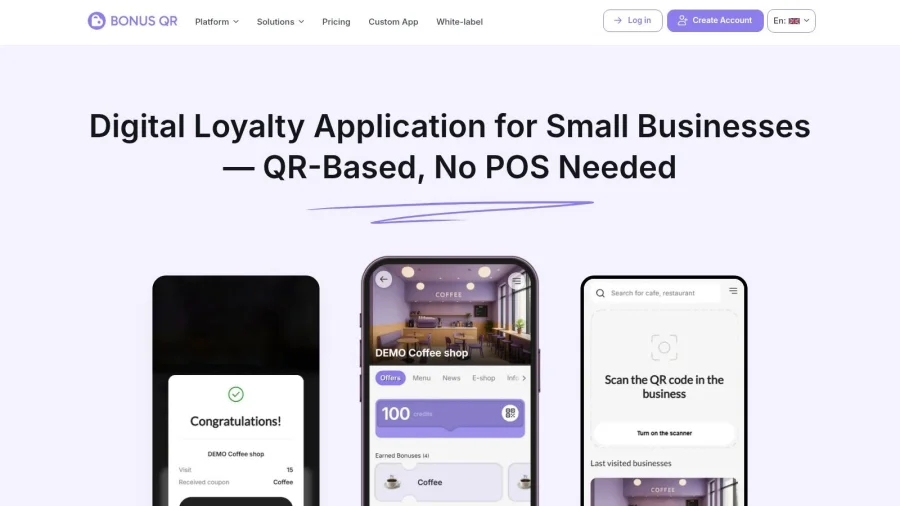
BonusQR supports QR-based loyalty for bricks-and-mortar businesses, including stamps, points, cashback, visit and spend thresholds, fixed discounts, welcome bonuses, birthday and seasonal coupons, wallet passes, and analytics, without extra hardware or POS integration. For owners comparing tools, that makes it a practical rewards program solution when speed, flexibility, and simple day-to-day use matter more than a long setup project.
Step two, customise the card for use, not just appearance
Branding matters, but function matters more at the counter.
A useful digital card setup should include:
- Logo and brand colours so the pass feels recognisable
- A clear programme name such as "Coffee Club" or "Salon Points"
- One primary reward shown first with secondary offers underneath
- A customer QR code that staff can scan quickly
The trade-off is straightforward. The more information you cram onto the card face, the harder it is for customers to spot progress and for staff to redeem confidently. Keep the front focused on what helps the next transaction. Put supporting terms deeper in the flow.
Step three, cut sign-up friction before launch day
Owners often blame weak uptake on customer apathy. In practice, the process is usually the problem.
If staff need to explain five steps, ask for too many details, or wait for a slow page to load, the invitation rate drops. Customers who would have joined during a calm moment will not join when there are three people behind them in line.
A lean sign-up flow usually looks like this:
- The customer scans one QR code
- They enter only the details you need at launch
- Their loyalty profile is created immediately
- The QR code or wallet pass is ready on the spot
- Staff issue the first stamp, point, or visit during that purchase
Short sign-up beats perfect sign-up. A usable customer record collected quickly is better than a long form nobody finishes.
This matters even more if you are moving regulars off paper cards. Some customers will be happy to scan and join on the spot. Others will need a simple nudge, especially older customers or people who are used to handing over a stamped card. The answer is not to keep two messy systems running forever. It is to give staff one script, one QR entry point, and a short migration period with printed prompts that lead into the digital record.
Step four, decide what to track from day one
A digital programme earns its keep when you use the data to make decisions.
Do not start with a long KPI dashboard. Start with a short list that answers practical questions:
| KPI | What it tells the business |
|---|---|
| Sign-ups per day | Whether staff are consistently inviting customers |
| Wallet-add rate | Whether customers want to keep the card accessible |
| Member average order value vs non-member | Whether members tend to spend more |
| Visit frequency lift | Whether members are returning more often |
These numbers matter because they show where the programme is working and where it is stalling. Low sign-ups usually point to a staff process issue. Strong sign-ups but weak repeat visits often mean the reward is too distant or too easy to ignore. A healthy wallet-add rate usually signals that the offer is clear enough for customers to keep it handy.
For UK independents with mixed-rule offers, this tracking becomes even more useful. You can test whether a simple coffee stamp works better than spend-based points, or whether a birthday coupon brings back dormant customers without cutting margin on regular visits.
Step five, keep version one simple enough to manage
Version one does not need to do everything. It needs to run cleanly for four to six weeks so you can see how customers and staff use it in real conditions.
A strong starting version usually includes:
- One earning rule
- One easy-to-understand reward
- One visible sign-up route
- One short staff explanation
- One weekly review of results
Once the basics are working, then you can add complexity with a reason behind it. That is the right point to test mixed rewards, time-based campaigns, or different incentives for high-frequency and occasional customers. Without that discipline, many small businesses end up with a programme that sounds flexible on paper but creates confusion at the till and weak redemption control in practice.
Launching Your Programme and Training Your Team
A loyalty programme doesn't fail because the software is broken. It usually fails because launch day is passive.
The owner prints a counter sign, mentions the programme once in a staff briefing, and assumes customers will spot it and join on their own. Most won't. They need a prompt at the right moment, from a person they already trust.
What a good launch day looks like
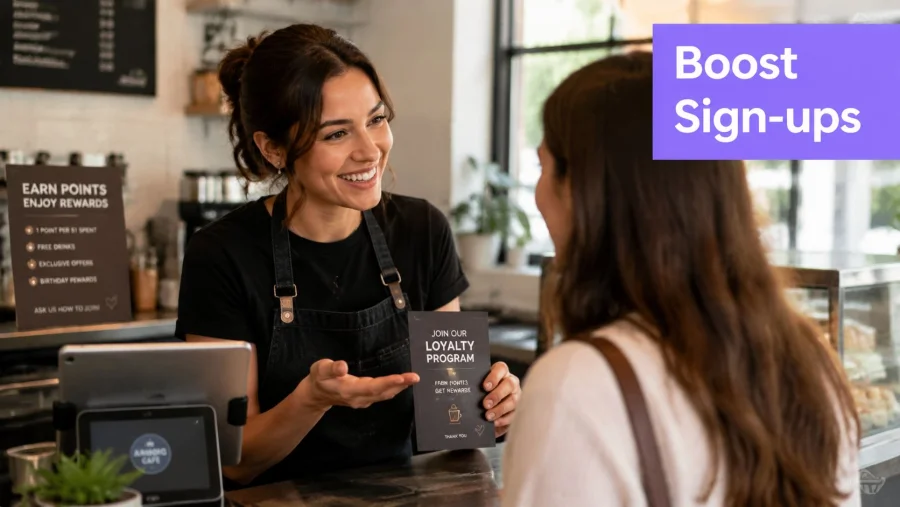
The front-of-house team knows the offer before the doors open. The QR code is visible at the till, on the counter, and near the entrance. Staff aren't improvising the explanation.
That matters because 56% of UK adults say they'd be more loyal to a brand if they were rewarded for their loyalty, based on eMarketer's UK loyalty and membership coverage. The demand is already there. Staff training is what turns that interest into sign-ups.
Train staff on timing, not just wording
The best script delivered at the wrong moment still falls flat.
Good moments to invite sign-up include:
- While the customer is waiting for preparation: enough time to scan and join
- At payment: the customer already has the phone in hand
- After a positive service moment: when the customer is more receptive
- On a first visit: before habits form elsewhere
Poor moments include the peak of a queue, a complaint interaction, or after the customer has already walked away from the till.
Give staff short scripts they can actually use
Avoid anything that sounds like a hard sell. Keep it practical.
Useful examples
- For a café: "If you'd like, there's a quick loyalty scan. It takes less than a minute and starts your rewards today."
- For a salon: "There's a digital loyalty card now, so visits and rewards are tracked on your phone rather than paper."
- For takeaway: "You can scan here and collect rewards from this order straight away."
Those lines work because they answer the customer's silent questions. What's this. How long will it take. Why should the customer bother.
The strongest staff pitch doesn't describe every feature. It gives one reason to join now and lets the system do the rest.
Use simple launch materials
Printed materials still matter, even for a digital programme. Their job isn't to explain every rule. Their job is to trigger the scan.
A small business should prepare:
- Counter cards: with one QR code and one benefit-led message
- Window signage: useful for customers deciding whether to come in
- Receipt mention or bag insert: especially helpful during the first weeks
- Social posts: a few plain images showing the sign-up step and reward path
Run the first week like a test, not a ceremony
Launch week is for observation. Owners should stand near the till, watch where customers hesitate, and note where staff skip the invitation.
Three issues show up quickly:
- Customers don't notice the code
- Staff forget to ask
- The benefit isn't clear enough
All three are fixable with better placement, simpler wording, and short daily reminders during pre-shift briefings.
Measuring Success and Avoiding Common Pitfalls
A loyalty programme becomes useful when the owner stops asking "How many people joined?" and starts asking "Did member behaviour improve?"
That shift matters because sign-ups alone can flatter a weak programme. Plenty of customers will join out of curiosity. The stronger signal is what they do next.
Read the numbers in business terms
Analytics should answer practical questions, not just populate a dashboard.
The most useful interpretations
- Sign-ups are high, repeat visits are low: staff are pitching well, but the reward isn't motivating a return.
- Members spend more than non-members: the offer may be influencing basket size.
- Redemption is low: customers may not understand the reward, or the threshold may feel too distant.
- Wallet adoption is weak: customers may be joining but not keeping the card accessible.
These are not software problems first. They are usually offer-design or staff-process problems.
Common pitfalls and how to fix them
| Problem | What it often means | Practical response |
|---|---|---|
| Low sign-up rate | Staff aren't asking consistently, or sign-up feels slow | simplify the script and test the QR placement |
| High sign-up, low return use | Welcome offer gets attention, but ongoing value is weak | strengthen the second reward trigger |
| Customers ask too many questions | Rules are too complex | shorten the offer and remove exceptions |
| Rewards rarely redeemed | Threshold is too far away or not visible enough | bring the first reward closer and show progress more clearly |
| Staff apply exceptions manually | The programme isn't operationally tight | standardise the redemption rules and retrain the team |
Watch behaviour by cohort
One of the most useful habits is to review customers by join period rather than looking only at totals. People who joined last week may behave very differently from people who joined a month ago.
That helps answer questions like:
- Are new members returning quickly enough
- Do certain offers bring customers back sooner
- Are some staff shifts generating better-quality sign-ups
- Does one location or daypart produce stronger loyalty behaviour
This kind of review is where digital loyalty starts to outperform paper by a wide margin. Paper tells a business that a card was stamped. A digital system can show whether the programme is creating a pattern worth keeping.
A loyalty programme should be edited like a menu. Keep what sells. Remove what confuses. Improve what nearly works.
Avoid these strategic mistakes
Some mistakes come from ambition rather than neglect.
Too many reward types at launch
An owner wants stamps, points, birthday offers, cashback, and referral rewards all at once. Customers get confused and staff stop mentioning the programme.
Rewards that arrive too late
If the path feels too long, customers mentally write the reward off. The scheme becomes wallpaper.
Measuring only redemptions
Redemptions matter, but so do visit frequency, spend pattern, and whether members behave differently from non-members. A reward can redeem often and still fail to improve profitable behaviour.
Use review cycles, not one-off fixes
A strong routine is simple. Check the metrics weekly. Review staff feedback. Adjust one element at a time.
That might mean changing the first reward, reducing the number of steps to redeem, or tightening the wording on in-store signage. Small edits usually outperform dramatic resets because customers and staff don't need to relearn the whole programme every month.
Frequently Asked Questions
| Question | Answer |
|---|---|
| Is a digital loyalty card expensive to launch for a small business? | Cost depends on the tool, the level of branding, and whether the business needs only loyalty or also wants extras such as messaging, reviews, reservations, or a branded app. The key comparison isn't only software fee versus print cost. It is whether the business gains usable data, easier redemption, and fewer manual errors than a paper system can provide. |
| Should a business keep paper cards as a backup? | In many cases, yes for a short transition period. A mixed rollout helps regulars move over without frustration. The important step is shifting the active loyalty record into a digital profile, even if some printed prompts or temporary bridge materials remain in use. |
| How can a business move existing paper-card customers to digital without upsetting them? | Honour existing progress. Staff can invite customers to scan the new programme and manually recognise their current status where appropriate. The transition works better when the customer sees it as an upgrade, not a reset. Explain the practical benefits clearly: no lost cards, easier tracking, and rewards kept on the phone. |
| Is QR-based loyalty too technical for older or less confident customers? | Not usually, if the process is short and staff assist at the first scan. Many customers only need one guided sign-up before it becomes routine. Printed prompts with a large code and one sentence of instruction help a lot. |
| What if the business has mixed rewards, such as visits plus spend-based offers? | That's exactly where digital formats are stronger than punch cards. The rules can be presented more clearly, tracked consistently, and adjusted without reprinting a stack of outdated cards. The main discipline is keeping the explanation simple enough for front-of-house staff to deliver fast. |
| Does a business need a POS integration or extra scanner hardware? | Not always. Some QR-based loyalty systems work without POS integration or new hardware, which is often a better fit for independent shops, cafés, and salons that need a lighter rollout. |
| What should be checked for GDPR and data handling? | The business should understand what customer data is collected, where consent is captured, how records are stored, and who can access them. A sensible setup keeps the sign-up form lean, explains the purpose of the data, and uses a platform that supports GDPR-safe handling rather than informal staff workarounds. |
| How long should a business wait before changing the programme? | Long enough to collect a stable pattern, but not so long that a weak setup becomes habit. Review the early metrics regularly, note recurring customer questions, and change one part at a time so the impact is easier to judge. |
A loyalty programme doesn't need more decoration. It needs clearer rules, faster sign-up, and a format customers will keep using. For most UK independents, that means moving from paper to a QR-based digital system, then refining the offer based on what customers do.


