A lot of UK business owners start in the same place. They want a loyalty offer that's simple, cheap, and easy to explain at the till. They search for free punch card templates, download a design, print a stack, and hope it brings customers back more often.
That instinct is sound.
Paper punch cards still work for many local businesses. They're familiar, fast to launch, and easy for staff and customers to understand. The problem isn't the idea. The problem is that most free templates are badly designed, badly printed, or used without any plan for what happens after the first card goes out.
Why Punch Cards Are Still a Smart First Step
A small café, salon, gym, or retailer doesn't need a complex loyalty platform on day one. It needs something that staff can explain in one sentence and customers can understand in one glance. That's why punch cards remain a practical starting point.
In the UK, physical loyalty cards drive a 15% increase in repeat visit frequency among small retailers, and 68% of UK coffee shops and cafés still use punch card or stamp-based templates as their primary loyalty mechanism, largely because they're affordable and familiar to customers. That makes paper a rational choice, not an old-fashioned mistake. The same pattern is visible in many local customer stamp card programs.
Why paper still earns its place
Paper works well when a business needs to move quickly. There's no staff training programme, no customer app to explain, and no platform setup before launch. A card, a stamp or punch, and a clear reward can be enough to get a basic loyalty offer live this week.
It also fits the way many neighbourhood businesses sell. Coffee shops, bakeries, barbers, car washes, nail salons, and lunch spots all depend on repeated habit. A physical card gives that habit a visible form.
Three things make punch cards attractive:
- Low barrier to launch: A business can design, print, and start handing them out quickly.
- Immediate customer understanding: Most customers already know how a stamp card works.
- Low financial risk: If the first version needs changing, nothing expensive has been locked in.
Paper punch cards are often the right first move for a small business. They're just rarely the right final move.
The part owners often miss
A paper card shows progress, but it doesn't show behaviour. Staff can see that a customer has six punches. They can't see whether that customer used to come twice a week and has now stopped, whether they spend more than average, or whether a birthday offer would bring them back.
That's the hidden issue with free punch card templates. They're easy to start, but they create a black box. The programme exists. Customers use it. But the business learns very little from it.
Designing a Punch Card That Actually Works
Most free punch card templates are graphic files, not loyalty tools. They look acceptable on screen, but they ignore the details that determine whether the card survives in a wallet, avoids disputes at the counter, and gets redeemed.
Start with the offer, not the artwork
The card should answer four questions instantly:
- What action earns progress?
- How many visits or purchases are needed?
- What reward does the customer get?
- Are there any important limits?
If the design looks polished but the reward is vague, the card won't do its job. “Collect 10 stamps for a free regular coffee” is stronger than “Rewards available”. “One stamp per paid haircut” is stronger than “Terms apply”.
A practical card usually includes:
- Business name and logo: So the card is recognisable in a wallet.
- Clear reward line: State the exact reward with no guesswork.
- Visible stamp or punch spaces: Keep them evenly spaced and easy to mark.
- Basic terms: Include essentials such as exclusions, one stamp per transaction if relevant, and whether the card has an expiry policy.
- Contact point: A website, Instagram handle, or phone number helps reconnect customers with the brand.
Protect the card from confusion and misuse
A generic circle punch bought online is fine, but businesses should think beyond the template. If every member of staff marks cards differently, disputes follow. If marks are too small or too easy to fake, redemption gets messy.
Useful controls include:
- A consistent punch tool: Use the same hole punch across the team.
- A distinctive mark: If punching isn't possible, use a branded stamp or signature rule.
- Simple terms on the card: Staff need a clear rule they can apply consistently.
- Reward limits that make sense: The reward should feel worthwhile without creating confusion over what qualifies.
Practical rule: If a new staff member can't explain the card in under 10 seconds, the design is too complicated.
Print specs matter more than most templates admit
Many free punch card templates fall short. They focus on layout and ignore the physical reality of pockets, wallets, spills, and repeated handling.
A key issue is cardstock. According to UK-based printing guidance covered by Loopy Loyalty's punch card design tips, standard 300gsm cardstock without a matte coating leads to a 27% higher rate of punch-hole smudging. The same guidance notes that the benchmark for UK small businesses is 350gsm matte-coated stock with a 12mm punch circle diameter, which reduces ambiguity errors by 34%.
Use 350gsm matte-coated stock if the card is meant to live in a wallet for weeks. Thin uncoated cards may save pennies up front and create arguments later.
A simple design checklist
Before printing, check the card against this list:
- Readable at a glance: The reward must stand out first.
- Brand-consistent: Colours and fonts should match the business, not the template site.
- Not overcrowded: Too much text makes a small card unusable.
- Durable enough for real use: Print finish and stock matter.
- Operationally clear: Staff should know exactly when to punch and when to redeem.
The strongest punch cards don't try to be clever. They remove hesitation. Customers know what they're earning. Staff know how to issue it. The business knows the offer won't fall apart after a week in someone's handbag.
From Your Screen to Your Customer's Wallet
A finished design file isn't a loyalty programme. Printing and distribution are where most paper systems either become part of daily trade or sit ignored behind the counter.
Choose the right file before sending it to print
If a local printer asks for a file, send the format that preserves layout and print quality. In most cases, that means a print-ready PDF. A JPG can work for quick jobs, but quality may drop if the dimensions or resolution aren't right. Editable design files such as AI are useful if the printer needs to adjust bleed, crop marks, or text placement.
When speaking to a print shop, clear language helps. Ask for:
- Business-card size printing
- 350gsm matte-coated stock
- Double-sided print if terms need the reverse
- Proof before full run
- Trim accuracy and safe area checks
That gets better results than emailing a screenshot and asking for “some loyalty cards”.
Think about durability based on the setting
For many cafés and salons, quality card stock is enough. But some businesses need something tougher. Pool venues, car washes, outdoor food kiosks, and high-handling environments may want to review options for durable PVC card printing before committing to paper. That resource is useful because it explains when extra durability is worth the cost and when standard printed cards are still the better fit.
The practical question isn't “What's the fanciest format?” It's “What will survive how customers carry and use it?”
Handing out cards properly
A loyalty card only works when staff actively place it in the right hands and explain it in the moment. Leaving a pile by the till rarely creates strong uptake.
Different businesses should distribute differently:
- Cafés and coffee shops: Staff should offer the card with every qualifying drink and stamp the first visit immediately.
- Salons and wellness businesses: Add the card at checkout, then mention the reward while the next appointment is being discussed.
- Retail shops: Slip the card into the shopping bag and point out how the next visit counts.
- Gyms and studios: Include it in welcome packs or hand it over after a class package purchase.
- Quick-service eateries: Keep the script short, especially in busy periods. “This starts today. Bring it next time for your next stamp.”
A loyalty card handed over silently is a piece of paper. A loyalty card introduced with a clear reason to come back becomes an offer.
Distribution improves when the card isn't entirely physical
Paper has one obvious weakness. Customers forget it. That's where a hybrid step can help, even before a full digital move. A mobile pass stored in the phone gives customers something they're less likely to leave at home, and it reduces the awkward “I've got the card somewhere” exchange at the counter.
A useful example is BonusQR's Apple Wallet loyalty feature, which shows how wallet-based loyalty can keep the programme accessible without asking customers to learn a complicated new process. Even businesses that still like the feel of paper should pay attention to that convenience standard, because customers now expect loyalty to be easy to carry.
The Hidden Costs and Limits of Paper Cards
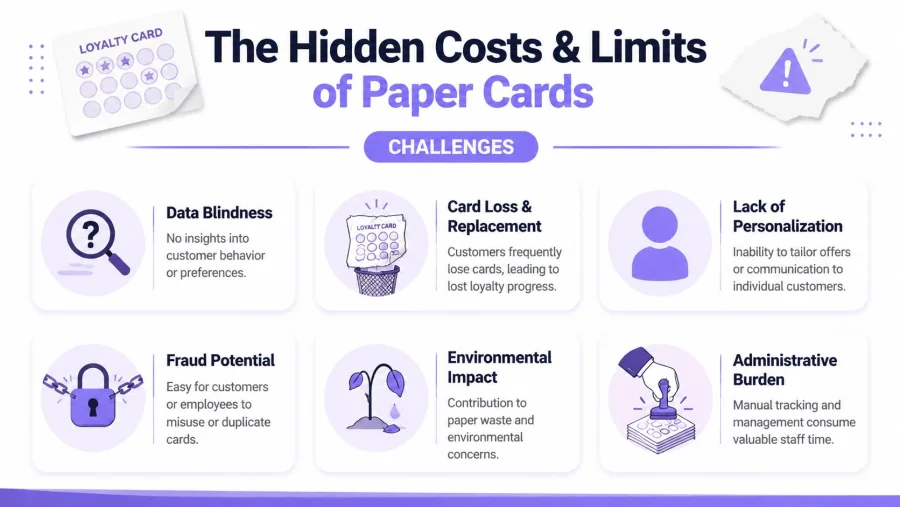
Paper cards look cheap because the template is free and printing feels manageable. Its true cost shows up later, in missed redemptions, weak customer data, staff inconsistency, and loyalty programmes that run for months without teaching the business anything useful.
Paper creates data blindness
A paper punch tells staff that a transaction happened. It doesn't identify the customer, map visit habits, or show who has stopped coming back. That means the business can't separate occasional buyers from top regulars. It can't trigger a return offer when someone goes quiet. It can't test one reward against another with any real confidence.
That blind spot matters more now because loyalty competition is crowded. In the UK market, only 57% of loyalty programme owners report satisfaction with their programmes, and 55% of shoppers belong to at least four schemes while 58% have actively used only three or fewer in the past six months, according to Antavo's analysis of UK loyalty programme trends. A generic static card easily becomes background noise.
Lost cards are not a small annoyance
Owners often treat forgotten or lost cards as an occasional inconvenience. In practice, they break momentum. A customer who loses progress doesn't always start over. Some ask for goodwill punches. Some feel embarrassed. Some disengage.
Paper also creates friction at exactly the wrong moment. A loyalty reward should feel satisfying. Instead, staff end up negotiating whether someone “probably had seven punches” or whether a faded mark counts.
Common failure points include:
- Cards left at home: The customer visited, but no progress was recorded.
- Worn-out punches: Staff can't tell whether the mark is valid.
- Replacement requests: No one knows how much progress should transfer.
- Inconsistent handling: One staff member is strict, another is generous.
Loyalty works best when progress feels secure. Paper makes progress fragile.
Free templates often ignore compliance
Some businesses add names, phone numbers, or handwritten notes to a card because they want a backup if it gets lost. That creates a different problem. Once personal data is being collected, even informally, the business needs a clear reason, storage method, and customer understanding of what's happening.
The issue isn't abstract. According to TemplateArchive's discussion of punch cards and compliance gaps, only 12% of UK loyalty programmes explicitly state data compliance in their punch card terms, and UK merchants report 34% higher opt-out rates when loyalty cards lack clear data handling statements. Generic free punch card templates rarely address this at all.
Administrative drag builds quietly
Paper sounds simple because there's no dashboard. But the manual work still exists. Staff have to explain the offer, remember the rules, keep cards stocked, replace cards, judge damaged punches, and answer disputes. None of that appears on a subscription invoice, but it still costs time.
A paper-first system also struggles when the business wants to do anything more advanced:
| Loyalty goal | Paper card reality |
|---|---|
| Reward frequent visitors differently | Hard to track consistently |
| Run seasonal campaigns | Requires new print runs and staff explanation |
| Send birthday offers | Not practical without managed customer data |
| Compare customer behaviour | No real reporting |
| Recover lapsed customers | No direct contact path |
The hardest truth about paper is this. A well-designed paper card can increase repeat trade. But even a strong paper system eventually hits a ceiling because it can't adapt, measure, or personalise at the level modern loyalty now demands.
The Modern Upgrade A Smarter Loyalty System
The best upgrade from paper isn't a complicated enterprise platform. It's a system that keeps the simplicity of a stamp card and removes the operational weaknesses that make paper stall.
What a modern loyalty setup fixes
The most useful digital systems solve four specific paper problems.
Problem one is card loss. A digital loyalty card stored on a customer's phone is much harder to forget than a bit of card stock. The customer doesn't need to search a wallet or ask staff to “remember this visit”.
Problem two is validation. A QR-based flow gives staff a cleaner way to issue and redeem rewards. UK merchants report 27% higher redemption rates when punch cards include a scannable QR code for instant digital validation, and 68% of UK brick-and-mortar retailers are now using QR-based loyalty to replace paper cards, according to GotPrint's review of loyalty card template trends.
Problem three is lack of visibility. Digital systems can show visit history, reward usage, and campaign performance without asking staff to track anything manually.
Problem four is generic rewards. Once the system knows who the customer is and how often they visit, the business can move beyond one-size-fits-all offers.
Better loyalty without adding technical fear
Small businesses often delay digital loyalty because they assume it requires POS integration, hardware changes, or staff retraining. That fear is understandable, but it's often based on the wrong kind of software.
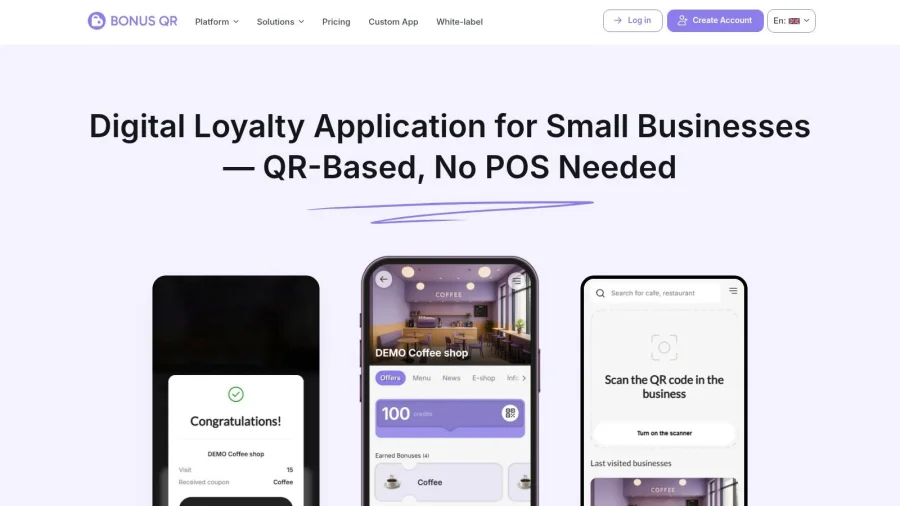
The most practical platforms work more like a better punch card than a complicated tech stack. Staff scan a code. Customers see their progress on their phones. The owner can launch offers such as:
- Birthday coupons
- Seasonal rewards
- Welcome bonuses
- Visit-based stamps
- Spend thresholds
- Fixed discounts or cashback
That makes digital loyalty useful for cafés, restaurants, salons, gyms, and local retail. The business keeps the clarity of a simple reward structure while gaining tools that paper can't offer.
A smart loyalty platform shouldn't feel like buying software. It should feel like removing friction from a process the business already understands.
Why this step usually becomes unavoidable
As customer expectations shift, businesses need more than a punch pattern on a card. They need a way to keep offers visible, reduce missed progress, and make loyalty feel relevant. That doesn't mean paper was the wrong decision. It means paper did its job as a starter system.
A modern QR-based setup is the natural next stage for owners who want to increase repeat visits for brick-and-mortar without turning loyalty into an IT project.
The strongest transition path is often simple:
- Start with a clear reward model.
- Learn what customers respond to.
- Move that logic into a digital system with better tracking and fewer points of failure.
That upgrade gives the business something paper never really could. A loyalty programme that is visible to customers, manageable for staff, and measurable for the owner.
Frequently Asked Questions About Loyalty Programmes
Can a business run paper and digital at the same time
Yes. For many businesses, that's the most practical transition path. It allows regulars who like paper to keep using it while newer customers adopt a QR-based option.
This hybrid approach is common in service categories. UK businesses using customisable punch card templates saved an average of £1,250 annually compared with digital loyalty platform subscriptions, but 57% of UK beauty salons and wellness centres moved from punch cards to digital QR solutions between 2020 and 2024, with many keeping hybrid systems for different customer segments. This highlights the primary trade-off. Paper can save money up front, but digital adds data and personalisation that paper can't match.
How can older customers be encouraged to switch
The easiest route is not to “sell technology”. It's to sell convenience. Staff should explain that the customer won't need to remember a card, won't lose progress, and can keep everything on their phone.
A few habits help:
- Offer choice first: Customers are more open when they don't feel forced.
- Show the screen at the till: A visual demo works better than a verbal explanation.
- Keep the reward identical: Don't make the digital version feel like a different scheme.
- Let staff do the first step: If setup is guided in the moment, adoption improves.
Are free punch card templates still worth using
They can be, if the business treats them as a starting point rather than a finished loyalty strategy. A well-made paper card is still better than having no repeat-visit system at all.
But “free” often hides other costs. Owners still pay in print quality, staff time, lost cards, missed customer insight, and weak personalisation. When a business starts asking who its best customers are, who hasn't visited lately, or which reward drives the strongest return, paper usually runs out of road.
Free punch card templates are appealing because they solve the first problem. They give a small business a fast, low-risk way to start rewarding repeat visits. For many local shops, cafés, salons, and gyms, that's a sensible place to begin.
But paper has limits that good design can only reduce, not remove. Cards get forgotten. Progress gets disputed. Data goes missing. Personalisation never really starts.
That's why the strongest long-term move is to keep the simplicity of a stamp card and upgrade the delivery. BonusQR gives brick-and-mortar businesses a QR-based loyalty system that's simple to launch, easy for staff to use, and built for the realities that paper can't handle well. Businesses can start with stamps, points, cashback, visit thresholds, birthday offers, seasonal campaigns, and wallet-friendly digital access without needing POS integration or extra hardware.
For owners who want the easiest path from paper loyalty to something smarter, BonusQR is the practical next step.


