
 Deutsch
 Español
 Français
 Italiano
 Magyar
 Polski
 Slovenčina
 Čeština
68% of UK consumers say they prefer shopping with environmentally conscious companies, but only 12% of small brick-and-mortar UK businesses actively measure or communicate their sustainability impact via customer loyalty programmes according to Hubble's UK sustainability overview. That gap changes the whole conversation.
For a small shop, sustainability isn't just about recycling bins, paper straws, or a greener supplier. It's also about whether customers can see the effort and whether the business can prove it. Many owners already make better choices day to day, but those actions often stay invisible at the till.
That's where the topic gets practical. An environmentally conscious company isn't only a large brand with a glossy report. A café rewarding reusable cup use, a salon replacing printed price lists with mobile access, or a shop reducing waste and tracking customer participation can all move in the same direction. The key opportunity sits in making those actions visible, simple, and repeatable.
Why Sustainability Matters for Small Shops
The biggest issue for many independents isn't a lack of good intent. It's the loyalty gap. Customers care, but the shop often has no easy way to connect eco-friendly behaviour with repeat visits, rewards, or measurable progress.
A small business can feel this gap in subtle ways. A customer asks whether packaging is recyclable. Another notices whether receipts are still printed automatically. A regular wants to bring a reusable cup or container, but there's no reward for doing it. None of these moments looks dramatic on its own, yet together they shape trust.
Why the gap matters
Sustainability now influences how many people choose where to spend. When a business does the work but doesn't communicate it, customers may assume nothing is happening. When a business wants to encourage better habits but has no system for rewards, staff end up handling it inconsistently.
That creates two risks:
- Lost preference: customers who care about greener habits may choose a competitor that makes those actions clearer.
- Missed loyalty value: businesses may overlook simple ways to reward and reinforce good behaviour.
- Weak proof: owners may know improvements are happening, but they can't show progress in a way customers understand.
Why small shops are in a strong position
Independent businesses often have one advantage large chains struggle to match. They can change routines quickly. A café can reward a reusable cup tomorrow. A salon can shift from paper price sheets to mobile access this week. A local retailer can highlight low-waste products at the counter without waiting for head office approval.
Practical rule: start with one visible action customers can join, not ten back-office changes nobody sees.
That's why QR-based rewards for small businesses fit this problem well. They let a shop link everyday eco-actions to something customers already understand, which is loyalty.
Understanding Environmentally Conscious Companies
An environmentally conscious company treats the business like a small living system. Resources come in. Products, services, and waste go out. The healthier the system, the less energy, packaging, spoilage, and landfill the business creates.
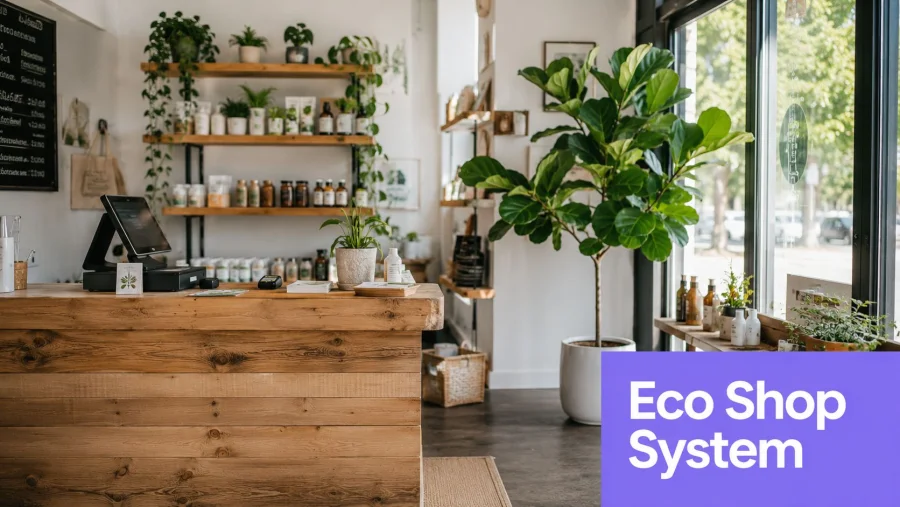
That sounds abstract until it's brought down to shop level. In a café, “clean inputs” can mean renewable electricity, better sourcing, and reusable serving options. “Responsible outputs” can mean less food waste, fewer single-use items, and clearer communication with customers. In a salon, it can mean reducing paper, choosing better product lines, and managing laundry and energy use carefully.
What counts as meaningful action
A useful starting point is planning. Only 65% of businesses in the UK have established a formal strategy to cut their emissions to net zero by 2050, according to The Guardian's reporting on the September 2024 study. That matters because an environmentally conscious company doesn't rely on random one-off gestures. It makes choices on purpose.
For a small shop, that usually shows up in a few practical areas:
- Energy choices: using lower-waste equipment, reviewing heating and lighting, and moving towards renewable electricity where possible.
- Waste handling: reducing what gets thrown away first, then reusing, recycling, composting, or diverting surplus.
- Sourcing decisions: choosing local, seasonal, refillable, recyclable, or lower-waste options when they fit the business model.
- Customer communication: showing what the business is doing in plain language rather than hiding it in vague marketing.
- Simple measurement: tracking a few operational and customer-facing indicators so the effort can be managed.
What greenwashing looks like
Many owners worry about “getting sustainability wrong”. Usually, the problem isn't doing too little at first. It's making claims that are broader than the action itself.
An example helps. Saying “this salon is sustainable” is too vague. Saying “printed price lists were replaced with mobile access and refill options are being expanded” is clear. Saying “this café rewards reusable cups and redistributes surplus food when possible” is also clear. Specific language builds trust.
A helpful way to think about this is through corporate sustainability practices that focus on environmental stewardship rather than broad slogans. The principle is simple. Reduce harm, improve systems, and explain what's changing.
Clear sustainability communication sounds ordinary. That's a good sign. If a claim needs too much polishing, it probably needs more proof.
How this applies to a small premises
Small businesses sometimes assume “environmentally conscious companies” means national brands with large budgets. It doesn't. The test is whether the shop is making repeatable choices that improve inputs, reduce waste, and communicate transparently.
A useful checklist is:
- Is there a written plan? Even a one-page plan counts if staff can follow it.
- Are the actions operational? Lighting, packaging, sourcing, waste, menus, laundry, stock, and customer incentives all count.
- Can staff explain it clearly? If not, customers probably won't understand it either.
- Can the shop show progress? Even basic tracking is stronger than vague promises.
Benefits for Small Brick-and-Mortar Businesses
Sustainability pays off in three ways that matter to a local business. It helps the brand feel more credible. It can trim avoidable waste and energy loss. It also makes the business more prepared for changing customer expectations.
The wider business environment already points in that direction. Investment into sustainable UK companies has risen from £658 million in 2013 to £9.69 billion in 2022, according to the Barclays Labs report on environmental and social signals in startups and scaleups. That doesn't just matter for large firms. It shows where attention, capital, and market confidence are moving.
Stronger customer trust
For a neighbourhood shop, trust is usually built through repeated small signals. A visible refill option. Lower-waste packaging. A reward for a reusable cup. A digital menu instead of disposable printouts. These choices don't need to be dramatic to matter. They need to be consistent.
When sustainability ties into retention, it becomes more than a values statement. It becomes part of the customer experience. Many of the same mechanics behind loyalty program benefits also apply here. People come back when the experience feels aligned with what they care about.
Better control over waste and operating habits
Owners often think sustainability starts with expensive upgrades. In practice, many improvements begin with routine discipline. Waste less stock. Print less paper. Use less energy during quiet hours. Reduce avoidable packaging. These changes can simplify operations as much as they support greener goals.
A small business doesn't need to transform the whole premises at once. It needs to identify where money leaks out through preventable waste and then fix those points one by one.
A steadier position as expectations rise
Rules, supplier standards, and customer questions around environmental performance aren't going away. Shops that already track a few basics, train staff, and communicate clearly are in a calmer position when expectations tighten.
Businesses that treat sustainability as part of daily operations usually find it easier to explain decisions, answer customer questions, and adapt without panic.
That resilience matters just as much as image. A small shop with clear routines is easier to run than one relying on ad hoc promises.
Practical Sustainability Practices to Implement
The best sustainability plan for a small shop is usually boring in the right way. It fits the budget, staff can follow it, and customers can recognise it without needing a lecture.
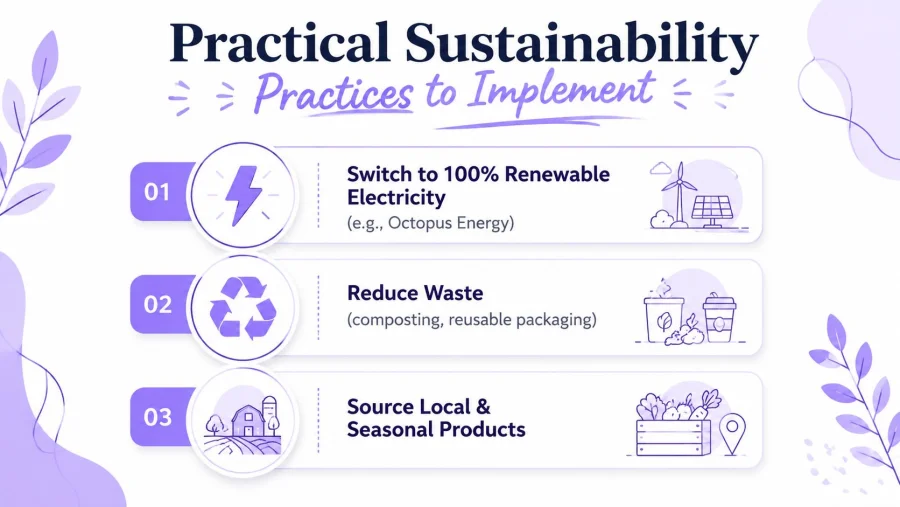
59% of UK organisations have invested in renewable energy and efficiency measures, making it the most common emissions-reduction action among businesses, according to the 2024 UK Net Zero Business Census Report. That's a useful clue for independents. Start where action is common and manageable, not where it's most complex.
Start with energy and equipment
A café, salon, gym, or shop uses energy every day whether customers notice it or not. That makes energy one of the best first places to act.
Some businesses choose 100% renewable electricity through providers such as Octopus Energy. Others begin with simpler efficiency steps, such as checking opening and closing routines, replacing old bulbs, reducing unnecessary heating or cooling, and reviewing fridges, laundry cycles, or water heating habits.
A straightforward way to manage this is:
- List the biggest users: coffee machines, dryers, lighting, refrigeration, heating, and ventilation usually sit near the top.
- Set a staff routine: create clear rules for start-up, idle time, and shutdown.
- Review tariffs and suppliers: renewable options can support the story customers hear at the counter.
- Track monthly usage: not for perfection, but to spot waste.
Cut waste before trying to offset it
Waste reduction is where many small premises can move fastest. Food businesses can review spoilage, surplus, takeaway packaging, and cup use. Salons can review disposables, product packaging, paper handouts, and laundry habits. Retailers can review packaging, receipts, and damaged stock.
Useful examples already exist in the UK market. Too Good To Go and Olio help businesses handle surplus food more responsibly. Notpla is known for seaweed-based packaging alternatives. Bio-Bean is often cited for turning coffee grounds into useful outputs rather than treating them as simple rubbish.
A good waste plan asks two questions. What shouldn't have been bought in the first place, and what can still be used once it's no longer saleable in the usual way?
For extra ideas, owners can review PureHQ Inc. sustainability initiatives, which show the kind of practical habits businesses can adapt rather than copy blindly.
Use digital tools where paper adds little value
Paper often survives in small businesses because “that's how it's always been done”. Printed menus, printed price lists, punch cards, printed promos, and one-off notices all create waste and extra admin.
A digital approach doesn't need to feel cold. It can make information easier to update and easier for customers to access. Menus, treatment lists, loyalty balances, promotions, and shop notices work well on mobile. That's one reason many shops start by implementing mobile loyalty programs that reduce the need for paper while keeping rewards visible.
Turn customer behaviour into part of the system
This is the area most guides miss. Sustainability improves faster when customers take part.
A café can reward reusable cup use. A salad bar can reward plant-based orders. A refill shop can reward container returns. A salon can reward choosing digital aftercare notes instead of printouts. A gym can highlight low-paper sign-up and class communication.
The key is to reward specific actions that staff can recognise without friction:
- Reusable choices: cups, containers, or bags
- Lower-waste ordering: digital receipts, fewer printed materials
- Surplus rescue participation: selected end-of-day offers where appropriate
- Refill or return habits: packaging brought back or reused
- Greener menu selections: where this fits the brand and offering
The easier the action is to explain at the counter, the more likely it is to become routine.
Measuring Sustainability Impact with KPIs
A small business doesn't need a giant reporting framework. It needs a handful of KPIs that connect daily operations to customer behaviour. That's how sustainability stops being a vague ambition and becomes a managed part of the business.
The simplest rule is this. Track what staff can influence and what customers can notice. If a metric can't guide a decision, it's probably not worth starting with.
Choose KPIs that fit the shop
A café and a salon won't measure exactly the same things. But both can combine operational indicators with loyalty-related ones. That creates a more useful picture than tracking energy or waste alone.
Key Sustainability KPIs for Small Businesses
| KPI | Definition | Measurement Approach |
|---|---|---|
| Energy usage per square metre | How much energy the premises uses relative to its size | Review utility bills regularly and compare usage against floor space over time |
| Waste diverted to compost or reuse | The share of waste kept out of general rubbish through composting, reuse, or redistribution | Track collection records, supplier logs, or simple internal counts by waste type |
| Local sourcing share | The proportion of stock or ingredients sourced locally | Review purchasing records and tag local suppliers in the buying list |
| Reusable-cup redemptions | The number of rewards linked to customers bringing reusable cups | Count each qualifying loyalty redemption tied to that action |
| Digital receipt or menu uptake | How often customers choose mobile access instead of printed materials | Track digital views, opt-ins, or staff-marked selections |
| Sustainability-tagged reward activity | Loyalty actions linked to greener behaviour | Label qualifying rewards and review campaign performance in the dashboard |
| Carbon-saving proxy per visit | A simple estimate based on repeated lower-waste customer actions | Assign internal tags to actions such as reusable cup use or paper-free choices and monitor frequency |
Keep the system simple
Most confusion comes from trying to measure everything at once. That usually leads to staff ignoring the process. A better model is to choose one operational KPI, one waste KPI, and one customer-behaviour KPI first.
For example:
- A café might track energy use, surplus food redirected, and reusable-cup rewards.
- A salon might track laundry and electricity habits, paper reduction, and digital price-list engagement.
- A retailer might track packaging reduction, supplier mix, and bag-free or refill-related rewards.
Track behaviour first, then tell the story. Customers trust numbers more when the business can explain how they were gathered.
Once those KPIs are stable, a shop can tag sustainability-related actions inside its loyalty reporting and review which offers change behaviour. That matters because a reward programme shouldn't only show who visits often. It should also show which greener actions people adopt willingly.
Case Studies and Next Steps
A neighbourhood café offers a simple example. Staff give a QR reward stamp whenever a customer brings a reusable cup. The reward isn't framed as a lecture about climate. It's framed as an easy habit that earns something back. Over time, the café can see which regulars adopt the behaviour, how often the action happens, and which reward campaign keeps participation active.
A salon example looks different. Instead of handing out printed price lists and service updates, the salon moves those materials into its mobile loyalty experience. Paper use drops sharply, updates become easier, and staff no longer need to throw away outdated prints. Customers also have a cleaner way to check offers and revisit service information.
These examples matter because they turn sustainability into a visible routine rather than a hidden principle. That's what many environmentally conscious companies get right. They make the greener choice easier for staff, easier for customers, and easier to measure.
Small shops don't need a perfect sustainability strategy to start. They need one clear action, one simple way to reward it, and one dashboard that shows whether it's working. Start a free BonusQR loyalty programme to link customer rewards with sustainability habits, track participation through QR-based actions, and build a more loyal, more environmentally conscious business without extra hardware or POS complexity.