
 Deutsch
 Español
 Français
 Italiano
 Magyar
 Polski
 Slovenčina
 Čeština
A small café can serve excellent coffee, train staff well, keep the room spotless, and still lose money through weak repeat trade. The pattern is familiar. New faces come in, enjoy the experience, then disappear into the routine of bigger chains, delivery apps, and whatever place sits closest to the office.
That's where a dining rewards program stops being a nice extra and starts becoming a retention tool. For an independent operator, the core job isn't only getting a first visit. It's giving that customer a reason to come back before the habit breaks.
Most owners don't need a flashy app, a complicated points engine, or a marketing agency retainer. They need a simple system customers will join, staff will use, and margins can support.
Why Your Restaurant Needs More Than Just Great Food
A customer buys a flat white on Monday, compliments the pastry, smiles at the counter, and says they'll be back. Then nothing. Not because the experience failed, but because most hospitality businesses are competing against habit, convenience, and familiarity.
Great food gets a trial. It doesn't guarantee a routine.
In the UK, loyalty has already become normal behaviour. In 2025, 80% of adults in Great Britain were members of at least one loyalty program, while another report shows 54% of UK diners prefer supporting local, independent venues, yet most national dining rewards programs fail to integrate them, leaving a significant underserved market for merchant-customisable loyalty according to Statista's UK loyalty scheme overview. That matters for independent cafés because it means two things at once. Customers already understand rewards, and many of them want to spend locally.
The one-and-done customer problem
A lot of operators still treat churn as a mystery. It usually isn't. The customer forgot, got busy, chose the nearest option, or saw no practical reason to return to one café over another.
A dining rewards program fixes a specific gap. It gives a customer a visible next step.
That next step can be simple:
- One more visit needed: A clear progress marker encourages another stop this week.
- A familiar perk: A free coffee, pastry upgrade, or birthday treat feels tangible.
- A local reason to stay loyal: Independent businesses can offer rewards that feel personal instead of generic.
Great service creates goodwill. A good rewards programme turns goodwill into repeat behaviour.
Why independents have an opening
National schemes often work well for chains because they spread broad offers across many sites. Independent venues win differently. They know their regulars, can move faster, and can shape offers around actual buying patterns.
That's why merchant-led systems matter. A small café doesn't need to copy a supermarket or chain restaurant model. It needs customizable loyalty solutions that fit its own pricing, visit frequency, and customer mix.
Loyalty is a margin decision, not just a marketing idea
Owners often worry that rewards mean giving things away. That happens when the programme is built badly. The better view is this: a reward should nudge profitable behaviour.
A free item after a profitable number of visits can protect margin better than a constant blanket discount. A reward that encourages breakfast add-ons, second weekly visits, or slower-day traffic can outperform random promotional offers.
The biggest mistake is waiting too long because the business wants the perfect setup. Most restaurants don't need perfection. They need a repeatable reason for a customer to choose them again next time.
Defining Your Program Goals and Rewards
A dining rewards program fails when it starts with the wrong question. “What freebie should be offered?” sounds practical, but it skips the core issue. The better question is, “What customer behaviour should change?”
A café might want more weekday return visits. A quick-service lunch spot may need to lift average basket size. A neighbourhood restaurant may want to stay top-of-mind between occasional visits. The reward should follow the goal, not the other way round.
Start with one commercial objective
Most small businesses overcomplicate loyalty because they try to solve everything at once. Keep the first version narrow.
Choose one primary objective:
- Increase visit frequency: Best for coffee shops, bakeries, and lunch counters with repeat potential.
- Raise average spend: Useful when customers often buy one item but could be nudged into a meal, dessert, or drink add-on.
- Bring back quiet-day traffic: Strong for businesses with obvious dips on certain days or dayparts.
- Build a usable customer list: Helpful when the business has footfall but no reliable way to re-engage customers.
If the goal isn't clear, the reward structure won't be clear either.
Pick a reward structure that matches buying behaviour
Not every model suits every venue. A high-frequency coffee shop often performs better with a stamp-style structure. A restaurant with varied spend may prefer points or cashback. A business with lots of impulse purchases may benefit from a simple fixed reward.
Here's a practical comparison.
Choosing Your Reward Structure
| Reward Type | Best For | Customer Psychology | BonusQR Feature |
|---|---|---|---|
| Digital stamps | Cafés, bakeries, sandwich shops | Simple progress. Customers like seeing how close they are to the next reward. | Visit-based stamps |
| Points | Restaurants with varied ticket sizes | Flexible and familiar, but only if earning and redemption stay easy to understand. | Points rules based on visits or spend |
| Cashback | Venues where customers compare value closely | Feels fair because value accumulates with each purchase. Works best when redemption is straightforward. | Cashback-style rewards |
| Fixed discount reward | Price-sensitive local traffic | Direct and immediate. Good for reactivation or quiet periods. | Coupons and fixed discounts |
| Welcome bonus plus ongoing reward | New programmes that need fast uptake | Gives instant reason to join, then creates a habit loop for future visits. | Welcome bonuses and automated offers |
Smaller rewards beat distant rewards
Customers lose interest when the finish line feels too far away. UK diners respond better to frequent, smaller rewards such as a free coffee after five visits because that structure keeps the restaurant top-of-mind, as explained by Stampme's UK restaurant loyalty guidance.
That principle matters more than many owners realise. A reward doesn't need to be expensive to work. It needs to feel reachable.
A free coffee after a realistic number of visits often works better than a large reward that takes months to achieve. A pastry upgrade can outperform a vague future discount. Progress is the product.
Practical rule: If a customer can't quickly understand how to earn the reward and roughly when they'll get it, the reward is too complicated.
Avoid the classic maths mistake
Many programmes look generous on paper and weak at the till. The problem usually comes from setting the reward threshold without checking margin.
A safer process looks like this:
List profitable items
Choose rewards with strong perceived value and manageable food cost. Coffee, sides, desserts, or upgrades often work better than headline dishes.Map normal behaviour
Look at what regulars already buy. A reward should encourage one more visit or a slightly bigger basket, not reward activity that would happen anyway.Protect the core spend
Don't build a structure that teaches customers to wait for discounts on their usual order.Keep redemption friction low
If staff need to explain exceptions every time, the programme will annoy both teams and customers.
Points are useful, but only when they stay liquid
Points can work well for restaurants because they can scale with spend. They also create room for targeted promotions later. But points become a liability when customers feel the value is vague, delayed, or easy to lose.
That's where a lot of UK loyalty schemes go wrong. Customers often dislike expiry rules and slow redemption because the reward doesn't feel fully theirs. A small business can differentiate by making value easier to understand and easier to use.
The operational lesson is straightforward:
- No hidden catches: Avoid complicated exclusions.
- No long wait for first value: Give members a visible early win.
- No confusing conversion logic: If points exist, explain them in one sentence.
- No expiry pressure if it can be avoided: Customers remember frustration more than they remember the reward itself.
Match the format to the brand
A quick café doesn't need the same reward design as a full-service dinner venue.
A few examples:
- Coffee shop: Digital stamps for repeat morning trade.
- Neighbourhood bistro: Spend-based points with occasional bonus offers on quieter nights.
- Bakery café: Visit rewards paired with birthday treats.
- Takeaway lunch spot: Threshold rewards that encourage a drink, side, or dessert add-on.
Even non-loyalty materials can reinforce the programme. For example, staff uniforms and branded aprons help customers recognise team members who can explain the offer at the counter. For operators updating front-of-house presentation, Arklavo embroidered apparel is a practical reference for branded workwear that supports a more polished launch.
Build for simplicity first
The first version of a dining rewards program should be boring in the best way. It should be easy to join, easy to explain, and easy to redeem.
A strong starting setup for a small café usually includes:
- A welcome incentive: Something immediate enough to create sign-ups.
- One core earning rule: Visits, spend, or stamps. Not all three at once.
- One flagship reward: The offer most customers will understand instantly.
- One reactivation offer: A simple nudge for customers who stop coming.
Owners often assume complexity looks impressive. Customers usually experience it as work.
Choosing and Implementing Your Loyalty Technology
Technology can undermine a good loyalty idea. Not because the concept is wrong, but because the setup asks too much from staff, customers, or the budget.
The old model relied on plastic cards, paper stamps, expensive tills, custom app builds, or deep POS integrations. Those systems can work for large chains. For a small independent business, they often create friction before the programme has a chance to prove itself.
Why branded apps usually struggle
A lot of owners still assume a dedicated app is the serious option. In practice, most customers don't want another app unless the brand is already part of their daily life.
That's why the adoption gap matters. Wallet-based loyalty passes reach adoption rates of 65–75%, while branded apps typically sit at 10–20%, according to LoyaltyPass restaurant loyalty statistics. For a small hospitality business, that difference affects everything from sign-up rate to repeat visits to usable customer data.
If joining the programme means searching an app store, downloading software, creating a password, and verifying details, a large share of customers will abandon the process before the first reward is even relevant.
What a low-friction setup looks like
A better stack for an independent venue has a few traits:
- QR-based joining: Customers scan and sign up in seconds.
- No extra hardware: Staff use devices already on hand.
- No heavy integration project: The business can launch without changing the whole till setup.
- Wallet support: The reward card lives where customers already store tickets and passes.
- Fast redemption: Staff can recognise and process a reward without a queue forming.
This is what that flow looks like in practice.
The practical trade-offs
There's no perfect loyalty technology. There is only the right trade-off for the business model.
A custom app offers design control, but most independents won't get enough repeat interaction to justify the friction. A full POS-linked system can centralise data, but setup time and cost often outweigh the early benefit. A QR-led platform is less glamorous, yet it usually wins on speed, adoption, and ease of use.
The best loyalty system for a small café is often the one that staff can explain in one sentence and a customer can join before the coffee is ready.
A sensible implementation checklist
Before launch, the owner should answer five operational questions.
Where will customers see the QR code first?
Counter display, table card, receipt, takeaway bag, and menu insert all work differently. The strongest placement is usually at the point of payment.What happens immediately after sign-up?
If there's no welcome message or visible first step, the customer forgets the programme almost instantly.How does staff redemption work during a rush?
If redemption takes too many taps or a supervisor override, it won't happen consistently.Can the programme run without till changes?
Most small operators need something independent of a major POS rebuild.Can the business learn from the data without specialist help?
If the owner can't quickly see member activity and offer performance, the programme becomes guesswork.
Keep implementation boring and fast
For a small business, a good launch often means minimal moving parts:
- One QR sign-up route
- One visible reward journey
- One staff action for earning
- One staff action for redeeming
- One place to check performance
That's why many operators look for tools designed to increase customer loyalty and spend without needing new hardware or a long deployment cycle.
The best implementation choice isn't the most advanced one. It's the one customers will use next week, and staff won't resist by the second lunch rush.
Onboarding Staff and Launching Your Program
A dining rewards program doesn't fail at the strategy stage nearly as often as it fails at the counter. If the team forgets to mention it, explains it differently each time, or feels awkward during redemption, customers lose confidence fast.
Staff don't need a workshop full of jargon. They need a clear script, a short routine, and a reason to care.
Train the team on behaviour, not theory
The strongest staff training is practical. Show exactly what happens from customer sign-up to reward redemption.
Cover these basics:
- What the programme offers: Staff should know the main reward and the welcome incentive without checking notes.
- Who should be invited to join: New customers, occasional visitors, and takeaway buyers often need the prompt most.
- How to explain it quickly: Keep the pitch conversational.
- How to scan and redeem: This should be drilled until it feels routine.
- What to say if a customer hesitates: A simple reassurance usually works better than a hard sell.
A useful pitch is short enough to say while taking payment. For example, staff can invite the customer to join the café rewards programme with a quick scan and mention the first benefit immediately.
Use a launch checklist
A programme launch gets smoother when the team treats it like an opening weekend, not a background update.
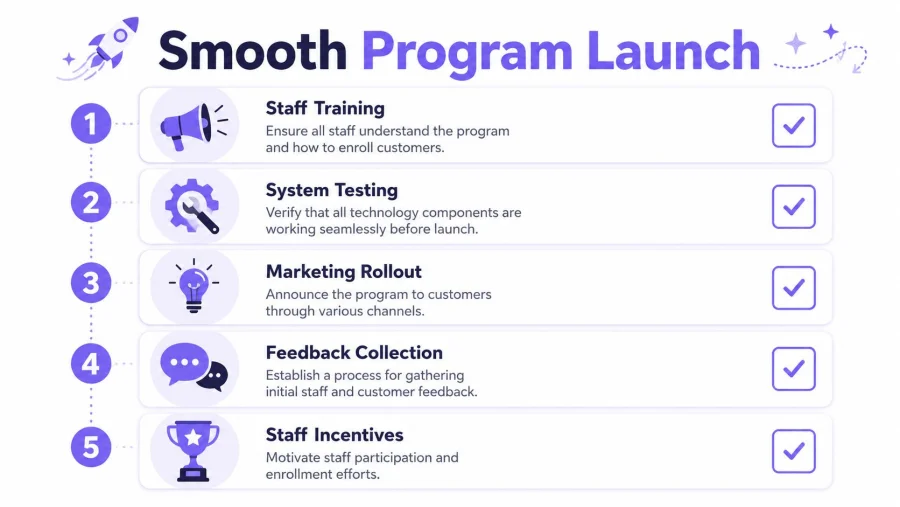
A practical launch routine usually includes:
- Soft testing first: Run the process with staff and a few trusted regulars before public promotion.
- Counter prompts: Place signage where staff can naturally point to it.
- Defined owner oversight: One person should monitor whether invites are happening.
- A response plan for confusion: Decide in advance how staff handle failed scans, forgotten phones, or reward disputes.
Give staff a simple script
Many groups underperform on sign-ups because they think they need to “sell” the programme. They don't. They only need to make the next step obvious.
Good scripts tend to share three traits:
- They're brief
- They mention the first benefit
- They sound natural in service
Here's the shape of a workable pitch:
“If you scan this, you'll join our rewards programme and start working toward your next treat straight away.”
That works better than a long explanation of points, terms, and conditions.
Promote in the places customers already look
A launch doesn't need a full campaign calendar. It needs consistent visibility across the customer journey.
Focus on these placements:
- At the till: Best for first-time sign-ups.
- On tables: Useful in sit-down settings where customers have dwell time.
- On takeaway packaging: Strong for return reminders.
- On social media: Good for announcing the programme and showing how it works.
- In post-visit messages: Useful for reminding customers they've started earning.
Short social posts tend to outperform overexplained ones. A single image, the reward headline, and a clear instruction to scan in store is usually enough.
Keep the first month tight
The launch month is for consistency, not experimentation. Don't introduce multiple reward changes, extra tiers, or special exceptions too early.
A stable rollout should include:
- One customer-facing offer
- One staff script
- One sign-up flow
- One redemption process
- One owner review each week
If staff are missing the prompt, fix that before changing the reward. If customers are joining but not using it, look at the reward design before spending more on promotion. Most launch issues are operational, not strategic.
Measuring Success and Optimising for Growth
A dining rewards program shouldn't be judged by sign-ups alone. Plenty of weak programmes attract members and still fail to improve repeat business. The numbers that matter are the ones tied to customer behaviour and profitable spend.
That's why the owner needs a short list of metrics they'll review.
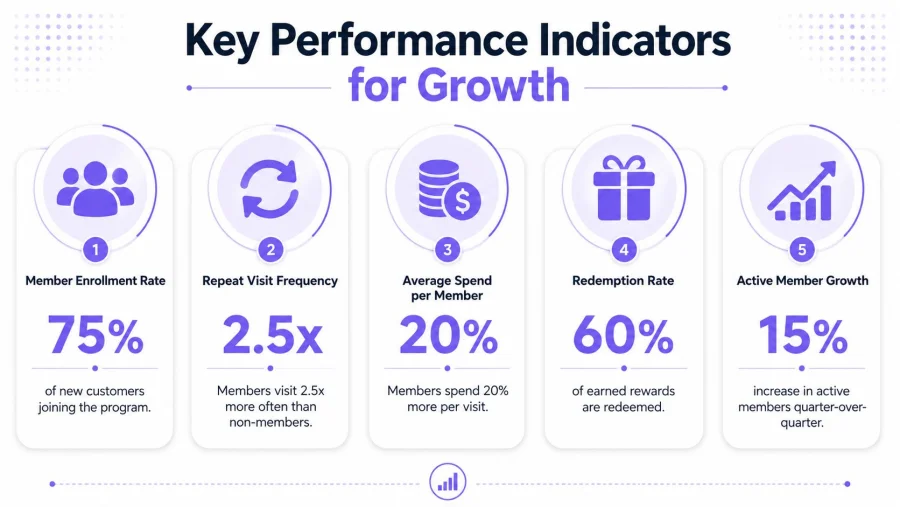
The four numbers worth watching first
Start with practical indicators, not vanity metrics.
- Member enrolment rate: Are customers joining at the till and through visible prompts?
- Repeat visit behaviour: Are members returning more often than before?
- Average spend by members: Are members adding more to each order?
- Reward redemption rate: Are rewards achievable and used, or ignored?
This visual sums up the type of dashboard view operators should aim for.
What healthy performance usually means
The strongest loyalty programmes create a useful cycle. Customers join easily, come back often enough to see progress, redeem rewards without friction, then continue spending after redemption instead of dropping off.
Restaurant loyalty members matter financially. On average, loyalty program members in the restaurant sector generate 12-18% more incremental revenue growth annually compared to non-members, with approximately 64% of members spending more per transaction to maximise point earnings, according to Deliverect's restaurant loyalty trends.
That should change how owners read the dashboard. Rewards aren't only a cost line. They can be a revenue engine when they increase frequency and basket size.
How to interpret common patterns
The same headline metric can signal different problems. Context matters.
High enrolment, low redemption
This usually means the reward feels too distant, too confusing, or not valuable enough.
Good redemption, weak repeat visits
The programme may be attracting deal-seekers without building routine. The reward might need to connect more closely to normal buying behaviour.
Members spend well, but staff sign-ups are flat
The structure may be fine. Execution at the till is probably inconsistent.
Customers join, then go quiet
The business likely needs a better welcome message, a clearer first milestone, or a timely follow-up offer.
A low redemption rate isn't always a win. It can also mean customers don't believe the reward is within reach.
Optimise one lever at a time
Owners often react to weak results by changing everything. That makes learning impossible. Change one variable, then watch what happens.
Useful optimisation levers include:
- Reward threshold: Lower it if customers aren't reaching the first milestone.
- Reward type: Swap abstract points for a clearer item reward if understanding is weak.
- Offer timing: Push quieter-day offers to smooth demand.
- Welcome incentive: Strengthen the first reason to join if sign-up momentum is poor.
- Staff prompt placement: Move QR materials closer to the payment action.
For small operators, the easiest route is using BonusQR loyalty analytics to spot which offers get used, which members return, and where sign-up behaviour stalls.
Review monthly, not endlessly
A useful review rhythm is simple:
- Weekly: Check whether staff are inviting customers and whether sign-ups are coming through.
- Monthly: Compare member activity, redemption behaviour, and average spend.
- Quarterly: Decide whether the reward structure still matches the business goal.
The owner doesn't need to become a data analyst. They only need enough visibility to answer three questions. Are customers joining, are they coming back, and is the programme paying for itself through stronger behaviour?
If the answer to all three is yes, the programme is working. If one is weak, optimise that part before rebuilding the whole system.
Your Next Regular Customer Is Waiting
A dining rewards program works best when it feels ordinary to the customer and useful to the business. That's the target. Not complexity. Not gimmicks. Just a simple reason for someone to choose the café again next time.
Independent restaurants and cafés don't need chain-level budgets to build loyalty. They need a reachable first reward, a joining process that doesn't create friction, staff who remember to mention it, and regular review of the results. When those parts line up, a casual visitor has a much better chance of becoming a regular.
The biggest missed opportunity for small operators is delay. Many wait until trade softens, marketing costs rise, or familiar customers start disappearing. By that point, the business is trying to recover lost habit instead of building it early.
A low-cost QR-led setup is often the most practical route because it removes the usual blockers. No complex rollout. No extra hardware. No need to force customers into another app just to earn a coffee reward.
If the goal is to stop losing one-time visitors and start building profitable repeat trade, start a free BonusQR programme and turn everyday visits into measurable loyalty.