
 Deutsch
 Español
 Français
 Italiano
 Magyar
 Polski
 Slovenčina
 Čeština
A lot of small businesses are still running loyalty the hard way. A paper punch card sits by the till. Staff try to remember regulars by face. A customer says they lost their card and asks whether the last few visits can still count. Nobody knows which reward brings people back, which customers have stopped visiting, or whether the scheme is making money.
That setup feels familiar because it is. It also leaves the business blind.
Digital membership cards fix more than the card itself. Done properly, they turn a loose collection of transactions into a usable record of member behaviour. That changes loyalty from a giveaway into a system a business can measure, improve, and scale without adding operational chaos.
The End of the Crumpled Paper Punch Card
Paper punch cards look simple because all the complexity is hidden. Staff have to explain the offer, stamp it consistently, spot fakes, replace lost cards, and rely on memory to recognise regulars. The customer experience is fragile too. Cards get bent, forgotten, washed, or thrown away.
The bigger problem is less obvious. Paper cards create a data black box.
A business can hand out hundreds of punch cards and still not know which customers returned, how often members visit, which reward gets redeemed most, or who stopped coming altogether. The scheme exists, but the learning doesn't.
Loyalty is already mainstream in the UK
Customers already understand the value exchange; in 2025, eight out of 10 adults in Great Britain (80%) were members of at least one loyalty programme, the highest share since 2018, according to Statista's UK loyalty scheme market overview.
That means the issue usually isn't whether customers want loyalty. The issue is whether the scheme is easy enough to join, worth using, and useful enough for the business to manage properly.
Staff recognising a regular is helpful. It isn't a loyalty strategy.
A paper system can't tell a café that one morning customer is also likely to buy lunch. It can't tell a salon that clients who book one treatment often return for a higher-value service later. It can't tell a boutique which members respond to seasonal offers and which only buy during promotions.
What paper cards cost behind the scenes
The visible cost is printing. The hidden cost is missed action.
- No customer history: Staff can't see visit patterns, reward usage, or inactivity.
- No targeted follow-up: A business can't send a birthday reward, a welcome offer, or a return incentive if it doesn't know who the customer is.
- No operational consistency: One staff member stamps generously, another forgets, another bends the rules.
- Easy misuse: A physical card can be shared, duplicated, or altered without much resistance.
- Weak brand value: A generic paper square in a wallet doesn't reinforce the brand after the customer leaves.
The upgrade isn't digital paper
A proper digital membership card isn't just a prettier version of the same idea. It's a live membership credential tied to a customer profile. That means every scan, reward, visit, and redemption can feed back into the system.
At this point, many businesses change their thinking. The goal isn't only to replace paper. The goal is to stop guessing.
When loyalty becomes measurable, a business can answer practical questions:
| Question | Paper punch card | Digital membership card |
|---|---|---|
| Who joined last week | Hard to know | Visible in the platform |
| Who hasn't returned | Not trackable | Can be identified and re-engaged |
| Which reward performs best | Guesswork | Based on redemption patterns |
| How staff issue rewards | Inconsistent | Standardised process |
| Whether the scheme drives value | Anecdotal | Measurable over time |
For a small business, that's a significant shift. Loyalty stops being a stack of cards by the counter and becomes a working customer retention system.
How Digital Membership Cards Actually Work
Most confusion starts with one mistake. People assume a digital membership card is just a QR code saved as an image or a PDF attached to an email. That isn't the same thing.
A true digital membership card works more like a secure hotel key than a photocopy. The card sits in Apple Wallet or Google Wallet, connects back to the issuing system, and can update without being reissued.
The basic workflow
For the customer, the process is usually short:
Sign-up happens online or on a phone The customer joins through a simple form, app, or web page.
The card is issued instantly Instead of waiting for post or printing, the membership pass is delivered to the customer's wallet on their phone.
The customer presents the pass when visiting Staff scan the code or identifier from the phone screen.
The system updates in real time Points, stamps, rewards, visit counts, or status can change straight away.
The card remains current If the business changes an offer, updates member details, or issues a reward, the card can reflect that change without replacing the pass.
What staff need to use it
In this regard, many owners expect complexity and discover the opposite. In most setups, staff don't need specialist hardware or a major POS rollout. A phone or tablet is often enough to scan, validate, and redeem.
That matters because loyalty fails when the front line finds it awkward. If redemption takes too long, queues build, staff improvise, and members stop bothering.
Practical rule: If a new loyalty system adds friction at the till, it won't survive busy periods.
A workable digital process should let staff do three things quickly:
Find the member Usually by scanning their code or searching basic details.
Apply the reward Staff should be able to mark a stamp, add points, or redeem an offer in a few taps.
Move on The transaction shouldn't become a training exercise every time.
Why wallet-based cards are different
Wallet passes aren't just convenient. They can be significantly more secure and cheaper to operate than printed cards.
UK-based digital membership cards can use cryptographically encrypted payloads (DPAN/Device Token) stored in Apple Wallet and Google Wallet. According to Romax on digital membership card security and delivery, this approach reduces production costs by approximately 80% compared to printed cards and binds the credential to a specific mobile device for stronger fraud prevention. The same source reports that UK sports clubs and gyms saw a 65% reduction in counterfeit credential usage after moving to digital wallet standards.
That difference isn't academic. A static QR image can be copied and forwarded. A wallet-based credential is harder to misuse because it's linked to the device and often protected by the phone's own authentication.
Businesses comparing providers should also look at how the mobile experience is delivered. Systems built around digital loyalty cards for Apple Wallet remove a lot of the adoption friction because customers already know where to find the pass.
For membership-heavy venues such as private clubs, it also helps to look beyond the card and study the wider operating model. Golf operators, for example, can drive predictable golf club growth by linking membership access, renewals, communication, and retention into one process instead of treating cards as a standalone admin task.
Essential Features of a Modern Loyalty Program
A digital card on its own isn't the full solution. Plenty of programmes still underperform because the business digitised the token but not the strategy.
The strongest setups combine easy access for customers, simple execution for staff, and enough flexibility for the owner to adapt offers without rebuilding the programme every month.
The non-negotiables
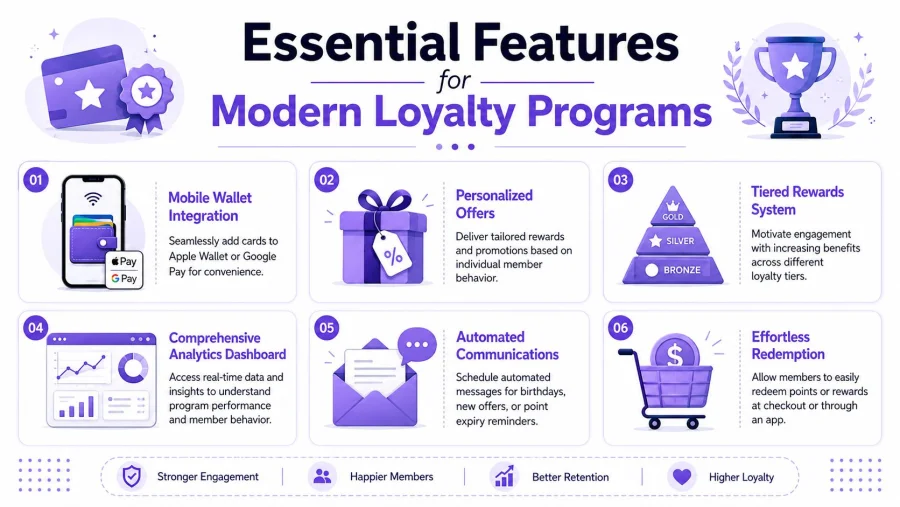
A modern loyalty programme should include these core components:
Mobile wallet support If customers can add the pass to Apple Wallet or Google Wallet, usage becomes much more natural. They don't need to search old emails or remember login details every time.
Flexible reward logic A single "buy ten, get one free" mechanic can work, but it shouldn't be the only option. Different businesses need different triggers, such as visits, spend thresholds, points, cashback, fixed discounts, or milestone rewards.
Brand control The card should look like the business, not like a generic software template. Brand colours, logo, reward naming, and customer-facing language all affect whether the programme feels polished or improvised.
Automation Good loyalty software should send useful messages without staff manually chasing every customer. Welcome rewards, birthday offers, reminders, and lapsed-customer nudges are the practical baseline.
Low-friction redemption Members shouldn't need to remember passwords, download a heavy app, or argue with staff about whether the reward is valid.
Analytics that lead to decisions If the dashboard only shows sign-ups and scans, it isn't enough. The business needs to understand behaviour, not just activity.
Features that separate basic from valuable
Not every feature has equal weight. Some look impressive in a demo but don't change day-to-day results. Others subtly make the whole programme work better.
| Feature | Why it matters in practice |
|---|---|
| Tiered rewards | Gives frequent customers a reason to keep climbing rather than plateauing after one repeatable offer |
| Personalised offers | Lets the business reward different behaviours instead of treating all customers the same |
| Visit history | Helps staff recognise loyal members without relying on memory |
| Offer scheduling | Supports seasonal promotions and quiet-day incentives |
| Member segmentation | Makes it easier to target regulars, new joiners, and inactive customers differently |
| Simple staff controls | Prevents delays and mistakes during busy service periods |
The analytics question most owners miss
A lot of businesses ask whether the software can issue a card. The better question is whether the system can show what the card is doing.
That means being able to spot patterns such as:
- members who joined but never redeemed
- regulars whose visits are slowing
- rewards that get claimed often but don't encourage return visits
- offers that lift basket size rather than just giving away margin
- customers who are engaged enough to merit VIP treatment
The best loyalty feature is often the one the customer never sees. Reliable reporting lets the owner stop repeating offers that feel popular but don't change behaviour.
A useful programme doesn't have to start complicated. It does need room to grow. A café might begin with stamps, then add lunchtime rewards. A salon might start with points, then create service-based bonuses. A retailer might test welcome offers before building member tiers.
The right platform supports that progression without forcing a full reset.
Putting Digital Memberships into Practice
The easiest way to judge digital membership cards is to look at how they behave in ordinary businesses, not in product demos. A local café, a beauty salon, and an independent boutique all need different loyalty mechanics, even if they use the same underlying tools.
What works is usually the same principle applied three ways. Reward the first useful action, make repeat use obvious, and give the owner enough information to refine the offer.
A coffee shop that wants more than morning traffic
A paper card often starts and ends with "buy a number of coffees, get one free". That can create repetition, but it doesn't help the owner shape behaviour.
A stronger digital version can do more:
- Welcome reward Give new members a small reason to join on the spot.
- Visit-based progression Reward frequency so the customer builds a habit.
- Behaviour shift Add a lunchtime or pastry offer to customers who usually only buy one morning drink.
- Reactivation If a regular stops visiting, send a simple nudge rather than waiting for them to drift away.
The café doesn't just want more visits; it wants to widen the customer's routine.
A salon that wants to lift spend without feeling pushy
Salon loyalty often fails when the reward is too blunt. A generic discount on everything can train clients to wait for offers rather than book at full value.
A digital membership structure gives more control. The salon can reward retention and service progression at the same time.
One practical setup looks like this:
| Stage | Offer logic | Business purpose |
|---|---|---|
| Join | New-member bonus | Captures customer details and gets early buy-in |
| Return visit | Points or visit reward | Encourages the next booking before the client drifts |
| Service upgrade | Bonus tied to selected treatments | Supports movement into premium services |
| Lapse recovery | Timed follow-up incentive | Brings back clients who haven't booked recently |
A system delivered through a mobile web application loyalty flow can be especially useful for salons because staff can sign people up quickly at reception without forcing a separate app download before the client understands the value.
If the reward structure doesn't reflect how the business actually earns margin, the loyalty scheme will stay busy and still underperform.
A boutique that wants repeat customers, not one-off browsers
Independent retail has a different challenge. The visit cycle is less predictable than a café, and the product mix changes more often. A static punch card rarely fits.
Digital membership works better when it supports multiple triggers. The boutique might issue points for purchases, reserve a surprise reward for milestone visits, and send specific offers around new arrivals or quieter periods.
The benefit isn't only convenience. The owner can start to separate window shoppers from genuine repeat buyers.
What these examples have in common
Each business above uses a different reward pattern, but the operating habits are similar:
Join quickly at the point of contact Don't send customers home to think about it.
Offer one clear reason to start Too many reward choices at sign-up can slow adoption.
Use the second and third visit to build momentum That's where habit starts forming.
Watch for inactivity The absence of a visit is often more useful than the presence of one.
Adjust based on real behaviour Keep the rewards that drive profitable return visits. Drop the ones that only create redemptions.
That's the practical advantage of digital membership cards. They don't just hold a member number. They give the business a repeatable way to learn what keeps customers coming back.
Your Simple Digital Launch Checklist
Most loyalty launches become harder than they need to be because the owner tries to solve every scenario at once. A better approach is to launch a clean first version that staff can explain in one sentence and customers can use immediately.
Start with one business goal
Pick the main outcome first. Not three goals. One.
That goal might be:
More repeat visits Common for cafés, quick-service food, and fitness businesses.
Higher average spend More relevant for salons, boutiques, and specialist retail.
More known customers Useful when a business has lots of anonymous transactions and little usable customer data.
Once that goal is clear, the reward becomes easier to choose. If the goal is repeat visits, use visit-based logic. If the goal is bigger baskets, reward spend or service upgrades.
Build a first version staff can explain fast
A good launch offer is simple enough that any team member can say it naturally during a busy shift.
A practical checklist looks like this:
Choose the entry reward Make the first reason to join obvious and immediate.
Name the ongoing reward Customers should understand what they are working towards.
Set the visual identity Use the business logo, colours, and reward wording customers already recognise.
Write a one-line staff script Keep it short enough for a queue. Something direct works best.
Decide how customers join Counter sign-up, table QR, receipt prompt, website form, or a mix.
Prepare launch materials Window signs, till cards, table talkers, posters, and a short social post all help.
Avoid a messy rollout
The first week matters because staff will create the programme's reputation. If joining feels awkward on day one, customers will assume the whole scheme is awkward.
A loyalty programme should be easier to explain than the specials board.
Before launch day, test the customer journey from start to finish. Join as a customer. Add the card. Redeem a reward. Ask a staff member to do the same without coaching. Any friction that appears in testing will appear twice as badly during a rush.
One more point matters. Decide how exceptions will be handled before they happen. If someone forgets their phone, if the screen won't scan, or if a reward was meant to trigger but didn't, staff need a simple fallback rule. Consistency builds trust faster than generosity applied unevenly.
Navigating Privacy and Customer Accessibility
Some businesses assume that once a loyalty scheme goes digital, every customer will prefer the digital version. That isn't how real adoption works.
Some customers like wallet passes straight away. Others still prefer something physical or don't want another digital process in their day. A sensible programme accepts that and plans for it instead of treating non-digital behaviour as resistance.
Accessibility matters more than enthusiasm
According to FinTech Weekly on UK payment card preferences, 66% of UK shoppers still carry a physical card regularly, and 63% of Gen Z shoppers specifically prefer to use a physical card over a digital wallet for payments. That doesn't mean digital membership cards are a bad idea. It means businesses shouldn't assume every customer wants the same format because smartphones are widespread.
For some groups, the gap is even more practical than preference. Age UK's published figures show a significant digital inclusion challenge among older people, with many still not using the internet or having limited access. That should shape how a business designs enrolment and support, even without forcing every member into a phone-based process.
Privacy needs a plain-English explanation
Most customers aren't asking for a legal lecture. They want to know three things:
What information is being collected Usually basic contact and membership activity.
Why it's being collected To issue rewards, identify the member, and manage the programme.
How it will be used For loyalty communication and service improvement, not as a vague free-for-all.
The safest approach is clear consent, limited data collection, and a process for updating or removing customer information when needed. GDPR-safe handling isn't just a box to tick. It affects trust at sign-up.
Practical ways to stay inclusive
A business doesn't need to abandon digital membership cards to serve less technical customers well. It just needs fallback options.
| Situation | Practical response |
|---|---|
| Customer doesn't want to use a wallet pass | Offer an alternative membership lookup method |
| Customer forgets their phone | Find the account by phone number or other approved detail |
| Staff member is unsure about a privacy question | Use a short approved explanation rather than improvising |
| Customer wants fewer messages | Make opt-out and preference handling straightforward |
A loyalty system should reduce friction, not create embarrassment at the counter. If a customer needs help finding their card or confirming their membership, staff should be able to resolve that discreetly and quickly.
The strongest digital programmes are inclusive by design. They don't confuse "digital-first" with "digital-only".
How to Measure Your Loyalty Program's Success
If a loyalty programme can't be measured, it becomes a cost centre dressed up as customer engagement. The main advantage of digital membership cards is that they turn loyalty into something visible.
That starts with rejecting vanity metrics. A large sign-up list might look encouraging, but sign-ups alone don't prove the programme is working. The useful question is whether members come back, spend sensibly, and redeem in ways that support the business.
Metrics that actually help decision-making
A practical dashboard should help a business monitor:
Repeat visit frequency How often members return over time.
Average member spend Whether loyalty members buy more, or redeem more discounts.
Reward redemption patterns Which offers are being used and which are ignored.
Inactive members Who joined, engaged briefly, and then disappeared.
Top customer groups Which members are most valuable and may deserve a different experience.
Businesses often discover the weakness of simple QR-based setups. According to PerkStar's analysis of digital membership card misconceptions, 68% of small businesses mistakenly believe DIY QR solutions equal functional digital cards, leading to poor member retention. A static code may help with identification, but it doesn't automatically create a loyalty engine with useful reporting.
Reading the story behind the numbers
A dashboard becomes valuable when the owner uses it to change something.
If a welcome reward gets lots of claims but few second visits, the onboarding offer may be attracting opportunists instead of future regulars. If one reward is redeemed steadily by reliable members, that offer may be worth protecting. If a high-value customer segment starts going quiet, a targeted follow-up may be more effective than another mass promotion.
The point isn't to watch charts. It's to make better operational decisions.
Businesses using a dedicated analytics view such as customer loyalty stats can quickly separate surface activity from useful retention signals. That makes loyalty management less emotional and more commercial.
Good loyalty data doesn't just show who claimed a reward. It shows which customer behaviour is worth encouraging next.
A simple review rhythm works well. Check the dashboard regularly, identify one pattern, change one offer or message, and monitor whether member behaviour improves. Small adjustments usually outperform dramatic programme overhauls because staff can keep executing them consistently.
Paper cards can still punch holes in cardboard. They can't show which members are slipping away, which rewards work, or which regulars are ready for a better offer.
Digital membership cards give a small business something much more useful than a modern-looking pass. They provide a practical system for retention, insight, and repeat revenue, without turning the counter experience into a tech project.
For businesses that want a simple way to launch wallet-friendly loyalty, automate offers, and track results without extra hardware, BonusQR is built for exactly that. It helps cafés, salons, retailers, restaurants, and studios move from guesswork to a loyalty programme they can run.