Customer retention strategies in CRM are defined as the systematic use of customer relationship management data, automation, and personalised communication to keep existing customers buying and engaged over time. A 5% increase in retention can boost profits by 25% to 95%, while acquiring a new customer costs 5 to 25 times more than keeping one. That gap makes retention the highest-return activity most small and medium-sized businesses can pursue. The techniques covered here, from proactive churn detection to loyalty programme automation and causal uplift modelling, give you a practical framework built on 2026 industry data.
What are the most effective customer retention strategies in CRM?
The most effective CRM retention strategies combine personalisation, proactive engagement, and loyalty automation. Each one works because it uses data your CRM already holds to make customers feel known and valued.
Personalisation and tailored communications
80% of customers prefer personalised brand experiences, and 72% respond to communications tailored to their interests. That means generic newsletters and blanket promotions actively reduce engagement for the majority of your audience. Your CRM holds purchase history, browsing behaviour, and contact preferences. Use those fields to send birthday offers, product recommendations based on past orders, and re-engagement messages triggered by inactivity. Personalisation does not require a large team. It requires well-structured data and the right automation rules.

Proactive churn prevention
Detecting early churn signals through CRM data gives SMEs a genuine competitive advantage. A customer who stops opening emails, reduces purchase frequency, or raises repeated service complaints is signalling risk weeks before they leave. Set up CRM alerts for these behaviours and trigger personalised win-back offers before the customer disengages completely. Reactive retention, waiting until a customer cancels to act, is far more expensive and far less effective.
Loyalty programmes driven by CRM automation
Loyalty programmes work best when they are connected directly to your CRM data. Points collection, stamp cards, cashback rewards, and visit-based incentives all become more powerful when the CRM triggers them automatically at the right moment. A customer who reaches a spend threshold gets an instant reward notification. A lapsed member receives a re-engagement offer after 30 days of inactivity. You can find a detailed breakdown of proven retention approaches that work well in retail and service settings.
Multi-channel engagement and omnichannel synchronisation
Companies without omnichannel strategies retain only 33% of their customers. That figure alone justifies the effort of connecting your email, SMS, push notification, and in-store touchpoints into a single CRM view. When a customer receives a consistent message across every channel, trust builds faster. When channels contradict each other, trust erodes.
- Personalised email sequences triggered by purchase milestones or inactivity
- Push notifications for loyalty reward updates and time-sensitive offers
- SMS reminders for appointment-based businesses or subscription renewals
- In-app messaging for businesses with a branded mobile presence
- Post-purchase follow-ups that request reviews and offer next-step incentives
Upselling and cross-selling via CRM insights
CRM data reveals natural upsell moments. A customer who buys a starter product three times is ready to hear about the premium version. A client who books one service regularly may not know you offer a complementary one. These conversations feel helpful rather than pushy when they are timed correctly and grounded in the customer’s actual behaviour.
Pro Tip: Set a CRM rule that flags any customer who has made three or more purchases in a single category. That segment is your highest-probability upsell audience. Contact them with a relevant upgrade offer within 48 hours of their third purchase.
How does CRM technology integration improve retention outcomes?
CRM technology improves retention outcomes when it connects behavioural, transactional, and communication data into a single customer profile. Without that integration, you end up with siloed data that produces contradictory messages and missed opportunities.
The most common mistake SMEs make is buying a CRM platform and treating it as a contact database. A contact database stores names and phone numbers. A properly integrated CRM records every interaction, purchase, complaint, and preference, then uses that data to trigger the right action at the right time.
Here is how to build that integration effectively:
- Unify your data sources. Connect your point-of-sale system, e-commerce platform, email tool, and customer service records into one CRM profile per customer. Gaps in this profile produce gaps in your retention strategy.
- Activate marketing automation. CRM automation responding to real-time behaviour with personalised messaging and AI-powered product recommendations significantly improves retention. Set up abandoned cart recovery sequences, post-purchase nurture flows, and milestone reward triggers.
- Apply segmentation before every campaign. Divide your customer base by recency, frequency, and monetary value (the RFM model). Each segment needs a different message. High-value frequent buyers need VIP recognition. Low-frequency recent buyers need education and encouragement.
- Use predictive analytics for churn risk. Advanced CRM platforms can score each customer’s churn probability based on their recent behaviour. Prioritise your retention spend on customers with a high churn score and a high lifetime value.
- Move beyond risk-targeting to causal uplift modelling. Traditional CRM retention targets customers who are already at risk. Causal uplift estimation focuses marketing only on persuadable customers, reducing wasted spend and increasing net value. One documented application of this approach reduced unnecessary interventions by 141,534 and generated campaign savings of $1.33M alongside a net expected value increase of $12.4M.
The critical lesson from SME CRM research is that technology sophistication alone does not drive results. Integrating technology with genuine operational customer knowledge is what separates high-performing SMEs from those that invest in CRM and see little return.
Pro Tip: Before adding any new CRM feature or integration, ask one question: “Does this help us understand or serve a specific customer better?” If the answer is no, deprioritise it.
What metrics should SMEs monitor to refine CRM retention?
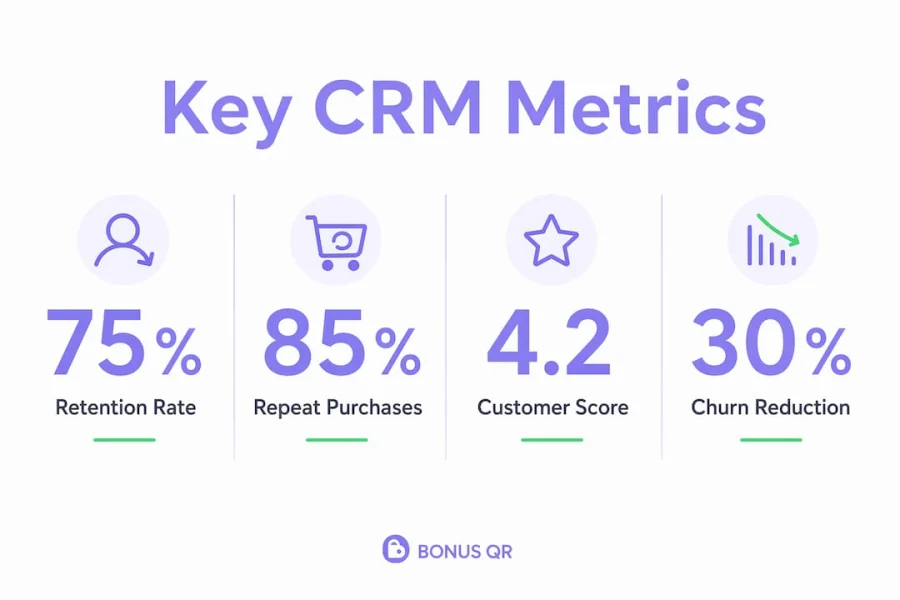
Measuring retention without the right metrics is guesswork. Monitoring key KPIs including Customer Retention Rate, Repeat Purchase Rate, Customer Lifetime Value, Net Promoter Score, and customer effort scores is the foundation of iterative CRM improvement.
| Metric | What it measures | Why it matters |
|---|---|---|
| Customer Retention Rate (CRR) | Percentage of customers retained over a period | Shows the overall health of your retention effort |
| Repeat Purchase Rate (RPR) | Share of customers who buy more than once | Indicates product satisfaction and loyalty depth |
| Customer Lifetime Value (CLV) | Total revenue expected from one customer | Guides how much to invest in retention per segment |
| Net Promoter Score (NPS) | Likelihood of customers recommending you | Predicts organic growth and flags satisfaction issues |
| Customer Effort Score (CES) | Ease of doing business with you | High effort predicts churn even among satisfied customers |
Each metric tells a different part of the story. CRR tells you whether your retention is working overall. RPR tells you whether customers find enough value to return. CLV tells you which customers deserve the most investment. NPS and CES tell you whether the experience is strong enough to sustain loyalty long-term.
The ratio of CLV to Customer Acquisition Cost (CAC) is particularly useful for SMEs. A CLV:CAC ratio below 3:1 means you are spending too much to acquire customers relative to what they return. Improving retention raises CLV without increasing acquisition spend, which is the most direct way to improve that ratio.
- Track CRR monthly, not annually. Annual tracking hides seasonal churn patterns.
- Segment NPS by customer tier. A low NPS among high-value customers is a critical warning signal.
- Review CES after every service interaction. Friction in the customer experience predicts churn before purchase data does.
- Use RPR to identify your most loyal product lines. Double down on what drives repeat behaviour.
You can explore 8 ways to improve retention with specific CRM approaches tied to each of these metrics.
How can SMEs apply CRM retention strategies in practice?
Applying CRM retention strategies in practice requires a structured approach, not a collection of disconnected tactics. The businesses that see the strongest results treat retention as an operational process, not a marketing campaign.
- Map the full customer journey. Identify every touchpoint from first contact to repeat purchase. Mark the friction points where customers drop off or disengage. These are your highest-priority areas for CRM intervention.
- Set up automated personalised communications. Use your CRM to trigger welcome sequences for new customers, loyalty milestone notifications, and re-engagement messages for lapsed buyers. Automation removes the dependency on manual effort and ensures consistency.
- Build loyalty triggers into your CRM workflows. Reward customers automatically when they hit spend thresholds, complete a set number of visits, or refer a friend. These triggers reinforce positive behaviour without requiring your team to monitor every account manually.
- Align your team around customer-centric goals. Service responsiveness and communication quality predict retention more reliably than complex loyalty schemes. Train your staff to use CRM data before every customer interaction. A customer service agent who can see a customer’s full history resolves issues faster and leaves a better impression.
- Build feedback loops into your process. Send short post-purchase surveys. Monitor NPS quarterly. Review churn data monthly and ask why customers left. Feed those answers back into your CRM segmentation and automation rules. Retention improves through iteration, not through a single perfect setup.
Resource allocation matters too. Many SMEs over-invest in acquisition and under-invest in retention. A practical starting point is to allocate at least a third of your customer marketing budget to retention activities. That shift alone, combined with the right CRM tools, produces measurable profit improvement within two to three months. For a broader view of growing your business through retention, the principles of customer-centric resource allocation apply across sectors.
Key takeaways
CRM-driven retention strategies deliver the strongest results when personalisation, proactive churn prevention, and loyalty automation work together within a unified customer data system.
| Point | Details |
|---|---|
| Retention beats acquisition on cost | Keeping a customer costs up to 25 times less than acquiring a new one. |
| Personalisation drives response | 72% of customers respond to communications tailored to their interests. |
| Proactive churn detection wins | Detecting churn signals early and intervening with personalised offers prevents loss before it happens. |
| Metrics guide improvement | Track CRR, CLV, NPS, and CES monthly to identify where retention is breaking down. |
| Integration outperforms technology alone | CRM success depends on connecting customer knowledge with technology, not on platform sophistication. |
Why most SMEs get CRM retention wrong
The businesses I see struggle most with retention are not the ones using the wrong tools. They are the ones using the right tools in isolation. A CRM platform sitting next to a separate email system, a disconnected loyalty app, and a point-of-sale that shares no data with either is not a retention strategy. It is a collection of expensive subscriptions.
The insight that changed how I think about this comes from SME CRM research: effective CRM use arises from operational customer knowledge integration, not from high-tech investment. That means the SME owner who knows their top 50 customers by name, purchase pattern, and preference, and who has built simple CRM automations around that knowledge, will outperform a larger competitor running a sophisticated platform on incomplete data.
The second mistake I see constantly is reactive retention. Businesses wait for a customer to cancel, complain, or go silent before acting. By that point, the relationship has already deteriorated. The SMEs that consistently outperform their peers on retention are the ones that have built early warning systems into their CRM. They spot the customer who has not purchased in 45 days and send a relevant offer on day 46. They do not wait for day 90.
The third mistake is treating loyalty programmes as a separate initiative from CRM. A stamp card that lives on paper, disconnected from your customer database, tells you nothing about who is using it or why. Connect your loyalty mechanics directly to your CRM and every redemption becomes a data point that sharpens your next campaign.
The proven strategies for customer retention that hold up across industries all share one characteristic: they are built on knowing your customer well enough to act before the customer decides to leave.
— Michal
How Bonusqr supports your CRM retention strategy
Bonusqr is built for SMEs that want to connect loyalty mechanics directly to customer data without complex technical setup. The platform supports points collection, stamp cards, cashback, coupon distribution, and visit-based rewards, all manageable from a single dashboard. Push notifications, real-time analytics, and automated campaign triggers mean your retention workflows run without manual intervention. Bonusqr requires no POS integration, which removes the most common barrier SMEs face when connecting loyalty to their existing systems. You can review the full set of loyalty system features to see which modules fit your business model. Whether you run a café, a service business, or a multi-location retail operation, Bonusqr gives you the tools to turn one-time buyers into repeat customers.
FAQ
What are customer retention strategies in CRM?
Customer retention strategies in CRM are data-driven methods that use customer relationship management systems to keep existing customers engaged and buying. They include personalised communications, loyalty programme automation, churn prediction, and multi-channel engagement.
How much does improving retention affect profits?
A 5% increase in customer retention can boost profits by 25% to 95%. That range reflects the compounding effect of repeat purchases, reduced acquisition spend, and higher average order values from loyal customers.
What is the most important CRM metric for retention?
Customer Lifetime Value (CLV) is the most important retention metric because it shows the total revenue a customer generates over time. Tracking CLV alongside Customer Retention Rate and Net Promoter Score gives a complete picture of retention health.
How does a loyalty programme improve CRM retention?
A loyalty programme connected to your CRM automates reward triggers based on real customer behaviour, such as spend thresholds or visit frequency. This keeps customers engaged between purchases and gives your CRM richer data to personalise future communications.
Can small businesses use CRM retention strategies effectively?
Yes. Research confirms that CRM success in SMEs depends more on integrating customer knowledge with technology than on the sophistication of the platform itself. A small business with clean customer data and simple automation rules can outperform larger competitors using complex systems poorly.


