A customer retention company is defined as a specialist provider of strategies, tools, and services that help businesses keep existing customers loyal, reduce churn, and grow revenue from their current base. The industry term for this discipline is customer retention management, and it sits at the heart of sustainable business growth. Retaining existing customers costs significantly less than acquiring new ones, yet most small and medium-sized businesses (SMBs) invest the majority of their marketing budget in acquisition. A dedicated customer retention company changes that equation by applying data-driven retention marketing tactics, loyalty programme design, and customer success processes to protect and expand the revenue you already have.
What does a customer retention company actually do?
A customer retention company delivers a structured set of services designed to stop customers from leaving and to increase how much they spend over time. These services span technology, strategy, and day-to-day operations.
The core services typically include:
- Data unification. Consolidating customer data into a single profile is the foundation of every effective retention effort. Customer retention rates improve when businesses unify customer data to enable real-time personalisation and multichannel communication. A single customer view means you can send the right message at the right moment, not a generic email blast.
- Personalised, multichannel communication. Retention companies build automated communication flows across email, SMS, push notifications, and in-app messaging. Each message is triggered by customer behaviour, not a calendar date.
- Loyalty programme design and management. This includes points systems, stamp cards, cashback schemes, tiered rewards, and referral incentives. The goal is to give customers a concrete reason to return rather than shop elsewhere.
- Cancellation flow implementation. When a customer tries to cancel or leave, a well-designed cancellation flow collects their reason and offers a relevant alternative. Cancellation flows can recover 25–45% of potentially lost customers and can be deployed in under two hours. That is a high-return intervention for minimal setup cost.
- Payment recovery and dunning automation. Between 20% and 40% of customer churn is administrative, caused by failed payments rather than dissatisfaction. Addressing a failed payment within 12 hours is four times more effective than waiting 72 hours. Automated dunning sequences handle this without manual effort.
- Customer success management. For B2B businesses, this means structured account reviews, health scoring, and proactive outreach to at-risk clients. Regular Quarterly Business Reviews (QBRs) are a key tool here.
Pro Tip: If you are just starting out, prioritise payment recovery and cancellation flows before building a full loyalty programme. These two interventions deliver measurable results quickly and require very little technical setup.
Which KPIs do retention companies monitor?

Retention companies measure what matters. Without clear metrics, you cannot tell whether your efforts are working or where to focus next.
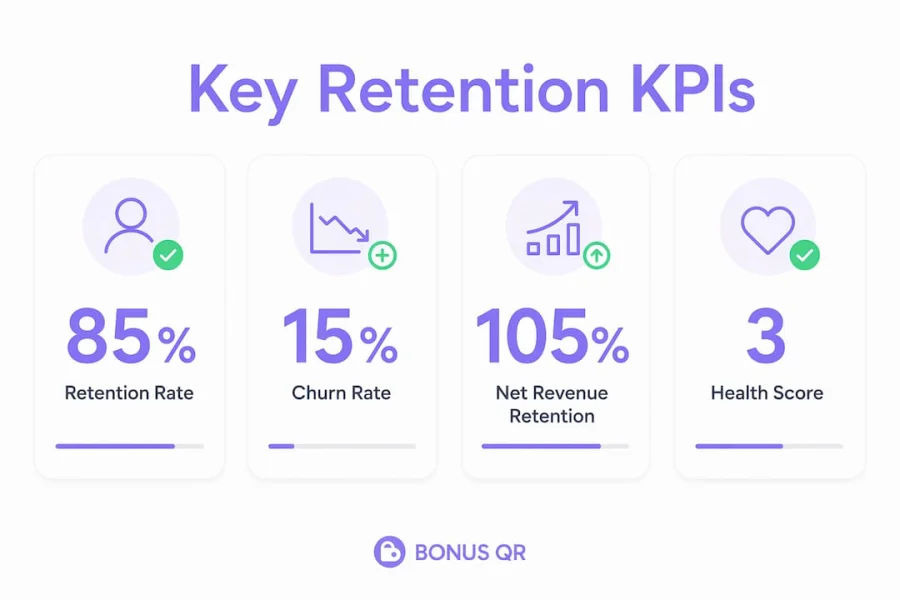
| KPI | What it measures | Why it matters |
|---|---|---|
| Customer retention rate | Percentage of customers kept over a period | Baseline health of your customer relationships |
| Churn rate | Percentage of customers lost over a period | Direct signal of retention problems |
| Net Revenue Retention (NRR) | Revenue retained plus expansions, minus churn | Shows whether existing customers are growing in value |
| Customer Lifetime Value (LTV) | Total revenue expected from one customer | Guides how much to invest in keeping each customer |
| Customer health score | Composite score of engagement, payments, and usage | Early warning system for at-risk customers |
Net Revenue Retention deserves particular attention. An NRR above 100% means your existing customer base is growing in revenue even without new acquisitions. That is the clearest sign that your retention process is working.
Cohort analysis is another tool retention companies use regularly. By grouping customers by the month they joined, you can track whether newer cohorts retain better than older ones. This tells you whether recent changes to your product or loyalty programme are actually improving outcomes.
Pro Tip: Build a simple customer health score in your CRM using three signals: last purchase date, average order frequency, and support ticket volume. You do not need enterprise software to spot customers who are drifting away.
Customer health scores and risk signals are particularly valuable for SMBs. Automated alerts triggered by cross-referenced signals from payments, product use, and support activity enable timely corrective actions without requiring a large team. The goal is to act before a customer decides to leave, not after.
How do SMBs implement a customer retention process?
Small and medium-sized businesses often assume that proper retention management requires enterprise budgets. It does not. The customer retention process for an SMB can be built in phases, starting with the highest-impact actions and adding complexity over time.
-
Build a unified customer data foundation. Start by connecting your point-of-sale system, email platform, and any loyalty programme into one place. You do not need a data warehouse. A well-configured CRM with consistent data entry is enough to begin. SMBs should start building their data foundation now rather than waiting for perfect readiness.
-
Align retention tactics with natural buying behaviour. Most customers repurchase on a monthly or weekly cycle. Loyalty programmes perform better when matched to customers’ natural buying rhythms rather than attempting to override them. A coffee shop rewards programme that resets every 30 days works with customer behaviour. One that resets every 90 days fights it.
-
Start customer success functions gradually. You do not need a full customer success team on day one. A phased model, starting with a part-time customer success role and evolving to dedicated Customer Success Managers (CSMs) as revenue grows, ensures both cost efficiency and scalability. Most European mid-sized B2B firms lack a dedicated customer success function and lose 30–50% of revenue within 18 months as a result. Starting small is far better than not starting at all.
-
Use automation for personalisation. Email automation tools can send replenishment reminders, birthday offers, and win-back sequences without manual effort. Pair these with your loyalty programme data to make each message relevant. For a broader view of how to apply these tactics, the proven retention strategies used in retail and ecommerce offer practical frameworks that translate well to most SMB sectors.
-
Introduce QBRs for high-value clients. If you serve business clients, schedule a quarterly review call with your top accounts. Regular QBRs can elevate Tier A customer retention from 70% to over 90% within 12 months. The investment is a few hours per quarter. The return is a materially stronger client relationship.
Pro Tip: Map your top 20% of customers by revenue and treat them as a separate segment. Give them earlier access to offers, personal check-ins, and priority support. The cost is low and the retention impact is disproportionately high.
What challenges arise when working with a retention company?
Working with a customer retention company is not without friction. Understanding the common obstacles helps you get more value from the relationship and avoid wasted effort.
The most significant challenges include:
- Perception gaps between businesses and customers. 67% of consumers believe brands prioritise new customers over existing ones, despite brands reporting equal budget allocation between acquisition and retention. This gap is a perception problem, not just a spending problem. If your loyalty benefits are not visible and consistent, customers will not feel valued even if you are investing in them.
- Delayed or invisible loyalty rewards. Many loyalty programmes front-load the effort required from customers while delaying the reward. A points programme where customers need to accumulate for six months before redeeming anything will lose engagement quickly. Retention companies address this by designing programmes with early, visible wins.
- Budget concerns and ROI timelines. Retention infrastructure takes time to show results. Retention tools like cancel flows and payment recovery reduce churn by 2–3 percentage points, which compounds significantly over 12–24 months. Businesses that expect immediate returns often abandon the effort too early.
- Timing of payment recovery actions. Many businesses address failed payments too slowly. Waiting more than 72 hours to follow up on a failed payment dramatically reduces recovery rates. Automation solves this, but only if it is set up correctly from the start.
Retention is more about refining the visibility, alignment, and relevance of your loyalty initiatives than constantly launching new tactics. Businesses that chase novelty over consistency rarely see sustained improvement in their retention rates.
The most effective approach is to focus on making existing programmes work better before adding new ones. Clarity in your retention messaging, consistency in your communication, and speed in your operational responses matter more than the number of tactics you deploy.
For a deeper look at how omnichannel data integration supports these efforts, the omnichannel marketing approach to unifying customer experience offers a useful framework for SMBs thinking about data and communication alignment.
Key takeaways
The most effective customer retention process combines payment recovery, cancellation flows, loyalty programme design, and customer success rhythms, all built on unified customer data.
| Point | Details |
|---|---|
| Fix administrative churn first | Address failed payments within 12 hours; 20–40% of churn is billing-related, not dissatisfaction. |
| Align loyalty with buying behaviour | Match programme rewards to customers’ natural repurchase cycles for higher engagement. |
| Start customer success early | A phased CSM model prevents the 30–50% revenue loss linked to absent post-sale processes. |
| Make loyalty benefits visible | 67% of consumers feel overlooked by brands; consistent, visible rewards close this perception gap. |
| Use retention infrastructure to scale | Cancel flows and payment recovery reduce churn by 2–3 points, compounding over time. |
What I have learned from watching SMBs get retention wrong
My honest view on customer retention for SMBs is this: most businesses wait too long and then try to do too much at once.
The pattern I see repeatedly is a business that ignores retention until churn becomes a visible problem, then attempts to launch a full loyalty programme, hire a customer success manager, and overhaul their CRM simultaneously. That approach almost always stalls. The technology becomes a distraction, the team gets stretched, and the results take so long to appear that leadership loses confidence in the whole effort.
The businesses that get retention right start with two things: clean data and one high-ROI intervention. Payment recovery is almost always the right first move. It requires minimal setup, delivers measurable results within weeks, and builds the internal confidence needed to invest in the next layer of retention infrastructure.
I also think the customer retention strategies that work best for SMBs are the ones that respect how customers actually behave, not how businesses wish they would behave. A loyalty programme that requires ten purchases before delivering any reward is not a retention tool. It is a friction generator. Start with a reward customers can reach in two or three visits, then build from there.
The other lesson worth stating plainly: data readiness is not a prerequisite for starting. You do not need a perfect CRM or a unified data platform before you begin. You need enough data to identify your best customers and your most at-risk ones. That is achievable with basic tools today.
— Michal
How Bonusqr supports your retention efforts
Bonusqr is a loyalty platform built specifically for SMBs that want to increase customer retention without complex integrations or large budgets. The platform covers the full range of retention marketing tactics: points collection, stamp card programmes, cashback, coupon distribution, and rewards tied to visit frequency or spend thresholds. Push notifications and automated campaign tools let you communicate with customers at the right moment, based on their actual behaviour. Bonusqr’s loyalty system features include real-time analytics, branding customisation, and mobile and web app integration, with no POS system required. Setup is fast, and pricing tiers start with a free option, making it accessible from day one.
FAQ
What is a customer retention company?
A customer retention company provides specialist services and tools to help businesses reduce customer churn, increase loyalty, and grow revenue from their existing customer base. Services typically include loyalty programme management, payment recovery automation, cancellation flows, and customer success support.
How do I measure whether my retention efforts are working?
Track customer retention rate, churn rate, and Net Revenue Retention (NRR) as your primary metrics. An NRR above 100% confirms that your existing customers are growing in value, which is the clearest sign that your retention process is delivering results.
What is the fastest retention improvement an SMB can make?
Automating payment recovery is the fastest high-impact action. Addressing failed payments within 12 hours is four times more effective than waiting 72 hours, and between 20% and 40% of churn is caused by billing issues rather than genuine dissatisfaction.
How does a loyalty programme help with retaining existing customers?
A well-designed loyalty programme gives customers a concrete reason to return by rewarding their natural buying behaviour. Programmes aligned with customers’ repurchase cycles, such as weekly or monthly visit rewards, consistently outperform those that require long accumulation periods before any benefit is delivered.
When should an SMB start building a customer success function?
Start as early as possible, even with a part-time role. Research shows that mid-sized firms without a dedicated customer success function lose 30–50% of revenue within 18 months due to absent post-sale retention processes. A phased approach, beginning with one part-time CSM, is both cost-effective and scalable.


