A queue forms, the till rings, regulars order without looking at the menu, and first-time visitors drift away unrecorded. That pattern feels healthy, yet it hides a leak. Without a deliberate customer engagement strategy, a local business can't tell who's new, who's slipping away, or which offer brought someone back.
Why Most Local Businesses Get Engagement Wrong
Friday morning in a busy café exposes the problem. Staff recognise faces, remember orders, and assume loyalty is handled. Meanwhile, a customer who visited twice last month hasn't returned, a new buyer received no reason to come back, and nobody knows which group drives most revenue.
Recognition isn't a system. A friendly greeting helps, but it doesn't record a visit, trigger a timely reminder, or recover a customer who's gone quiet. Relationships stay accidental, dependent on memory and chance.
The Cost of Untracked Regulars
Identifiable members matter commercially. Collinson's 2025 Loyalty Landscape reports that 61% of loyalty-programme members made a purchase in the previous 12 months, generating 52% of total UK sales revenue. A business that can't identify its repeat buyers can't measure that contribution or protect it.
Untracked regulars create three blind spots:
- No second-visit plan: First-time buyers leave with no incentive tied to a return date.
- No lapse signal: Staff notice absence weeks after a customer has switched to a competitor.
- No margin control: Broad discounts go to everyone, including people who'd have paid full price.
Busy doesn't mean retained. A full room can still contain a constant churn of replacements.
Transaction Versus Relationship
A transaction ends at payment. A relationship continues with permission to stay in touch, a record of behaviour, and a relevant next step. Paper cards illustrate the gap well. They reward visits, but they don't show who's close to a reward, who has stalled, or who should receive a win-back offer.
The fix doesn't require a CRM department. Five building blocks do the heavy lifting: a clear definition of engagement, the right reward mechanic, real examples to copy, disciplined channels, lawful consent, and simple measurement. Owners who install those blocks stop guessing. They see repeat behaviour, act at the right moment, and spend reward budget where it changes a decision.
What Customer Engagement Actually Means for a Small Business
Consultants love abstract definitions. A café, salon, or gym needs something usable before opening time. Engagement means three observable behaviours.
First, a customer chooses to return. Second, a customer accepts a relevant offer. Third, a customer recommends the business or gives useful feedback. Likes and vague awareness don't pay rent unless they lead to one of those actions.
Four Moving Parts in Every Loop
Every tactic can be described with four parts:
- Value exchange: The customer receives something clear, such as a free treatment, a birthday benefit, or progress toward a reward.
- Channel: The message arrives through a wallet pass, email, push notification, receipt prompt, or a staff cue at the counter.
- Data point: A visit, spend band, birthday, reward balance, or period of inactivity triggers the action.
- Moment: Timing matches the behaviour, not a random marketing calendar.
Take a lapsed gym member. The data point is missed visits, the moment is before the habit fully breaks, the channel is a push notification, and the value is a guest pass or class credit. That's a loop, not a slogan.
Personalisation Without Pretence
Small businesses hold an advantage here. Staff already know local routines, peak times, and favourite services. Basic rules can turn that knowledge into timely offers without complex software. Owners wanting broader ideas on interaction design can compare approaches in the Blu Dragonfly LLC engagement guide, then strip each idea back to value, channel, data, and moment.
Practical rule: If a tactic can't name its trigger and its customer benefit in one sentence, it isn't ready to launch.
Choosing the Right Reward Mechanics for Your Type of Business
The wrong mechanic wastes money. It either rewards behaviour that would've happened anyway or sets a target so distant that customers stop caring. Choice should start with purchase rhythm, average spend, and how easily a tired customer can understand the offer at the till.
Owners comparing setup costs and sequencing can use Adwave's step-by-step loyalty playbook as a planning reference, then apply the stricter test below: fast first reward, predictable cost, instant readability, and no developer required.
Reward Mechanics Matched to Business Type
| Mechanic | Best fit | First reward speed | Predictable cost | Customer readability |
|---|---|---|---|---|
| Digital stamps | Cafés, bakeries, quick-service food | Fast | High | Very clear |
| Points and balances | Retail, salons, mixed baskets | Medium | Medium | Clear if values stay simple |
| Tiered membership | Salons, premium retail, studios | Slow | Medium | Needs clear tier names |
| Cashback | Grocery, retail, higher baskets | Medium | Medium | Clear |
| Visit thresholds | Gyms, classes, services | Medium | High | Very clear |
| Spend thresholds | Salons, restaurants, clinics | Medium | High | Clear |
| Timed coupons | Seasonal pushes, win-back | Immediate | High | Very clear |
How to Pick Without Overbuilding
High-frequency, low-spend businesses should favour stamps. Progress feels visible, and the reward cost is easy to model. A digital stamp card for gyms and studios follows the same logic for class attendance, where each visit is a clean, countable action.
Salons and restaurants usually suit spend thresholds or points because ticket values vary. A colour appointment and a quick trim shouldn't earn identical progress if margins differ sharply. Tiers can add status later, but launching with tiers on day one often confuses customers and staff.
Cashback works when customers compare prices closely. It keeps value inside the business instead of training people to expect headline discounts. Timed coupons shouldn't become the main loop. They work better as a targeted lift for birthdays, quiet periods, or lapsed customers.
BonusQR is one option for running stamps, points, thresholds, and coupons through a customer QR code without POS integration or extra hardware. Whatever platform an owner chooses, the rule stays the same. Pick one main mechanic, add at most one supporting coupon, and make the first reward feel reachable.
Three Real Mini-Cases From Cafés, Salons and Gyms
Examples expose the mechanics better than theory. The three patterns below reflect common independent setups. Each one names the mechanic, trigger, channel, and measure that matters.
The Coffee Shop With a Six-Visit Card
A small coffee shop replaced paper stamps with a digital card. Six paid visits earned a free coffee on the next visit. Customers joined through a QR code at the counter, staff scanned the personal code at payment, and progress lived in the customer's profile rather than a wallet full of cardboard.
The trigger wasn't enrolment. It was behaviour. Customers close to completion received a reminder, while customers who'd stopped visiting received a timed incentive. The owner tracked weekly repeat visits and redemption cost, not raw sign-ups. That distinction matters because a long member list can hide weak activity.
The Salon Using Points Plus Early Access
A hair salon needed a mechanic that respected different service values. Points were earned on spend, with a treatment reward at a set balance. Higher-balance members received early access to new services, adding recognition without constant discounting.
The channel mix stayed narrow. Email announced service launches, and in-salon staff prompts reminded clients to scan before payment. The owner watched average transaction value and time between appointments. Points worked because the salon's visit cycle was longer and each booking carried a higher spend.
The Gym Protecting Quiet Periods
A neighbourhood gym used visit thresholds rather than discounts on membership. Members who reached a monthly attendance threshold earned a small benefit, and birthday-month members received an upgrade-style perk. Inactive members received a win-back prompt before absence became cancellation.
Wallet passes carried the reminders because members already used phones for entry and class booking. Staff measured return visits after each prompt and separated active regulars from at-risk members. The goal wasn't more messages. It was earlier intervention.
These cases fit wider UK behaviour. The UK Government's 2024 review of loyalty pricing in the groceries sector found 97% of surveyed shoppers belonged to at least one supermarket loyalty scheme, with the average shopper holding memberships in three schemes, and the average saving on loyalty-priced products ranging from 17% to 25% across the five supermarkets examined. Customers already understand membership. Local businesses win by making value obvious, fair, and fast to earn.
Channels That Convert Without Annoying the Customer
More messages don't equal more engagement. They often equal faster opt-outs. The costliest channel isn't the one with a weak response. It's the one that burns permission and stops every future message from landing.
Channel choice should be boringly disciplined. Pick two or three routes, assign each one a job, and control frequency before writing clever copy.
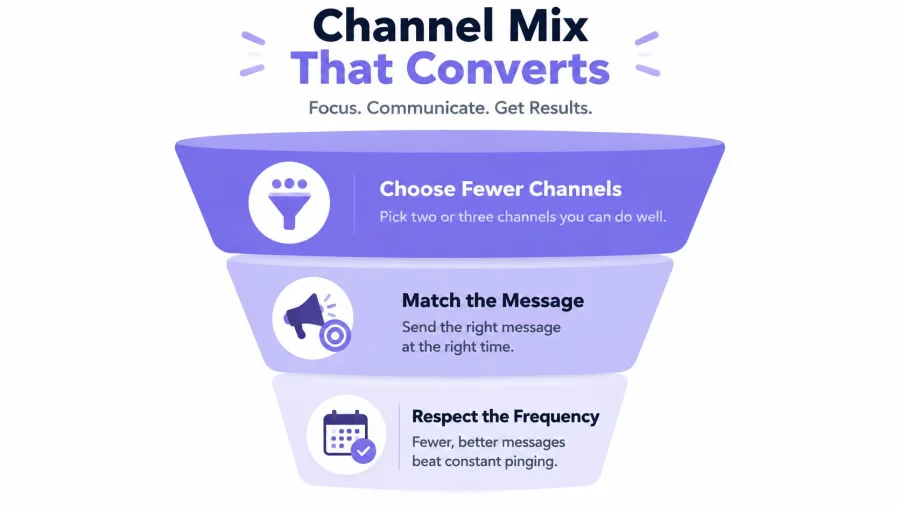
Assign Each Channel a Single Job
- Wallet passes: Keep the loyalty card visible and carry reward updates. Apple Wallet integration for coffee shops suits frequent visits because the pass sits beside payment cards.
- Email: Handle richer news, service launches, and monthly offers that don't need instant action.
- Push notifications: Deliver time-sensitive prompts, such as an expiring reward or a birthday benefit.
- SMS: Reserve for rare, high-value moments because interruption cost is high.
- Receipt and counter prompts: Recruit new members at the point where satisfaction is freshest.
- Staff cues: Fix exceptions, correct balances, and reassure customers when automation fails.
That last channel gets neglected. A failed scan or confusing points balance can undo a campaign in seconds. Staff need authority to honour a missed reward and correct an error without sending the customer into a support loop. Automation should handle routine value. Humans should handle exceptions.
Relevance Beats Visible Automation
Customers want useful offers, not a lecture about technology. UK research covering more than 2,000 consumers found that 40% wanted better personalisation through tailored offers and deals, but only 8% wanted more AI-led brand interactions. The lesson is direct. Show the benefit, hide the machinery.
A birthday reward feels personal. A message boasting about algorithmic targeting feels intrusive. Campaign copy should state the value, the deadline, and the action. Nothing else needs explaining.
Frequency Caps and Cooldowns
Every customer state needs a rule:
- Recently redeemed: Enter a quiet cooldown and receive no fresh discount push.
- Close to a reward: Receive one reminder tied to progress already earned.
- Inactive: Receive a stronger, time-limited win-back offer rather than repeated generic emails.
- Recently joined: Receive a welcome benefit and a simple explanation of the next reward.
Permission is inventory. Every unnecessary message spends it.
Owners should review opt-outs after each campaign, not just redemptions. A coupon that sells well but drives unsubscribes may be too frequent, too broad, or poorly timed. Fewer touches, sent for a clear reason, protect both margin and trust.
Consent, Trust and Compliance Without the Headache
Compliance isn't paperwork for its own sake. It's the trust layer under every message. Customers who feel trapped into marketing won't engage, and regulators don't treat loyalty enrolment as a blank cheque.
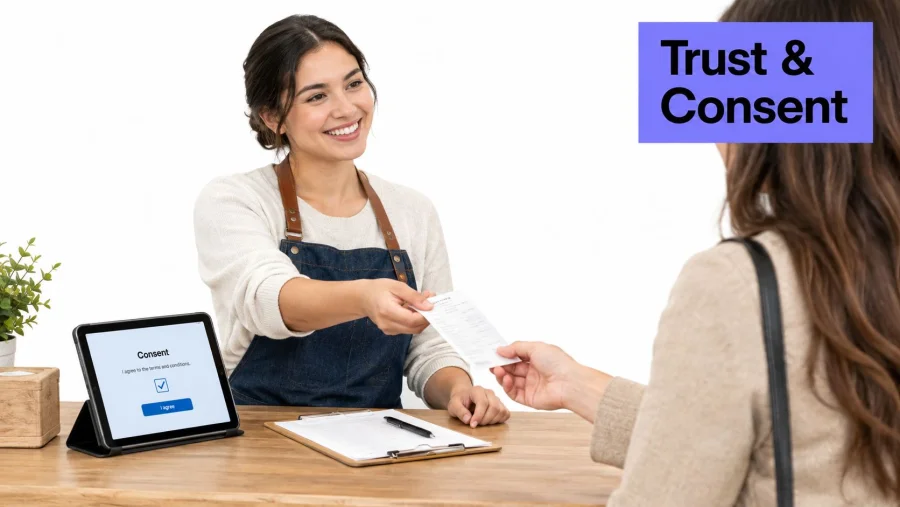
Separate Loyalty From Marketing
Transactional messages administer the scheme, such as confirming a reward. Promotional messages sell something extra. Sign-up should separate those purposes in plain English.
A compliant flow can stay short:
- Account essentials: Collect only the details needed to run membership and rewards.
- Optional promotions: Ask separately for email or SMS offers, with affirmative consent.
- Clear explanation: State what's collected, why it's used, and how long it's kept.
- Visible exit: Put an opt-out route in every marketing message.
Other service businesses face the same trust challenge when explaining choices clearly. The plain-language approach used in Amanda OH dental care resources offers a useful model for separating essential information from optional material without burying people in jargon.
Trust also means flexible loyalty rules. Reduced visit frequency doesn't always mean reduced loyalty, especially during financial pressure. Rigid labels can punish good customers for temporary circumstances. Owners should adapt thresholds, allow communication control, and watch trust signals such as opt-outs and returns after a pause alongside redemptions.
Measuring Engagement So You Can Improve It
Measurement should fit on one page. Owners don't need a dashboard full of vanity metrics. Four numbers show whether a customer engagement strategy creates profitable repeat behaviour.
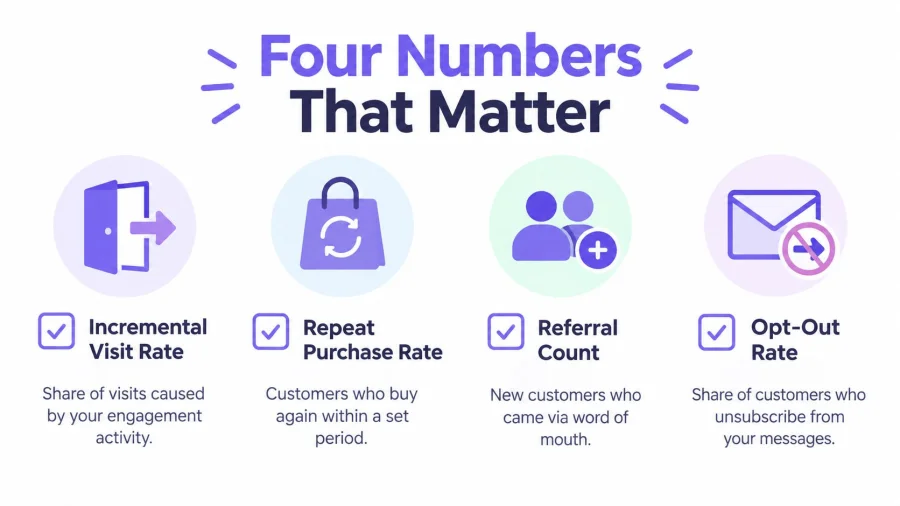
Four Numbers Worth Reviewing Monthly
- Incremental visit rate: Members returning within a set period compared with a similar group that received no prompt.
- Redemption rate: Issued rewards claimed, balanced against reward cost.
- Member share of revenue: Proportion of takings from identifiable repeat customers.
- Time to next visit: Average gap between purchases, watched for shortening or drift.
Built-in loyalty data reporting can surface these patterns without a separate analytics project. The monthly review only needs four prompts: what changed, what worked, what should stop, and what gets tested next. A simple holdout test keeps owners honest. One comparable group receives an offer, another receives nothing, and visit behaviour decides whether the offer earned its cost.
The stakes are real because switching is easy. YouGov's 2024 survey of 1,000 UK adults found that 67% were either very likely or somewhat likely to switch retailers when prices increased, and 93% said prompt customer-service response times were valuable, while separate 2024 research reported 67% felt less loyal to brands than two years earlier compared with 58% the previous year. Fast help, timely value, and measured follow-up aren't extras. They're retention defences.
Start this week with one mechanic, one QR sign-up point, and one win-back rule for quiet customers. Set the first reward within easy reach, separate marketing consent at sign-up, and review repeat visits after the first month. A small, measured loop beats a year of untracked goodwill, so launch the simplest version now and improve it with real customer behaviour.


