Customer engagement in SaaS is defined as the continuous, preference-based management of multi-channel interactions that converts user behaviour into sustained subscriptions and measurable growth. For small to mid-sized SaaS companies, this is not a marketing add-on. It is the operational system that determines whether users activate, stay, and expand. Platforms like Stripe, Courier, and ChurnTools have built entire frameworks around this principle, and the data supports their focus. Median net revenue retention across public B2B SaaS companies sits at 122%, with top performers reaching 155%. That gap between median and top decile is almost entirely explained by how deliberately a company manages engagement at every stage of the customer lifecycle.
What are the core customer engagement metrics for SaaS?
Tracking the right numbers is the foundation of any engagement programme. Without clear metrics, you cannot distinguish between users who are thriving and those who are quietly drifting toward cancellation.
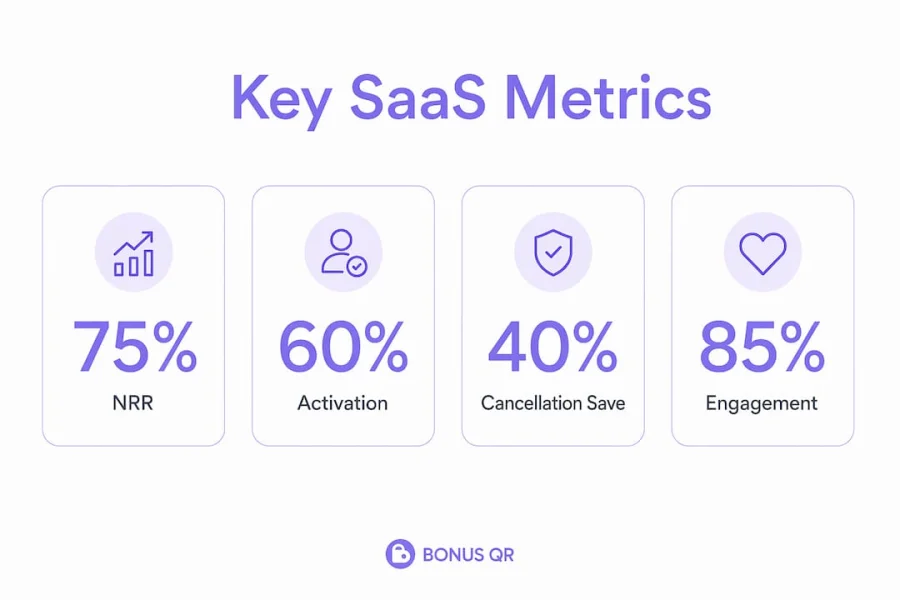
Net Revenue Retention (NRR) measures the percentage of recurring revenue retained from existing customers after accounting for upgrades, downgrades, and cancellations. An NRR above 100% means your existing base is growing without any new sales. The 122% median NRR benchmark tells you that top SaaS companies are not just retaining revenue. They are expanding it through upsells and cross-sells driven by engaged customers.

Activation rate is arguably the most predictive early metric you can track. It measures the percentage of new users who reach a defined “aha moment” within a set timeframe. Activated users churn 60 to 80% less than non-activated users, which makes this the single most important cohort dimension for retention-focused teams. Tracking activation by cohort rather than as an aggregate figure reveals which onboarding sequences actually work.
Cancellation save rate tracks the proportion of customers who intended to cancel but were retained through a save flow. Industry data shows that typical save rates sit at 20 to 30%, while mature, segmented save flows reach 30 to 40%. That difference is worth real revenue at scale.
The table below summarises the five metrics every SaaS engagement team should monitor:
| Metric | What it measures | Why it matters |
|---|---|---|
| Net Revenue Retention (NRR) | Revenue retained and expanded from existing customers | Indicates whether engagement drives growth beyond acquisition |
| Activation rate | Users reaching a defined value milestone early | Predicts long-term retention at the cohort level |
| Cancellation save rate | Customers retained after initiating cancellation | Quantifies the effectiveness of save flows |
| Engagement rate | Opens, clicks, and in-app actions across channels | Shows whether communications are reaching and motivating users |
| Customer health score | Combined score of usage, support tickets, and NPS | Enables proactive intervention before churn occurs |
Health scores deserve particular attention. Companies using health scores that combine usage patterns, support tickets, and NPS reduce churn by 15 to 25% through early intervention. A health score is only useful if it triggers an action. Build it into your customer success workflow from day one.
How do multi-channel engagement platforms enhance SaaS customer interactions?
A customer engagement platform is not the same as a marketing campaign tool. Campaign tools send scheduled messages. Engagement platforms, as Courier describes, centralise multi-channel communication and track business-impacting user engagement metrics in real time. The distinction matters because SaaS users interact across many surfaces, and a fragmented approach creates inconsistent experiences that erode trust.
The channels that matter most for B2B SaaS engagement include:
- Email for lifecycle sequences, renewal reminders, and product updates
- In-app notifications for contextual nudges tied to user behaviour
- Push notifications for mobile-first or hybrid SaaS products
- SMS for high-priority alerts and time-sensitive communications
- Slack and Microsoft Teams for B2B users who live in collaboration tools
Preference management is the piece most teams overlook. If a user has opted out of email but is active on Slack, sending renewal reminders by email is wasted effort. A proper engagement platform routes messages to the channel each user actually uses, which directly improves open rates and response rates.
Integration with analytics tools and Customer Data Platforms (CDPs) like Segment makes this routing intelligent. When your engagement platform receives event data from your product, it can trigger the right message at the right moment rather than relying on a fixed schedule. This is the difference between reactive messaging and proactive engagement.
Pro Tip: Build your notification delivery and routing infrastructure before you invest in campaign complexity. A single API delivery layer, as Courier’s architecture demonstrates, handles routing and preferences at scale and prevents the technical debt that comes from bolting on channels one at a time.
For SaaS companies exploring how multi-channel engagement works across different business models, the principles of preference-based routing apply well beyond software products.
What effective strategies reduce churn and improve SaaS retention?
Improving SaaS customer retention requires a shift from reactive rescue to proactive management. The most effective teams treat engagement as a value-monitoring system, not a last-minute renewal sales tactic. That reframe changes everything about how you structure your outreach calendar and your customer success workflows.
Here are the seven tactics with the strongest evidence behind them:
-
Start renewal outreach 60 to 90 days before contract end. Stripe advises early check-ins segmented by renewal patterns to build momentum and resolve issues before they become blockers. Waiting until 30 days out leaves no time to address product gaps or stakeholder concerns.
-
Segment customers by churn risk, not just account size. A large account with declining usage is a higher churn risk than a small account with growing engagement. Health scores make this segmentation possible.
-
Hit activation milestones fast. ChurnTools reports that activation milestone hits double conversion and triple retention rates. Design your onboarding to reach the aha moment within the first session or first week, not the first month.
-
Deploy behavioural triggers, not scheduled campaigns. Generic scheduled messaging misses the behavioural drop-offs that predict churn. Triggered moments linked to specific user actions are far more effective at re-engaging at-risk users.
-
Build personalised cancellation save flows. Segmenting save offers by cancellation reason prevents offer mismatch. A user cancelling because of price needs a different response than a user cancelling because they cannot find a feature. Personalised save offers consistently outperform universal discounts.
-
Use NPS and CSAT data to identify expansion candidates. Highly satisfied customers are the most receptive to upsell conversations. Engagement data tells you who they are before your sales team has to guess.
-
Automate dunning for payment failures. Failed payments are a mechanical form of churn that engagement automation can address directly. AI-assisted dunning systems recover a meaningful proportion of revenue that would otherwise be lost silently.
Pro Tip: Proactive retention driven by health scores and behavioural triggers drastically outperforms reactive cancel-save strategies. Build your health score model before you need it, not after you notice a churn spike.
How can SaaS companies use customer feedback loops to boost engagement?
A customer feedback loop is a repeatable four-stage process: collect feedback, analyse it, apply changes to the product or service, and communicate the outcome back to the customer. Most feedback programmes fail not at the collection stage but at the final stage. Companies gather data, make changes internally, and never tell the customer what happened. That silence breaks trust and reduces the likelihood that the customer will engage with future feedback requests.
Collecting feedback in context is more effective than periodic survey blasts. A short in-app prompt triggered after a user completes a key workflow produces higher response rates and more relevant data than a quarterly email survey sent to your entire database. Continuous operational collection outperforms periodic blasts on both quality of insight and close-loop rate.
The metrics that indicate a healthy feedback loop are:
- Response rate on in-context surveys (aim for above 15% for in-app prompts)
- Time-to-insight, meaning how quickly feedback is analysed and shared with relevant teams
- Close-loop rate, the proportion of feedback items where the customer received a follow-up communication
Common pitfalls include survey fatigue from over-surveying, siloed feedback data that never reaches the product team, and a lack of governance. Feedback programmes succeed when governance assigns clear owners and links outcomes directly to product and customer success decisions. Without an owner, feedback sits in a spreadsheet and changes nothing.
Pro Tip: When you make a product change based on customer feedback, tell the customers who raised the issue. A simple in-app notification or email saying “You asked for this, we built it” creates a powerful engagement moment that no campaign can replicate.
For teams looking to operationalise this approach, the guide on harnessing customer feedback for loyalty programmes offers a practical framework that translates directly to SaaS contexts.
Which tools best support customer engagement initiatives in SaaS?
The technology stack for SaaS customer engagement has matured considerably. Small to mid-sized teams no longer need to build engagement infrastructure from scratch. The right combination of purpose-built tools covers the full lifecycle from activation to renewal.
Customer engagement platforms like Courier handle multi-channel notification infrastructure through a single API delivery layer. This approach routes messages across email, SMS, push, in-app, Slack, and Teams without requiring separate integrations for each channel. For a small engineering team, this is a significant efficiency gain over building channel-by-channel.
Product analytics tools like Mixpanel and Amplitude track user behaviour at the event level. They answer the question of which features drive activation and which workflows precede cancellation. Without this data, your engagement sequences are based on assumptions rather than evidence.
Customer Data Platforms (CDPs) like Segment sit between your product and your engagement tools. They collect events, standardise them, and route them to the right destination, whether that is your engagement platform, your analytics tool, or your CRM. For SaaS companies with multiple data sources, a CDP prevents the fragmentation that makes personalisation impossible.
The table below maps common engagement challenges to the tools that address them:
| Challenge | Recommended tool type | Example platforms |
|---|---|---|
| Multi-channel message delivery | Engagement platform | Courier |
| Behavioural event tracking | Product analytics | Mixpanel, Amplitude |
| Event routing and segmentation | Customer Data Platform | Segment |
| Health score calculation | Customer success platform | ChurnTools |
| Feedback collection and analysis | Feedback tools | Perspective AI |
Automation of lifecycle sequences is where these tools combine to create real leverage. When Segment routes a “feature not used after 14 days” event to Courier, which then sends a contextual in-app message, you have a triggered engagement moment that no manual process could replicate at scale. For teams exploring SaaS loyalty and retention as part of their engagement stack, integrating reward mechanics with behavioural triggers adds another layer of motivation for continued product use.
Preference centres are the final piece most teams neglect. Giving users control over which notifications they receive, and through which channels, reduces unsubscribe rates and increases the relevance of the messages that do get through. Respecting user preferences is not just good practice. It is a direct driver of engagement quality.
Key takeaways
Effective customer engagement in SaaS requires combining proactive health score monitoring, behavioural triggers, closed feedback loops, and multi-channel delivery infrastructure to reduce churn and drive sustainable revenue growth.
| Point | Details |
|---|---|
| Activation is the priority metric | Activated users churn 60 to 80% less; optimise onboarding to hit the aha moment fast. |
| Start renewal outreach early | Begin renewal conversations 60 to 90 days before contract end to resolve issues with time to spare. |
| Personalise save flows by reason | Segmenting cancellation save offers by reason lifts save rates from 20 to 30% up to 30 to 40%. |
| Close the feedback loop visibly | Communicating product changes back to customers who raised issues builds trust and repeat engagement. |
| Use a single delivery layer | A unified API delivery platform like Courier prevents channel fragmentation and scales with your team. |
Why I think most SaaS teams are solving engagement backwards
After working with dozens of small to mid-sized SaaS businesses on their retention and engagement systems, the pattern I see most often is this: teams invest heavily in acquisition, build a basic onboarding sequence, and then wait to see who cancels. Engagement becomes a fire-fighting exercise rather than a designed system.
The uncomfortable truth is that the metrics most teams track, monthly active users and login frequency, tell you very little about whether a customer is getting value. A user can log in every day and still churn because they are not reaching the outcomes they paid for. Linking engagement metrics directly to renewal outcomes, as Stripe recommends, forces you to ask a harder question: are our customers succeeding, not just using the product?
The teams I have seen make the biggest gains in retention are the ones who build their health score model in the first quarter, not after their first churn spike. They treat behavioural segmentation as a product decision, not a marketing one. And they assign a named owner to their feedback loop, someone whose job it is to close the loop with customers every single month.
Resource constraints are real in small and mid-sized SaaS businesses. You cannot do everything at once. My advice is to start with activation. Fix the onboarding experience so that new users hit their first value milestone within the first week. Everything else, save flows, renewal outreach, feedback loops, becomes easier when your activation rate is strong. Build iteratively from there, and resist the temptation to run one-off campaigns as a substitute for a systematic engagement programme.
— Michal
How Bonusqr supports your SaaS retention and engagement goals
The principles covered in this article, proactive outreach, behavioural triggers, personalised rewards, and closed feedback loops, are exactly what Bonusqr is built to support. Bonusqr’s electronic reward platform lets you design and deploy digital loyalty mechanics, including points, cashback, and milestone rewards, that integrate with your existing SaaS workflows without requiring POS hardware or complex technical setup.
The platform’s mobile and web application capabilities mean your customers can engage with your loyalty programme wherever they are, while the analytics and stats dashboard gives you real-time visibility into engagement performance. For SaaS teams looking to add structured reward mechanics to their retention stack, Bonusqr offers a practical starting point with free and premium tiers to match your current scale.
FAQ
What is customer engagement in SaaS?
Customer engagement in SaaS is the ongoing management of multi-channel interactions between a software company and its users, designed to drive activation, retention, and expansion. It encompasses in-app messaging, email, push notifications, feedback collection, and health score monitoring across the full customer lifecycle.
Which metrics should SaaS companies track for engagement?
The five most important metrics are Net Revenue Retention, activation rate, cancellation save rate, engagement rate across channels, and customer health score. Activation rate is the most predictive early indicator, as activated users churn 60 to 80% less than those who never reach a value milestone.
How early should renewal outreach begin?
Renewal outreach should begin 60 to 90 days before contract end. Stripe advises segmenting this outreach by renewal patterns to build momentum and resolve product or commercial issues before they become blockers to renewal.
What is a cancellation save rate and how can I improve it?
A cancellation save rate measures the proportion of customers who intended to cancel but were retained through a save flow. Industry benchmarks sit at 20 to 30%, but mature save flows that segment offers by cancellation reason can reach 30 to 40%.
How does a customer feedback loop improve SaaS retention?
A closed feedback loop, covering collection, analysis, applied changes, and communication back to the customer, builds trust and increases the likelihood that customers remain engaged. Most programmes fail by collecting feedback but never communicating what changed as a result.


