Client retention strategies are systematic approaches that help small and medium-sized businesses keep customers engaged, loyal, and spending over time. Acquiring a new customer costs five times more than keeping an existing one, which means your retention rate directly determines your profit margin. The best client retention strategies 2025 demands combine Voice of Customer programmes, loyalty platforms like Bonusqr, and behavioural data to deliver consistent value rather than one-off promotions. Customer expectations have shifted. Passive service no longer holds accounts. You need a repeatable system built around early engagement, personalised communication, and measurable outcomes.
What are the most effective client retention strategies for 2025?
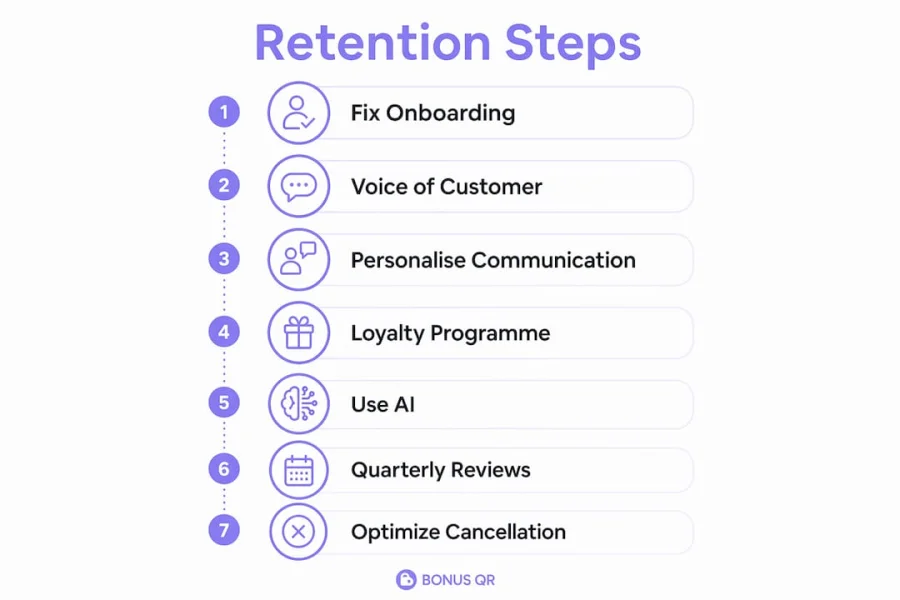
The most effective retention techniques for businesses in 2025 address the full customer lifecycle, from the first login to long-term advocacy. Below are seven strategies ranked by impact for SMB owners.
1. Fix your onboarding within the first seven days

Users hitting activation milestones early are twice as likely to convert and retain three times better long-term. That single finding should reshape your entire onboarding sequence. If fewer than 30% of new clients reach a meaningful activation milestone within their first week, your onboarding has a leak. Fix that before spending a penny on incentives or advertising.
2. Build a Voice of Customer programme with a closed feedback loop
A Voice of Customer (VoC) programme collects structured feedback from clients at defined intervals, then routes that feedback to someone with authority to act on it. Customers are 2.4 times more likely to stay with brands that listen and resolve issues quickly, according to Forrester research. The retention impact of a well-run VoC programme becomes measurable within 90–180 days. The key word is “closed.” Collecting feedback without acting on it damages trust more than collecting none at all.
3. Personalise communication by channel and behaviour
Generic newsletters produce generic results. Behavioural emails triggered by activation milestones are two to three times more effective at re-engagement than broadcast campaigns. Segment your clients by product usage, purchase frequency, and preferred channel, then send messages that reflect where each client actually is in their relationship with you.
Pro Tip: Set up three behavioural email triggers before you build any other campaign: a welcome sequence for new clients, a re-engagement message for anyone inactive after 21 days, and a loyalty reward notification when a client hits a spend threshold.
4. Launch a loyalty and referral programme
Loyalty programmes give clients a tangible reason to return. Points collection, stamp cards, cashback, and tiered rewards all work when they are tied to behaviours you want to reinforce. Referral incentives extend that value by turning loyal clients into advocates. Platforms like Bonusqr make it straightforward to build a loyalty programme without requiring POS integration or technical expertise.
5. Use AI and behavioural data for proactive retention
Proactive retention means identifying at-risk clients before they cancel, not after. AI tools analyse usage patterns, payment history, and engagement signals to flag accounts that need attention. This approach shifts your team from reactive firefighting to planned outreach, which is far more efficient and far less expensive.
6. Run quarterly business reviews, even as an SMB
Quarterly Business Reviews (QBRs) are structured conversations where you review progress, address concerns, and set goals with your client. QBR programmes retain 92–96% of accounts compared to 70–80% for ad-hoc check-ins. QBRs are not exclusive to enterprise sales teams. A 30-minute video call with your top 20 clients each quarter builds the kind of relationship that survives competitor offers.
7. Optimise your dunning and cancellation flows
Involuntary churn, where clients leave because a payment fails rather than because they chose to leave, is one of the most preventable revenue losses an SMB faces. AI dunning systems recover 30–50% of failed payments, reducing involuntary churn by 8–24%. A smart dunning flow includes automatic payment retries, personalised email prompts, and an easy path to update payment details.
How do you measure and track client retention effectively?
Retention measurement is where most SMBs make their biggest mistake. They look at total subscriber or client counts and conclude things are fine. Aggregate numbers hide the truth. Cohort analysis reveals it.
Why cohort analysis changes everything
A cohort is a group of clients who started with you in the same period, for example, everyone who signed up in january. Subscription retention analysed using cohort data over 60–90 days reveals the real retention curve. A programme may look healthy at the top line while losing 60% of a specific cohort by their third month. Without cohort tracking, you would never see that problem until it became a crisis.
When you make changes to your programme, pricing, or onboarding, track separate cohorts for each version. Label your dashboards by cohort start month and configuration version. This keeps your data clean and your conclusions accurate.
Key metrics every SMB should track
| Metric | What It Measures | Why It Matters |
|---|---|---|
| Gross Retention Rate | Percentage of revenue retained, excluding upsells | Shows baseline loyalty without expansion effects |
| Net Revenue Retention | Revenue retained including upsells and expansions | Indicates whether existing clients are growing with you |
| Activation Rate | Clients reaching key milestones within 7 days | Leading indicator of long-term retention |
| Monthly Churn Rate | Percentage of clients lost each month | Benchmark: median SaaS churn is around 4.7% |
| Customer Lifetime Value | Total revenue expected from a client relationship | Guides how much to invest in retention per client |
Pro Tip: Track activation rate as your primary leading indicator. Churn rate tells you what already happened. Activation rate tells you what is about to happen, giving you time to intervene.
Monitoring leading indicators gives you a window to act before a client leaves. If activation rates drop in a new cohort, you know your onboarding needs attention weeks before that cohort’s churn rate rises. This is the difference between managing retention proactively and reacting to losses after the fact.
Which tools support client retention for smbs in 2025?
The right technology does not replace good strategy. It makes good strategy repeatable and measurable. Below is a comparison of the main tool categories SMBs should consider when building their retention stack.
| Tool Category | Primary Function | SMB Suitability |
|---|---|---|
| Loyalty platforms (e.g., Bonusqr) | Points, stamps, cashback, referral rewards | High: no POS needed, free tier available |
| CX feedback tools (e.g., Zonka Feedback) | VoC surveys, NPS, closed-loop alerts | High: scalable pricing, easy setup |
| Behavioural email platforms | Triggered campaigns based on user actions | Medium: requires data integration |
| AI dunning tools | Automated payment recovery | Medium: most value at higher revenue volumes |
| CRM with retention dashboards | Cohort tracking, churn alerts, client history | High: central to any retention system |
Bonusqr sits at the practical end of this stack. Its customer loyalty cards support points collection, stamp cards, cashback, and visit-based rewards. The platform’s mobile and web app lets you manage campaigns, send push notifications, and view real-time analytics without needing a developer. For clients who prefer digital wallets, Bonusqr supports Google and Apple Wallet integration, making loyalty cards accessible directly from a smartphone.
Investing in a quality CX technology stack including AI, messaging, and feedback tools strengthens retention by improving the overall customer experience. The Zendesk 2026 guide identifies 12 key retention strategies, the majority of which depend on technology to execute at scale. For SMBs, the priority is choosing tools that integrate with each other and do not require a dedicated IT team to maintain.
Pricing structure also affects retention. Annual pricing reduces churn three to five times compared to monthly plans. If you offer a subscription or retainer model, presenting an annual option with a modest discount is one of the highest-return retention moves available to you.
How do you implement retention strategies step by step?
Knowing the strategies is one thing. Executing them without losing momentum is another. Here is a practical sequence for SMB owners starting from scratch or rebuilding a retention system.
Step 1: Set a clear retention goal
Pick one metric to improve first. Gross retention rate is the most honest starting point. Decide what improvement you are targeting over the next 90 days and write it down. Vague goals produce vague results.
Step 2: Audit your onboarding flow
Map every step a new client takes in their first seven days. Identify where drop-off happens. Most retention gains come from addressing early onboarding leaks before attempting incentives. Fix the leak before you add rewards.
Step 3: Launch a VoC programme
Start with a simple NPS survey sent at day 30 and day 90. Assign one person to own the feedback and respond to every detractor within 48 hours. A successful VoC programme requires defined cadence, ownership, and an action loop. Without ownership, feedback sits unread and clients feel ignored.
Step 4: Design your loyalty reward structure
Decide which behaviours you want to reward: repeat purchases, referrals, visit frequency, or spend thresholds. Keep the reward structure simple enough that clients understand it in one sentence. Complexity kills participation.
Step 5: Personalise your communication cadence
Build a communication calendar that includes onboarding messages, milestone celebrations, re-engagement prompts, and loyalty reward notifications. Use proven retention strategies to inform your messaging approach, particularly around reducing churn through timely, relevant contact.
Step 6: Review and iterate quarterly
Hold a monthly internal review of your retention metrics. Hold a quarterly review with your top clients. Adjust your strategy based on what the data shows, not what you assumed would work.
Common mistakes to avoid:
- Treating all clients as one cohort instead of segmenting by start date and behaviour
- Reacting to churn after it happens instead of monitoring leading indicators
- Launching a loyalty programme without a clear reward redemption path
- Sending generic communications to clients at different lifecycle stages
- Skipping follow-up after collecting VoC feedback
Pro Tip: Run a 30-day retention sprint. Pick one strategy from this list, implement it fully, and measure the impact before adding another. Stacking too many changes at once makes it impossible to know what is working.
What i have learned about retention after years of watching smbs struggle
Most SMB owners I speak with treat retention as a reaction. A client goes quiet, so they send a discount. A client cancels, so they offer a free month. That approach is expensive and ineffective. It trains clients to wait for a crisis before they get attention.
The businesses that retain clients consistently treat retention as a system, not a response. They have defined onboarding milestones. They collect feedback on a schedule. They send communications triggered by behaviour, not by calendar. They review cohort data monthly. None of this is complicated, but all of it requires discipline.
The part that surprises most SMB owners is how much early onboarding matters. I have seen businesses spend thousands on loyalty incentives while losing 40% of new clients in the first two weeks because the onboarding experience was confusing. Fix the beginning before you invest in the middle.
VoC programmes are underused by SMBs because they feel like an enterprise tool. They are not. A simple NPS survey with a committed follow-up process costs almost nothing and builds the kind of trust that no discount can buy. Clients who feel heard stay longer and spend more.
AI and automation are genuinely useful here, particularly for dunning and behavioural emails. But they work best alongside human touchpoints, not instead of them. A QBR call with a long-term client does something that no automated email can replicate. It signals that you value the relationship, not just the transaction.
Retention is the most sustainable competitive advantage available to an SMB. It compounds. A client who stays for three years and refers two others is worth ten times a client who churns after six months. Build the system that earns that loyalty, and customer service retention becomes a genuine growth driver rather than a cost centre.
— Michal
How Bonusqr can support your retention efforts
Building customer loyalty in 2025 requires tools that work without complexity. Bonusqr gives SMB owners a practical platform to launch and manage digital loyalty programmes quickly. You can set up customer loyalty cards with points, stamps, cashback, or visit-based rewards in a matter of hours, with no POS integration required. The platform’s mobile and web app lets you send push notifications, track engagement in real time, and automate reward campaigns. Clients can store their loyalty cards directly in Google or Apple Wallet for frictionless access. If you are ready to turn your retention strategy into a working system, explore what Bonusqr offers at bonusqr.com/register.
Key takeaways
The most effective client retention strategies for 2025 combine early onboarding fixes, structured feedback loops, loyalty rewards, and cohort-based measurement into a repeatable system that compounds over time.
| Point | Details |
|---|---|
| Fix onboarding first | Users who hit activation milestones within 7 days retain three times better long-term. |
| Use cohort analysis | Track separate client cohorts to reveal real retention curves and avoid misleading aggregate data. |
| Close the feedback loop | VoC programmes only work when feedback triggers a defined action within 48 hours. |
| Reward the right behaviours | Loyalty programmes should reinforce repeat visits, referrals, or spend thresholds with clear, simple rewards. |
| Measure leading indicators | Activation rate predicts churn before it happens; monitor it monthly alongside gross retention rate. |
FAQ
What is the average client churn rate for small businesses?
Monthly churn benchmarks vary by sector, but median SaaS churn sits around 4.7%, with best-in-class enterprise products under 1%. SMBs should use this as a reference point and aim to reduce churn by addressing onboarding and payment failure first.
How quickly do retention strategies show results?
Onboarding improvements can show results within 30 days. VoC programmes and loyalty initiatives typically take 90–180 days to produce measurable retention gains. Set realistic timelines and track cohort data to see genuine progress.
Do loyalty programmes actually improve client retention?
Yes. Loyalty programmes work when the reward structure is clear and tied to behaviours clients repeat naturally, such as purchases, visits, or referrals. Platforms like Bonusqr make it straightforward to launch a loyalty programme without technical complexity.
Are quarterly business reviews realistic for smbs?
Absolutely. QBR programmes retain 92–96% of accounts versus 70–80% for ad-hoc contact. A 30-minute video call with your top clients each quarter is achievable for any SMB and produces a measurable retention lift.
What is the single highest-return retention action for an SMB?
Fixing onboarding leaks produces the highest return because it addresses the point where most clients are lost. After that, implementing proven retention approaches such as behavioural email triggers and annual pricing options delivers strong, measurable results at low cost.


