Best QR Loyalty App for Small Business in 2026
The best QR loyalty app for a small business is one that customers can use after a single scan, that you can launch without buying or connecting a POS system, and that handles rewards, reminders and reporting for you. BonusQR is built around exactly that: stamp cards, points, cashback and fixed discounts run from a QR code, with a Free plan to start and paid plans at €19 and €69 per month. Below you will find the criteria that separate a good QR loyalty app from a clumsy one, the main types of option compared, and a way to match each type to your kind of business.
Key Takeaways
- A QR loyalty app should work in seconds for the customer and in minutes for you: scan, sign up, earn, redeem, with no extra hardware.
- The biggest practical dividing line is whether the app depends on a specific POS or works independently. Independent QR platforms are faster to launch for cafes, gyms, salons and small shops.
- Look for several reward types (stamps, points, cashback, fixed discounts), automated notifications, and analytics that show who comes back.
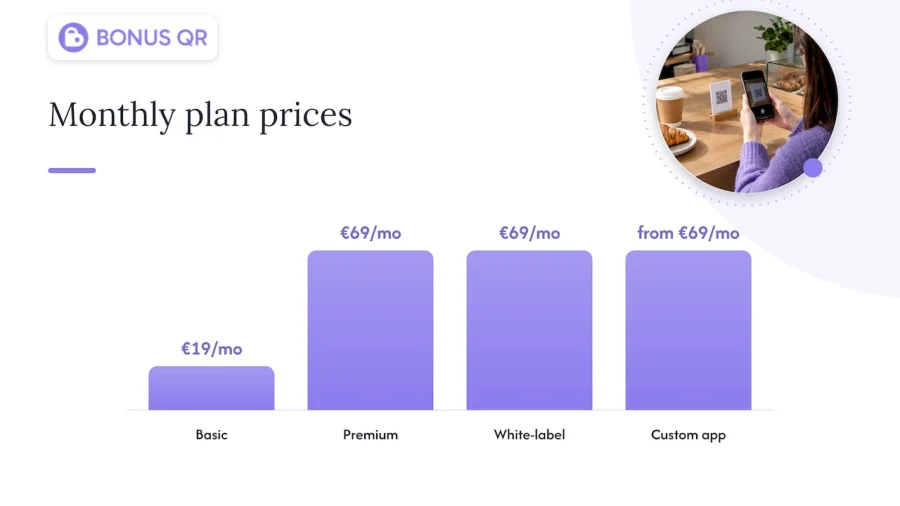
- BonusQR starts free, then costs €19 per month (Basic) or €69 per month (Premium), with a branded white-label app available for larger businesses.
- Choose a QR-only card when speed matters most, and add a branded app or wallet card once you want richer personalization.
How a QR Loyalty Program Works for Your Customers
A QR loyalty program replaces the paper punch card with a code. The customer scans your QR code with their phone camera, signs in or creates an account in the browser, and an accepted visit adds progress to their card. Once the target is reached, a staff member with the right permissions confirms the redemption, as Bitly’s guide to QR code loyalty programs describes the typical flow.
For you, the appeal is simple. There is nothing to install at the counter, nothing for the customer to download before their first reward, and no card to lose. Repeat customers are the lifeblood of any small business, and the less friction between a purchase and a reward, the more often customers actually use the program.
The flow in practice looks like this:
- You display a QR code at the till, on tables, on receipts or on the door.
- A new customer scans it and joins in a short sign-up.
- Each purchase or visit earns a stamp, points or cashback, depending on the program you configured.
- The customer sees progress on their phone and receives a reward when they hit the threshold.
- You see the activity in your dashboard and can message customers who have gone quiet.
The quality of an app shows in how few of those steps need your attention once the program is live.
What to Look for in a QR Loyalty App
Bitly’s guide points to a few features that matter in any QR program: codes you can customize and track, branding that matches your business, and real-time scan tracking with analytics. It also notes that connecting to a POS or CRM through an API can automate point allocation, which is useful for businesses that already run those systems. For a small business that has no such system, the same list translates into a practical checklist.
No POS required
Many loyalty tools assume you already have, or will buy, a compatible point-of-sale system. A QR-first platform skips that dependency. This is the single biggest time saver for a cafe, barbershop, gym or neighborhood store that runs on a basic card reader or a cash drawer. BonusQR is designed to run without a POS, so you can start from a QR code alone.
Several reward mechanics
A stamp card suits a coffee shop. Points suit a retailer where basket sizes differ. Cashback suits a grocery store or gas station where customers want a visible return on spend. A fixed discount suits a salon or spa that wants to reward every tenth visit. The more mechanics one platform offers, the less likely you are to outgrow it. BonusQR covers stamp cards, points, tiered cashback, fixed discounts, rewards for visits and for spend, onboarding promotions and special occasion rewards.
Protection against abuse
If stamps are added automatically on every scan, a customer can scan the code repeatedly without buying anything. A good setup confirms each stamp or purchase in a way staff can control. Ask any platform how stamps are validated before you print the code and put it on your counter.
Customer communication
A loyalty program that only counts visits leaves value on the table. The feature that turns a card into a retention tool is the ability to send a push or email notification: a reward that is about to expire, a birthday offer, a quiet-day promotion. Look for automation, so that these messages go out without someone remembering to write them.
Analytics you will actually read
You want to know how many members you have, how often they return, which rewards get redeemed and which customers have lapsed. Dashboards that answer those four questions are worth more than dozens of charts.
Branding and growth modules
Your card should look like your business. Referral and review modules help new customers find you and happy ones tell others, which fits the broader logic of social proof strategies that support engagement and visibility online.
Setup time
For a busy owner, a platform you can configure in an afternoon beats a more powerful one that needs a consultant. Test setup speed by asking how long it takes from sign-up to a live QR code on your counter.
The Main Types of QR Loyalty Options Compared
The market has four broad types of option. Individual brands differ, and features and pricing change, so use the types below to narrow your shortlist and then check what each vendor publishes today.
| Type | How customers join | Needs a specific POS? | Best for | Typical limitation to plan around |
|---|---|---|---|---|
| QR-first loyalty platform (BonusQR) | Scan a QR code, short sign-up | No | Cafes, restaurants, gyms, salons, small retail, grocery, gas stations | None to plan around for most small businesses |
| POS-bound loyalty add-on (for example Square Loyalty) | Linked to the phone number or card at checkout | Yes, it lives inside the POS | Businesses already committed to that POS | Tied to that POS ecosystem |
| Wallet-pass card tools (for example Loopy Loyalty) | Scan, then add a pass to Apple or Google Wallet | No | Businesses that want a wallet card and little else | Narrower marketing and reward options |
| Stamp-card apps (for example Stamp Me) | Download an app or scan a code | Varies | Simple stamp programs | Reward types often centered on stamps |
Two things stand out when you compare like this. First, the decision is less about brand names than about your starting point: if you already run a POS with its own loyalty module, that is one path, and if you do not, a QR-first platform is the shortest one. Second, flexibility matters over time. A business that begins with stamps often wants points, cashback or tiers a year later, and migrating customers between tools is the most painful part of switching.
BonusQR: The Pick for Most Small Businesses
BonusQR is a QR-based digital loyalty platform built for small businesses. Customers earn rewards through points, stamps and cashback, and the platform automates reward distribution, customer insights and promotional notifications so you can stay focused on operations.
What you get
- Customizable digital stamp cards, points systems and tiered cashback
- Fixed discounts, onboarding promotions and special occasion rewards
- Coupon and reward management
- Automated marketing with push and email notifications
- Referral and review modules
- Analytics on customer behavior
- Brand and app customization, mobile and web app integration, and Apple and Google Wallet support
Pricing as published on BonusQR’s pricing page
| Plan | Price |
|---|---|
| Free | No published price |
| Basic | €19 per month |
| Premium | €69 per month |
For larger businesses that want their own branded app, the white-label option has a one-off setup fee of €690 and a monthly subscription of €69. Businesses with specific requirements can commission a custom app from €1,500 one-off, with monthly maintenance from €69. The custom route can include e-shop and booking widget features.
Best for: owners of cafes, restaurants, gyms and wellness centers, salons and service businesses, retailers, grocery stores, hotels and gas stations who want a loyalty program running quickly without technical work, and who want room to grow from a free start to a branded app.
Match the App to Your Kind of Business
Cafes and restaurants
Speed at the counter decides whether a program survives. A stamp card or a visit reward scanned from a table or till code keeps the line moving. Restaurants that want to see how rewards systems differ can read our comparisons of restaurant rewards systems and restaurant loyalty software, and our examples of restaurant loyalty programs show reward structures you can copy.
Gyms, salons and wellness centers
Visits are frequent and predictable, so a visit-based reward or a tiered program works well. Automated notifications help here more than anywhere: a reminder to a member who has not visited in three weeks is often the cheapest retention tool you have.
Retail and grocery
Basket sizes vary, so points or cashback tied to spend are the natural fit. Fixed discounts at a set number of points give customers a clear target.
Hotels and gas stations
These businesses need a program that guests or drivers can join in seconds, often once, then return to months later. A wallet card keeps the reward within reach, which is where Apple and Google Wallet support helps.
Larger or multi-site businesses
Once you want your own name on the app icon, a white-label app gives you a branded experience, and a custom build lets you add booking or e-shop features. This is the route to consider when the loyalty program becomes part of your brand rather than a tool behind the counter.
QR Loyalty Card or Downloaded App?
A QR-based system is fast to roll out and effortless for customers, since nobody has to visit an app store before earning a first stamp. A downloaded app offers richer personalization and more direct communication. The question is which matters more at your stage.
- Choose a QR card first when you want customers enrolled during their first visit, when your visits are short (a coffee, a haircut), or when you are testing whether loyalty works for your business.
- Add a branded app or wallet card when your customer base is established, when you want push notifications under your own name, or when you offer ordering or booking and want it in one place.
The practical answer for most small businesses is not to choose. A platform that supports QR enrollment, wallet cards and a branded app lets you start light and move up without rebuilding your customer list. That is the path BonusQR is designed around.
How to Launch Your Program in a Day
- Pick one reward you can afford. A free drink after ten purchases or a discount after a set number of visits is easier to sustain than a complicated scale. Work out the cost of the reward against the value of ten visits.
- Set up the card. Choose the mechanic, name the reward and add your logo and colors. With BonusQR you can begin on the Free plan.
- Place the QR code where decisions happen. The counter, the table card, the receipt and the door all work. Add a short line telling people what they earn.
- Train staff in one sentence. They should be able to say what the card earns and how to scan it.
- Turn on automation. Welcome offers for new members and reminders for lapsed ones are the highest-value messages.
- Review after a month. Look at sign-ups, repeat visits and redemptions, then adjust the threshold or reward.
If you want more detail on design choices, our digital loyalty card guide walks through them.
What to Check Before You Commit
Before choosing any app, make sure you have clear answers to a handful of questions:
- Does it need a POS? If the answer is yes, add that cost and setup time to your estimate.
- Which reward types are included on which plan? Plans differ in what they unlock, so match the plan to the program you want to run.
- What does it cost at 100, 500 and 2,000 members? A plan that looks cheap at launch can change as you grow.
- Who owns the customer data and how easy is it to export? Your member list is a business asset.
- Can you add a branded app later? Growth should not mean starting over.
- How are stamps validated? This protects your margin.
- Which rules apply to messaging? Marketing emails and texts are regulated by country. In the US, for example, the FTC explains the CAN-SPAM rules for commercial email, so make sure customers opt in to your notifications and can opt out.
Our Perspective
We built BonusQR for the owner who does not have an IT department or a spare afternoon. Most small businesses we think about do not need a complicated loyalty engine. They need customers to come back, a reward that is easy to understand, and a way to see whether it works.
That is why we start with a QR code and no POS requirement. A customer can join on the first visit, and you can launch in a day. From there, the same platform grows with you: more reward types, automated notifications, referral and review tools, analytics, and when you are ready, a white-label or custom app under your own brand.
Our view is that loyalty should feel like part of running the business, not another system to maintain. When rewards, messages and insights are automated, you spend your time on the people in front of you, and the program keeps working for the ones who are not.
Michal Palus
Start With the Plan That Fits Today
If you are ready to launch, BonusQR’s plans begin with a Free option, then Basic at €19 per month and Premium at €69 per month. Larger businesses that want their own app can look at the white-label setup, and those with unique requirements can explore custom app development.
FAQ
What is the best free QR loyalty app?
The best free option is the one that lets you run a real program, not just a demo. BonusQR has a Free plan, so you can set up a QR-based loyalty card and see how your customers respond before moving to Basic at €19 per month or Premium at €69 per month.
Do customers need to download an app to use a QR loyalty card?
Not with a QR-based card. Customers scan your code with their phone camera and sign in or register in the browser, and progress is added to their card after an accepted visit. They can later add the card to Apple or Google Wallet where the platform supports it.
Can I run a QR loyalty program without a POS system?
Yes. A QR-first platform works independently of your till, which is why it suits cafes, salons, gyms and small shops. BonusQR is designed to run with no POS required.
Which reward type should I choose: stamps, points or cashback?
Use stamps when the purchase is small and frequent, such as coffee. Use points or cashback when spend varies, as in retail, grocery or fuel. Use a fixed discount or visit reward for appointment-based services like salons and gyms.
When should I move to a branded app?
Consider a branded app when your member base is established and you want your own name on the home screen, or when you want to add ordering or booking. BonusQR offers a white-label app with a €690 one-off setup fee and a €69 monthly subscription, and custom app development from €1,500 one-off.


