The most refined loyalty platform isn't automatically the best reward app for every UK merchant. A coffee shop may need a stamp card customers can use in seconds, while a salon may gain more from automated rebooking prompts and birthday offers. A multi-site retailer may prioritise POS integration, card-linked identification and unified customer data instead.
The practical choice depends on the bottleneck. This comparison weighs setup effort, sign-up friction, reward flexibility, marketing depth, reporting, pricing visibility, POS requirements and GDPR-safe data handling. It also considers whether customers need another app, can use a wallet pass, or can join through a QR code without downloading anything.
The seven platforms below solve different loyalty problems. BonusQR is a relevant simpler option for merchants who want QR-based rewards without POS integration or extra hardware, but it isn't a universal winner. The right choice depends on the business type, budget, customer behaviour and operational complexity.
1. Square Loyalty
Square Loyalty makes the most sense when a business already runs payments, ordering or marketing through Square. Because the loyalty programme sits inside the wider Square ecosystem, staff can enrol customers at checkout and connect rewards with in-store and online activity without introducing a separate operational layer.
Customers can join at the POS, through Square Online, on invoices or via a shareable link. Wallet pass support for Apple Wallet and Google Wallet can help customers check in or redeem without searching for a dedicated loyalty app. A café using Square for counter orders and online collection can therefore keep earning activity close to the existing checkout flow.
Best for Square-based operators
The reward structure supports points or stamp-style programmes, multiple rewards, points expiry and item exclusions. Multi-location support is useful for a small chain that wants common rules across sites while still managing locations within one system.
The main trade-off is dependency. Square Loyalty is strongest when the merchant has already standardised on Square hardware and software. A business using another POS may find that the native integration advantage disappears, leaving an additional loyalty layer to manage.
Practical rule: Choose Square Loyalty when the POS is already Square. Don't select it solely because the feature list looks familiar if the business would need to replace or work around its current checkout system.
Pricing is charged per location per month, and public pricing isn't always displayed upfront. That makes the total cost harder to assess before a sales or account discussion, particularly for businesses with several sites.
Merchants comparing this route with lighter QR systems should also consider this guide to POS loyalty programmes for small businesses. Square's advantage is connected transaction data. Its limitation is that the merchant gets the best experience only by staying inside the Square environment.
Website: Square Loyalty
2. Loyalzoo
Loyalzoo is suited to independent cafés, salons and retailers that want loyalty combined with customer messaging. It supports both points and stamps, so a coffee shop can reward repeat visits while a salon can use spend-based points or a membership structure.
The platform includes promotions through email, SMS and push notifications, along with birthday and automated marketing. That gives a merchant more room to communicate beyond the basic “one more visit until a reward” message. A salon could combine a loyalty offer with a birthday promotion, while a retailer could promote a seasonal product to returning customers.
Memberships are a useful differentiator
Loyalzoo also supports paid memberships, subscriptions and recurring payments. This matters for businesses that want predictable customer relationships rather than occasional reward redemptions. A beauty business, gym or specialist retailer may use membership billing alongside loyalty to create a more structured programme.
Apple Wallet and Google Wallet passes reduce reliance on a separate branded app. An optional branded progressive web app is available for businesses that want a more distinctive customer-facing experience without requiring every customer to install a conventional app.
The pricing model is comparatively easy to investigate because the site provides public pricing and a seven-day trial. However, prices are shown in US dollars, and UK customers will need to account for VAT. Integration depth also varies by POS, so a merchant should verify the exact connection available for its till rather than assuming every marketplace listing provides the same functionality.
A useful comparison is this guide to digital loyalty programmes for small businesses, particularly for merchants deciding whether marketing automation justifies a more involved setup.
Loyalzoo works well for businesses that want a visible CRM layer and memberships. It may be more than a single-site café needs if a simple QR stamp card would solve the repeat-visit problem.
Website: Loyalzoo
3. Stamp Me
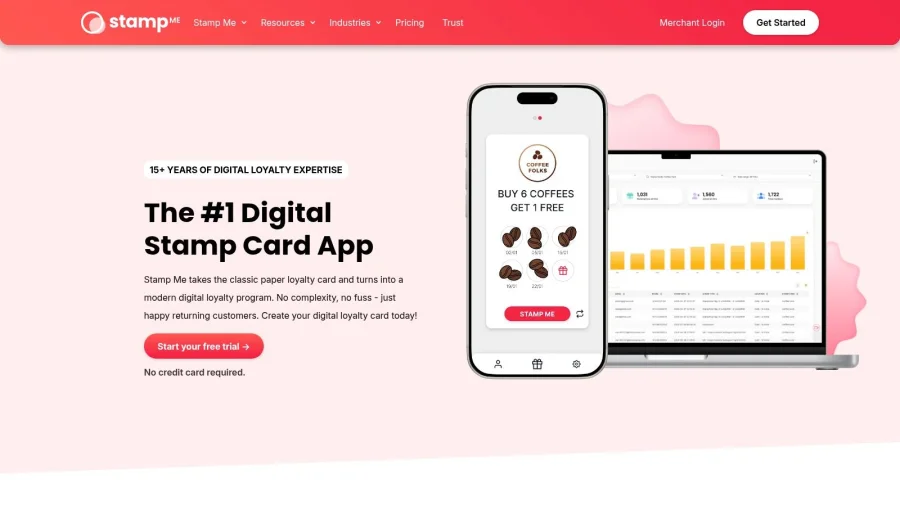
Stamp Me focuses on the most familiar loyalty mechanic, a digital stamp card. It doesn't require POS integration, which makes it attractive to independents and chains that want to launch quickly without changing how payments are processed.
A merchant can use QR codes or NFC Stamp Tags. Customers interact with the tag through the consumer Stamp Me app, while staff can keep the operational process close to a paper card, without the printing, loss and manual storage that physical cards create.
A low-change launch for repeat visits
The platform covers cafés, quick-service restaurants, salons, gyms and retail. That broad category fit is useful because the core model is easy to explain. A café can reward visits, a salon can reward completed appointments, and a gym can recognise attendance without building complex spend rules.
Plans include Lite, Pro and Elite options, onboarding resources and staff training. The subscription is paid monthly, with annual discount options. The merchant should still confirm the complete feature and price combination before committing, because pricing details require additional navigation or contact with sales rather than appearing together on one clear public page.
Stamp Me is less suitable where reward eligibility depends on detailed transaction data. A retailer that needs item exclusions, basket-level rules or POS-tied earning may find a dedicated stamp model restrictive. The platform is strongest when the behaviour being rewarded is simple and visible, such as visits or completed purchases.
A stamp card succeeds when staff can explain it in one sentence and customers can use it before leaving the counter.
Businesses considering this approach can use a practical guide to setting up a stamp-based loyalty programme. The main decision is whether customers will accept the Stamp Me app as part of the experience, or whether a wallet pass or browser-based QR flow would create less friction.
Website: Stamp Me
4. SQUID Loyalty
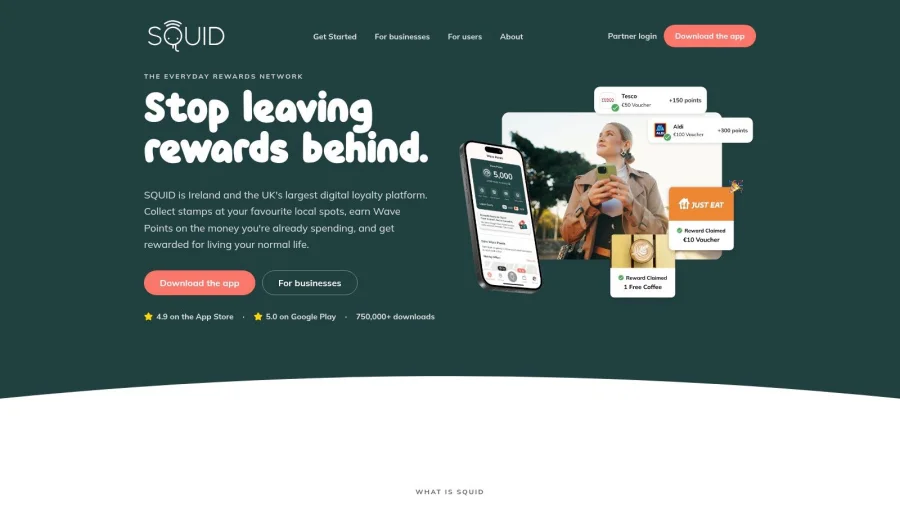
SQUID Loyalty solves a different problem from a standalone merchant stamp card. It combines NFC tap-to-stamp loyalty with a local network, so customers can discover participating venues as well as collect rewards from them.
That network effect may suit high-street clusters, independent cafés and local businesses that benefit from shared footfall. A customer already using SQUID at one venue may encounter another nearby business through the same consumer app, creating a discovery route that a private loyalty card can't provide.
Low staff effort, shared customer network
The business uses SQUID tags, and customers tap to record a stamp on a branded digital card within the SQUID app. The business and consumer apps provide real-time tracking, while the merchant's existing POS can remain in place. Staff don't need to reconcile a paper card or operate a complicated checkout workflow.
The cost structure is tied to active-user tiers. That can be sensible for a small programme with limited activity, but costs rise as participation grows. Merchants should model the relationship between active users and recurring fees before promoting the programme widely.
The largest customer-side compromise is the app requirement. Customers need to download SQUID, and wallet-pass alternatives aren't the platform's core experience. That adds a step compared with a QR system that opens in a mobile browser or a pass that sits directly in Apple Wallet or Google Wallet.
Use SQUID when local discovery is part of the value proposition. Use a simpler private card when the only objective is rewarding visits to one venue.
SQUID is a practical choice for merchants that value low staff lift and community reach. It is less compelling for operators who want full control over the customer interface, advanced spend rules or a no-download sign-up flow.
Website: SQUID Loyalty
5. Embargo
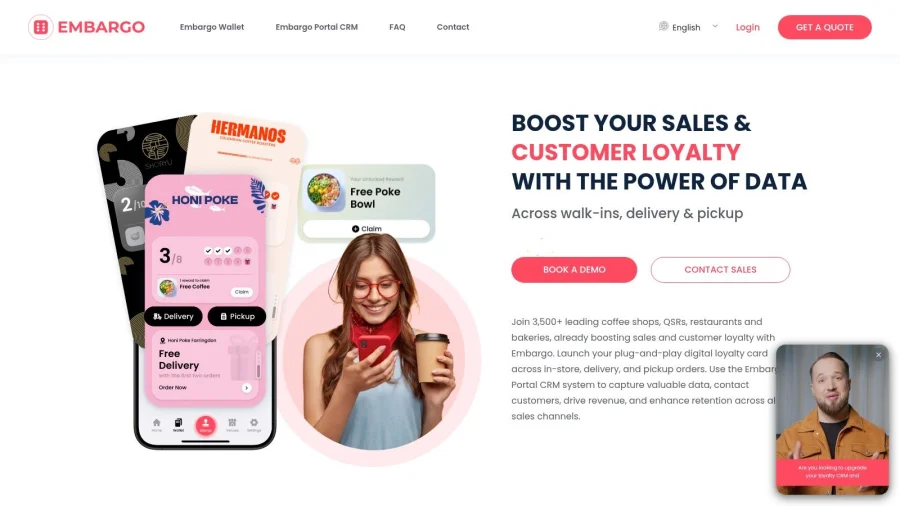
Embargo targets hospitality businesses that want loyalty to sit beside ordering and customer relationship management. Its branded digital stamp card lives in the Embargo Wallet app, while the wider platform adds delivery, click and collect, marketing and analytics.
That combination is relevant to cafés, bakeries and fast-casual brands with more than one customer journey. A bakery can reward an in-store purchase, promote a collection offer and use customer data for a later campaign. A growing café brand can connect loyalty with direct ordering rather than sending every interaction through a third-party marketplace.
Loyalty connected to direct ordering
Embargo includes a CRM with more than 40 reports, plus multi-channel marketing and analytics. The value isn't the report count by itself. The value comes from connecting customer activity with operational decisions, such as which offers drive collection orders or which audience should receive a reactivation message.
The platform promotes a quick go-live, with design and launch possible in 1 to 3 days, and uses a simple in-store device. That can reduce implementation disruption for a hospitality team that needs a working system quickly.
The trade-off is commercial visibility. Pricing is quote-based and isn't publicly listed, so the merchant needs to ask for the full recurring, setup and transaction-related cost. The customer experience also depends on adoption of the Embargo Wallet app, which creates more friction than a browser-led QR flow for occasional visitors.
A single-site café with no direct ordering strategy may not use enough of the platform to justify the added scope. A hospitality operator already investing in CRM, delivery and click and collect may find the combined approach more coherent than stitching separate tools together.
Website: Embargo
6. Yoyo Rewards
Yoyo Rewards is built for merchants that want to reduce the number of actions customers take at checkout. Its bank-card-linked loyalty model lets customers use a debit or credit card as the loyalty identifier, removing the need to scan a separate app or remember a membership code.
That approach suits retail and food chains, as well as independents with enough transaction volume to benefit from more advanced targeting. A customer can earn through WhatsApp or Apple Wallet and Google Wallet, and Yoyo also offers a no-app option.
Frictionless identification for larger programmes
The merchant side goes further than a basic stamp card. Yoyo provides real-time insights on redemptions, float and spend, with API access for businesses that need data to flow into existing systems. Enterprise-grade rules and segmentation support targeted offers rather than one promotion for everyone.
A food chain could use different rewards for lunch customers and evening customers. A retailer might segment offers by spend behaviour. These use cases depend on clean implementation and clear consent practices, not just on activating a feature.
The cost is sales-led and typically isn't designed for micro-operators. Implementation can require coordination between the loyalty provider, payment environment, data systems and marketing team. That makes Yoyo a poor fit for a small café seeking a same-week stamp-card launch, even if the customer experience itself is attractive.
The less customers need to do, the more carefully the merchant must manage consent, matching logic and data governance.
Yoyo is the strongest candidate in this list for frictionless card-linked loyalty and complex customer targeting. Merchants should request a detailed implementation plan, data-flow explanation and complete commercial proposal before comparing it with lighter platforms.
Website: Yoyo Rewards
7. Stampede
Stampede is designed for hospitality operators that want loyalty connected to a broader guest profile. It brings together bookings, guest Wi-Fi, reviews, payments, marketing and loyalty, allowing a restaurant, pub or group to connect activity across several touchpoints.
The loyalty record can include bookings, Wi-Fi interactions, orders and reviews. That gives the merchant a more complete view of the guest than a stamp count alone. A restaurant could identify a customer who booked previously, joined Wi-Fi during a visit and later left a review, then use that context to shape a follow-up offer.
An end-to-end guest view
Automated workflows can award points, trigger offers and encourage repeat visits. This is useful for venues with varied visit patterns, where a basic “buy several, receive one free” mechanic doesn't capture table bookings, order value or guest engagement.
Stampede is built for UK venues and cites a footprint of more than 2,500 UK venues on its website. That figure is a product-published claim, so merchants should assess the relevance of its integrations and support for their own venue estate rather than treating footprint alone as proof of fit.
The platform can reduce vendor sprawl by combining several functions. That benefit comes with a corresponding cost in onboarding and decision-making. Pricing isn't public, onboarding is sales-led, and a single-site small operator may pay for more functionality than the team can actively use.
Stampede works best when the business already needs a connected hospitality stack. It isn't the obvious choice for a salon, independent retailer or café that only needs a quick visit reward and straightforward customer messaging.
Website: Stampede
Top 7 UK Reward Apps Comparison
| Solution | 🔄 Implementation complexity | 💡 Resource requirements | ⭐ Expected outcomes | 📊 Ideal use cases | ⚡ Key advantages |
|---|---|---|---|---|---|
| Square Loyalty (UK) | 🔄 Low–Medium, native if already on Square; higher otherwise | 💡 Requires Square POS/Online; per-location fees; minimal staff training | ⭐ High, integrated loyalty + checkout capture (⭐⭐⭐⭐) | 📊 Multi-location retailers, cafés and businesses already using Square | ⚡ Seamless native integration; fast setup when on Square |
| Loyalzoo | 🔄 Low, standalone or POS marketplace; integration depth varies | 💡 Subscription (public pricing, USD); built-in email/SMS; optional branded PWA | ⭐ Solid, automated marketing & memberships (⭐⭐⭐⭐) | 📊 Cafés, salons, retail wanting memberships and automated campaigns | ⚡ Transparent pricing and built-in promotion tools |
| Stamp Me | 🔄 Very Low, QR/NFC stamp flow; no POS integration needed | 💡 Minimal hardware (QR/NFC tags); monthly plans; consumer app usage | ⭐ Good, rapid adoption and fast launch (⭐⭐⭐) | 📊 Independents, cafés, QSRs, salons seeking low‑lift loyalty | ⚡ Fast to launch with minimal operational change |
| SQUID Loyalty | 🔄 Very Low for staff; requires customer app adoption | 💡 NFC tap tags; usage‑tiered pricing by active users; network app | ⭐ Moderate, strong discovery/network effects (⭐⭐⭐) | 📊 High‑street clusters and venues benefiting from shared network | ⚡ Low staff lift and discovery via network of venues |
| Embargo | 🔄 Low–Medium, quick design/launch but app adoption needed | 💡 Quote‑based pricing; branded wallet app; CRM and D2C tooling | ⭐ High, combined loyalty + CRM + ordering (⭐⭐⭐⭐) | 📊 Cafés, bakeries and fast‑casual brands needing D2C + marketing | ⚡ All‑in‑one platform with rapid go‑live (1–3 days) |
| Yoyo Rewards | 🔄 Medium–High, card‑linking and enterprise integrations required | 💡 Sales‑led pricing; payment/card integrations; API access | ⭐ Very High, frictionless capture and enterprise targeting (⭐⭐⭐⭐⭐) | 📊 Retail and food chains seeking card‑linked, data‑driven loyalty | ⚡ Extremely low friction for customers; powerful segmentation |
| Stampede | 🔄 High, unified platform integration across bookings, Wi‑Fi, payments | 💡 Sales‑led onboarding; enterprise feature set; multi‑venue support | ⭐ Very High, unified guest profiles and automated journeys (⭐⭐⭐⭐⭐) | 📊 Restaurants, pubs and groups wanting visit/spend‑linked loyalty | ⚡ End‑to‑end guest view; reduces vendor sprawl and improves measurement |
Choose the Simplest System You Will Actually Use
A loyalty programme should start with the behaviour the business wants to change. Is the goal more coffee visits, earlier salon rebooking, higher basket value, more direct orders or stronger retention across multiple sites? A reward that doesn't match the purchase pattern will create cost without producing useful customer behaviour.
The selection process should stay practical:
- Define the repeat behaviour: Decide whether the programme rewards visits, items, spend, bookings, memberships or referrals.
- Choose stamps or points: Use stamps for a simple repeat-visit habit. Use points when spend, product categories or several reward levels matter.
- Test the customer journey: Join, earn and redeem the reward on a real phone. Count every tap, download, form field and staff action.
- Confirm POS dependence: Establish whether transaction-level integration is essential or whether staff can scan a QR code independently.
- Calculate the full cost: Include setup, subscriptions, location fees, VAT, hardware, messaging, integrations and staff training.
- Review data controls: Check what information the platform collects, how consent is recorded and how customers can manage communications.
- Agree the measurement plan: Track repeat visits, redemption behaviour, average spend, campaign response and inactive members.
The UK context makes this discipline important. A 2026 survey of 2,000 UK adults found that 73% believed loyalty cards offered good value for money, 70% said loyalty programmes encouraged them to return to the same shops, and 41% said the savings helped manage their finances. The survey coverage also found that only 9% had never used a loyalty scheme.
Supermarket schemes dominate attention, with 76% of respondents using supermarket loyalty cards most frequently and 79% describing supermarket schemes as the most important loyalty-programme type. Digital wallets and dedicated brand apps are both established preferences, with 29% preferring a digital wallet card and 28% preferring a dedicated brand app. For a local merchant, that means the customer already understands loyalty, but also expects a quick, useful experience.
The choice by business type is relatively clear:
- Square suits businesses already committed to Square payments, ordering and marketing.
- Stamp Me or SQUID suits operators seeking a low-lift stamp scheme without POS integration.
- Loyalzoo suits merchants that need memberships, subscriptions and CRM promotions.
- Embargo or Stampede suits hospitality businesses building a broader ordering, guest-data and marketing ecosystem.
- Yoyo Rewards suits retail and food operators that need frictionless card-linked identification, segmentation and enterprise reporting.
BonusQR provides another route for merchants that want configurable rewards without a POS connection or extra hardware. Businesses can create stamps, points, cashback, visit and spend thresholds, fixed discounts, welcome bonuses, birthday offers and seasonal coupons, then combine rules around the behaviour they want to encourage.
Customers can join through mobile or web, receive a personal QR code and track points, rewards and visit history in one profile. Apple Wallet and Google Wallet passes keep offers accessible, while staff scan and redeem within the app. The platform also supports menus, price lists, news, reviews and reservations, with analytics for customer activity, coupon performance and visit trends.
BonusQR can be started for free, extended into an affordable white-label app under the merchant's icon in about 14 days, or developed as a fully custom app with advanced integrations. GDPR-safe data handling, ready-to-print promotional materials and guided setup support a controlled launch for cafés, restaurants, salons, gyms and retailers.
The most sensible starting point is one clear reward. Promote it at checkout, observe how customers join and redeem, monitor repeat visits and review the data before adding more rules. Merchants can start with BonusQR and build a loyalty flow that fits existing operations, rather than paying for complexity customers and staff won't use.


