Tired of seeing the same old "buy 10, get 1 free" advice for your restaurant's loyalty program? You know you need to encourage repeat business, but paper punch cards get lost, and complicated point systems feel like they cost more than they're worth. If you're searching for "restaurant rewards program ideas," you're likely facing a common problem: how do you keep customers coming back without creating an operational headache or draining your budget?
The good news is, you're right to be skeptical of outdated methods. A modern rewards program is a powerful tool for turning first-time visitors into regulars and regulars into your most vocal supporters. It's about building a connection, not just offering a discount.
This guide cuts through the noise. We'll give you 10 unique, actionable, and cost-effective loyalty program ideas designed for small-to-medium-sized restaurants like yours. For each idea, we'll answer the critical questions:
- What is it? A simple, jargon-free explanation.
- Why does it work? The psychology behind why customers love it.
- How do I start? A step-by-step plan you can implement this week.
- How do I know it's working? The key metrics to track for success.
We'll also highlight how a simple, affordable tool like BonusQR can launch many of these ideas in minutes, solving the problem of complexity and high costs. Let's build a loyalty program that grows your bottom line.
1. The Simple Points-Based Program
A points-based loyalty program is a classic for a reason: it's easy to understand and directly rewards customer spending. Customers earn points for every dollar they spend, which they can redeem for free items or discounts. It answers the customer's question: "What do I get for being a regular?"
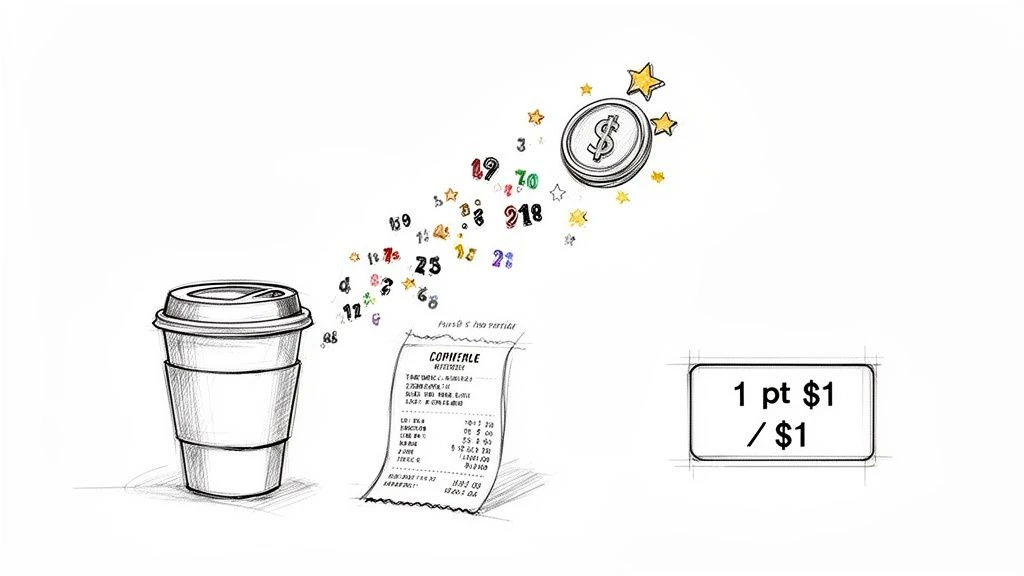
Why It Works: This model directly ties spending to value. The "spend more, earn more" concept encourages customers to increase their order value and visit frequency. It's a proven system used by giants like Starbucks and Chipotle to build massive, loyal customer bases.
How to Start a Points-Based Program
- Define Point Value: Keep it simple. A 1:1 ratio (e.g., $1 spent = 1 point) is easiest to communicate.
- Set Clear Rewards: Create achievable redemption tiers. For example:
- 100 Points: Free Fountain Drink
- 250 Points: Free Side of Fries
- 500 Points: $5 Off Your Next Order
- Make It Visible: Customers must be able to see their point balance easily. If it's out of sight, it's out of mind.
Pro Tip: Don't make customers download an app just to see their points. A simple solution like BonusQR lets them scan a QR code to see their balance instantly on a web page, keeping them engaged without the friction of a full app download.
Metrics to Track:
- Redemption Rate: What percentage of earned points are being used?
- Average Order Value (AOV): Are loyalty members spending more per visit than non-members?
- Visit Frequency: Are members coming back more often?
2. The Tiered "VIP" Membership
A tiered program gamifies loyalty by creating status levels customers can achieve. As they spend more, they "level up" to new tiers, unlocking better rewards. This transforms a simple rewards program into an aspirational journey, making your best customers feel like true VIPs.
Why It Works: This system taps into the human desire for status and recognition. It encourages customers to consolidate their spending at your restaurant to reach the next exclusive level. It's the model perfected by airlines and hotels to make their most valuable customers feel special.
How to Start a Tiered Program
- Define Your Tiers: Start with three clear levels based on annual spending or points.
- Assign Aspirational Rewards: Make each tier's benefits noticeably better than the last.
- Bronze (Entry): 1 point per $1 spent.
- Silver ($250/year): 1.25 points per $1 + early access to new menu items.
- Gold ($500/year): 1.5 points per $1 + a quarterly free entrée and an invitation to an exclusive tasting event.
- Show Their Progress: A visual progress bar is crucial. When a customer sees they're just "$20 away from Silver status," it creates a powerful incentive to make one more purchase.
Pro Tip: The benefits for higher tiers should be experiential, not just transactional. Early access, exclusive events, or "skip the line" privileges cost you little but provide immense value to a loyal fan.
Metrics to Track:
- Tier Migration: How many customers are moving up from Bronze to Silver?
- Spend Per Tier: How much more are Gold members spending than Bronze members?
- Customer Retention by Tier: Are higher-tier members more loyal over time?
3. The Effortless QR Code Program
A QR code-based program is the modern, contactless answer to the clunky paper punch card. Customers simply scan a QR code with their phone at checkout to earn points or stamp their digital card. It's one of the simplest and most cost-effective restaurant rewards program ideas available today.
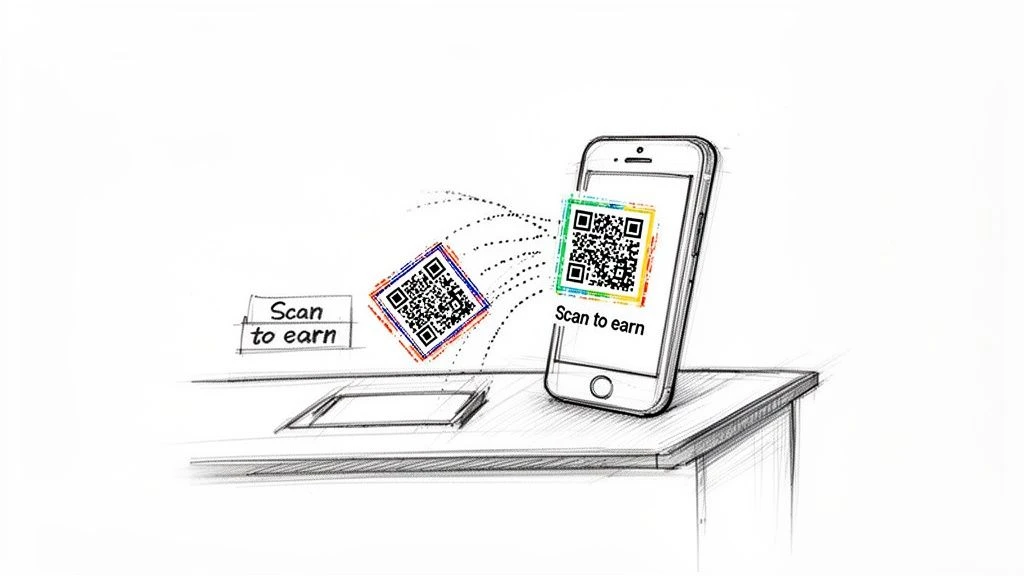
Why It Works: It's frictionless. There's no app to download, no card to carry, and no phone number to remember. Everyone has a smartphone, making participation instant and easy. It also positions your restaurant as modern and tech-savvy.
How to Start a QR Code Program
- Choose a Platform: Partner with a provider like BonusQR that generates a unique loyalty QR code for your business. This is the simplest, most affordable way to get started.
- Display the Code: Place the QR code on a small sign at your checkout counter or on table tents.
- Guide the Customer:
- Customer scans the code after paying.
- A simple webpage opens on their phone to claim points.
- Their points are instantly saved to their digital account.
Pro Tip: A QR code is a gateway. Beyond just tracking points, a platform like BonusQR can use that same scan to prompt customers for a quick review, display a special promotion, or collect feedback, turning a simple transaction into a rich data opportunity.
Metrics to Track:
- Scan Rate: How many customers are scanning the QR code per day?
- Sign-up Conversion: What percentage of scanners join the program?
- Time to First Redemption: How quickly are new members earning their first reward?
4. The Birthday & Anniversary Program
A celebration-focused program offers customers a special gift on their birthday or anniversary. This is a highly personal and emotionally resonant idea that shows customers you value them as people, not just as transactions.
Why It Works: People rarely celebrate birthdays alone. A "free birthday entrée" often results in a table of four, making it a high-ROI promotion. It creates powerful goodwill and gives customers a compelling reason to choose your restaurant for their special occasion.
How to Start a Birthday Program
- Collect Birth Dates (Optionally): During loyalty signup, ask for their birth month and day with a prompt like, "Add your birthday for a special surprise!"
- Make the Offer Meaningful: A free dessert or appetizer feels more celebratory than a 10% discount.
- Automate the Delivery: Use a system that automatically sends a "Happy Birthday!" email or text at the beginning of their birthday month with the offer.
Pro Tip: Provide a flexible redemption window. Allowing them to redeem the reward anytime during their birthday month accommodates busy schedules and increases the chance they'll use it.
Metrics to Track:
- Birthday Reward Redemption Rate: How many customers use their special offer?
- Average Party Size for Birthday Redemptions: Is the offer bringing in groups?
- Customer Churn Rate: Does the annual birthday touchpoint help retain customers year-over-year?
5. The Referral "Bring a Friend" Program
A referral program transforms your loyal customers into your marketing team. It incentivizes them to recommend your restaurant to friends and family, creating powerful word-of-mouth advertising. You only pay for marketing that works-a new customer walking through your door.
Why It Works: A recommendation from a trusted friend is far more powerful than any ad. This model taps into that trust, bringing in high-quality new customers who are already predisposed to like you.
How to Start a Referral Program
- Use a "Give & Get" Model: This is the most effective structure. Both the referrer and the new customer receive a reward.
- Referrer Gets: 100 bonus points or a free appetizer on their next visit.
- New Customer Gets: 10% off their first order.
- Make Sharing Easy: Provide each member with a unique referral link or QR code they can easily text or email to a friend.
- Track Everything: Ensure your system can reliably track who referred whom so you can deliver the rewards accurately. To effectively manage and track your referral initiatives, leveraging specialized referral forms template solutions can streamline the process.
Pro Tip: Combine referrals with social sharing. Create a unique hashtag (e.g.,
#YourRestaurantNameEats) and offer bonus points to customers who post a photo of their meal and tag your restaurant.
Metrics to Track:
- Referral Rate: How many new customers are coming from referrals each month?
- Cost Per Acquisition (CPA): How much does it cost in rewards to acquire one new customer?
- New Customer LTV: Do referred customers spend more over their lifetime?
6. The Digital Punch Card
The classic "buy X, get 1 free" punch card is simple, visual, and effective. The digital version eliminates the problems of lost paper cards and fraud while providing valuable customer data. It's perfect for items with high purchase frequency, like coffee, sandwiches, or burritos.
Why It Works: The visual progress of filling up a card is psychologically satisfying. The "goal-gradient effect" suggests that as people get closer to a reward, their effort to reach it increases. That 9th stamp creates a powerful urge to come back for the 10th.
How to Start a Digital Punch Card
- Choose Your Core Item: Select a popular, high-frequency item (e.g., coffee, bowl, slice of pizza).
- Set the Goal: 8-12 stamps is the sweet spot. It feels achievable without giving away too much.
- Go Digital: Use a simple QR code system like BonusQR. Customers scan the code, and their digital card is automatically "stamped" on their phone's web browser. No app needed.
Pro Tip: Give customers a "bonus" first stamp for free when they sign up. This immediately gets them invested in the program and makes the goal feel 10% closer from the very start.
Metrics to Track:
- Card Completion Rate: What percentage of started cards are completed?
- Time Between Stamps: How frequently are customers earning stamps?
- Uplift in Core Item Sales: Is the program driving sales of the target menu item?
7. The Gamified Challenge Program
Turn loyalty into a game with challenges, badges, and leaderboards. A gamified system drives specific behaviors by rewarding customers for completing tasks beyond just spending money. It's an exciting way to keep your restaurant top-of-mind.
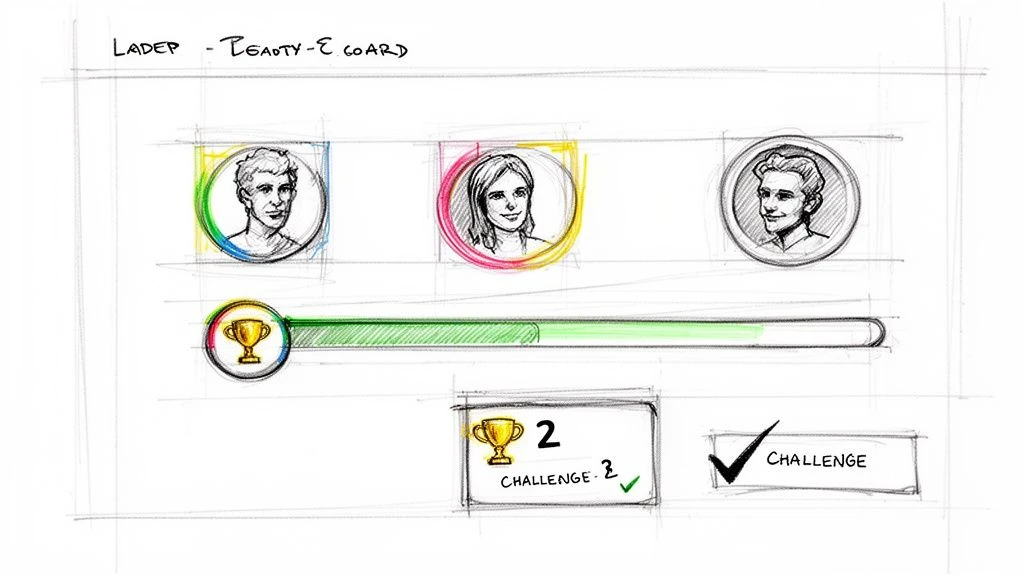
Why It Works: Gamification taps into our natural desire for achievement, competition, and fun. It encourages customers to try new things and visit during off-peak hours, helping you solve real business challenges.
How to Start a Gamified Program
- Create Simple Challenges: Align challenges with your business goals.
- Slow Day Challenge: "The Weekday Warrior" - Visit 3 times Monday-Thursday in one week to earn 50 bonus points.
- New Item Challenge: "The Adventurous Eater" - Try our new seasonal special and get a free drink.
- Frequency Challenge: "The Morning Regular" - Buy coffee before 9 AM for 5 days in a row to unlock a free pastry.
- Keep it Fresh: Rotate challenges monthly to maintain excitement.
Pro Tip: Make sure challenges are achievable. If they're too difficult, customers will disengage. The goal is to make rewards feel earned but not impossible to get.
Metrics to Track:
- Challenge Participation Rate: How many of your loyalty members are attempting challenges?
- Behavioral Change: Are you seeing an increase in visits on weekdays or sales of new items?
- Engagement Over Time: Are customers continuing to participate in new challenges?
8. The "Fear of Missing Out" (FOMO) Program
A seasonal or limited-time offer (LTO) program creates urgency and excitement by featuring rotating promotions tied to holidays, seasons, or special events. It taps into the powerful "fear of missing out," compelling customers to visit now.
Why It Works: Scarcity and novelty are powerful motivators. When a reward is only available for a short time, it feels more valuable. Think of the annual craze around Starbucks’ Pumpkin Spice Latte or McDonald's McRib.
How to Start a FOMO Program
- Plan a Promotional Calendar: Map out your year with offers tied to seasons, holidays, or local events.
- Design Exclusive Offers:
- Holiday Special: "Earn double points on all peppermint mochas in December."
- Summer Kick-Off: "Redeem 200 points for a free scoop of our limited-edition Mango Sorbet in June."
- Game Day Deal: "Get a free order of wings during Super Bowl weekend."
- Communicate Urgency: Use countdowns in your marketing. "Only 3 days left to get your free Holiday Cookie!"
Pro Tip: Use your loyalty platform to send push notifications or emails about expiring offers. A direct reminder is the most effective way to ensure your LTOs are seen and acted upon.
Metrics to Track:
- Traffic Lift During Promotion: Did the LTO drive a measurable increase in visits?
- LTO Redemption Rate: How popular was the limited-time reward?
- Social Media Mentions: Did the LTO create buzz online?
9. The Hyper-Personalized Offer Program
Go beyond generic discounts by using customer purchase history to send highly relevant, personalized offers. This data-driven approach makes your loyalty program feel like a smart, personal concierge service.
Why It Works: Personalized offers make customers feel seen and understood. Instead of a blanket "10% off," an offer for a customer's favorite dish or a suggestion based on past orders feels curated and genuinely helpful, leading to much higher redemption rates.
How to Start a Personalized Program
- Track Purchase Data: Use a loyalty system that connects to your POS or tracks purchases digitally.
- Segment Your Customers: Start with simple groups based on their habits.
- "The Latte Lover": Buys a latte every morning.
- "The Lunch Regular": Orders a salad 3x a week.
- "The Lapsed Customer": Hasn't visited in 60 days.
- Send Targeted Offers:
- To the Latte Lover: "Buy 4 lattes this week, get the 5th free."
- To the Lunch Regular: "Try our new seasonal salad for 50% off."
- To the Lapsed Customer: "We miss you! Here's a free appetizer on us."
Pro Tip: Use technology to automate this. A platform like BonusQR can automatically track visit frequency and purchase data, allowing you to easily identify and target lapsed customers with a "we miss you" offer to win them back. To further enhance this, robust social media CRM tools can help track customer interactions across multiple platforms.
Metrics to Track:
- Personalized Offer Redemption Rate: Compare this to your generic offer redemption rate.
- Customer Reactivation Rate: How many lapsed customers return after receiving an offer?
- AOV on Personalized Offers: Are customers spending more when they redeem a targeted deal?
10. The Community & Cause-Based Program
Connect your loyalty program to social responsibility by allowing customers to support a cause with their purchases. This model appeals to values-driven consumers by turning their loyalty into a force for good.
Why It Works: This approach builds a deep emotional connection. When customers know their spending helps a cause they care about (like a local food bank or animal shelter), their relationship with your brand becomes more than just transactional. It builds a community around shared values.
How to Start a Cause-Based Program
- Choose an Authentic Partner: Select a local charity that aligns with your brand's values. Authenticity is key.
- Define the Contribution Model:
- Point Donation: Allow customers to donate their points (e.g., 500 points = $5 donation).
- Milestone-Based Giving: Pledge a donation when your community reaches a collective goal (e.g., "We'll donate $1,000 to the local food bank for every 10,000 loyalty check-ins!").
- Be Transparent: Regularly share updates on how much has been raised and the impact it's having. Show photos and tell stories.
Pro Tip: Let your customers help choose the charity. Run a poll among your loyalty members to decide which local cause to support for the next quarter. This increases buy-in and makes them feel even more involved.
Metrics to Track:
- Participation Rate: How many customers are choosing to donate points?
- Brand Sentiment: Are you seeing positive social media mentions about your cause-based program?
- Customer Loyalty: Do participants in the cause-based program have a higher retention rate?
Top 10 Restaurant Rewards Program Comparison
| Program | Implementation complexity | Resource requirements | Expected outcomes | Ideal use cases | Key advantages |
|---|---|---|---|---|---|
| Points-Based Loyalty Program | Low-Medium | Loyalty platform, POS/app integration, rewards catalog | Steady repeat visits; increased customer lifetime value | QSRs, coffee shops, pizza chains, regular customers | Simple, flexible, widely understood |
| Tiered Membership Program | Medium-High | CRM/tier tracking, communications, exclusive perks management | Higher average spend; stronger emotional loyalty and segmentation | Fine dining, premium coffee, high-ticket establishments | Status-driven loyalty; targeted marketing |
| QR Code-Based Digital Rewards | Low | QR system, web-based platform, analytics | Frictionless sign-ups; real-time engagement data | Small/medium restaurants, food trucks, tech-forward venues | Low cost, contactless, easy to start |
| Birthday and Anniversary Rewards Program | Low | Customer data capture, automated email/SMS | High emotional engagement; predictable group visits | Full-service, family-oriented restaurants, cafes | Low cost, high delight, strong re-engagement |
| Referral and Social Sharing Rewards | Medium | Referral links/codes, tracking, fraud prevention, social assets | New customer acquisition; user-generated content; viral growth potential | Community-focused restaurants, social-savvy brands | Low-cost acquisition; dual-sided incentives |
| Punch Card and Digital Stamp Programs | Low | Simple digital stamp system (QR-based) | High-frequency repeat visits; easy redemption completion | Coffee shops, bakeries, high-frequency QSRs | Familiar, visual progress, minimal tech needed |
| Gamified Loyalty with Challenges and Leaderboards | High | Robust app/platform, content creation, analytics, ongoing ops | Strong engagement and visit frequency; rich behavioral data | Younger demographics, tech-forward, competitive customer bases | Highly engaging, shareable, habit-forming |
| Seasonal and Limited-Time Offers Program | Medium | Marketing calendar, inventory planning, promotional creative | Short-term traffic spikes; renewed interest and urgency | Coffee shops, casual/QSRs, businesses with seasonal cycles | Creates urgency, easy to refresh, drives excitement |
| Personalized Offers Based on Purchase History | High | Data infrastructure, AI/ML, segmentation tools, privacy/compliance | Higher redemption rates, increased AOV and retention | Large chains, diverse menus, high-frequency visitors | Highly relevant offers; reduced marketing waste |
| Community and Cause-Based Loyalty Program | Medium | Partnership vetting, donation tracking, reporting and comms | Strong brand affinity, PR benefits, values-driven loyalty | Community-focused, sustainable/premium restaurants, younger audiences | Emotional connection, positive social impact, differentiation |
Ready to Launch a Loyalty Program That Actually Works?
You've just explored ten powerful restaurant rewards program ideas, each designed to build real customer loyalty beyond a simple discount. We've moved past the generic advice to give you concrete, actionable steps. The common thread is clear: the best loyalty program isn't the most complicated one. It's the one that is simple for you to manage and genuinely delightful for your customers.
Modern loyalty is about connection. It’s about making a customer feel seen, whether through a surprise birthday reward, a fun challenge, or the simple satisfaction of earning that final digital stamp for a free coffee.
Key Takeaways for Building Customer Loyalty:
- Simplicity Wins: Complicated rules get ignored. The most effective programs are effortless. QR-code programs and digital punch cards are popular because they require almost no work from the customer or your staff.
- Personalization Connects: A targeted offer for a customer’s favorite dish is far more powerful than a generic coupon. It shows you're paying attention.
- Reward Advocacy: Encourage and reward customers for referrals and social media shares. They are your most credible marketers.
- Start Small and Learn: You don't need a complex system from day one. Start with a simple digital stamp card, track your results, and listen to feedback.
Your Next Step: From Idea to Reality in Minutes
Feeling motivated but worried about the complexity and cost? That's a common hurdle. But technology has made this easier and more affordable than ever.
You don't need a team of developers or an expensive POS integration. Solutions like BonusQR were built specifically for busy restaurant owners who need a program that just works. It is the simplest, most direct path to launching an effective loyalty program that solves your biggest challenges:
- Problem: Paper punch cards are messy and get lost.
- Solution: Launch a QR-code-based digital stamp card in minutes.
- Problem: You don't know who your most loyal customers are.
- Solution: Track visit frequency automatically and identify your regulars.
- Problem: You're worried about high costs and complex tech.
- Solution: Manage everything from your phone. No special hardware or app development needed.
Stop letting valuable customers walk out the door, never to return. The tools to build a thriving community of regulars are simple, affordable, and right at your fingertips. It’s time to choose a strategy, take that first step, and start rewarding the people who keep your business thriving.


