White Label vs Custom App: Which Loyalty App Fits Your Business?
For most small and mid-sized businesses, a white-label loyalty app is the right first move. You get your own name, colors and logo on a working loyalty engine in weeks, not months, and you pay a setup fee plus a monthly subscription instead of funding a software project. A custom app earns its cost later, when your reward logic, workflows or integrations are so specific that no standard platform can carry them. At BonusQR, white-label setup is a one-off €690 plus €69 per month, and custom app development starts from €1,500 one-off, so you can start with one and move to the other without changing vendors.
Key Takeaways
- A white-label loyalty app is a ready platform that you brand as your own. A custom app is software designed and built only for your business.
- White label fits businesses with a standard loyalty model (points, stamps, cashback, tiers) and a need to launch quickly on a limited budget.
- Custom fits businesses with unusual reward rules, deep system integrations or a loyalty app that is itself a competitive asset.
- With white label you license the platform, you do not own its source code. With custom, you design the product and carry its upkeep.
- Starting with white label and moving to custom once you have proof of demand is a common, lower-risk path.
What the two options actually are
A white-label app is software that one company builds and many businesses brand as their own. Behind your logo sits a running backend, admin tools and a shared codebase maintained by the provider. Industry guides describe the setup as a common core app, branding and configuration controls for colors, content and menus, and provider-managed infrastructure. Your customers see your brand. Under the hood, the engine is shared.
A custom app is designed from a blank page for one company. Your team (or a developer you hire) decides every screen, every reward rule and every integration, and the result is built around how your business works.
For a loyalty app, this plays out in practical terms:
| Question | White-label loyalty app | Custom loyalty app |
|---|---|---|
| Who builds the engine? | The provider, already running | A developer, for you only |
| What do you control? | Branding, rewards, content, settings | Everything, including logic and workflows |
| Typical launch | Weeks | Months |
| Upfront cost | Setup fee | Project budget |
| Ongoing cost | Subscription | Maintenance and development |
| Source code | Licensed, not owned | Depends on your contract |
| Best for | Standard loyalty models | Unique reward logic and integrations |
One distinction trips up many buyers: source code ownership is the most misunderstood point in white-label contracts. A rebranded SaaS product does not transfer its code to you. You license access to a platform under your name. For a cafe or a gym, that is usually fine, because what you want to own is the customer relationship, the brand and the data on your own program, not a codebase.
White labeling is also a familiar model well beyond apps. Marketing teams, for example, use white-label SEO platforms to deliver tools under their own brand without building the technology. The logic is the same: someone else maintains the engine, you own the presentation and the customer.
What it means for a small business
If you run a cafe, a retail shop, a gym, a hotel, a grocery store or a gas station, loyalty is about repeat visits. Your goal is a program that customers understand in ten seconds and that you can run without hiring a developer. That is the white-label use case in one sentence.
It also helps to separate the app from the program. The program is the set of rules: buy nine coffees, get the tenth free; earn a percentage back as cashback; reach a tier and unlock a better reward. The app is how customers see and use those rules. Most small businesses succeed or fail on the program and on the habit of using it, rather than on the app having one-of-a-kind screens.
A standard platform already covers the common program types. BonusQR, for example, offers digital stamp cards, points systems, tiered cashback, fixed discounts, onboarding promos, special occasion rewards and coupon and reward management. It also covers referral and review modules, push and email notifications, and analytics. A QR-based approach means customers can earn rewards without you adding a POS system. If those building blocks already describe your loyalty program, building from scratch means paying to recreate them.
Cost: setup, subscription and the long tail
Cost is where the two paths separate most clearly, and where the headline price misleads.
White label usually has three cost layers: a one-off setup, a recurring platform fee, and the store accounts you need to publish a branded app. At BonusQR, the white-label route is a €690 one-off setup fee plus a €69 monthly subscription. Because the infrastructure is shared and maintained by the provider, you are not paying a team to keep servers, updates and core features running.
Custom has a different shape. There is a build cost, then a maintenance cost that does not end. A practical guide to custom loyalty apps notes that building your own shifts product responsibility to the business: testing, security, compliance and maintenance all become yours. Agency quotes for fully bespoke apps commonly run far above the cost of a white-label subscription, and the gap widens once you count a year of upkeep. At BonusQR, custom app development starts from €1,500 one-off, with monthly maintenance from €69.
A worked example makes the difference concrete. Take a two-location cafe that wants a branded loyalty app in the Apple and Google stores.
- White label at BonusQR: €690 setup plus €69 per month. In the first year that is €690 + (12 × €69) = €1,518.
- Custom at BonusQR, at the listed starting price: from €1,500 one-off plus maintenance from €69 per month, so from €2,328 in the first year, and more as the scope grows beyond the starting point.
Those are the listed starting prices, and the final custom figure depends on what you need built. The point is the pattern: custom costs more at the start and the gap grows with every feature you add, so you should only pay it for something a standard platform cannot do.
Costs both paths share
Whichever way you go, a branded app in the stores needs developer accounts. Apple’s Developer Program costs 99 USD per membership year, and Google Play charges a one-time registration fee of 25 USD. These are the platforms’ own fees and sit outside any provider’s pricing, so include them in your budget from the start.
Launch time
Speed is the other big difference. A custom app has to be specified, designed, built, tested and submitted for store review. Industry estimates put custom mobile app projects at roughly 3 to 9 months, depending on scope, and every added feature stretches that.
A white-label app skips most of that, because the engine already exists. What remains is configuring your rewards, applying your brand and publishing. BonusQR describes its approach to launching loyalty software in 1 to 3 weeks in its own guide.
What affects the timeline on either path:
- How many reward types you want. One stamp card is faster than points, tiers, referrals and reviews together.
- Brand assets. Logo, colors and app store text ready on day one save days.
- Store accounts. Developer accounts for Apple and Google need to be set up and verified before you can publish.
- Integrations. Anything that has to talk to your booking, e-shop or other systems adds work. This is the main reason custom projects run long.
- Staff readiness. A program only works when the person at the counter knows how to explain it to customers.
Control, flexibility and vendor dependence
The honest trade-off is control against speed. One comparison puts it this way: custom is inherently more flexible because changes can be made at any stage, while white label depends on the vendor’s roadmap and platform. That is accurate, and it is worth turning into a practical question: do you need the flexibility that custom gives?
For most small businesses the answer is no, because the changes you actually make are changes to your program, not to the software. You adjust how many stamps a reward needs. You launch a birthday offer. You push a notification on a quiet Tuesday. Those are configuration tasks, and a platform with customizable modules is built for them.
Vendor dependence is a fair thing to think about, and the way to manage it is by choosing a provider that also offers a route up. A white-label customer who outgrows the standard platform can move to a custom build with the same provider, carrying the loyalty program, customer relationships and learning along.
Branding
With white label you control the visible layer: your name, logo, colors and content. Customers open an app that is clearly yours, not a third-party loyalty network. Custom adds control of structure and design, so the app can look and behave unlike anything else. For a business whose brand is its entry in the shopper’s phone, that matters. For most local businesses, a consistent branded look and a smooth first scan matter more.
Features and integrations
A white-label platform gives you the modules the provider has built, configured to your needs. A custom app gives you what you specify. If you are weighing custom, the test is whether you can name a feature that would change customer behavior and that no available module offers. If you can, you have a case. If you cannot, you are buying flexibility you will not use.
BonusQR’s custom route also lists e-shop and booking widget features, which matter for service businesses where reward and appointment live in the same flow.
Ownership and data
You do not own the code of a white-label platform, as covered above. You do run the program under your brand and build your own customer relationships through it. With custom, ownership terms depend on your contract, so settle them in writing before work begins: who holds the code, who holds the store accounts and what happens if you change developers.
When white label is the right call
White label fits when your business follows a standard pattern. Guidance on this choice points to white label when the timeline is tight, the budget is limited and the competitive edge comes from service quality, not unique technology. A neighborhood cafe, a salon, a gym, a hotel or a petrol station fits that description well. You win on product, location and people, and loyalty is a way to bring customers back.
Choose white label if most of these are true:
- You want to launch in weeks and learn from real usage.
- Your reward logic is points, stamps, cashback, tiers or discounts.
- You do not have an in-house developer or a product team.
- You want your own app icon in the store with your name on it.
- You prefer predictable monthly costs to a project budget.
When custom is the right call
Custom becomes attractive as the product turns into a competitive asset. As one guide frames it, the earlier your business is, the more white label appeals, and the more the app becomes a differentiator, the more custom earns its cost. A custom loyalty app enables unique workflows, reward logic and a release roadmap built around your own requirements.
Choose custom if most of these are true:
- Your reward rules combine conditions no standard module supports.
- The app has to connect deeply with other systems you run.
- You operate multiple brands or locations that need tailored experiences.
- You have the budget and the people to manage a product over time.
- You have already run a loyalty program and know exactly what you need next.
The hybrid path
Starting with white label and building custom later is a common approach that reduces overall risk. You prove that customers use the program, learn which features matter, and only then invest in something bespoke. Your loyalty data and the habit of using the program carry over.
A sensible ladder for a small business looks like this:
- Start on a free or low-cost plan to run your first stamp card or points program.
- Move to a branded white-label app when you want your own name in the app stores.
- Commission custom development when you can name the specific thing the standard platform cannot do.
Our guide to what white label branding means covers the middle step in more detail.
A decision framework you can use today
Answer these five questions in order.
- Can a standard loyalty model describe what you want? If yes, white label. If no, continue.
- Can you name the feature that is missing? If you cannot describe it in one sentence, you are not ready to commission it.
- Do you have budget for build and maintenance? Custom needs both, indefinitely.
- How soon do you need to launch? If the answer is “this quarter”, the timeline points to white label.
- Who will run it? If nobody on your team will manage a software product, a platform that handles rewards distribution, notifications and analytics fits better.
If you land on white label for question 1 and are still unsure, the answer is white label. You can always add custom later. You cannot get back the months spent building before you knew what customers wanted.
Where BonusQR fits
BonusQR is built for the standard-pattern business. Its platform automates the work that eats a small owner’s week: distributing rewards, tracking customer behavior for insights, and sending promotional notifications. It runs on QR, so customers can earn points, stamps or cashback without you adding POS integration. It has Apple and Google Wallet support, plus brand and app customization.
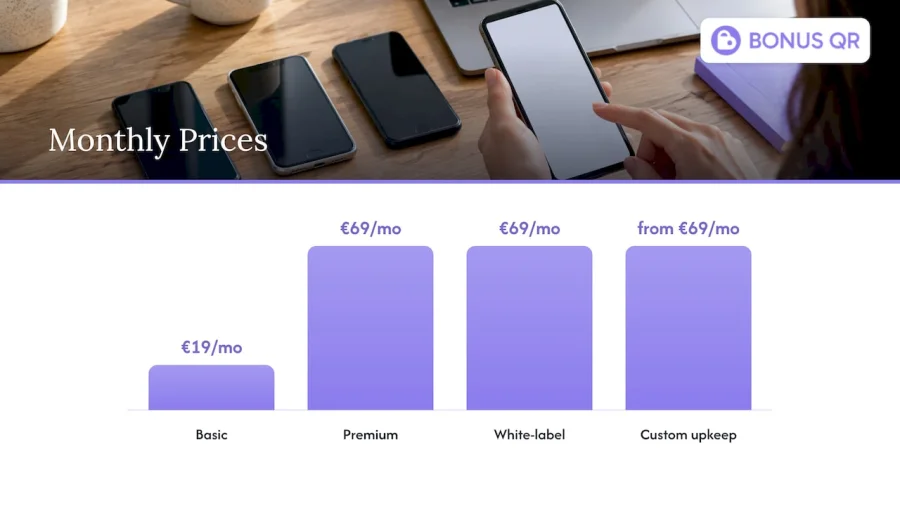
The pricing page lists three plans: Free, Basic at €19 per month and Premium at €69 per month. The white-label route adds your own branded app for a €690 one-off setup and a €69 monthly subscription. If your needs go beyond that, custom app development starts from €1,500 one-off, with monthly maintenance from €69. For a small business that is not a decision between two vendors. It is one provider with a path from first stamp card to a fully tailored app.
Our view: start with the program, not the app
We talk to owners who begin with the question “should we build an app?” The better question is “what behavior do we want to reward?” A cafe wants a third visit this month. A gym wants a member to book the next class. A hotel wants a direct rebooking. Once that is clear, the technology choice usually follows.
That is why we built BonusQR around standard modules you can configure in days: stamps, points, cashback, tiers, referrals and reviews, with automation behind them. Most small businesses get their best results from running a clear program consistently, and a platform that does the repetitive work lets them do exactly that.
We also built the route upward. White label gives you your own branded app, with your name in the stores. Custom development is there for the day your requirements outgrow the standard modules. We would rather you spend your first budget on proving that loyalty works for your customers than on a long build, and we would rather be the provider you grow with when the program proves itself.
Michal Palus
FAQ
What is the difference between a white label app and a custom app?
A white-label app is a ready platform that you brand with your own name, logo and colors, while the provider maintains the engine. A custom app is designed and built only for your business, so you decide every feature and carry its upkeep. White label is faster and cheaper to start. Custom offers more control.
Is a white-label loyalty app cheaper than a custom one?
Usually yes, because you pay a setup fee and a subscription instead of funding a full build and its maintenance. At BonusQR, white label is a €690 one-off setup plus €69 per month, and custom development starts from €1,500 one-off with maintenance from €69 per month. Custom totals grow with scope, so the final figure depends on what you need built.
Do I own a white-label app?
You own the brand, the presentation and your customer relationships, but you license the underlying platform and do not receive its source code. For most small businesses that is the right trade, since the provider keeps the engine running and updated. If code ownership matters to you, that points toward a custom build with ownership terms set in your contract.
Can I start with white label and switch to custom later?
Yes, and it is a widely used approach. You launch quickly, learn which rewards your customers respond to, and commission custom features only once you know what you need. With BonusQR, both routes come from the same provider, so you can move up without starting over.
How long does each option take to launch?
A custom app commonly takes several months, depending on scope and integrations. A white-label app is configured on an existing platform, so launch is measured in weeks. Store accounts, brand assets and the number of reward types you want are the main things that change the timeline.


