
 Deutsch
 Español
 Français
 Italiano
 Magyar
 Polski
 Slovenčina
 Čeština

Most advice about what is white label branding starts with the wrong idea: put a logo on somebody else's product and launch quickly. That description is technically familiar, but commercially incomplete. A branded customer app changes what shoppers expect from the café, salon, gym or retailer whose name appears on the screen. They expect that business to stand behind the rewards, the messages, the privacy notice and the support experience.
White labelling can reduce duplicated development and give a small business access to specialist technology. It can also hide important responsibilities behind a polished interface. The right question is not just whether a platform can carry a business's colours. It's whether the business can deliver a trustworthy, useful and accountable customer experience under its own name.
The Hidden Reality of White Label Branding
White-label branding is a commercial arrangement where a provider supplies a standardised product or service and another company presents it using its own name, logo, colours, customer communications and interface. In software, the supplier normally operates the reusable infrastructure while the merchant controls the visible experience and often handles first-line customer support.
That distinction creates a trust problem. A customer scanning a reward code in a branded app rarely thinks about the platform provider, messaging vendor, payment service or app-store operator behind it. The customer sees the local business. If a reward fails, a promotional email is unwanted or personal data is mishandled, the merchant's reputation absorbs the impact.
The brand owns the visible promise
A branded app can make a service feel native. The icon, colours, tone of voice, menus, offers and redemption journey all suggest that the merchant owns the entire relationship. That perception is valuable, but it means the merchant must know which party controls each operational layer.
A useful supplier review should ask:
- Customer support: Who answers when a customer's points or stamp balance is wrong?
- Data responsibility: Is the merchant the data controller, or does the provider determine the purposes of processing?
- Privacy communication: Which privacy notice appears at registration, and does it explain every relevant recipient?
- Service failure: Who communicates during downtime, a security incident or a failed campaign?
- Exit rights: Can the merchant export customer and transaction data in a usable format if the contract ends?
The feature overview for agencies is a useful reference for businesses comparing branded delivery workflows and account responsibilities across multiple client experiences.
Loyalty data needs separate decisions
The UK Information Commissioner's Office guidance on legitimate interests notes that using loyalty-scheme data for core programme functions may rely on contract. Profiling customers for targeted discounts is different direct marketing activity, requiring an appropriate legal basis and an easy-to-use objection route.
That distinction matters for a high-street merchant. A customer may need an account to receive and redeem a reward, but that doesn't automatically authorise personalised promotional messages based on purchase history. Privacy must be designed into the service rather than added after the app has been branded.
Practical rule: If the merchant's name is on the interface, the merchant needs a clear answer for every customer-facing question, even when another supplier operates the technology.
White labelling therefore isn't merely a cheap visual rebrand. It's a decision to own the visible promise while sharing the underlying delivery responsibilities. The commercial advantage appears when the supplier's infrastructure is dependable and the merchant actively governs the experience.
Historical Roots in UK Retail and Modern Software
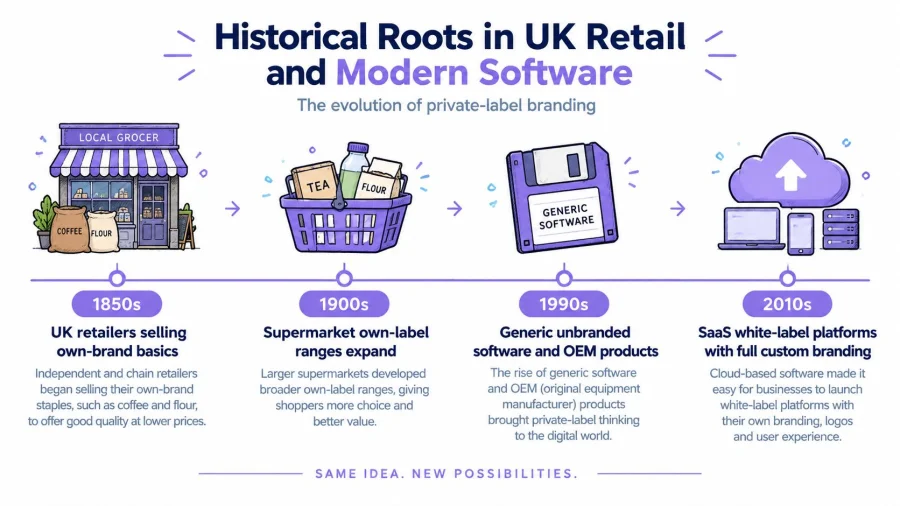
The UK has lived with the separation between production and branding for a long time. Retailers with more than one shop were already selling own-brand basics such as coffee, tea and flour in the 1850s and 1860s, while manufacturer brands were emerging alongside them. The retailer controlled the presentation and customer relationship, even when another party produced the goods.
From own-brand shelves to digital services
This model became familiar enough that British shoppers could buy products identified primarily by a retailer's brand. By 2005, private-label products represented approximately 41% of UK sales, making Britain the largest single market among the countries compared in the source, as documented by Packaging Gateway's account of private-label retail.
The significance isn't just historical. It demonstrates that customers don't require the manufacturer's name to trust a product. They judge the visible brand through consistency, performance, price and the retailer's reputation. That same judgement now applies to digital services.
A café can use specialist loyalty infrastructure while presenting rewards under its own identity. A salon can provide a branded booking and offer experience without developing the underlying software. A gym can make customer communications feel like part of its membership proposition rather than an unrelated vendor tool.
What transfers from retail to software
The underlying principle is simple:
- Production layer: A specialist provider builds and maintains reusable technology.
- Presentation layer: The merchant controls the logo, colours, icon, wording and customer journey.
- Commercial layer: The merchant decides how the service supports visits, spending and retention.
- Governance layer: The contract defines data, security, support, licensing and exit responsibilities.
Modern white-label software extends the private-label model, but it also makes the separation less visible. A customer can see a café's icon in an app store without knowing which provider hosts the platform. That creates a stronger branded impression than a retailer's own-brand packet on a shelf, because the app can collect behavioural information and send direct communications.
The historical lesson is therefore balanced. Retailers can build strong propositions around supplied products, but they must control quality and accountability. For a digital loyalty service, branding is only the front layer. The merchant also needs dependable redemption, accurate balances, accessible terms and an honest explanation of how customer data is used.
Comparing White Label to Custom and Private Solutions
Business owners often use white label, private label, white-box and custom software as if they mean the same thing. They don't. The practical difference lies in who builds the product, who controls the source code, who owns the customer-facing brand and who carries the maintenance work.
UK intellectual-property guidance defines licensing as an agreement that allows another party to use rights owned by the IP holder. The GOV.UK licensing guidance makes trademark, software and content permissions central to any arrangement where one business uses another party's rights.
Four models with different trade-offs
White label uses an existing product that can be presented under the merchant's identity. The supplier maintains the platform, security and core releases. The merchant usually controls branding, commercial configuration and first-line support, subject to the contract.
Private label generally suggests a more exclusive product or service made for one retailer or brand. In software, the term is sometimes used loosely, so the contract should define what is exclusive and what remains shared infrastructure.
White-box usually gives the buyer deeper technical access, potentially including source code or a deployable product. That control comes with a need for internal developers, release management, security testing and documentation.
Custom software is built around the merchant's requirements. It can provide the highest level of control, but the merchant funds discovery, development, testing, maintenance, hosting decisions and future enhancements.
| Model Type | Upfront Cost | Time to Launch | Data Ownership | Maintenance Burden |
|---|---|---|---|---|
| White label | Lower than a ground-up build because existing infrastructure is reused | Usually faster, depending on configuration and publishing | Must be defined contractually, with export and deletion rights | Provider carries core maintenance, merchant manages governance and customer support |
| Private label | Varies with exclusivity and product scope | Faster than a full custom build when the base service already exists | Must specify merchant access, provider processing and portability | Shared, with supplier maintaining the base product |
| White-box | Higher because technical control requires implementation work | Longer, as the buyer must configure, test and operate the product | Greater control may be possible, but responsibilities sit closer to the buyer | High internal burden, including updates, security and support |
| Custom software | Highest because the product is developed around the business | Longest, with discovery, build and testing required | Can be designed around the merchant's requirements | Merchant or appointed technical team owns most ongoing work |
The sensible choice for a high-street business
A custom build makes sense when a business has unusual workflows, a capable technical team and a reason to own every part of the stack. It doesn't automatically make sense for a café or independent retailer whose real challenge is getting customers to return and making rewards easy to use.
A white-box product can look attractive because it appears to offer freedom. In practice, source-code access is only useful when someone can maintain that code safely. Otherwise, the business has bought responsibility rather than independence.
A white-label service occupies the practical middle ground. The specialist provider maintains reusable infrastructure while the merchant invests attention in brand experience, reward economics, customer communication and governance. Businesses evaluating a bespoke route can compare the implications with BonusQR's custom app option, particularly when integration requirements may eventually justify a deeper build.
The cheapest route is not the one with the lowest subscription. It's the route that leaves the merchant with a manageable operational burden.
Before signing, the merchant should check service levels, permitted branding, software and trademark licences, subcontractors, security obligations, data-controller allocation, export formats, termination support and the process for removing the branded service. Those details separate a controlled white-label arrangement from a logo placed on an opaque supplier product.
Designing a Branded Loyalty Experience That Converts
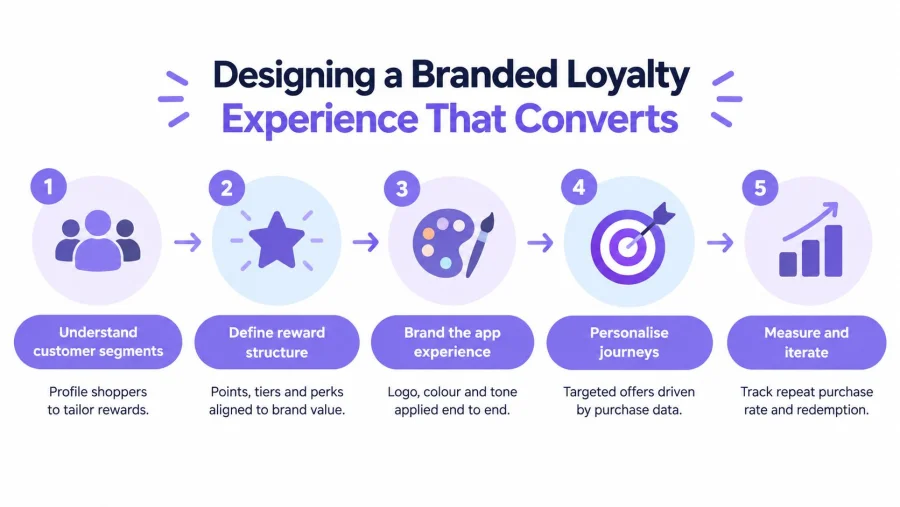
A white-label loyalty app earns its place through the customer journey, not the app icon. The branding should make the service recognisable, but the reward mechanics must give customers a clear reason to return.
UK consumer research reports that 73% of shoppers say loyalty cards offer good value and 70% say they encourage shoppers to return to the same shops, while 35% stop using a programme when rewards take too long to earn, according to SumUp's UK loyalty programme survey. A polished interface won't rescue a reward that feels distant, confusing or difficult to redeem.
Start with the customer's next visit
The first reward should be understandable before registration. Customers need to know what they receive, how they earn it and when they can use it. Asking for extensive information before showing value creates friction, particularly when a customer is standing at a counter or waiting to leave a salon.
Useful mechanics include:
- Stamps: A straightforward option for repeat purchases such as coffees, treatments or classes.
- Points: Suitable when customers buy different products or spend varying amounts.
- Cashback: Clear when the business wants to return value based on spending.
- Visit thresholds: Helpful for gyms, salons and service businesses that care about attendance.
- Fixed discounts: Easy to understand when the offer has simple eligibility rules.
- Welcome and birthday rewards: Effective when the business can explain the benefit and handle the associated personal data responsibly.
- Seasonal coupons: Useful for timely campaigns, provided customers understand expiry and redemption terms.
A business shouldn't use every mechanic just because the platform supports it. Complexity increases the chance that staff explain the programme differently, customers misunderstand eligibility or the merchant creates reward liability that doesn't support its margin.
Make the brand consistent end to end
The visible identity should extend beyond the opening screen. The app icon, registration page, reward cards, push messages, email templates, wallet passes, menus, offers and redemption confirmations should use a coherent design system. Guidance such as RecensioAI B.V.’s guide to branded QR codes can help a merchant consider how QR presentation affects recognition at the point of sign-up.
The digital journey also needs to work in the physical environment. Counter cards, table signs, till prompts and staff scripts should explain the same benefit using the same language. Customers shouldn't have to ask whether a reward can be combined with another offer or whether an expired coupon can be restored.
BonusQR's guidance on customising white-label rewards programmes for a brand provides a useful reference point for connecting programme rules with the merchant's identity rather than treating branding as a final cosmetic step.
Customer-experience test: A customer should understand the reward, the next action and the redemption condition without needing staff to translate the app.
The strongest white-label experience feels native because it is useful, not because every screen is heavily decorated. Clear rewards, accessible redemption and timely communications create the connection between the merchant's brand and the customer's next visit.
Navigating UK Data Governance and Compliance Rules
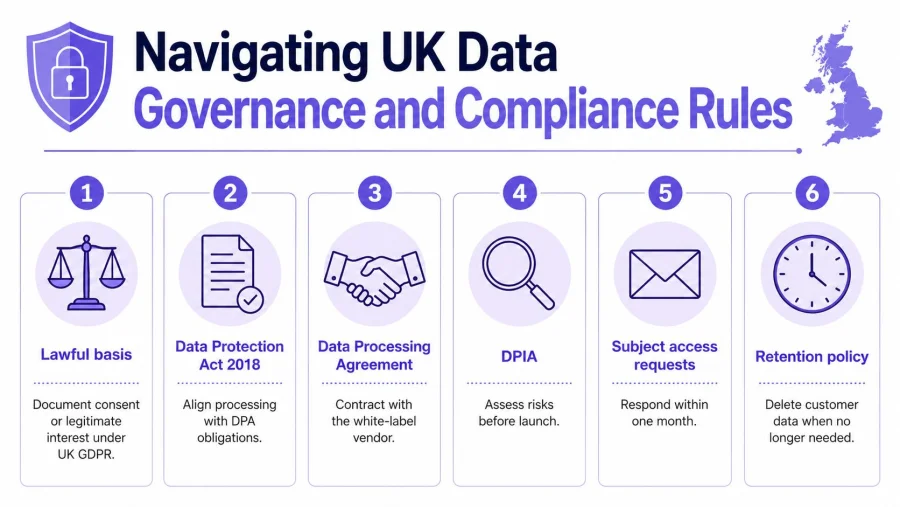
A branded loyalty programme that identifies customers processes personal data under the UK GDPR and the Data Protection Act 2018. That can include names, email addresses, phone numbers, customer IDs, purchase history, preferences, birthday information, location data and redemption behaviour.
The merchant shouldn't assume that a supplier's compliance page transfers responsibility. The branded business needs to document why data is collected, who receives it, how long it is retained and how customers can exercise their rights.
Build the governance file before launch
A practical launch file should contain the following:
- Map the processing. List each data field, its purpose, the system that stores it and the people or suppliers who can access it.
- Allocate roles. Decide whether the merchant is the data controller and whether the platform acts as a processor. Record the reasoning rather than relying on an informal assumption.
- Choose a lawful basis. Separate information needed to administer the programme from optional marketing, profiling and targeted offers.
- Write the privacy notice. Identify the merchant, explain the processing, name relevant categories of recipients and describe customer rights.
- Set retention rules. Define when inactive profiles, old purchase records and unredeemed reward information should be deleted or anonymised.
- Prepare rights handling. Establish who receives subject-access, deletion, correction and portability requests and how the platform assists with them.
- Review security. Confirm access controls, incident reporting, backups, subcontractors and staff permissions.
- Assess higher-risk processing. Consider whether profiling, location data or extensive behavioural analysis requires a data protection impact assessment.
The UK loyalty programme data guidance confirms that a programme identifying customers must document a lawful basis, apply suitable security and define a retention period instead of keeping information indefinitely.
Protect the brand asset
A white-label launch also creates intellectual-property work. The business should clear the programme name, app icon, logo and campaign artwork before publishing. UK trade-mark protection can cover names, logos, sounds and other identifiers, but registration is class-specific. Registration in one class doesn't automatically prevent similar use in another.
The merchant should check both its core trading category and any relevant loyalty, software or promotional activity. Specialist graphic design services from Moonb may help produce consistent assets, but design quality doesn't replace a trade-mark clearance review.
A practical customer-data checklist can be developed alongside this guide to customer database software for small businesses. The important point is ownership. If the merchant wants the customer relationship to be an asset, it needs records, policies and contracts that make that ownership operational.
Executing a Phased Launch with BonusQR
A small business doesn't need to choose between an unbranded experiment and a large custom build. A phased launch reduces the risk of investing in elaborate features before the reward proposition has earned customer adoption.
Phase one tests the commercial idea
The first stage uses a standardised loyalty experience to test the basics. The merchant can decide whether stamps, points, cashback, visit thresholds or fixed discounts match the buying pattern. Staff can practise scanning and redemption, while the business observes whether customers understand the offer and return to use it.
This stage should answer practical questions:
- Do customers complete registration at the point of sale?
- Do staff explain the reward consistently?
- Are customers redeeming or just collecting?
- Which offers create repeat visits without weakening margin?
- Are customers asking for clearer terms or fewer steps?
A free starting option such as BonusQR can support this type of validation with QR-based registration and redemption, without requiring POS integration or extra hardware. The platform can support configurable rewards, customer profiles, wallet passes and campaign communications, but the merchant still needs to choose the mechanics and govern the data.
Phase two gives the service a proper identity
Once the mechanics are clear, the merchant can publish an affordable white-label app under its own icon. BonusQR describes this route as taking about 14 days, with the service presented through the business's own name, colours, menus and selected modules. The app can be published through Google Play, the Apple App Store and a web version.
The point of upgrading isn't to make the programme look expensive. It's to make the customer relationship feel continuous across the shop, app, email, wallet pass and reward message. A café can use its menu and welcome offer, while a salon or gym can organise benefits around visits and appointments.
Phase three adds deeper integration only when justified
A fully custom app or advanced integration becomes easier to justify when the business has evidence of demand and a clear technical limitation. At that point, the merchant can specify the workflows that matter instead of paying to discover them through an oversized first release.
This progression protects cash, staff time and customer goodwill. It also keeps the business focused on repeat visits, average spend, reward redemption and incremental margin rather than treating a branded app as an end in itself.
Measuring the True ROI of Your Branded App
Downloads and registrations can make a dashboard look busy without proving that the programme helps the business. A merchant should connect the branded experience to behaviour and margin.
Recent UK evidence reports that 51% of brands view loyalty as both a growth and brand-building tool, while 61% of registered members purchased in the prior 12 months, according to Collinson's 2025 UK Loyalty Landscape. The commercial question for a smaller business is whether its own programme changes profitable behaviour.
Use an operating scorecard
Track a small set of measures consistently:
- Repeat visits: Compare visit patterns among participating customers over time.
- Average spend: Check whether rewards encourage larger baskets or merely discount existing purchases.
- Redemption rate: A low rate may indicate weak value or confusing terms, while an unexpectedly high rate may expose reward-cost pressure.
- Coupon performance: Compare offer uptake, expiry and repeat behaviour after redemption.
- Customer mix: Identify frequent customers, lapsed customers and newly registered members.
- Incremental margin: Calculate the value created after reward cost, campaign cost and staff effort.
- Opt-outs and complaints: Treat these as experience and trust signals, not just administrative events.
The useful story isn't “the app has many users”. It's that a specific reward encouraged a customer to return, produced a commercially sensible purchase and strengthened the merchant's relationship without creating an avoidable data or support problem.
White-label branding works when the visible brand, customer value, operational ownership and measurement system all point in the same direction. For a café, salon, gym or retailer ready to test that model, start by documenting the reward proposition and data responsibilities, then launch a small QR-based pilot before commissioning deeper customisation.
Speak to BonusQR about setting up a branded loyalty pilot for your business. Define the first reward, prepare the privacy and support workflow, test customer response in-store, then decide whether a white-label app under your own icon is the right next step.