Customer engagement is defined as the ongoing, meaningful relationship between a brand and its customers, built through every interaction across all touchpoints rather than any single transaction. It is distinct from customer experience, which describes perception, and from customer satisfaction, which describes feeling. Engagement is about actual customer actions such as app use, content sharing, or repeat purchases. Platforms like Qualtrics, Clevertap, and Zendesk have all shaped how businesses understand and measure this concept. For business owners and marketing professionals, understanding what customer engagement means in practice is the foundation of any strategy that builds lasting customer loyalty.
What is customer engagement and how does it differ from related concepts?
Customer engagement describes the active participation of customers in their relationship with your brand. A customer who opens your emails, redeems a reward, or shares a post is engaged. A customer who simply made one purchase and left is not.
The distinction matters because many businesses confuse engagement with satisfaction. Customer satisfaction measures how a customer felt after a specific interaction. Customer engagement measures whether they keep coming back and taking action. You can have a satisfied customer who never returns. An engaged customer, by contrast, builds a habit around your brand.

Customer experience is another term that often gets conflated with engagement. Experience refers to the overall perception a customer holds of your brand across every interaction. Engagement is the behavioural result of that experience. Think of experience as the cause and engagement as the effect.
Engagement is behavioural and motivational. Customers choose to participate based on perceived value. That means your strategy must centre on giving customers a genuine reason to act, not just on sending more messages.
What are the core components and types of customer engagement?
Customer engagement takes several distinct forms, and understanding each one helps you build a more complete strategy. The four primary types are emotional, contextual, convenient, and social engagement.
Emotional engagement occurs when a customer feels a personal connection to your brand. Loyalty programmes that recognise birthdays or reward milestones create this type of bond. Contextual engagement happens when your communication is relevant to where a customer is in their journey, such as a follow-up message after a purchase. Convenient engagement removes friction, making it easy for customers to interact through mobile apps, web platforms, or self-service tools. Social engagement involves customers sharing, reviewing, or advocating for your brand in public spaces.
The components that underpin all four types are consistent across most expert frameworks:
| Component | What it does | Effect on engagement |
|---|---|---|
| Personalised communication | Addresses customers by name and behaviour | Increases relevance and response rates |
| Omnichannel touchpoints | Connects email, app, social, and in-store | Reduces drop-off between channels |
| Loyalty programmes | Rewards repeat behaviour with points or perks | Builds habit and increases visit frequency |
| Feedback mechanisms | Surveys, reviews, and community forums | Creates two-way dialogue and trust |
| Event-driven messaging | Triggers based on actions like cart abandonment | Outperforms generic batch messaging |
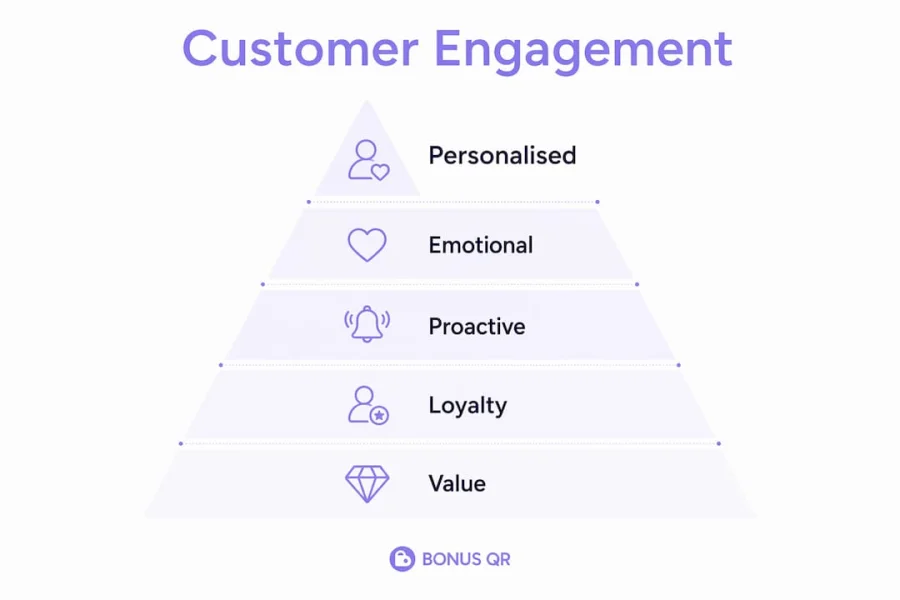
Effective engagement strategies include personalised communication, loyalty programmes, and proactive event-driven interaction that increase customer lifetime value and reduce churn.
Pro Tip: Focus on well-timed, meaningful interactions rather than volume. Sending three relevant messages a month outperforms sending thirty generic ones.
How do customer engagement strategies work and what tactics are effective?
Customer engagement strategies are the planned approaches businesses use to build and maintain active relationships with their customers. The most effective strategies share one quality: they treat customers as individuals, not as a mass audience.
Audience segmentation and lifecycle targeting
Segmentation is the practice of dividing your customer base into groups based on shared characteristics such as purchase history, location, or engagement level. Lifecycle targeting goes one step further by tailoring your communication to where a customer sits in their relationship with your brand. A new customer needs a different message than a lapsed one.
Leading organisations use audience segmentation, omnichannel communications, and event-driven tactics to build engagement. Segmentation prevents the common mistake of sending the same offer to every customer regardless of their history with you.
Event-driven and proactive communication
Event-driven engagement aligned with customer milestones significantly outperforms generic batch messaging. A message triggered by a cart abandonment, a lapsed visit, or a loyalty milestone lands at the right moment. It feels personal because it is responding to something the customer actually did.
Proactive communication means reaching out before a customer has a problem, not after. Sending a reminder when a reward is about to expire, or a personalised offer on a customer’s anniversary with your brand, are both proactive tactics that drive action.
Top customer engagement strategies for business owners
- Build a loyalty programme. Points collection, stamp cards, and cashback rewards give customers a concrete reason to return. Loyalty programme benefits include higher purchase frequency and stronger emotional connection to your brand.
- Personalise every touchpoint. Use purchase history and behavioural data to tailor emails, push notifications, and offers. Generic messages are ignored; relevant ones are acted on.
- Use omnichannel communication. Customers move between your app, website, email, and physical location. Connecting these channels creates a consistent experience that keeps customers engaged regardless of where they interact with you.
- Create feedback loops. Ask customers for their opinions through surveys or reviews, then act on what they say. Closing the loop with customer feedback builds trust and shows customers their voice matters.
- Run event-driven campaigns. Set up automated messages triggered by specific customer actions. Welcome messages, post-purchase follow-ups, and win-back campaigns all fall into this category.
- Experiment with A/B testing. A/B testing and control groups allow you to measure the true impact of engagement tactics rather than relying on open rates or other surface metrics.
- Reward referrals. Customers who refer friends are already engaged. Giving them an incentive to share amplifies your reach without significant additional cost.
Pro Tip: Avoid generic batch marketing. Segment your audience first, then test one variable at a time using A/B testing to understand what actually drives behaviour change.
For retail-specific approaches, customer engagement in retail requires particular attention to in-store and digital channel alignment.
How can businesses measure customer engagement success effectively?
Measuring customer engagement means tracking what customers actually do, not just how they feel. Behavioural metrics give you concrete data on the health of your customer relationships.
The most useful engagement metrics fall into several categories. Active user counts show how many customers are regularly interacting with your app or platform. Feature adoption rates reveal which parts of your product or service customers find valuable. Purchase frequency tracks how often customers return to buy. Click-through rates on emails and push notifications indicate whether your messages are relevant enough to prompt action.
| KPI | What it measures | What a low score signals |
|---|---|---|
| Active user count | Regular platform interaction | Customers are disengaging or churning |
| Purchase frequency | How often customers buy | Loyalty is weak or offers are irrelevant |
| Click-through rate | Message relevance and timing | Content is too generic or poorly timed |
| Feature adoption rate | Depth of product use | Customers are not finding full value |
| Reward redemption rate | Loyalty programme effectiveness | Programme is not compelling enough |
Engagement success should be measured using behavioural metrics such as active user count, feature adoption, purchase frequency, and click-through rates rather than vanity metrics. Vanity metrics like total followers or email list size tell you nothing about whether customers are genuinely connected to your brand.
One critical pitfall is measuring engagement in isolation across disconnected tools. 81% of leaders agree that data integration across six or more customer experience tools is essential to improve engagement outcomes. Fragmented data produces an incomplete picture. A customer might be highly active on your app but completely unresponsive to email. Without a unified view, you miss that nuance entirely.
For a practical framework on tracking these numbers, measuring customer engagement for real growth covers the key metrics and how to interpret them in context.
What are the best practices and common challenges in customer engagement?
Implementing customer engagement well is harder than defining it. Most businesses understand the concept but struggle with the practical realities of execution.
The most common challenges include:
- Data silos. Customer data spread across separate CRM, email, and point-of-sale systems prevents a unified view of each customer. Without that view, personalisation is guesswork and segmentation is inaccurate.
- Volume over quality. Many businesses default to sending more messages when engagement drops. Meaningful and well-timed interactions build trust more effectively than high-frequency, generic messaging. Increasing message volume without improving relevance accelerates disengagement.
- One-way communication. Sending information to customers is not engagement. Engagement is a two-way street requiring mechanisms like surveys, community forums, or social media to capture and act on customer feedback.
- Ignoring customer agency. Customers decide if and when to engage based on perceived value. A strategy that ignores this and pushes messages at customers without offering choice will see diminishing returns.
- Lack of measurement discipline. Tracking open rates and follower counts feels productive but reveals little about actual engagement. Businesses that do not measure behavioural KPIs cannot tell whether their efforts are working.
The best practice that separates effective engagement from ineffective activity is treating customers as active partners rather than passive recipients. This means creating genuine opportunities for dialogue, acting on feedback visibly, and giving customers control over how and when they hear from you.
Engagement strategies for SMB growth offer a practical starting point for smaller businesses working with limited resources and tools.
Understanding omnichannel marketing is also valuable here, as connecting your channels is one of the most direct ways to remove the friction that prevents customers from engaging consistently.
Key takeaways
Customer engagement is the ongoing, two-way relationship between a brand and its customers, measured through behavioural actions and built through personalised, well-timed, and value-driven interactions.
| Point | Details |
|---|---|
| Engagement is behavioural | Measure what customers do, not just how they feel, using KPIs like purchase frequency and active user count. |
| Quality beats volume | Well-timed, relevant messages outperform high-frequency generic campaigns every time. |
| Two-way dialogue is non-negotiable | Feedback loops through surveys, reviews, and forums are core to genuine engagement, not optional extras. |
| Data integration is critical | Unified customer data across all tools is the foundation of effective segmentation and personalisation. |
| Loyalty programmes drive action | Points, stamps, and rewards give customers a concrete reason to return and build habitual engagement. |
Why I think most businesses are approaching engagement backwards
Most businesses I speak with treat customer engagement as a broadcasting problem. They ask how to reach more customers, more often, across more channels. That framing is the wrong starting point entirely.
Engagement is not something you do to customers. It is something customers choose to do with you. The moment you accept that distinction, your entire strategy shifts. You stop asking “how do we send more?” and start asking “why would a customer want to respond?”
The businesses that get this right tend to share one habit: they listen before they send. They use feedback data, redemption rates, and behavioural signals to understand what customers actually value. Then they build their communications around that. The result is fewer messages that get more responses.
Event-driven engagement is the clearest example of this principle in action. A message triggered by a real customer action, such as a lapsed visit or an expiring reward, is relevant by definition. It arrives at a moment the customer cares about. That is why it outperforms batch campaigns so consistently.
The other shift I would encourage is moving from satisfaction as your north star to engagement as your north star. A satisfied customer is a good outcome. An engaged customer is a business asset. Satisfaction is a moment. Engagement is a relationship.
— Michal
How Bonusqr helps you put engagement into practice
Bonusqr is a loyalty platform built for businesses that want to move from theory to action. Its electronic reward system lets you create points-based programmes, cashback offers, and milestone rewards without any POS integration. The stamp card programme is particularly effective for businesses with regular foot traffic, turning repeat visits into a structured loyalty habit. Push notifications, real-time analytics, and branded mobile apps give you the tools to personalise communication and track engagement metrics in one place. Bonusqr supports businesses of all sizes, from independent retailers to multi-location operators, with a free tier available to get started.
FAQ
What is customer engagement in simple terms?
Customer engagement is the ongoing, active relationship between a customer and a brand, measured by the actions customers take such as purchases, app use, or content sharing. It goes beyond a single transaction to describe the depth of connection over time.
How does customer engagement differ from customer satisfaction?
Customer satisfaction measures how a customer felt after a specific interaction. Customer engagement measures whether they continue to take action and return to your brand over time.
What are the most effective ways to improve customer engagement?
The most effective approaches include personalised communication, loyalty programmes, event-driven messaging triggered by customer behaviour, and feedback loops that give customers a voice in your brand.
Why do businesses struggle with customer engagement?
The most common barriers are data silos that prevent a unified customer view, a focus on message volume over relevance, and treating engagement as one-way broadcasting rather than two-way dialogue.
What metrics should I use to measure customer engagement?
Track behavioural KPIs including active user count, purchase frequency, click-through rates, and reward redemption rates. These reveal actual customer connection far more accurately than follower counts or email list size.


