
 Deutsch
 Español
 Français
 Italiano
 Magyar
 Polski
 Slovenčina
 Čeština
A café owner sees the same customer every weekday at 8:15. Flat white. No sugar. Quick smile. That looks like loyalty.
It might not be.
That customer may merely work nearby, like the coffee, and find the queue tolerable. If a new café opens two doors down with a cleaner app, faster service, and a better offer, that “loyal” regular may disappear by next Monday. Small businesses make this mistake all the time. They confuse habit with commitment.
That confusion is expensive. It distorts cash-flow planning, weakens marketing decisions, and creates false confidence. A business that thinks it has loyal customers when it only has convenient footfall is operating with a blind spot.
Beyond Repeat Business What Is a Loyal Customer Really
The cleanest answer to what is a loyal customer is this. A loyal customer doesn't just come back. They choose the business again and again, even when alternatives are available.
That choice can come from two very different places.
Transactional loyalty versus emotional loyalty
Transactional loyalty is driven by practical reasons. Price. Proximity. Discounts. Convenience. A points stamp. A loyalty-priced product. These customers are useful, valuable, and worth keeping. But they are also easier to lose.
Emotional loyalty runs deeper. It comes from trust, familiarity, personal treatment, shared values, and the feeling that this business “gets” them. These customers don't just buy. They recommend, forgive the occasional mistake, and stay engaged even when they aren't purchasing that week.
A simple comparison helps:
| Type | What drives it | What it looks like in a local business | Main risk |
|---|---|---|---|
| Transactional loyalty | Savings, habit, convenience | A customer visits because the shop is on their route | They switch fast when a better deal appears |
| Emotional loyalty | Trust, belonging, experience | A salon client books again because they feel known and looked after | Harder to build, but much harder for competitors to steal |
This matters even more in the UK because loyalty is often defined in practical terms first. 67.2% of consumers define brand loyalty primarily as buying from the same brand, only 34.6% connect it with emotional connection, and nearly 42.1% say it takes five or more purchases before they consider themselves loyal, according to Yotpo's UK consumer loyalty report.
A repeat customer is like an acquaintance. Familiar, welcome, good to see.
A loyal customer is closer to a friend of the business. They have history with it. They trust it. They want it to keep doing well.
Why regulars and loyal customers aren't the same
Many small business owners watch repeat visits and assume the job is done. It isn't. A repeat visit only proves a transaction happened again. It doesn't prove attachment.
Practical rule: If a customer would leave for a small discount, they're repeat business. If they'd stay because the experience matters, they're loyal.
That gap is where opportunity sits. Local businesses don't need complicated systems to close it. They need a better way to recognise people, reward consistency, and create lightweight touchpoints between visits. That's the practical side of enhancing customer retention.
A café, salon, gym, or neighbourhood retailer doesn't need a brand manifesto. It needs a simple process that turns “I come here often” into “this is my place”.
Why Genuine Customer Loyalty Is Your Greatest Asset
Small businesses don't survive on one-off wins. They survive on dependable customers.
That's why genuine loyalty matters more than social media noise, more than a busy Saturday, and more than a short-lived discount push. When customers keep returning by choice, the business gets something every owner wants and rarely has enough of. Predictability.
Loyalty stabilises revenue
A loyal customer base makes cash flow less chaotic. Rent still needs paying when the weather turns bad. Staff still need wages when footfall dips. A business with committed returning customers has a stronger floor under monthly revenue.
That floor gets more valuable when margins are tight. Owners can plan stock better, schedule staff with more confidence, and stop reacting to every slow week like it's a crisis.
There's also a direct spending difference. Loyal consumers spend 67% more than new customers, according to the UK government's executive summary on loyalty pricing in groceries. That doesn't just mean more revenue. It usually means better economics on every customer relationship already won.
Loyal customers market the business for free
The cheapest marketing channel for a small business is still recommendation.
A happy regular who tells a friend to try the salon, café, studio, or shop brings in warmer demand than most paid ads ever will. What's more, those referrals often arrive with trust already built. The new customer walks in expecting a good experience, not evaluating from zero.
A strong loyalty experience turns ordinary customers into a sales force the business doesn't have to hire.
That same government review found that 90% of customers will recommend a brand to friends and family based solely on positive experiences with its loyalty programme. That should change how owners view loyalty offers. They aren't just retention tools. They shape word of mouth.
Loyalty protects the business when conditions get rough
A genuine loyal base gives a small business breathing room.
When a chain opens nearby, when a competitor cuts prices, when consumer confidence drops, loyal customers don't vanish at the first sign of pressure. They're more likely to stick, adapt, or reduce spend without disappearing entirely.
That resilience is a business asset, not a branding concept. It buys time. It reduces panic. It gives owners a base to build from instead of a treadmill they can't step off.
A business without loyalty is forced to re-earn attention constantly. A business with loyalty can focus on serving people well and growing from a more stable position.
Five Key Traits of a Truly Loyal Customer
Loyality becomes easier to manage when it stops being abstract. A small business doesn't need mystery around this. It needs observable behaviour.
The clearest way to identify what is a loyal customer is to watch for five traits that show up consistently in cafés, salons, gyms, quick-service venues, and local retail.
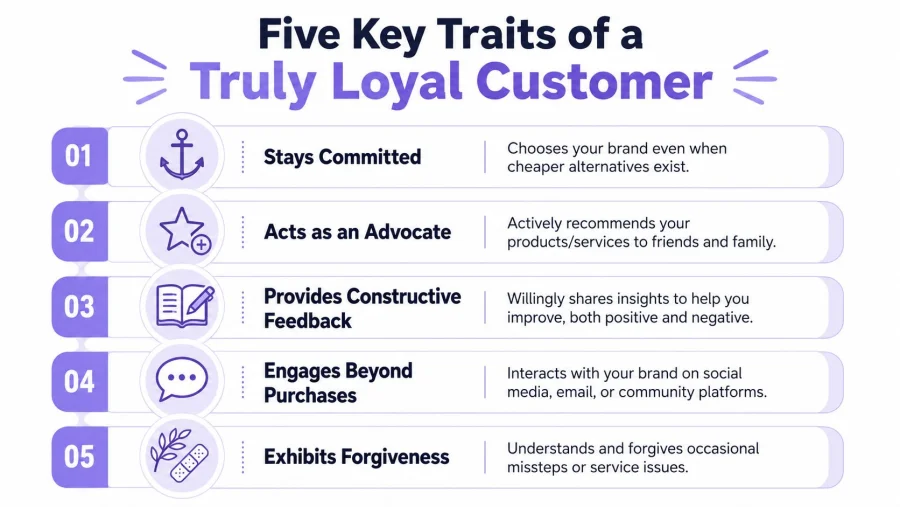
They come back without needing a push every time
The first sign is frequency with recency. They don't just return eventually. They return in a pattern.
For a café, that might be someone who visits several times across a normal month. For a salon, it may be a client who rebooks before leaving. For a gym studio, it's the member who keeps showing up even after the initial enthusiasm fades.
This kind of consistency matters because it signals routine, not curiosity.
They spend with confidence
Loyal customers often stop acting like cautious first-timers. They add the pastry. They book the treatment upgrade. They buy the retail product at the till. They trust the business enough to widen the relationship.
That doesn't mean every loyal customer spends extravagantly. It means they spend with less friction.
They resist easy switching
Loyalty faces real-life tests. A loyal customer doesn't disappear because a competitor offered a slightly cheaper lunch deal or a nearby barber posted a first-visit discount.
That trait matters more now because 56% of UK respondents said inflation pushed them to abandon previously loyal brands to save money, according to Mintel's UK customer loyalty in retailing market report. In that climate, loyalty isn't proven when spending is easy. It's proven when a customer still tries to stay connected despite financial pressure.
They engage beyond the purchase
A loyal customer behaves differently between transactions.
They follow the business on social media. They react to updates. They ask when the seasonal menu returns. They reply to a message. They notice changes in the shop. They care enough to pay attention outside checkout.
The strongest loyalty often shows up between purchases, not during them.
That's the hidden layer many local businesses miss. If the only signal being tracked is spending, the emotional side remains invisible.
They advocate and give useful feedback
Advocacy is a stronger trait than simple satisfaction. These customers bring a friend, mention the business in conversation, leave a positive review, or recommend a specific staff member by name.
They also speak up when something is off. Not to punish the business, but because they want it to improve.
A quick checklist helps:
- Frequent return pattern: They show up regularly enough to be recognised.
- Broader spend behaviour: They buy with trust, not hesitation.
- Switching resistance: They don't chase every cheaper alternative.
- Ongoing engagement: They stay connected between visits.
- Visible advocacy: They recommend, review, and refer.
If a customer shows one or two of these traits, they may just be a happy buyer. If they show all five, the business has something far more valuable.
How to Measure Loyalty Without Complex Technology
Most small business owners don't need another dashboard full of graphs they'll never open. They need a few simple measures that answer a practical question. Are customers coming back, spending more, and telling other people?
That can be tracked without a data team.
Start with three workable metrics
The first metric is repeat purchase rate. In plain terms, how many customers bought once and then came back again within a sensible timeframe for the business. A café may look at weeks. A salon may look at months.
The second is customer lifetime value. That sounds technical, but it's just the total value a customer brings over time. If one salon client books repeatedly, buys aftercare products, and refers a friend, that relationship is worth far more than the first appointment price.
The third is referral intent or advocacy. Some businesses use a formal score. Many small businesses can use simpler signs. Reviews, referrals, social engagement, redeemed friend offers, or direct mentions at checkout all count.
A basic version looks like this:
| Metric | Simple question | Manual method |
|---|---|---|
| Repeat purchase rate | Are first-time customers returning? | Track names or phone numbers in a spreadsheet |
| Customer lifetime value | Which customers are worth the most over time? | Add up visits and spend by customer |
| Advocacy | Who is sending others in? | Ask “How did you hear about us?” and log it |
Watch behaviour, not just discounts
Discounts clearly affect loyalty behaviour. 48% of consumers show incentivized loyalty, meaning loyalty is triggered by discounts, perks, or rewards offered through an app or programme, according to Emarsys customer loyalty statistics.
That means a business should track not only whether people return, but what made them return. Was it a reward? A birthday offer? A stamp threshold? A personal message? A seasonal coupon?
If the answer is always “they came back when money was on the table,” the business has transactional loyalty. Useful, but fragile. If they still engage and return after the reward is redeemed, the business is building something stronger.
Keep the system simple enough to use
Most local businesses fail at measurement for one boring reason. The process is annoying.
If staff have to remember extra steps, if owners have to build formulas after closing time, or if reports live in separate tools, tracking collapses within days. A usable system needs to be quick at the counter and clear in the back office.
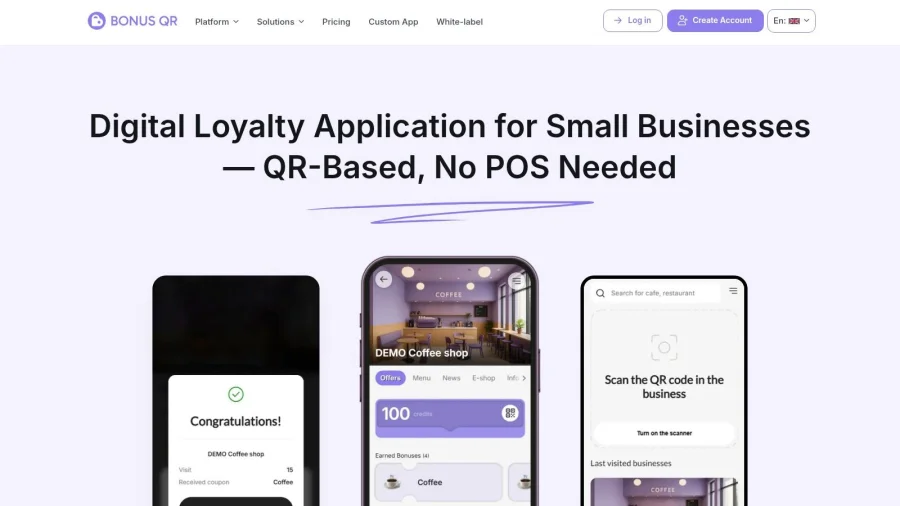
One practical option is BonusQR, which gives brick-and-mortar businesses a QR-based loyalty setup with wallet passes, built-in analytics, reward tracking, and no POS integration requirement. That makes it easier to monitor visit frequency, identify top customers, and test offers without adding hardware or creating admin drag. For owners who want a simple framework first, this guide on how to determine customer loyalty breaks down retention tracking in more detail.
Useful test: If the owner can't explain the loyalty numbers in under five minutes, the tracking setup is too complicated.
The right measurement system should save time, not create another unpaid evening task.
Your Roadmap to Building Genuine Customer Loyalty
Loyalty doesn't appear because a business printed a stamp card. It's built in layers.
That matters because many UK brick-and-mortar businesses are strong on the transaction and weak on the experience around it. Yet the opportunity is obvious. The gap between transactional and experiential loyalty is still underused in local retail, and data highlighted by Zendesk notes that 72% of UK customers stay loyal to only one brand, while loyal consumers spend 67% more than new customers, which points to real upside when a business deepens emotional connection rather than relying on repeat buying alone, as outlined in Zendesk's discussion of customer loyalty.
Step one fix the basics first
A weak experience can't be rescued by rewards.
If service is slow, standards are inconsistent, or staff treat regulars like strangers every time, loyalty won't stick. Customers may still buy, but they won't bond. The first job is operational consistency. Clean site, clear pricing, warm service, and a reliable product.
For a salon, that means on-time appointments and clear aftercare advice. For a café, it means the same drink quality every visit, not one good flat white and one forgettable one.
Step two make people feel recognised
Recognition is where emotional loyalty starts to form. Not grand gestures. Small signals.
A customer's usual order. A staff member remembering a name. A birthday reward that arrives on time. A message that reflects actual behaviour rather than a generic blast.
Many local businesses overcomplicate things. They think personalisation requires deep integrations and a full CRM setup. It doesn't. It requires a way to tie activity to a customer profile and then act on it consistently.
A useful outside example comes from Cultivating client loyalty through gifting, which shows how thoughtful, well-timed gestures can strengthen business relationships without turning every interaction into a discount.
Step three use rewards to open the door, not finish the job
Rewards work. But they should start the relationship, not define it.
A simple welcome bonus, a visit milestone, cashback, birthday perk, or spend threshold gives customers a reason to return soon. After that, the business needs to build memory and trust around the experience itself.
A practical structure looks like this:
- First visit: Offer a low-friction sign-up and a clear reason to return.
- Early repeat phase: Reward the second, third, and fourth visits to build habit.
- Established phase: Shift from generic discounts to relevant offers, updates, and recognition.
- Advocacy phase: Encourage referrals, feedback, and community-style engagement.
Step four remove friction with wallet-based loyalty
Traditional paper cards get lost. Many branded apps get ignored. That's why wallet passes matter for small businesses.
Apple Wallet and Google Wallet passes reduce friction because customers don't need to download another full app just to collect points or redeem an offer. The reward stays visible on the phone they already carry. That makes loyalty feel passive and convenient rather than like a chore.
For a busy owner, convenience matters on both sides. Staff need a system they can use during a rush. Customers need something they can access in seconds. A customizable loyalty platform with QR sign-up, wallet pass support, automated messages, and basic analytics keeps that manageable without adding hardware or a large setup project.
Step five turn activity into follow-up
The final step is where many businesses leave money on the table. They collect customer details and then do nothing with them.
The smarter move is simple follow-up:
- After a first visit: Send a return incentive while the experience is fresh.
- Before a likely repeat window: Prompt the next booking or visit.
- On birthdays or seasonal moments: Give customers a reason to choose the business again.
- After a reward redemption: Invite feedback or suggest the next step.
Loyalty grows when the business stays present between visits in a way that feels helpful, not noisy.
That's how discount-seekers become regulars, and how regulars become advocates.
Your Questions About Customer Loyalty Answered
Small business owners usually don't object to loyalty in principle. They object to the hassle, the margin pressure, and the fear of adding another system they won't maintain.
Those concerns are fair. Most loyalty programmes fail because they are badly designed, too complicated, or disconnected from the actual customer experience.
Does a small business really need a loyalty programme
Not every business needs a formal points scheme. Every business does need a retention system.
If customers can't be recognised, rewarded, or re-engaged in a consistent way, the business is relying on memory and luck. That works until staff change, competitors move in, or the owner gets too busy to manage relationships manually.
For a neighbourhood café or salon, a simple loyalty setup often replaces messy paper cards, inconsistent offers, and ad hoc customer follow-up. It brings structure to something that was already happening badly.
Won't discounts just eat the margin
They will if the business uses them carelessly.
A weak loyalty strategy trains customers to wait for the next deal. A smart one uses offers selectively to trigger return visits, then lets service and familiarity carry more of the load. The answer isn't “never discount.” It's “stop discounting blindly.”
Good offers should have a job. Bring back a first-time customer. Reward a milestone. Nudge a quiet regular. Mark a birthday. If an offer has no purpose beyond short-term volume, it usually damages margin without building loyalty.
How much time does this take to manage
Too much, if the process is manual.
A manageable loyalty system has to fit into real operations. Staff should be able to explain it quickly. Customers should understand it without a speech. Owners should be able to review results without pulling reports from five places.
That's why simple mechanics usually beat clever ones. Clear earning rules. Obvious rewards. Light automation. Easy redemption.
What if customers only care about rewards
At first, many of them do. That isn't failure. That's the entry point.
A lot of loyalty starts as a practical exchange. The mistake is stopping there. Once customers return, the business has a chance to build recognition, trust, and preference. If the experience remains forgettable, they stay discount-led. If it improves and feels personal, loyalty deepens.
Is emotional loyalty realistic for a local business
Yes, and local businesses often have an advantage.
Chains can outspend independents. They struggle to out-human them. A local team can remember names, adapt offers, respond faster, and build a sense of familiarity that large competitors rarely match.
That's the answer to what is a loyal customer. It's not someone who happened to buy again. It's someone who feels confident choosing the business, talking about it, and returning to it on purpose.
A small business doesn't need a complicated retention strategy. It needs a clear one. Track repeat behaviour, reward it simply, and build recognition between visits. For owners who want to launch quickly without POS integration or extra hardware, BonusQR offers a free starting point for QR-based loyalty, wallet passes, automated offers, and customer tracking that fits day-to-day operations.