
 Deutsch
 Español
 Français
 Italiano
 Magyar
 Polski
 Slovenčina
 Čeština
Loyalty schemes are structured marketing programmes that reward customers for repeat purchases and ongoing engagement with a business. The industry term is “loyalty programme,” and the two phrases describe the same concept. Over 90% of consumers use at least one loyalty app, which shows how deeply embedded these programmes are in everyday shopping behaviour. Yet membership alone does not equal loyalty. The real opportunity for business owners lies in understanding what are loyalty schemes at a structural level, then building one that creates genuine retention rather than just collecting sign-ups. Done well, a loyalty programme increases purchase frequency, raises customer lifetime value, and generates first-party data you can use for targeted marketing.
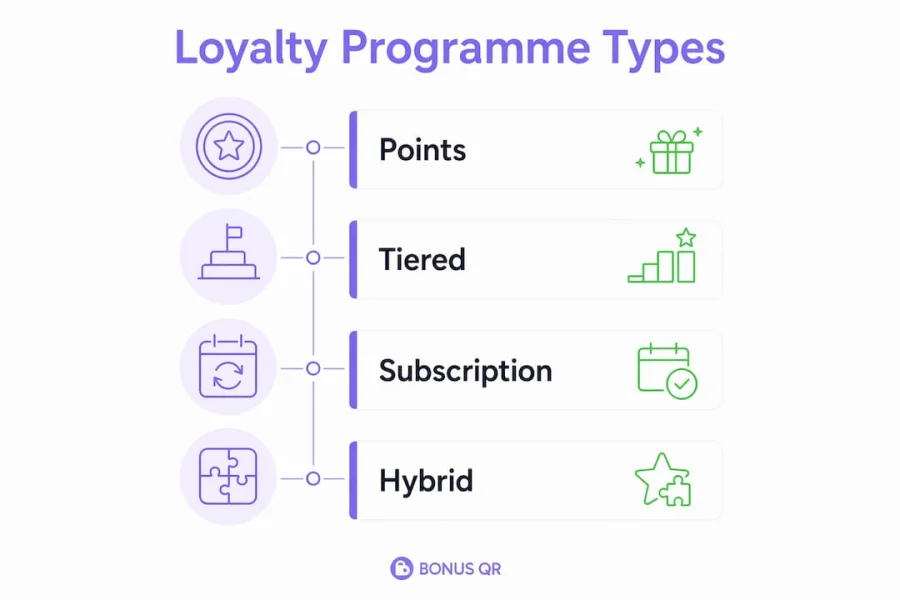
What are loyalty schemes and what types exist?
A loyalty scheme is a formal system that gives customers a reason to return. Every scheme has two core mechanics: earning and redemption. Customers earn rewards through purchases, visits, or specific behaviours, then redeem those rewards for discounts, free products, or exclusive access. The structure you choose shapes everything from customer experience to your cost per reward.
Points-based programmes
Points-based programmes are the most widely used format. Customers accumulate points with each purchase and redeem them once they reach a threshold. This model suits high-frequency retail environments such as grocery, pharmacy, and coffee shops, where customers transact often enough to see points grow quickly. The risk is that points can feel abstract. If customers cannot easily calculate what their points are worth, engagement drops.

Tiered programmes
Tiered programmes rank customers by spend or activity, typically across Bronze, Silver, and Gold levels. Higher tiers unlock better rewards, creating a clear incentive to spend more. Fashion and hospitality brands use this model effectively because it appeals to customers who value status and exclusivity. The challenge is keeping lower-tier members motivated. If the entry-level rewards feel weak, new members disengage before reaching the tiers that matter.
Subscription and paid membership programmes
Paid membership programmes charge customers an upfront fee in exchange for ongoing benefits such as free delivery, early access to sales, or members-only pricing. This model works when the perceived value of benefits clearly exceeds the membership cost. It also pre-qualifies your most committed customers, since only genuinely interested buyers will pay to join.
Hybrid programmes
Hybrid programmes combine two or more of the above formats. A retailer might offer points on every purchase, tier-based status rewards for high spenders, and a paid membership option for premium benefits. This flexibility suits businesses with diverse customer segments, though it adds complexity to both management and customer communication.
| Programme type | Core mechanic | Best suited to | Key advantage | Main risk |
|---|---|---|---|---|
| Points-based | Earn and redeem points | High-frequency retail | Simple and familiar | Points can feel abstract |
| Tiered | Status levels by spend | Fashion, hospitality | Drives higher spend | Low-tier disengagement |
| Paid membership | Fee for ongoing perks | E-commerce, grocery | Pre-qualifies loyal buyers | Value must be obvious |
| Hybrid | Combined mechanics | Multi-segment businesses | Flexible and personalised | Complexity and cost |
Pro Tip: Choose your programme type based on how often your customers already buy. High-frequency buyers respond well to points. Infrequent but high-value buyers respond better to tiered or membership models.
What are the benefits and limitations of loyalty schemes for customer retention?
The primary benefit of a loyalty scheme is increased purchase frequency. When customers know a reward is within reach, they choose your business over a competitor offering no incentive. This directly raises customer lifetime value, which is the total revenue a customer generates over their relationship with your business. A well-run loyalty programme also produces first-party data, giving you insight into purchase patterns, preferences, and seasonal behaviour that generic market research cannot match.
The loyalty deficit problem
The data reveals a significant gap between enrolment and genuine loyalty. Fewer than 25% of consumers cite emotional attachment as a reason for repeat purchases. That means most customers who hold a loyalty card are not emotionally invested in your brand. They will switch if a competitor offers a better deal. Transactional points alone do not create brand preference. They create programme engagement, which is a different and weaker thing.
The engagement problem is even sharper when you look at active usage. In Hungary, the average consumer belongs to six loyalty programmes but only 38% actively participate. The main reasons cited are technical problems, lengthy registration processes, and rewards that feel unappealing. This pattern repeats across markets. Membership numbers look impressive on a dashboard, but they mask the reality that most members are dormant.
Common pitfalls to avoid
- Poor personalisation. Sending the same offer to every member signals that you do not know your customers. Generic communications feel intrusive rather than helpful.
- Unclear reward value. If customers cannot quickly understand what their points are worth or when they can redeem them, they stop engaging.
- Overly complex structures. Too many tiers, rules, or expiry conditions create confusion and frustration.
- Neglecting emotional drivers. Programmes built entirely on discounts attract price-sensitive customers who leave the moment a better deal appears elsewhere.
- Technical friction. Slow apps, difficult registration, and broken redemption flows are the fastest way to lose members who were willing to engage.
Many businesses mistake programme enrolment for true customer loyalty. Enrolment is a starting point, not a result.
How to implement a loyalty scheme that actually works
Effective implementation starts before you build anything customer-facing. The most common technical failure point is fragmented customer data. Without unified customer profiles, your marketing system sends mass-market offers that feel irrelevant and intrusive. Solving your data integration challenge before launch is not optional. It is the foundation everything else sits on.
- Define your objectives first. Decide whether you are targeting retention, purchase frequency, average spend, or all three. Each objective requires different mechanics and different KPIs.
- Build a unified customer profile. Consolidate purchase history, contact data, and behavioural signals into a single record per customer before you go live.
- Set your KPIs before launch. Redemption rate and activity rate are the two most meaningful indicators of programme health. Redemption rate measures the percentage of issued points or vouchers that customers actually use. Activity rate tracks the share of members who made at least one purchase in the past year.
- Keep rewards simple and immediate. Customers respond better to rewards they can understand and access quickly. Complexity kills engagement.
- Reduce registration friction. Every extra step in the sign-up process costs you members. Aim for registration in under two minutes, with no POS integration required on the customer side.
- Plan a phased rollout. Launch with your core mechanic, measure performance for 60–90 days, then add features based on what the data shows.
- Allocate a standalone budget. Loyalty programmes require dedicated investment and long-term commitment. Treating them as a line item within general marketing spend leads to underfunding and poor results.
Pro Tip: Track purchase frequency incrementality, not just total revenue. You need to know whether your programme is causing customers to buy more often, or whether they would have bought anyway.
For a practical framework on what to measure, the SMB loyalty success guide covers the key metrics in detail.
How to personalise loyalty schemes by industry and customer segment
A single programme design does not work across all sectors. Different industries require different loyalty priorities, because the reasons customers return vary fundamentally by category. A grocery shopper values convenience and timely relevance. A fashion customer values identity and belonging. A DIY customer values expert advice and project support. Building a programme that ignores these distinctions produces generic rewards that fail to resonate with anyone.
| Sector | Primary loyalty driver | Most effective reward type | Key personalisation lever |
|---|---|---|---|
| Grocery | Convenience and price | Cashback, instant discounts | Purchase timing and basket analysis |
| Fashion | Identity and exclusivity | Early access, members-only drops | Style preferences and purchase history |
| DIY and home | Long-term project support | Expert advice, consultation perks | Project stage and product category |
| Hospitality | Experience and recognition | Upgrades, exclusive events | Visit frequency and occasion type |
| Restaurants | Habit and familiarity | Stamp cards, free items | Visit cadence and menu preferences |
Emotional loyalty drivers differ significantly by segment. Fashion customers respond to programmes that make them feel part of an exclusive group. Grocery customers respond to programmes that save them time and money without requiring effort. Hospitality customers respond to recognition, where staff and systems remember their preferences.
Relationship marketing principles apply directly here. The most effective loyalty programmes treat customer relationships as long-term investments, not one-off transactions. Personalisation at scale now relies increasingly on AI-driven segmentation, which analyses purchase patterns and predicts the next best offer for each individual customer. Partnerships between complementary brands also extend programme value, giving customers rewards they can use across a wider ecosystem without requiring you to fund every benefit yourself.
For hospitality businesses specifically, restaurant reward ideas that go beyond stamp cards can significantly improve repeat visit rates.
Pro Tip: Segment your members by recency, frequency, and value before personalising communications. Customers who visited once six months ago need a different message from those who visit weekly.
Key takeaways
Loyalty schemes deliver measurable retention and revenue benefits only when they combine clear mechanics, unified data, and rewards that match what customers actually value.
| Point | Details |
|---|---|
| Define objectives before building | Set retention, frequency, or spend targets before choosing a programme type or mechanic. |
| Enrolment is not loyalty | Over 90% of consumers hold memberships, but most are dormant; active engagement is the real measure. |
| Track redemption and activity rates | These two KPIs reveal true programme health far better than total membership numbers. |
| Personalise by sector and segment | Grocery, fashion, DIY, and hospitality each require different reward types and emotional drivers. |
| Unify customer data first | Fragmented data produces generic offers; a unified customer profile is the foundation of effective personalisation. |
Why points alone will never be enough
I have reviewed and worked alongside dozens of loyalty programmes over the years, and the pattern is consistent. Businesses launch with genuine enthusiasm, hit strong enrolment numbers in the first quarter, then watch engagement plateau or decline by month six. The diagnosis is almost always the same: the programme was built around what was easy to measure rather than what customers actually care about.
Points are easy to count. Emotional connection is harder to quantify, so it gets deprioritised. The result is a programme that looks healthy on a membership dashboard but produces no real change in customer behaviour. True loyalty arises from repeated positive experiences over time, where customers perceive both functional and emotional value. A discount is functional. Being recognised, remembered, and rewarded in a way that feels personal is emotional.
The businesses I have seen succeed long-term are those that treat their loyalty programme as a customer relationship tool, not a promotional mechanic. They invest in understanding why their best customers return, then build rewards around those reasons. They also accept that this takes time. A loyalty programme is not a campaign. It is an ongoing commitment that compounds in value the longer you run it with discipline and consistency.
My honest advice: resist the urge to add complexity early. Start with one clear mechanic, measure it properly using customer retention strategies as your benchmark, and only expand when the data tells you to. The businesses that overcomplicate their programmes in year one rarely make it to year three.
— Michal
How Bonusqr supports loyalty programme implementation
Bonusqr is a SaaS platform built for businesses that want to launch and manage digital loyalty programmes without complex technical setup. The platform supports multiple programme types, including stamp cards, tiered cashback, and electronic rewards, so you can match the mechanic to your customer base rather than forcing your customers into a one-size-fits-all structure. Bonusqr requires no POS integration, offers mobile and web app access, and includes push notifications and real-time analytics to keep your programme performing. For a full view of what the platform covers, the Bonusqr features page details every module available across pricing tiers, including free options for businesses starting out.
FAQ
What is a loyalty scheme in simple terms?
A loyalty scheme is a structured programme that rewards customers for repeat purchases or engagement. Rewards typically include points, discounts, free products, or exclusive access.
How do loyalty programmes work for customers?
Customers earn rewards by making purchases or completing specific actions, then redeem those rewards once they meet a threshold. The process is designed to make returning to the same business more attractive than switching to a competitor.
What are the main types of loyalty schemes?
The four main types are points-based programmes, tiered programmes, paid membership programmes, and hybrid programmes that combine multiple mechanics.
Why do so many loyalty programmes fail to retain customers?
Most programmes fail because they focus on enrolment rather than active engagement. Technical friction, poor personalisation, and rewards that feel irrelevant are the most commonly cited reasons customers stop participating.
What KPIs should I track for a loyalty programme?
Redemption rate and activity rate are the two most meaningful indicators. Redemption rate shows whether customers value the rewards enough to use them. Activity rate shows what share of your members are genuinely active within a given period.