Branded rewards are structured incentives that businesses issue under their own identity to encourage repeat customer behaviour and build long-term loyalty. They sit at the heart of branded loyalty programmes, giving customers a clear reason to return rather than switch to a competitor. Starbucks’ Stars, Sephora’s Beauty Insider points, and Amazon Prime’s membership benefits are all examples of branded customer rewards in action. Programmes designed with the right financial and structural foundations can deliver 20%–40% higher repeat purchase rates compared to unstructured offers, making them one of the most measurable tools in a marketer’s kit.
What are branded rewards and why do they matter?
Branded rewards are defined as any incentive a business offers customers through a formal, named programme that carries the company’s identity. The industry term for the broader system is a branded loyalty programme, and the rewards themselves are the currency that makes that programme work. Think of it as a formal contract between brand and customer: the customer commits to returning more frequently, and the business provides something genuinely valuable in return.
This distinction matters because branded rewards are not the same as a one-off discount or a seasonal sale. A discount reduces your margin once. A branded reward builds a habit. Starbucks’ Stars system, for example, trains customers to think in terms of earning and redeeming, not just spending. Sephora’s Beauty Insider programme layers points with tier perks, so customers feel both rewarded for every purchase and motivated to reach the next level.

The commercial case is straightforward. Businesses that design rewards around customer lifetime value rather than the cost of a single transaction consistently outperform those that rely on promotions alone. For small and medium businesses, that shift in thinking is often the difference between a loyalty programme that pays for itself and one that quietly erodes margin.
How do branded rewards work within loyalty systems?
Branded rewards operate as ongoing frameworks, not one-time campaigns. Reward systems are distinct from promotions precisely because they create predictable, repeating behaviour rather than a single spike in sales. Understanding the architecture helps you build something that works financially as well as commercially.
Every branded loyalty programme contains four core components:
- Reward types. Points, stamps, cashback, tier perks, or experiential benefits. Most successful programmes combine three to four types selected to match their margin and customer profile.
- Earning rules. How customers accumulate rewards. This could be spend-based (£1 = 1 point), visit-based (10 stamps = 1 free item), or behaviour-based (bonus points for referrals or reviews).
- Redemption rules. What customers can exchange their rewards for, and when. Clear, achievable redemption thresholds keep customers engaged without creating runaway liability.
- Pacing and tier structure. How quickly customers progress through the programme. Tiers create aspiration. A customer who is three purchases away from Gold status behaves very differently from one with no status at all.
The Starbucks 2026 loyalty programme illustrates this architecture well. It adds tiered Membership levels with personalised rewards and exclusive benefits, including extra referral bonuses and redemption perks for Reserve members. That layering gives customers multiple reasons to engage beyond the basic earn-and-spend loop.
Tier models also carry a financial dimension that many business owners overlook. Outstanding reward points are a liability on your balance sheet. You must forecast how many points will actually be redeemed and account for breakage rates of 15%–30%, the proportion of points customers earn but never use. Ignoring breakage leads to either over-generous programmes that damage margins or under-generous ones that customers abandon.
Pro Tip: Set your redemption threshold at a level that feels achievable within two to three visits. Customers who reach their first redemption milestone are significantly more likely to stay active in your programme long term.
What are the common types of branded rewards?
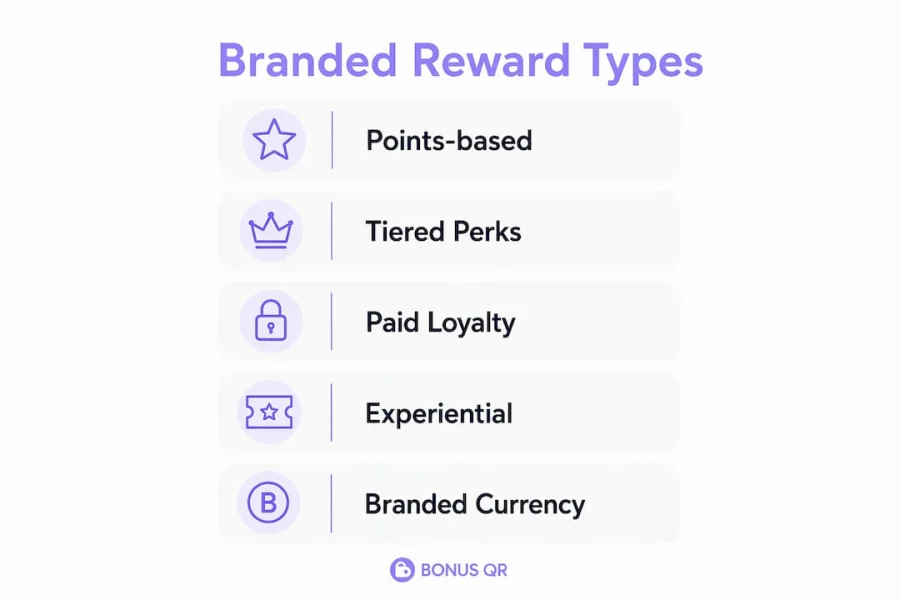
Successful programmes typically mix three to four reward types, chosen based on margin, brand positioning, and the behaviours you want to reinforce. Each type has a distinct commercial logic.
| Reward Type | How It Works | Best For | Trade-off |
|---|---|---|---|
| Points-based | Customers earn points per £ spent and redeem for products or discounts | Retail, food and beverage | Requires liability management |
| Tiered perks | Customers unlock benefits at spend or visit thresholds | Fashion, beauty, hospitality | Higher complexity to communicate |
| Paid loyalty | Customers pay a subscription fee for exclusive benefits | eCommerce, grocery, streaming | Requires strong perceived value upfront |
| Milestone rewards | One-time rewards triggered by specific actions or spend levels | Any sector | Less effective for ongoing engagement alone |
Sephora’s Beauty Insider programme combines points with tiered perks across Insider, VIB, and Rouge levels. That combination means customers earn on every visit and have a long-term goal to work towards. The result is a programme that drives both frequency and spend per visit.
Amazon Prime is the clearest example of paid loyalty at scale. Customers pay an annual fee and receive a bundle of benefits, including free delivery, streaming access, and exclusive deals. The perceived value of the bundle far exceeds the subscription cost in most customers’ minds, which is why retention rates remain high.
Experiential rewards represent a growing category. Gap Inc.'s Encore programme integrates fashion, entertainment, and cultural experiences alongside traditional points, giving members access to events and exclusive content. This approach shifts the reward from transactional to emotional, which is harder to replicate and harder for customers to walk away from.
Branded currency, such as Starbucks Stars or Sephora points, is a particularly powerful tool because it creates a proprietary unit of value that only exists within your ecosystem. Customers think in your currency, not in pounds and pence. That psychological shift strengthens brand attachment in a way that a straightforward discount never can.
What financial considerations keep branded rewards sustainable?
The most common reason branded loyalty programmes fail is not poor design. It is poor financial modelling. A programme that is too generous erodes margin. One that is too stingy loses customers. The goal is to find the range that rewards loyalty without subsidising behaviour you would have received anyway.
A healthy retail loyalty programme maintains a total reward payout of 1%–5% of trailing revenue. That range balances customer engagement with margin protection. Programmes structured within this band see 20%–40% higher repeat purchase rates compared to unstructured offers. The implication is clear: you do not need to give away the shop to drive loyalty. You need to give away the right amount, consistently.
Pro Tip: Before launching, model three scenarios: a 1% payout, a 3% payout, and a 5% payout. Run each against your average transaction value and visit frequency to see which delivers the best return without breaching your margin floor.
Breakage is your financial cushion. When outstanding points are treated as a liability and forecasted accurately, you can price your programme knowing that 15%–30% of issued rewards will never be redeemed. That unredeemed value offsets your cost of generosity. Businesses that ignore breakage in their planning consistently overspend on rewards relative to the revenue they generate.
The deeper principle is to design rewards based on customer lifetime value, not unit cost. A customer who visits your coffee shop twice a week is worth far more than the cost of a free drink every ten visits. When you model rewards against lifetime value, you can afford to be more generous at key moments, such as a welcome reward or a tier upgrade gift, because the long-term revenue justifies the short-term cost.
Comparing rewards to one-off promotions also clarifies the financial case. A promotion drives a spike in sales that disappears when the offer ends. A reward programme builds a customer retention workflow that compounds over time. The ongoing structure enables precise forecasting, which protects margins in a way that ad hoc discounting never can. For guidance on measuring the return on your marketing spend alongside loyalty investment, blended ROAS frameworks from eCommerce marketing specialists offer useful benchmarks.
How can you implement and optimise a branded rewards programme?
Launching a branded loyalty programme is straightforward when you follow a clear sequence. Optimising it over time is where most businesses either pull ahead or fall behind.
-
Define your objective before choosing your reward type. If you want to increase visit frequency, a stamp card or visit-based points system works well. If you want to increase average spend, a spend-threshold tier model is more effective. Matching the reward mechanic to the behaviour you want is the single most important design decision you will make.
-
Set achievable tier thresholds. Tiers only motivate customers if the next level feels reachable. Supergoop! redesigned its loyalty tiers to make progression feel attainable, and the result was a reduction in subscription churn from 11.2% to 4.8% within roughly 18 months. Loyalty members in the redesigned programme averaged £218 in lifetime value, while those with active subscriptions averaged £357. Achievable tiers drive that gap.
-
Build referral incentives into the programme architecture. Referrals are the highest-quality acquisition channel available to most businesses. Supergoop! tied referral rewards to tier upgrades, so customers had a personal reason to recruit friends. That mechanic turns your existing members into a sales channel without additional ad spend.
-
Communicate rewards in plain language. The biggest barrier to programme engagement is confusion. If customers cannot explain how your programme works in one sentence, they will not engage with it. Simplify your earning and redemption rules until they are obvious.
-
Use behavioural triggers and personalisation. Push notifications sent at the right moment, such as when a customer is two stamps away from a reward, drive redemption and repeat visits. Personalised offers based on purchase history outperform generic promotions consistently. Platforms that support real-time analytics make this level of personalisation accessible even for smaller businesses.
-
Review and adjust quarterly. A branded rewards programme is not a set-and-forget system. Track redemption rates, tier progression, and average transaction value for members versus non-members. Adjust earning rates, thresholds, and reward types based on what the data shows. The advantages of branded rewards compound when you treat the programme as a living system rather than a static offer.
The main challenges to anticipate are technology complexity and incentive calibration. Integrating a loyalty programme with your existing point-of-sale or eCommerce platform can require technical work. Choosing a platform that does not require POS integration removes that barrier entirely. Incentive calibration, finding the reward level that motivates without over-rewarding, takes two to three months of live data to get right. Build that adjustment period into your launch plan.
Key takeaways
Branded rewards work because they convert one-time buyers into repeat customers through a structured system of earning, progression, and redemption that is financially sustainable when designed around customer lifetime value.
| Point | Details |
|---|---|
| Definition of branded rewards | Structured incentives issued under a brand’s identity to encourage repeat behaviour and build loyalty. |
| Financial sustainability | Keep total reward payout between 1% and 5% of revenue and account for breakage rates of 15%–30%. |
| Programme architecture | Combine three to four reward types and set achievable tier thresholds to drive both frequency and spend. |
| Lifetime value focus | Design rewards against customer lifetime value, not unit cost, to justify generosity at key moments. |
| Ongoing optimisation | Review redemption rates and tier progression quarterly and adjust earning rules based on live data. |
Why most businesses get branded rewards wrong
From my experience working with businesses across retail, hospitality, and services, the most common mistake is treating a branded loyalty programme as a marketing campaign rather than a financial system. Marketers spend weeks designing the visual identity and the welcome offer, then launch without a breakage model or a payout rate calculation. Six months later, the programme is either costing more than expected or delivering so little reward that customers have stopped caring.
The second mistake is complexity. I have seen programmes with five earning rules, three redemption options, and four tier levels that customers simply cannot follow. Starbucks can sustain that complexity because they have the brand recognition and the app infrastructure to support it. Most businesses cannot. The simpler your programme, the higher your engagement rate. That is not a compromise. It is a design principle.
What genuinely excites me about the direction branded rewards are heading is the shift towards experiential incentives. Gap Inc.‘s Encore programme and Starbucks’ Reserve tier both point to a future where the most valuable rewards are not discounts but access: access to events, to exclusive products, to experiences that money cannot easily buy elsewhere. That shift is good for margins and good for brand attachment. Discounts train customers to wait for a deal. Experiences train customers to feel part of something.
The businesses that will build the most durable loyalty programmes over the next five years are those that treat rewards as a relationship tool, not a price reduction mechanism. The financial discipline matters enormously. But the strategic ambition should be to make your customers feel that belonging to your programme is genuinely worth something beyond the monetary value of the rewards themselves.
— Michal
How Bonusqr helps you build branded rewards that work
Bonusqr is a SaaS loyalty platform built for businesses that want to launch and manage branded rewards without the complexity of custom development. The loyalty system features include points collection, stamp cards, cashback, coupon distribution, and visit-based rewards, all configurable without POS integration. For service businesses, the services loyalty application provides tools tailored to appointment-based and repeat-visit models. Hotels can use Bonusqr’s hotel loyalty programme to reward guests across stays and on-property spend. The platform includes a mobile and web application, push notifications, and real-time analytics, giving you everything you need to run a financially sound, customer-facing rewards programme from day one.
FAQ
What is a branded loyalty reward?
A branded loyalty reward is an incentive issued by a business under its own name and identity to encourage customers to return and spend more. Examples include Starbucks Stars, Sephora Beauty Insider points, and Amazon Prime membership benefits.
How do branded rewards differ from standard discounts?
Branded rewards are part of an ongoing system designed to build repeat behaviour over time, whereas a discount is a one-off price reduction. Reward programmes enable financial forecasting and customer retention in a way that discounting cannot.
What reward payout rate is financially sustainable?
A total reward payout of 1%–5% of trailing revenue is the recommended range for retail loyalty programmes. Programmes within this range see 20%–40% higher repeat purchase rates compared to unstructured offers.
What types of branded incentives are most effective?
Points-based, tiered perks, paid loyalty subscriptions, and milestone rewards are the four main types. Most effective programmes combine three to four of these, selected based on margin and the customer behaviour they want to reinforce.
How should businesses manage outstanding reward points?
Outstanding reward points must be treated as a financial liability and forecasted with breakage rates of 15%–30% factored in. Accurate breakage forecasting prevents unsustainable accruals and keeps the programme profitable over the long term.


