A step-by-step loyalty system is a structured programme that rewards customers at defined stages, turning one-time buyers into repeat visitors through measurable, manageable incentives. For small and medium-sized businesses, this approach to customer retention is one of the most cost-effective growth tools available. Rather than running ad-hoc promotions, a well-designed loyalty programme creates predictable behaviour: customers return because they have a reason to. Platforms like Bonusqr have made it possible to launch a fully functional digital loyalty system without a development team or a large budget, putting this capability within reach of independent retailers, service providers, and hospitality businesses alike.
What do you need before launching a loyalty system?
Before you design a single reward, you need three things in place: clean customer data, a clear goal, and the right technology. Without these foundations, even the most generous programme will underperform.
Customer data and purchase history

Your programme design depends on what you already know about your customers. At minimum, you need basic contact information and a record of purchase frequency and average spend. This tells you how often customers visit, how much they spend per transaction, and which segments are worth targeting first. If you are starting from scratch, a simple sign-up form at the point of sale or on your website collects this data from day one.
Technology and integration requirements
A modern loyalty app requires a core set of features: a points engine, member dashboard, push notifications, QR or receipt scanning, and integration with your existing point-of-sale or CRM system. Skipping the planning stage here is costly. Developing all of these from scratch without a clear architecture can cost businesses over £40,000 in rebuilds later. For most small businesses, a SaaS platform like Bonusqr removes this risk entirely by providing these components out of the box, with no POS integration required.
Goal-setting and KPIs
Define what success looks like before you launch. Common goals include increasing visit frequency, raising average transaction value, or reducing customer churn. Attach a specific KPI to each goal: redemption rate, retention rate, or net promoter score. These numbers give you a baseline to measure against and a signal for when to adjust the programme.
- Redemption rate: the percentage of earned rewards that are actually claimed
- Retention rate: the proportion of customers who return within a set period
- Conversion rate: how many new sign-ups become active members
- Net promoter score: a measure of how likely customers are to recommend your business
Pro Tip: Set a 90-day review date before you launch. Loyalty programmes that go unreviewed for six months or more tend to accumulate inactive members and unclaimed rewards, which distorts your data and inflates your liability.
How to structure and design your loyalty programme step by step
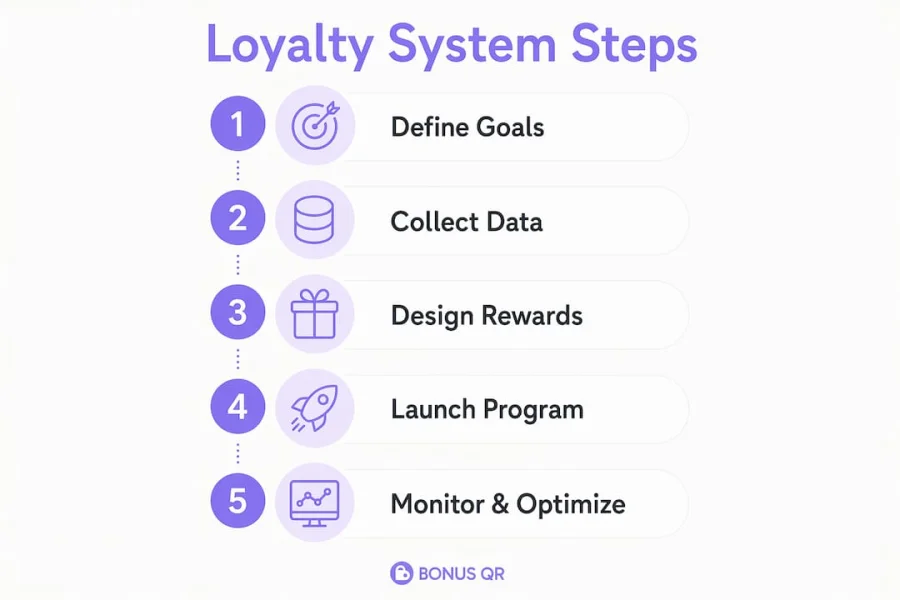
Choosing your programme structure based on specific business goals is the single most important design decision you will make. The structure shapes everything: how customers earn, what they earn, and how motivated they feel to return.
Comparing loyalty programme types
| Programme type | Best suited for | Key advantage | Key limitation |
|---|---|---|---|
| Points-based | Retail, cafés, restaurants | Simple to understand and track | Can feel transactional without added perks |
| Tiered (bronze/silver/gold) | Businesses with high repeat visit potential | Drives aspiration and deeper commitment | Requires more complex management |
| Stamp card | Low-ticket, high-frequency purchases | Extremely easy to explain and use | Limited data capture and personalisation |
| Referral-based | Service businesses, subscription models | Acquires new customers at low cost | Dependent on existing member satisfaction |
| Cashback | High-spend categories, B2B | Directly tied to spend, easy to value | Lower emotional engagement than tiered rewards |
Most small businesses benefit from starting with a points-based or stamp card model, then layering in tiers once they have enough member data to calibrate earning rates accurately.
Designing rewards that motivate
Reward catalogues should include cashback, exclusive events, referral bonuses, and surprise gifts to maintain customer interest. The critical rule is that members should earn their first reward within 30 days of joining. If the first redemption takes three months, drop-off rates rise sharply because customers lose confidence that the programme delivers real value.
Tier levels based on lifetime points, such as bronze, silver, gold, and platinum, with earning multipliers at each level, incentivise deeper commitment over time. A silver-tier member who earns points 1.5 times faster than a bronze member has a concrete reason to increase their spend. This structure also gives you a natural upsell mechanism without requiring a discount.
Pro Tip: Avoid setting your points-to-reward ratio so high that customers feel the goal is unreachable. Test your ratio by calculating how many visits a typical customer makes per month, then work backwards to a reward that feels achievable within six to eight weeks.
Setting clear earning and redemption rules
Write your rules in plain language and publish them where customers can find them easily. Specify the earning rate (for example, one point per pound spent), the minimum balance required to redeem, and any expiry conditions. Expiry dates on points create urgency, but they also create frustration if they are too short. A 12-month rolling expiry is a reasonable starting point for most businesses.
Which technology works best for small businesses in 2026?
The technology you choose determines how much manual work your team carries and how good the experience feels for your members. In 2026, the options range from fully custom builds to white-label SaaS platforms, and the right choice depends on your budget, technical capacity, and growth plans.
Build, buy, or white-label?
| Option | Typical cost | Time to launch | Best for |
|---|---|---|---|
| Custom build (e.g. Next.js + Supabase) | High | 1-2 weeks minimum | Tech-savvy businesses with specific requirements |
| SaaS platform (e.g. Bonusqr) | Low to medium monthly fee | Hours to days | Most small and medium businesses |
| White-label app | Medium to high | 2-4 weeks | Businesses wanting full brand control |
A functional points-based system with automated tier advancements can be built in one to two hours using modern tools like Next.js and Supabase. This is a realistic option for businesses with a developer on staff, but it requires ongoing maintenance. For the majority of small business owners, a SaaS platform delivers faster results with lower ongoing overhead.
Must-have software features
When evaluating any platform, check for these capabilities:
- Member dashboard: customers should be able to see their balance, tier status, and reward history without contacting you
- Automated tier progression: the system should move members between tiers without manual intervention
- Push notifications: direct communication to members’ phones drives redemption and repeat visits
- QR code or receipt scanning: frictionless point collection at the moment of purchase
- Fraud prevention: duplicate transaction detection and point cap rules protect your programme from abuse
- Real-time analytics: you need to see redemption rates and active member counts without waiting for a monthly report
Integrating your loyalty programme with payment systems like Stripe and using webhooks to trigger points for successful payments removes manual entry entirely. This matters because manual processes introduce errors and delay, both of which erode member trust.
Pro Tip: Before committing to any platform, ask specifically whether it supports omnichannel enrolment. A member who signs up in-store should be able to check their balance online and redeem via a mobile app. Programmes that work on only one channel consistently show lower engagement.
How to launch, promote, and sustain engagement in your programme
A well-designed programme that nobody knows about will fail. The launch phase sets the tone for member expectations and determines your initial enrolment rate. Treat it as a campaign, not a single announcement.
-
Create a welcome bonus. Offer new members a meaningful incentive for signing up, such as double points on their first purchase or a stamp card that starts pre-filled. This removes the inertia of starting from zero and gives members an immediate reason to engage.
-
Use multiple channels simultaneously. Continuous promotion using social media, window signage, and email sequences is the difference between a programme that grows and one that stagnates. Treating the launch as a one-time event is one of the most common failure points. Programmes like the Canadian Tire Triangle Rewards demonstrate how consistent multi-channel promotion, from in-store signage to email newsletters, sustains enrolment over years.
-
Schedule a 30-day email sequence. Send a welcome email on day one, a progress update on day seven, and a reward reminder on day 21. These three touchpoints alone significantly reduce early drop-off by keeping the programme visible during the period when new members are most likely to disengage.
-
Train your staff. Every person who interacts with customers should be able to explain the programme in two sentences and prompt sign-ups at the point of sale. Staff who are uncertain or unenthusiastic about the programme will not promote it, regardless of how good your marketing materials are.
-
Set a monthly review cadence. Look at your active member count, redemption rate, and new sign-ups every month. If any of these numbers drops for two consecutive months, investigate the cause before it becomes a trend. Common causes include a reward that has become less relevant, a technical issue with point collection, or a gap in your promotional activity.
Pro Tip: Segment your email list from the start. Members who have redeemed at least once respond differently to messaging than those who have never claimed a reward. Sending the same message to both groups wastes the opportunity to re-engage inactive members with a targeted offer.
How do you monitor and optimise your loyalty system long-term?
KPIs such as redemption rate, retention, conversion rate, and net promoter score are the primary tools for measuring whether your programme is working. Tracking these from day one gives you a data set that reveals trends rather than snapshots.
Core metrics to track monthly
- Redemption rate: if this falls below 20%, your rewards may not be compelling enough or your earning threshold is too high
- Active member rate: the proportion of enrolled members who have transacted in the last 90 days
- Average spend per member: compare this to non-members to quantify the programme’s revenue impact
- Churn rate among members: members who leave despite being enrolled signal a gap between expectation and experience
Using behavioural triggers and personalisation
Once you have six months of transaction data, you can introduce behavioural triggers. A trigger sends a push notification or email when a member reaches a specific milestone, such as being five points away from a reward, or when they have not visited in 30 days. These automated nudges are far more effective than broadcast messages because they are relevant to the individual member’s situation.
Personalised rewards, such as a birthday discount or a bonus for a customer’s favourite product category, require more data but deliver measurably higher engagement. The customer retention benefits of personalisation compound over time: a member who feels recognised is significantly more likely to refer others and resist competitor offers.
Common optimisation pitfalls
Avoid changing your earning rules too frequently. Members who feel the goalposts have moved lose trust in the programme. If you need to adjust the points ratio, give members at least 60 days’ notice and frame the change as an improvement where possible. Similarly, avoid adding so many reward tiers that the programme becomes confusing. Complexity is the enemy of participation, particularly for customers who are not deeply invested in your brand yet.
Successful loyalty programmes treat member engagement as a continuous process, requiring consistent nurturing and feedback loops. Quarterly surveys, even with just three questions, give you qualitative data that transaction records cannot provide.
Why simplicity is the most underrated loyalty strategy
When I look at the loyalty programmes that actually work for small businesses, the ones that generate genuine repeat visits and word-of-mouth, they almost always share one characteristic: they are simple enough that a customer can explain them to a friend in 30 seconds.
The temptation when building a loyalty system is to add features. A referral tier here, a seasonal multiplier there, a surprise reward for the top 10% of spenders. Each addition feels like it adds value, and individually it might. But collectively, complexity kills participation. Customers who cannot quickly calculate how close they are to a reward stop thinking about the programme entirely.
What I have found works better is launching with the simplest possible version of your programme, a single points rate, one or two reward options, and a clear earning threshold. Then you watch the data. After three months, you know which rewards are being redeemed, which member segments are most active, and where people are dropping off. That data tells you what to add next, rather than guessing upfront.
The other thing most guides do not say clearly enough: the technology matters far less than the habit you are trying to create. A well-promoted stamp card on a platform like Bonusqr will outperform a technically sophisticated programme that customers forget exists. Promotion, staff engagement, and a reward that feels genuinely worth earning are the variables that determine success. The software is just the infrastructure. Check out some common loyalty programme mistakes to avoid before you finalise your design.
— Michal
How Bonusqr helps you build and run your loyalty programme
Bonusqr is built specifically for businesses that want to launch a loyalty programme without a development team or a lengthy setup process. The platform covers the full range of programme types, including points collection, stamp cards, cashback, coupon distribution, and visit-based rewards, all configurable from a single dashboard. You can explore the complete loyalty system features to see how each module works and which combination suits your business model. For service-based businesses, Bonusqr also offers a dedicated loyalty application for services with tools designed around appointment-based and subscription models. Mobile and web app integration, push notifications, real-time analytics, and branded white-label options are all available, with pricing tiers that include a free entry point. Visit Bonusqr to register and configure your programme today.
Key takeaways
A loyalty programme succeeds when it combines a clear structure, achievable rewards, and consistent promotion, not when it relies on complexity or technology alone.
| Point | Details |
|---|---|
| Define goals before designing | Set specific KPIs such as redemption rate and retention before choosing a programme type. |
| Match structure to behaviour | Use points or stamp cards for high-frequency purchases; use tiers for businesses with strong repeat visit potential. |
| Make the first reward fast | Members should earn their first reward within 30 days to maintain engagement and trust. |
| Promote continuously | Multi-channel promotion via email, social media, and in-store signage is required after launch, not just at it. |
| Optimise with data, not instinct | Review redemption rate, active member rate, and average spend monthly, then adjust based on what the numbers show. |
FAQ
What is a step-by-step loyalty system?
A step-by-step loyalty system is a structured customer rewards programme that guides members through defined earning and redemption stages, encouraging repeat purchases through clear, measurable incentives rather than ad-hoc discounts.
How long does it take to launch a loyalty programme?
Using a SaaS platform like Bonusqr, most small businesses can configure and launch a working loyalty programme within a few hours. Custom-built solutions using tools like Next.js and Supabase typically require one to two weeks minimum.
What rewards work best for small business loyalty programmes?
Cashback, free products, exclusive discounts, and referral bonuses are the most effective reward types. The key rule is that members should be able to earn their first reward within 30 days of joining to keep redemption rates high.
Which KPIs should I track for my loyalty programme?
Track redemption rate, active member rate, retention rate, and net promoter score from day one. These four metrics give you a clear picture of whether your programme is delivering value and where to make adjustments.
Do I need a POS system to run a digital loyalty programme?
No. Platforms like Bonusqr are designed to operate without POS integration, using QR code scanning or manual entry to record transactions, which makes them accessible to businesses of any size or setup.


